The Tamarack Chronicles: Volume VI

Just prior to my departure from Tamarack Hill, Denny asked me what the most compelling lessons of the summer had been.  I found myself a little tongue tied, as it was nearly impossible to briefly summarize all of the concepts, large and small, that I will bring forward to my training, teaching and personal philosophies.  My time at Tamarack has been hugely influential; how to encapsulate it in just a few words?

I have been home from Vermont for less than a week, and slowly I am letting the dust settle from three months away.  Now that I have had some time for reflection, I think I am finally able to begin to tackle the answer to Denny’s question.  So here we go….

What DID you Do on your Summer Vacation?

Denny and May were generous enough to allow me to bring both of my horses to Tamarack this summer; as discussed in The Tamarack Chronicles: Volume I, had quite different goals with each of them.  I can confidently say that both horses met and exceeded my expectations of progress during the course of this summer.  The growth was slow and steady; while I was aware that both horses were improving, it is really now that I am able to step back and take a look at the overall development that I can acknowledge just how far they both came.

Lee has evolved into a true competitive trail horse.  Her current level of fitness exceeds anything that I have previously brought her to.  During our time in Vermont, she successfully completed 15 mile rides at GMHA and Hartland Riding Club and her first 25 mile ride at GMHA.  On my last day at Tamarack, Denny and I did our own personal 16 mile ride with Lee and Cordie, so though that ride didn’t include the vetting procedures it certainly counts towards her increased fitness level.  If everything stays on track, she will compete at the 25 mile ride at the GMHA Distance Days in late August.

25MileRideAug2014 004
Team “Long Sloe Gin Fizz” after completing the GMHA 25 mile ride.

Beyond the physical changes, Lee has grown tremendously in confidence.  While she still does not want to be the lead horse on a trail if someone else is available to do the job, she strides out with power and ease.  I have been riding her in an “S” curve hackamore, a style which Denny uses on Roxie and Cordie when hacking out, and feel completely in control.  Not only that, I think she is happier to move forward in the hackamore than in a bit.  She is less spooky both in the barn and out.  I think that she has finally found her niche.

Lee after completing her first 25 mile ride.

Anna has returned to her more confident self over fences, and the opportunity to jump “little and often” has helped to make jumping less of an anxiety filled experience for me.  I competed in both of the Tamarack Jumper shows, getting back up to the 2’9” level in the second show, and competed at the Huntington Schooling Trials.  With a re-emphasis on correct basics, I think I will be able to maintain this level of confidence as we move forward.  I have entered her at two USEA events, King Oak and Stoneleigh Burnham, this fall.

Anna at the July 2014 Tamarack Hill Jumper Show
Anna at the July 2014 Tamarack Hill Jumper Show (Photo by May Emerson)

Philosophical Thoughts

In school, teachers are trained in pedagogical theories, based on current educational research.  For example, elementary school teachers who help youngsters learn to read will use a combination of pedagogical approaches: phonics, whole language, etc.  Some approaches work better for one student than another, while some students will learn no matter which approach is used.  Therefore, teachers must rely on a tool box of different techniques and exercises, all while keeping a consistent philosophy in mind regarding their overall objective.

In my opinion, the best horse trainers and coaches are the ones who have a “training philosophy”, or pedagogy, which is the result of their own equestrian education and experience.  The best philosophies are grounded in classical theory, a calm and patient approach, and compassion.  The best trainers know that while it is important to keep an open mind and to learn about new techniques, they are also not inclined to go for the latest fad or shortcut.  They know that their system will work for their horses and riders.
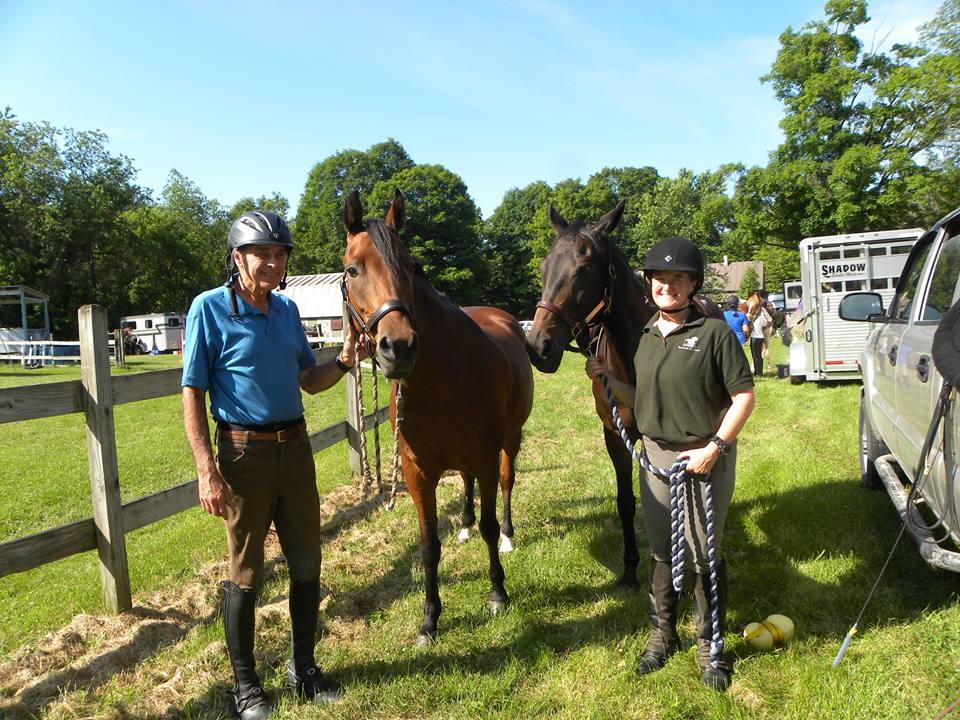
Denny and Roxie, Lee and I prior to completing the Hartland Riding Club ride in June.
Denny and Roxie, Lee and I after completing the Hartland Riding Club ride in June.

It is clear in working with Denny that his sixty odd years of riding experience have given him a personal pedagogy for riding education.  He admits freely that he has made mistakes (and has learned from them) and that he tends to jump in feet first to new endeavors, which honestly is part of why he has been so widely successful.  He regularly references the great riders and coaches of past eras (LeGoff, Steinkraus, Chapot, Jenkins, Davidson, and others) as well as the current era (Balkenhol, Davidson Jr, Dujardin, etc).  In other words, he honors the legacy left by those who have come before but also continues to learn from those who are currently coaching and competing.

One of the more compelling comments which Denny made this summer was regarding the young up and coming professionals in equestrian sport.  He said that in his opinion, there are two phases to a rider’s career—first, one must learn the craft, and second, one shoots for the top.  Denny’s observation is that many young riders are hungry for phase two to begin, and so they sort of “gloss over” phase one.  It is easy to understand why that is.  Phase two is where the glory, prestige and fame occur.  Phase one requires patience, hard work, diligence, persistence, and comes with little glory, prestige or fame.  But without taking the time to develop your Personal Pedagogy as a trainer, based on the classical work that has come before you, it is much less likely that phase two is even going to happen.  Sure, some people can buy fancy well trained horses or talk their way into getting others to buy them these horses, but for the most part, the holes will start to come through.

Denny told me this summer that when he was still actively doing clinics across the country, he was often introduced as a gold medalist, from his team’s win at the 1974 World Championships. While this fact was true, he said that it was AFTER that point that he really learned how to ride, and developed his understanding of the importance of keeping the lower leg under the rider and not jumping ahead with the upper body.  His point is that in spite of the fact that he had won a gold medal, he was really still in Phase One of his career—learning his craft.
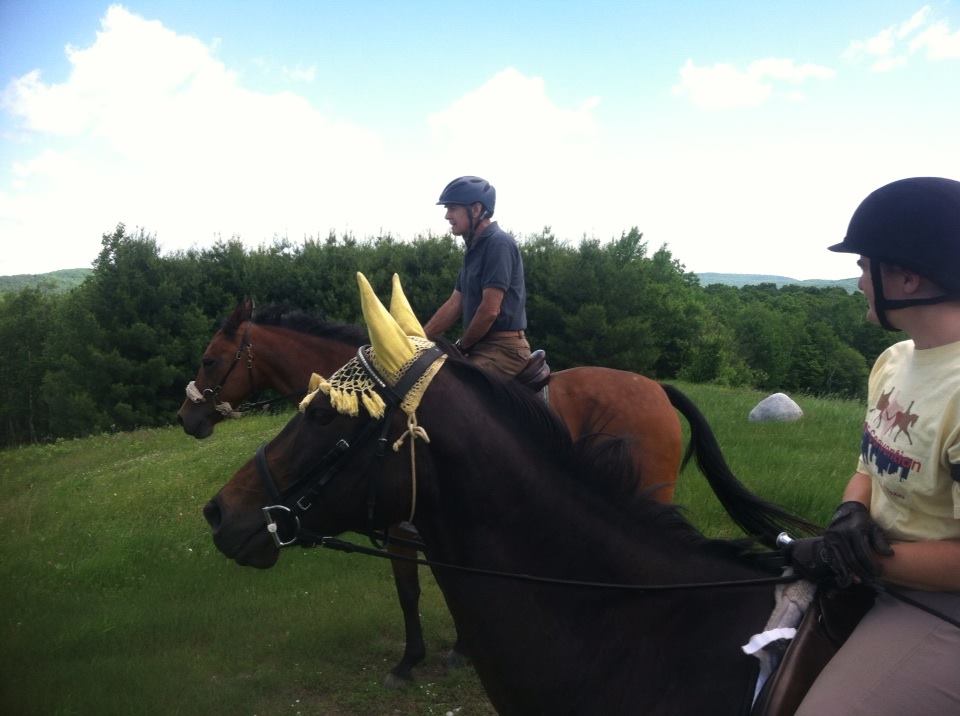
VT hacking Lee

So in being exposed to Denny’s teaching this summer, it is clear to me that his Personal Pedagogy is one which emphasizes correct basics, slow, steady and methodical training, and striving to ensure that horses are left happy and content (as opposed to mentally fried and physically exhausted) at the end of a work set.  Perhaps this is the most compelling lesson of the summer—it is far, far better to stop too soon in your training than to push too far or too long. As is true in so many aspects of horses, in the long run it is faster to go slow.

Looking Forward

Being at Tamarack gave me the opportunity to step away from my “real life” and be around people who are truly driven to ride and excel.  Everyone at Tamarack works hard, every day, and as summer goes along, the days get busy.  The horses are happy and content, the barn is CLEAN and riders routinely ship in for training.  I had my own two to ride daily, and often also was given the opportunity to hack out with Denny on Cordie, Roxie or Atti, or with fellow working student Katie on the babies, Derwin and Q.  I wish I knew how many miles we logged over the course of the summer on the plentiful trails around Tamarack—a few hundred, I would guess!

Hacking Denny's horse, Atti.
Hacking Denny’s horse, Atti.

It became clear to me over the course of the summer that I had been stuck in a rut with my own horses’ training programs.  There is an expression, “if you keep doing what you’ve always done you’ll get what you’ve always got” or something to that effect.  Being at Tamarack allowed me to reassess my basics and especially hone in on DETAILS that allowed my horses to make big strides forward.  As a trainer, I will endeavor to keep my focus on these details as I return to working independently at home.

Additionally, Denny’s emphasis on correct basics has only served to reaffirm for me as a coach and instructor that work in this area is time well spent.  As someone who primarily coaches college students coming from a wide range of equestrian backgrounds, I am frequently faced with “hungry” riders who are ready for phase two of their riding career to begin.  Unfortunately, many of them are still lacking a solid foundation of basic skills and understanding of training theory.  I know I won’t be able to reach all of them, but if I can strive to maintain this focus on correct basics and classical theory in my instruction, I think it will only serve to benefit my students more in the long run than the alternative.
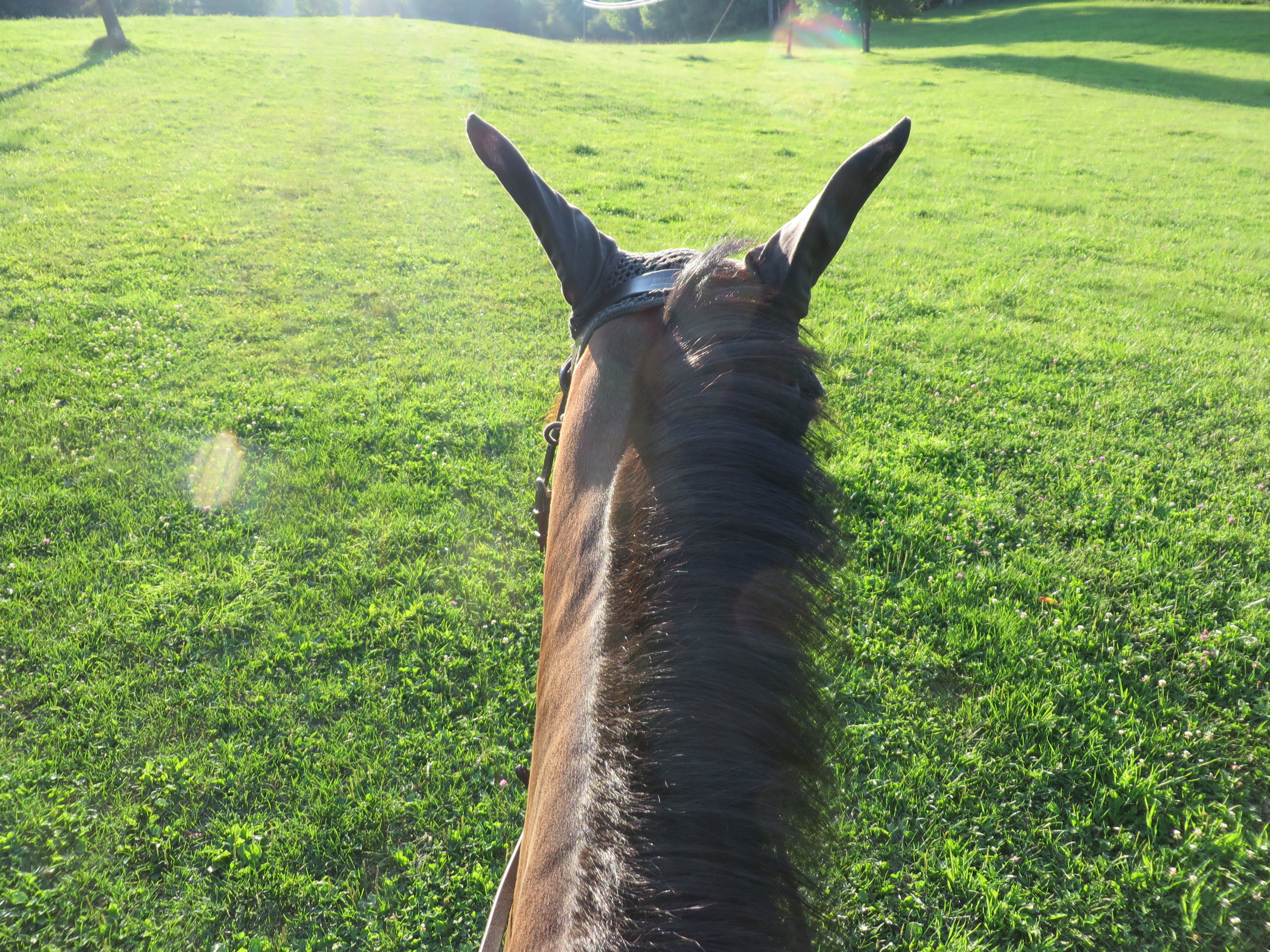
"Between the ears"... Anna hacking on the Tamarack cross country course.
“Between the ears”… Anna hacking on the Tamarack cross country course.

During my last week at Tamarack, Denny posed a question to me that was even more difficult than “what did you learn this summer.”  What he asked me was if I knew what kind of a rider I wanted to be.  This is a question that I have struggled to answer for years, so I didn’t have any better of a response for him than I usually have for myself.  His query was not meant to give me an answer specifically, but rather to open my eyes to possibilities and to how my own choices will affect the outcome.

It is clear (and has always been clear) that my path is not going to lead to the upper levels of eventing or show jumping.  I enjoy jumping, usually, but it does make me a little nervous and so I am best suited for low level sport.  That is fine.  What I have recognized this summer is that in spite of this, I actually have a fairly good eye on the ground.  At times I have felt insecure in the fact that I do an extensive amount of coaching over fences in spite of no longer being as comfortable as I used to be when it comes to jumping larger obstacles.  Denny reminded me that you can be a gifted instructor even if you no longer ride or even if you have never ridden at all, given a proper education.  After all, Sally Swift revolutionized the equine industry with her Centered Riding concept, and she never rode at all.
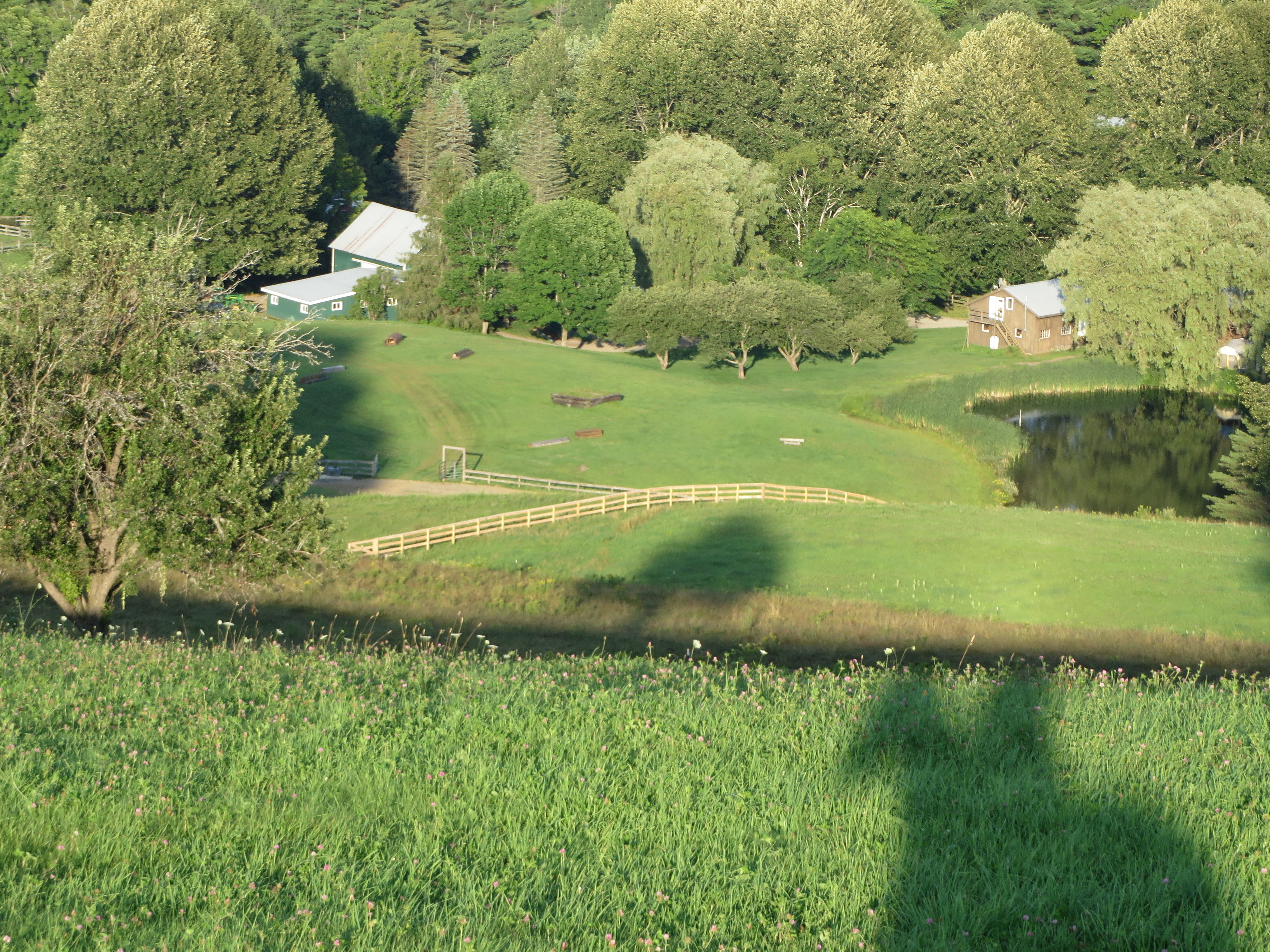
Looking down on the main farm from the top of the hill.

I enjoy dressage, and I probably have more innate skill in that sport than in work over fences.  I do want to compete at the FEI levels.  But again, to make a serious bid for fame and glory in this sport would take more financial backing and all-consuming dedication than I have interest in pursuing.  When I compete at the FEI levels, it will be for me, to fulfill my own goals, not to make any kind of a charge to “make a team” or be a true contender. And none of the horses in my current string are likely to be my FEI dressage mount.

So where does that leave me?

During one of our hacks, the day that he posed the question of “what kind of a rider do you want to be?”, Denny started listing the qualities of an elite endurance rider.  He said that those who are successful in endurance are steady, methodical and don’t have great mood swings regarding their riding.  They are motivated by the success that is completing a ride with a sound horse that is fit to continue.  They have a horse who is suited for the job—usually an Arabian or perhaps an Anglo-Arabian.  They come into their own at a slightly older age— where eventing is a sport largely for the young and fearless, endurance seems to appeal more to those who are able to take the time to properly condition a horse to handle the demands of long distance riding.  It takes at least three years to make a 100 mile horse, which means that you need to have a long term focus in sight beyond that day or week or month.
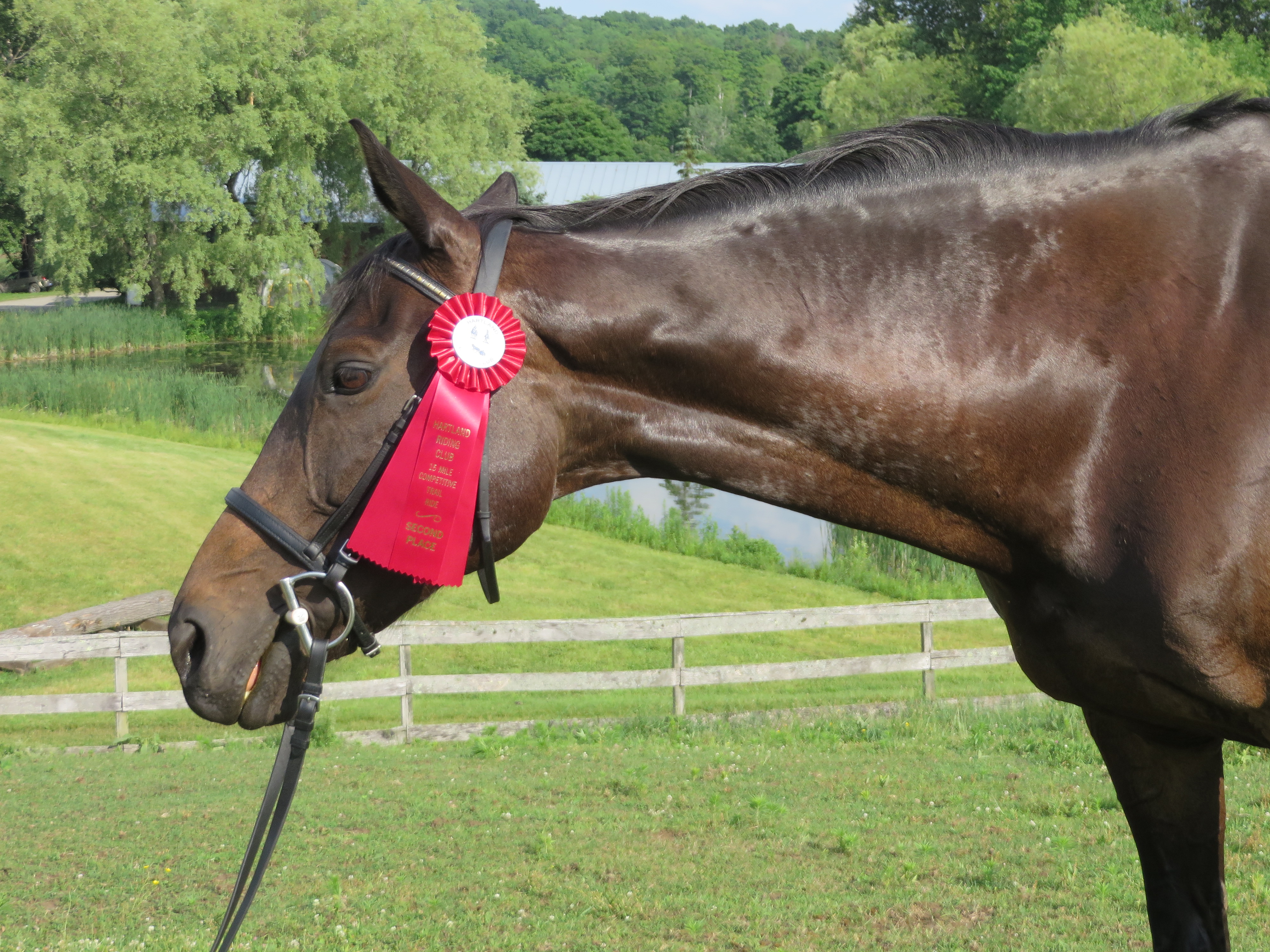
Lee showing off her prize from Hartland.

Denny’s point is that for the most part, these are all qualities that I have, and further, that if I wanted to shoot for the elite levels in endurance, that this could in reality be a goal that can be actualized.  I still have a lot to learn—you know, having completed a lifetime total of 65 competitive trail miles—but as Denny said, that is 55 more miles than I had at the beginning of the summer.  I am intrigued by the sport, I have enjoyed meeting the people involved with it and appreciate the values that the sport teaches.

I have never seriously considered trying to do a ride on the level of a one day hundred, never mind something as prestigious as the Tevis Cup or Old Dominion.  But Denny counseled that these rides are attainable, and do-able by someone like me, if I have the right horse.  During the summer, I met a Pan Am Games medalist in endurance, Connie Walker, and a recent first time Tevis finisher (11th place!) in Gene Limlaw.  Meeting these people made me realize that completing rides at this level is possible and do-able.

The idea excited me more than I would have thought it would.  I am by nature a bit more cautious when it comes to taking chances, so unlike how Denny would do it, I won’t be rushing out to purchase an experienced Arabian endurance horse or moving immediately to the endurance capital of the US (I am not sure even where that is, but surprisingly, I have heard there is a large endurance community in Florida).  But I am willing to consider the possibility and explore the options, large and small.

Overall, I am extremely grateful for having the opportunity to take these past three months at Tamarack and to clarify further the most important tenets of my own Personal Pedagogy.  I am pleased and proud of the progress which my horses have made. I am delighted to have made new friends in Vermont and am so, so glad that I took the step out of my comfort zone to take this time to further my own riding and education.

The Tamarack Chronicles: Volume V

Even though two of three phases at a horse trials involve jumping, the fact is that to be competitive you must be good at dressage.  It used to be that an accurate, steady test would be enough to put you in the top six after dressage, but now that same performance will usually leave you down the leaderboard, behind those riders who have really learned to embrace the Training Pyramid (and/or who have a better mover than yours, sorry to say).

Another important observation is that if you want to be safe on cross country and to leave the rails up in show jumping, you must be able to rider your horse’s canter.  And to do that, the rider must first understand what kind of canter she is looking for and to teach the horse to work in that place.  Essentially, the canter must be adjustable.  This means that the horse both understands how and is willing to move powerfully forward in a longer stride while maintaining balance and also is able to compress and engage without losing power.  This is not a skill you teach a horse by jumping a million jumps.  This is a skill you teach a horse by riding a million tiny transitions.  ON THE FLAT.

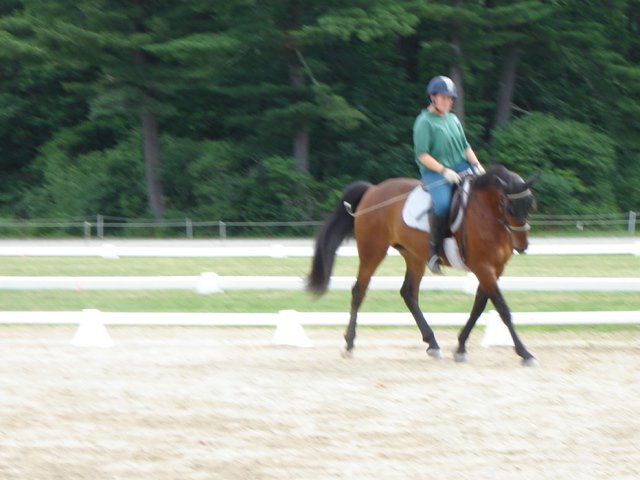
Working on the canter, during warm up.

While I haven’t yet put away my jumping saddle for good, I will freely admit to the fact that I actually ENJOY riding dressage.  However, I know that for many jumping riders, the “d” word (dressage) is just as much of a swear as some others and they work in the sandbox only under duress.  But the fact is that if you want to be a better jumping rider, you need to also better your dressage skills.  As Denny says, most horses don’t have a jumping problem, they have a canter problem.

Here at Tamarack, we have touched on many different themes during our dressage lessons.  Below is a brief summary of several of them.

Warm Up is the Most Important Part of the Ride

Denny attended a clinic with famed international coach Klaus Balkenhol, where he audited the sessions.  One of the messages he heard there which has stuck with him is that most riders hurry their horse’s warm up.  This is especially true in the dressage, but is also relevant to jumping.  The rider gets on, walks a lap or two of the ring, and then will start to pick up the reins and fuss and fiddle with their horse.  Balkenhol remarked that the warm up is the most important part of the ride, as it confirms that a horse’s muscles are supple and loose and ready for the day’s work.

Most horses living in the northeastern states do not have access to unlimited turnout.  Yet this is a species which has evolved to take thousands of steps per day.  Being stall bound is a necessary evil for many horses, but it is counter to the needs of equine physical and mental health. When we as riders are overly earnest, thinking about an upcoming competition or even just what we want to accomplish in our day’s ride, we do our horses no favors by forcing them into a connection when they are not yet ready.

Here at Tamarack, it is expected that you will walk your horse on a loose rein for about ten minutes before beginning to ask them to connect and work at a stronger pace.  Often times, this “walking warmup” can occur outside of the arena, by going on a short hack.  Once the rider begins her work, it is important to still take time as the horse’s muscles begin to warm up.  For example, Denny often warms up in the canter in a light seat, even when in a dressage saddle, to allow the topline time to loosen.

Hacking out with friends to loosen up prior to a cross country school at Tamarack, 2012.

Don’t think of the warm up as just something to get through.  If breakfast is the most important meal of the day, then your warm up is the most important part of your ride.  Just as we do not expect a child to focus in school when they have not been properly fueled, it is only when the horse’s muscles and mind are properly prepared for the work head of them can we expect their best effort.

Do Not Over Do

The challenge in developing dressage skills comes from finding a balance between asking the horse to push a little harder, engage a little more, be a little bit rounder or more supple, etc., without drilling.  Riders who specialize in dressage are stereotyped to have, shall we say, a bit of an “attention for detail” and this can lead to a habit of drilling movements on their horses.  Horses that associate the dressage arena with dull repetition and unrelenting demands are unlikely to be able to demonstrate the mental and physical relaxation that leads to supple, loose muscles, free forward movement and ultimately schwung, cadence and expression.

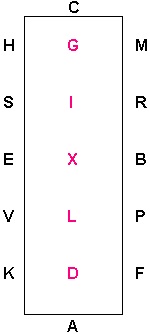
DressageArenaLetters

Denny compares the work in the dressage arena to body building at the gym.  If you are looking to “bulk up” your muscles, you will need to start with weights that are just a little bit hard to lift, and do enough repetitions to cause stress but not so many as to cause strain.  From there, you build, slowly and gradually, as the body adapts to the increased demands.  You also don’t usually work the same muscle groups day in and day out—muscles need rest periods in order to repair and grow stronger.

If you use this same philosophy in your dressage work, you will be able to condition your horse’s muscles, tendons and ligaments to be able to handle increased demands and pressure.   The growth will occur in a systematic manner, and the horse should never get to the point of feeling fried.

UNH Event Camp, 2011
University of New Hampshire Event Camp, 2011

Put yourself back in the gym again.  Imagine your least favorite machine or exercise.  Now imagine that, no matter how hard you have pushed, how many reps you have done, or how much your muscles are screaming for a break, your trainer kept demanding more and more and more, well beyond what you were capable of doing that day.  How will your body feel afterwards?  How likely are you to return to that trainer and that gym?  Realistically, you will be miserably sore and the next time you have a notion to go to the gym, you will likely hit the couch instead.

It seems so obvious that this approach is not the best way to improve strength and fitness, yet well intentioned riders do this exact thing to their horses every day by over-doing, repeating exercises too many times, and drilling on movements.

Denny says that if you think of dressage work as body building for your horse, you will be less likely to overdo the work.  The horse must know that the end is in sight and that the goals are attainable.  Work your horse in short sets with rest breaks. Change directions regularly.  Be happy with little and reward often.

Use the Canter to Improve the Trot

Denny says that a common mistake that many riders fall into when practicing dressage is to spend a disproportionate amount of time working in the trot, while disregarding the canter.  If you want your horse to become more adjustable for the jumping work, well, then you need to practice the canter on the flat.

Denny uses the “hoof print game” in his canter work on the flat (as well as when warming up for jumping).  Pick a point out ahead of you and ride actively towards it; Denny suggests using one of the doubtless hundreds of hoof prints in the footing.  Practice getting to that point with a count of 3, 2, 1.  Doing this will cause you to activate the horse’s canter with your leg and also to create balance in the canter by using your seat and upper body.

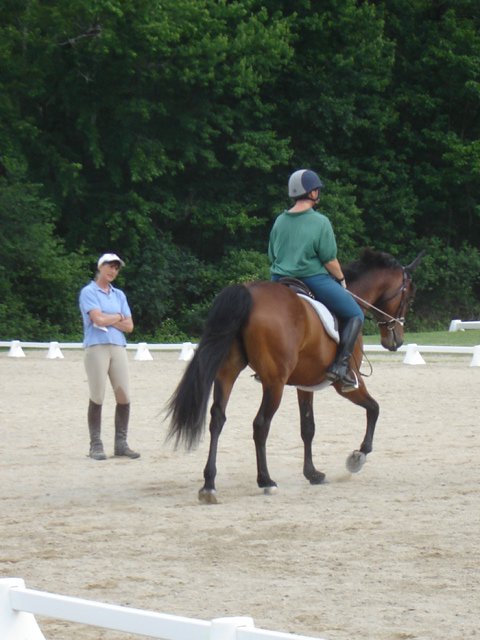
Anna at her first show, Sept 2010.

In addition to the benefit this will give you in terms of your horse’s overall adjustability, when the canter becomes connected and energetic, this will transfer over into the trot work.  All horses which demonstrate a true, two beat trot have a moment of suspension in every stride, when the diagonal pairs of legs switch positions.  With increased thrust from the hindquarters and swing in the topline, this moment of suspension becomes slightly longer.  This increased engagement and thrust creates a better quality of gait.  Of the basic gaits of the horse (walk, trot and canter), it is the trot which is most able to be improved upon.  Use your canter work to create the energy you need for better trot work.

If you Want Your Horse to Move Like a Jaguar….

In dressage, it is easy to become overly focused on what the horse’s body is doing, when the reality is that how they move is often a reflection of how the rider is (or isn’t) moving.  I teach my students that in the free walk, the horse should be moving like a jungle cat—supple, loose, slinky.  The challenge is to then take that feeling of losgelassenheit into the rest of the gaits.  But we can always come back to that jungle cat imagery.

"Mountain-lion-01623" by K Fink - NPS. Licensed under Public domain via Wikimedia Commons - http://commons.wikimedia.org/wiki/File:Mountain-lion-01623.jpg#mediaviewer/File:Mountain-lion-01623.jpg
“Mountain-lion-01623” by K Fink – NPS. Licensed under Public domain via Wikimedia Commons – http://commons.wikimedia.org/wiki/File:Mountain-lion-01623.jpg#mediaviewer/File:Mountain-lion-01623.jpg

Many times, if we as the rider imagine a feeling in our body, it is possible to steer our horses towards replicating that movement in theirs.  For example, if you want the horse to move in a specific tempo, that tempo should become your posting beat.

Sometimes the harder we try as riders, the more we impede our horse’s performance.  It is essential that the rider works to create elasticity and suppleness in her own body, in every joint (elbows, shoulders, and hips, especially), while not going to the extreme of being a floppy rag doll.

“If you want your horse to move like a jaguar…then you need to move like a jaguar,” says Denny.

In order to develop this suppleness, riders must also cultivate strength.  Why is it so hard to sit to the trot?  Well, it is a symmetrical gait with a moment of suspension, and the mechanics of its movement cause the horse’s topline to rise and fall with that rhythm.  To appear still on a moving object, in this case the horse, the rider must move their body in perfect coordination with the horse’s body.   Watch a dressage rider sometime—even though they appear to be immobile, look at their joints, and you will see movement.  There is a unique push and pull required between suppleness and strength.  This is not easy to master.

Working on suppleness.

The other piece here is that riders must learn to think of themselves as athletes.  Athletes, by definition, are fit.  Denny isn’t saying that someone needs to be rail thin skinny to be fit—he points out that 300 pound football players are athletes while someone else might be 100 pounds and bedridden.   Riding is an athletic endeavor.  You cannot expect your horse to be an athlete if you are not one yourself.

The “A-Ha” Moment

Just this past week, I had one of my biggest “a-ha” moments on Anna in terms of developing her work on the flat.  Anna gets a lot of points for being “cute” and is the queen of the balanced, steady test—we generally receive comments along the lines of “needs more forward energy” and “needs more suppleness/bend”.

Denny has remarked several times this summer that there are two horses in Anna; one who moves in little pony gaits and another which can move in a more elastic and fancy manner.  He says that I need to become more assertive with my aids, in particular the outside rein, in order to keep her working more honestly over and through her topline.  She has a tendency to bulge her shoulder and push her nose out, just a little bit, and therefore escapes being truly round and connected.

Denny has actually gotten on Anna a few times, and within fairly short order, I see her transform into the fancy mover.  But somehow, when I have gone to work Anna on my own, I am not quite so quick to find this version of my horse.  Instead, she has been resistant, as in my efforts to be more assertive with the outside rein instead I had become restrictive.

The “a-ha” moment came when Denny rode alongside me and said (again) that I needed to have her more onto the outside aids, and to use my ring finger to give the aid.  Hold the presses.  He has said this same thing countless times before, but for whatever reason, at that moment, I realized that instead of using primarily the ring finger, I had tensed my pointer and middle fingers as well.  This had created a pulling pressure on my horse; once I noticed that I was holding too much with all of these fingers, I also noticed that my wrist was locked and forearm muscles tense.  As I released all of this restriction, there came my horse onto the outside rein.  Magic.

The End.
The End.

This experience only serves as an excellent reminder that our bodies do things all the time that we are not aware of, and which impact our horses in a negative way.  It only shows that we riders really DO need to be athletes so that we can continue to develop precise and specific control of our body’s movements.