Book Review:  Endurance Riding: From First Steps to 100 Miles

Endurance Riding: From First Steps to 100 Miles by Clare Wilde

c 1996 Kenilworth Press, Buckingham (Great Britain) 170 pages

ISBN 1-872082-83-1

This past winter, I dedicated my equine reading to a selection of titles related to endurance and distance riding.  I knew that for 2015, I wanted to try to bring my horse up to a level of condition which might make it possible for her to tackle a 50 or even 100 mile ride, but I really didn’t know how to go about doing that.  It was with this mindset that I picked up Wilde’s book.  Wilde is an experienced endurance competitor whose love for the sport, and for riding and horses in general, is apparent throughout the book.
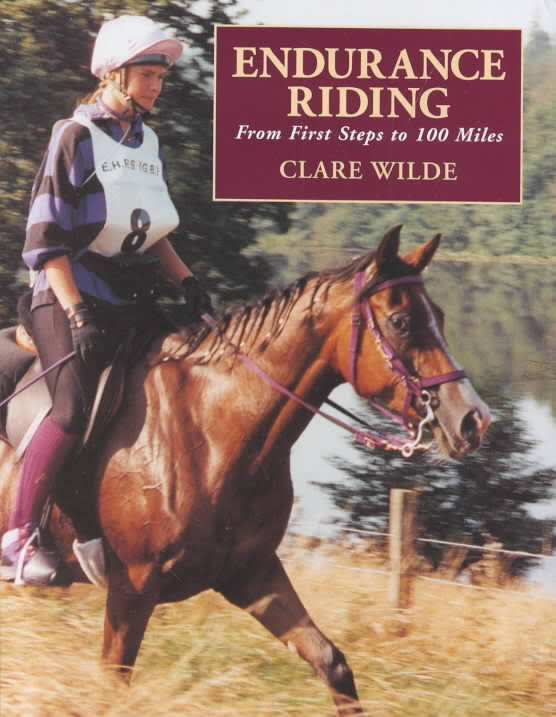
Wilde Cover

This book covers many aspects of the sport of endurance for the novice, tackling everything from horse selection to tack to schooling to what it takes to crew at a ride.  One of the sections that I enjoyed the most was called “Basic Schooling and Education,” and I liked it because it reviewed critical basics of training for any horse.  For example,  Wilde discusses the fact that in order for a horse to stay sound and sane over a long distance ride, they must move in an “economical, balanced yet dynamic motion” (Wilde, 1996, p. 45).  To achieve this, the rider must be conscientious in both their own posture and position and also work to develop suppleness and strength in the horse.  Horses must be encouraged to work correctly from back to front so that on the trail they can be supple and balanced.  In endurance riding, where competitive riders move at fast speeds much of the time, this preparation is essential.  “The versatile, supple horse will be able to move away from your leg to enable you to open gates quickly, avoid hazards and move off rough ground.  He will also be able to corner efficiently, particularly at speed” (Wilde, 1996, p. 46).   This information is so critical; a successful distance horse must be a true athlete, which requires paying attention to all forms of physical conditioning.

Wilde also points out that the endurance horse is the marathoner of the horse world, and the end goal of conditioning should be “to produce a supremely fit, laid-back equine athlete in the peak of physical condition” (Wilde, 1996, p. 49).  To do this requires not just attention to their workload, but also their overall stable management.  There is a big difference between the casual trail/pleasure horse that goes for a leisurely walk every now and then and a horse that is in preparation for a serious distance undertaking.  The horse’s stable management therefore must be of a higher standard than for a horse not in such intense training.  This is an important area of consideration which is sometimes overlooked.

Endurance and competitive trail riding can be enjoyed by riders of all ages and with all breeds of horse, with the proper conditioning.

Just like in other equine sports, Wilde reminds distance riders that the horse needs a warm up and cool down phase in each work set.  It is important to actively walk a horse for at least ten minutes before asking for faster gaits, and then to ease into the trot and canter.  Riders who are looking to start their race time at speed must budget in this warm up prior to the start.

The section titled “Conditioning for Competition” was especially enlightening.  Wilde says that once her horse has been built up to a base level of fitness which allows for easy completion and recovery from 20 mile rides, she rarely rides more than 15 miles in training.  One of the big challenges in distance riding is doing enough work to bring the horse to a fit level of condition but not doing so much that they become sore or unsound, or that their attitude becomes unwilling.  Learning how to “peak” your equine athlete at just the right time is both an art and a science, and certainly the ability to do this well separates the best from the also ran’s in any horse sport, not just endurance.  Wilde offers several sample conditioning and training schedules which can work to help horses develop for various distance rides, but also cautions readers to remember that each horse is an individual.

“Endurance riding Uzes 2005 front”. Licensed under Public Domain via Wikimedia Commons – https://commons.wikimedia.org/wiki/File:Endurance_riding_Uzes_2005_front.jpg#/media/File:Endurance_riding_Uzes_2005_front.jpg

The final chapter which I thought was particularly well done was titled “Personal Preparation”.  Here, Wilde discusses the care and feeding of the rider as an athlete, as well addresses the critical importance of rider fitness.  “In the most basic terms, your horse will find himself unable to perform, no matter how well he is prepared, if you are a hindrance to him rather than an asset” (Wilde, 1996, p. 95).  This last statement would seem to be true regardless of your chosen discipline, and is a concept which more riders need to take to heart if they truly want to progress in their riding.

Overall, Wilde’s book is an easy read with relevance to riders who want to improve their level of awareness on the subject of conditioning across the board.  While the author is certainly focusing on conditioning for the discipline of endurance, so very much of what she says relates to any equine endeavor that I would recommend it for anyone who wants to do a better job of preparing their equine athlete for their goals.  In this book, Wilde is essentially preaching practical, good horsemanship.  My only criticism is that at this point, the book is nearly twenty years in print, and photographs and certain references could use an update if there were to be a newer edition released.

4/5 stars

Blogger’s Note:  The featured image is from the first Tevis Cup ride.   Started in 1955 by Wendell Robie in California, the Tevis Cup 100 mile ride is regarded as one of the hardest in the world.  Wilde credits Robie with being one of the inspirations for the spread of endurance riders world wide, and especially within the United States. 

Trusting the Unstrustful Horse

We joke that the Dark Mare, Lee, is a survivor. She lives her life in a fairly constant state of alertness, and if there is a sign of trouble brewing, she is going to get out of dodge.  In her younger years, she broke cross ties and halters with frequent regularity and closely monitored objects such as dumpsters, mounting blocks and piles of jumps for the presence of trolls, chipmunks and other instigators of mayhem.   While she has mellowed somewhat, in general, if danger is afoot, Lee is leaving—with or without you.

When Lee gets upset about something, she can really revert to a primitive state of fight or flight.  On the one hand, it is easy to understand that this reaction has kept horses as a species alive for eons, and the behavior is imprinted in her genetic code.  But at the same time, it is frustrating because the reaction can be so out of proportion to the problem. And at some level, one would hope that her training and systematic exposure to all kinds of stimuli would result in at least one ounce of trust in her humans, but this has not always been the case.

Lee enjoyed the cow-free cow barn in Maine at the 30 mile CTR.  I was also impressed by her overall "coping" here, including the wind blowing hard all night, which rattled the metal roof panels to no end.
Lee enjoyed the cow-free cow barn in Maine at the 30 mile CTR. I was also impressed by her overall “coping” here, including the wind blowing hard all night, which rattled the metal roof panels to no end.

As a result of dealing with this behavior for the better part of a decade, I realize that I have come to assume the worst of Lee in many circumstances, expecting her to have mini or major meltdowns over various situations.  You might think that I am about to tell you how my preconceived ideas usually set up a self-fulfilling prophecy, and that Lee lives up to my (minimal) expectations when push comes to shove.  However, increasingly, the opposite is the case, and perhaps it is I who has the trust issue, not Lee.

This March, tired of being in the indoor and looking for a change of pace, I was riding Lee in the dirt parking lot at the University of New Hampshire during its Spring Break week.  The footing was actually quite good given the season and weather we had experienced this winter, but the lot was ringed with a decently sized plow bank creating a de facto fence line and leaving only one entrance/exit from the lot.  I had planned to do a set distance, changing direction at regular intervals, working at the trot and canter.  As I was getting close to the end of my set, I noticed a fairly dark and ominous looking cloud in the not so far distance, coming from the direction that ‘weather’ normally approaches us from.  “I am almost done,” I thought. “Two more laps and I will head in. No problem.”

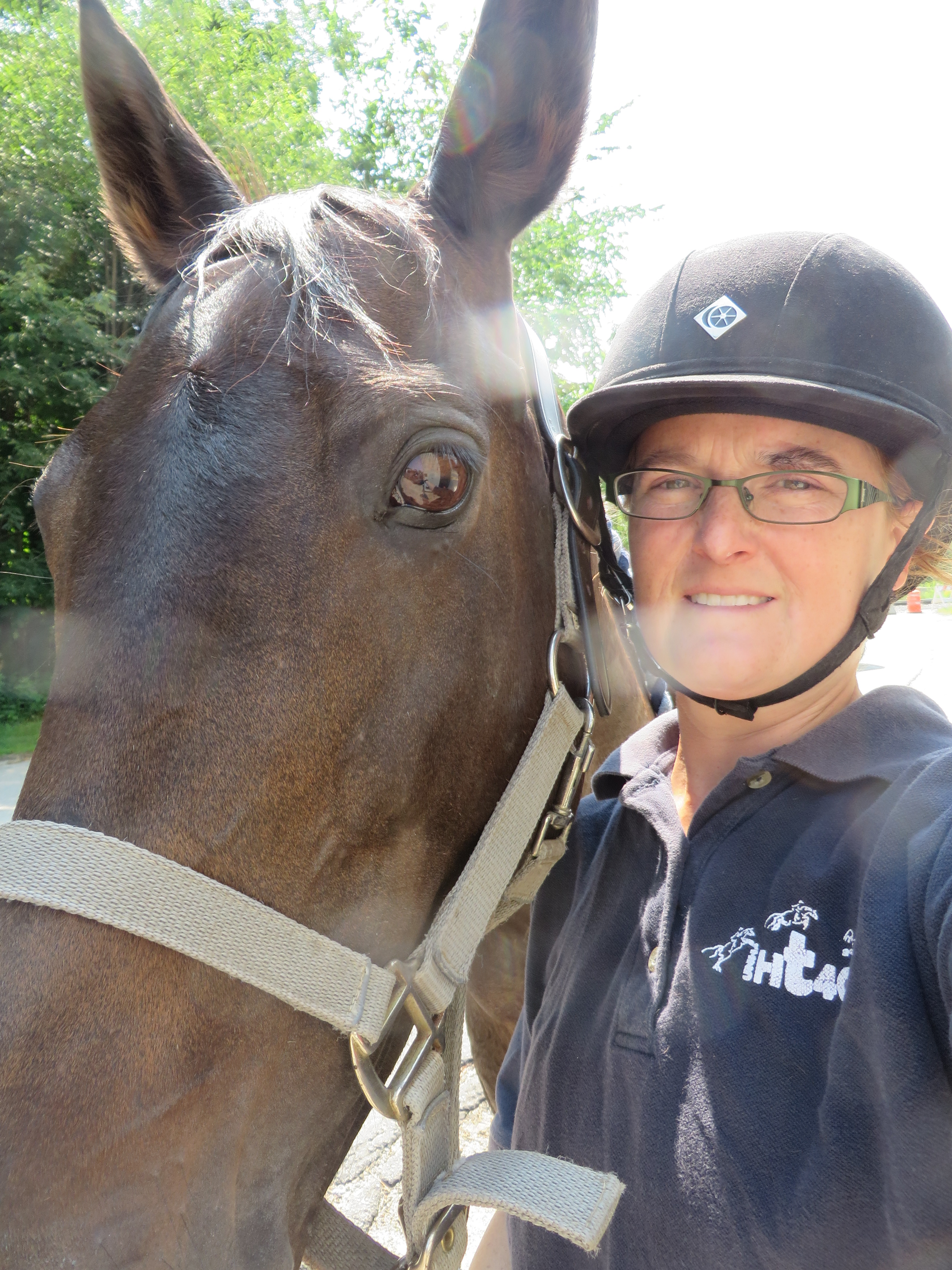
Lee and I took our first selfie ever at the Rockingham Rail Trail after a solo 14 mile conditioning ride this July.

Almost before the thought was complete, the wind picked up like I have never experienced and began to howl. Debris that I hadn’t previously noticed was flying sideways and into us.  Suddenly it began to precipitate—something.  Hail? Snow balls?  I couldn’t even tell you because the intensity of the icy precipitation combined with the incredible wind meant that I couldn’t even lift my head.  Lee instinctively swung her hindquarters into the wind, but we were still being pummeled from all sides and were instantly soaked through.  I had no idea what was going to come next—I wondered if a tornado were about to blow through, and had the thought, “so this is how it will end”.

We were not in a safe situation, and I knew we needed to get out of there, but due to the snow banks and our position in the lot, to do so required riding the length of the parking lot heading straight into the wind and snow/ice/rain to reach the exit.  I truly couldn’t even raise my head to see ahead of us due to the intensity of the weather, so I dropped down onto her neck and yelled “go on!” to Lee over the wind.  And sure enough, Lee actually went—straight into the wind, neck and head down, in spite of the power of the frenzied air.  As soon as we rounded the corner, I urged her to the trot and we made a break for the barn, wind to our backs.

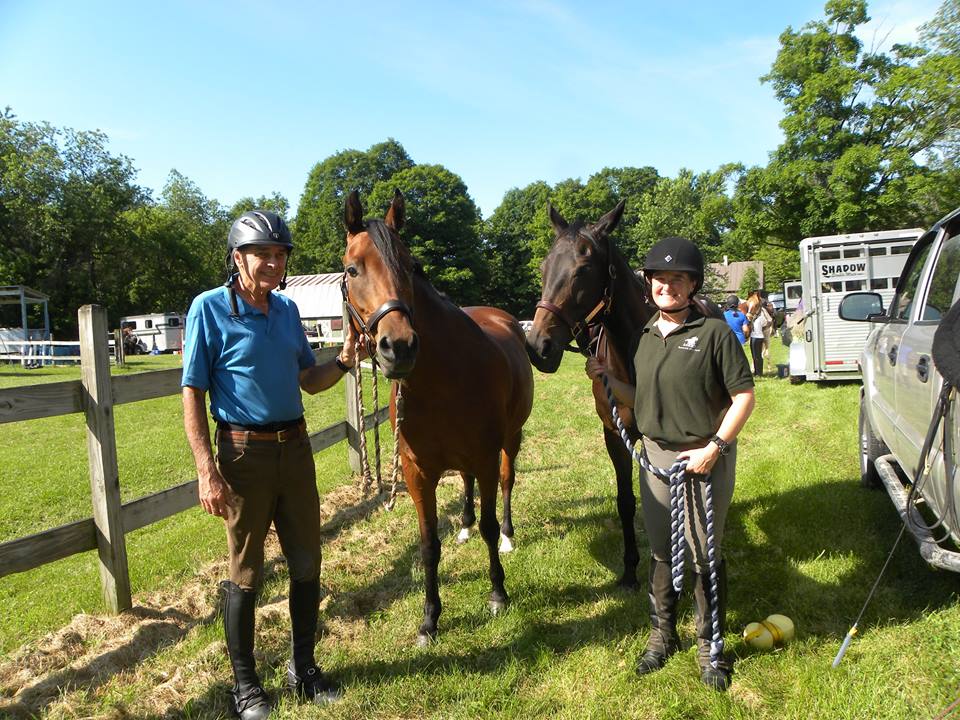
Denny Emerson and High Brook Rockstar and Lee and I about to start the Hartland 15 Mile CDR in July of 2014.

I was impressed with Lee that day.  She would have been well within her rights to bolt or panic, to scoot or ignore me.  But for whatever reason, she didn’t.  I was (and still am) quite proud of her for all of it and for getting the both of us to safety.

This spring, I had to move both of my horses to new facilities.  Anna had been in the same barn for five years, but Lee had been at UNH for over ten.  I wasn’t too worried about Anna making the transition, but I honestly worried and worried about Lee.  I can worry like it is my job.  The barn she moved to is a low key private barn at my good friend’s home; it allowed Lee her own paddock with run in and access to dirt roads and trails.  Perfect.  Yet I worried.  My friend has a mule—what if Lee is scared of her funny mule noises?  The fencing is just electric wire.  What if Lee doesn’t see it or respect it? What if I can’t ride Lee alone on the roads? What if…?

The night before the move, it poured, the first rain in almost a month.  When I say it poured, I am talking about the soaking type of deluge that saturates you through to your core instantly, the kind that is like a hose from above.  I don’t think I slept more than a few fits and starts as my anxiety and worry ate away at me.  What if Lee won’t go into the shelter?  What if she works herself up into a colic?

As I hitched up the trailer in the pouring rain, I not so silently cursed the Powers That Be for the weather on this most important of days.  The schedule was to move Lee first, then go back and pick up Anna, since she was taking over Lee’s stall at UNH.

When we arrived at Namaste Farm, Lee fairly quietly unloaded, marched into her new abode, and took a tour around.  She didn’t touch the wire fence.  She didn’t respond when her new neighbors whinnied to her.  While clearly not 100% settled, she was far, far less worried that I was.  We did end up having to lock her into her run in that evening, as it continued to pour, because she wanted to stand outside near the other horses (who had sensibly gone into their own sheds) even once she was shivering under her rain sheet.  Once she figured out that the shelter was dry though, she began using it on her own when the doors were re-opened the next day.  We haven’t had to shut them since.

PinelandKurLeeNewCar 100
Lee’s new friends, Taydee the Connemara and Marybeth Applebottom, the chestnut appaloosa mule.

After a day or two to settle in, I took her for her first ride.  I decided to start in the fields first.  Lee’s new neighbors whinnied as we left, but she didn’t answer, and instead was all business.  But when we got to the fields, she became quite unsettled and agitated, and was being overly spooky and difficult.  “Here we go,” I thought to myself.  “I knew this would happen.  She is going to be unrideable here.”  I ended up having to dismount for safety and led her in hand for a bit, full of negative thoughts and wondering what I had gotten myself into.

The fields were soaked after the heavy rain and I was worried about leaving hoof prints once she started to act up, so I decided that maybe I should try taking Lee down the dirt road instead.  I had hesitated to start with this, because the traffic on the road can occasionally be unpredictable and since she can be too, I thought it might be a bad combination.   However, I knew that on the road I could more confidently ask Lee to go forward and it seemed like maybe that was just what she needed.

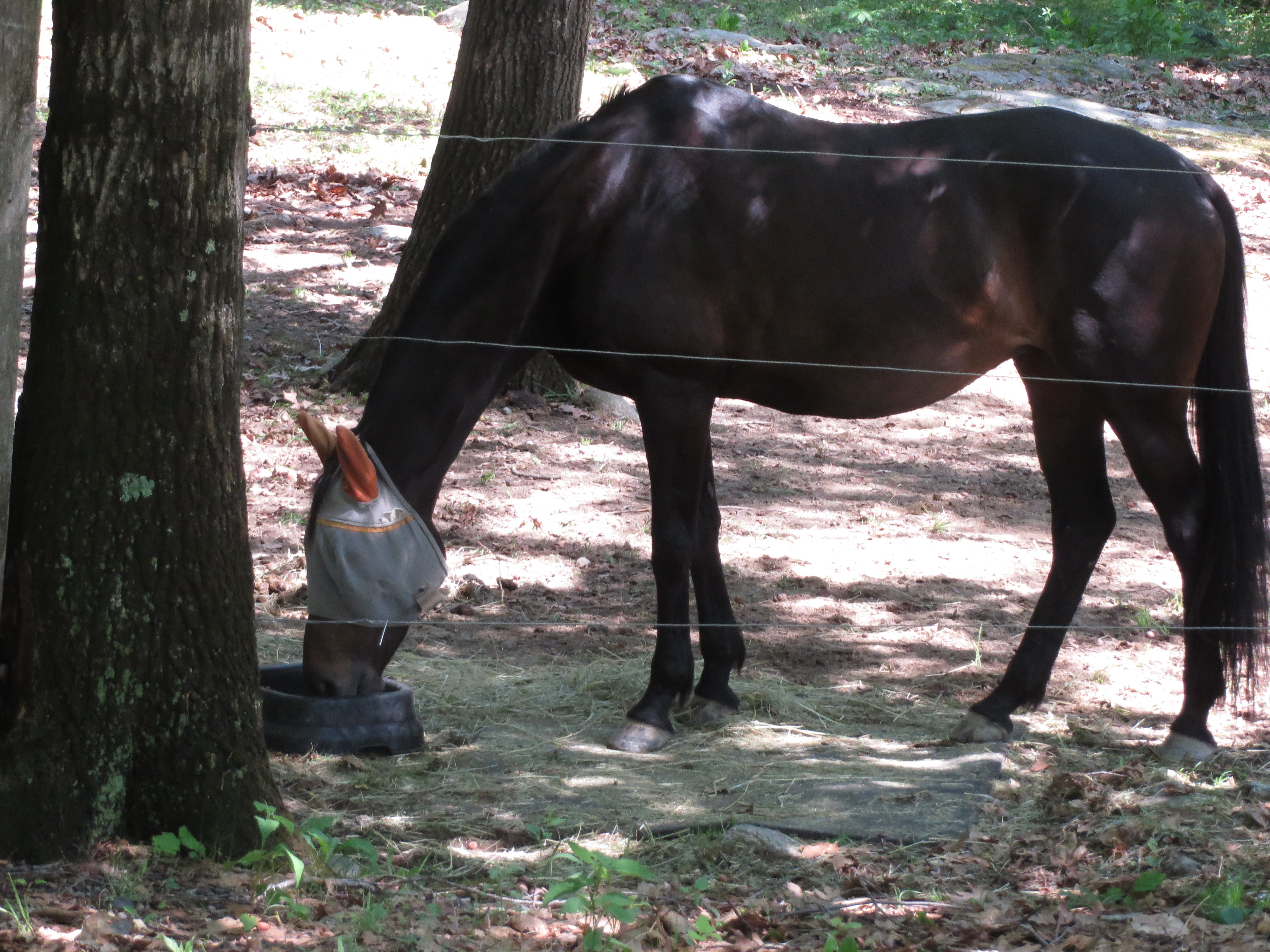
Lee having breakfast shortly after arriving at her new home.

So I gamely re-mounted and headed off down the road, away from the farm.  Almost instantly, my reliable distance horse was back.  She happily trotted off, one-two-one-two,  going all the way to where the pavement starts near the town line, and then home.  No issues.  No spooking.  No drama.  She was in her Zen place.

And so it has gone with Lee at Namaste Farm. Since that first ride, she has gone all the way into Newmarket and into a little subdivision, she has ridden alone and in company to Adams Point and seen her first cormorants and sailboats, and she has even come to tolerate the fields (though the bugs which live on them, not so much).  She has done nearly two hundred miles of trail since her arrival, and is just one of the herd.

I don’t think I will ever stop worrying about things which haven’t happened and might not ever happen.  I can at least recognize that the worry and anxiety I feel is, for me, an inevitable part of change, but I also am trying to learn to be more accepting of the fact that some variables are just out of my control.  I think worry starts with some kernel of truth, but then it can grow and mutate and take on a life of its own.

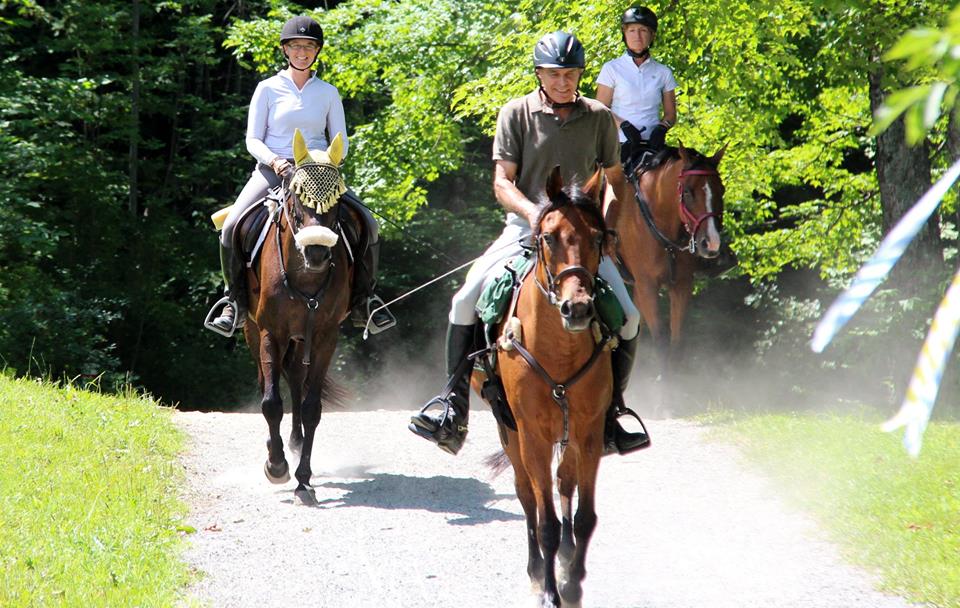
Lee completes her first two day 50 mile ride at GMHA, with her friends Roxie (middle, ridden by Denny Emerson) and Camille (ridden by Robin Malkasian).

I need to start to give Lee more credit for the animal she has become.  On August 1-2, she completed her first two day 50 mile competitive trail ride (CTR), and I never felt one ounce of quit in her the whole weekend.  In a week, she has more than recovered and was joyfully jigging all over the place on our AM ride today.  While I am sure there will be situations in the future where the “survivalist” Lee comes back, I also think that I know the horse well enough to start to trust that she will cope more often than she won’t.

As we all know, trust in any relationship is a two way street.  Perhaps Lee and I are more alike than we are different in our tendency to worry.  Sometimes I take care of her, and sometimes she takes care of me.

Early AM grazing in Vermont, August 2015.

Book Review:  Conditioning Sport Horses

Conditioning Sport Horses by Hilary M. Clayton

c 1991 Sport Horse Publications, Mason, MI, 256 pages

ISBN 0-9695720-0-X

Still referred to by many as the “Bible” of equine conditioning principles, I picked up Clayton’s 1991 work, Conditioning Sport Horses, this past winter as I was beginning to think seriously about the demands of conditioning for long distance riding.  I was worried at first that the book might be a bit dry or too technical for me, a non-scientist, to understand.  However, Clayton is skilled at breaking down complex concepts into manageable pieces and I found it a fairly pleasurable read.

Dr. Hilary Clayton   Photo taken from her promotional poster.
Dr. Hilary Clayton Photo taken from her promotional poster.

Conditioning Sport Horses is divided into three chunks.  Part One looks at the major systems involved in the process of preparing a horse for athletic work and devotes full chapters to the cardiovascular and respiratory systems, energy production, muscles, thermoregulation and fluid and electrolyte balance.  Part Two delves into the “practical aspects of conditioning” and covers concepts such as general conditioning principles, cardiovascular conditioning, strength training, increasing suppleness, and managing these elements in a horse’s overall training program (including using a heart rate monitor and providing adequate nutrition).  Finally, Part Three shows how to use these concepts to prepare a horse for the specific demands of various disciplines; Clayton addresses the traditional sport horse disciplines but also several western sports as well as polo, endurance and chuck wagon racing (!).

These polo ponies show how much a horse will naturally lean onto the inside forelimb and shoulder when turning. Polo is a fast moving sport, requiring speed and agility (Clayton, 1991, p 229).  "Polo3-1-" by Ems (Emanuel Sanchez de la Cerda) - de.wikipedia.org: 18:50, 16. Mär. 2006 .. Ems .. 800×520 (292.111 Bytes) (* Bildbeschreibung: Sal. Oppenheim Cup Finale 2005 * Fotograf/Zeichner: Emanuel Sanchez de la Cerda (~~~) * Datum: 26.06.2005 18:00). Licensed under CC BY-SA 2.0de via Wikimedia Commons - http://commons.wikimedia.org/wiki/File:Polo3-1-.jpeg#mediaviewer/File:Polo3-1-.jpeg
These polo ponies show how much a horse will naturally lean onto the inside forelimb and shoulder when turning. Polo is a fast moving sport, requiring speed and agility (Clayton, 1991, p 229).
“Polo3-1-” by Ems (Emanuel Sanchez de la Cerda) – de.wikipedia.org: 18:50, 16. Mär. 2006 .. Ems .. 800×520 (292.111 Bytes) (* Bildbeschreibung: Sal. Oppenheim Cup Finale 2005 * Fotograf/Zeichner: Emanuel Sanchez de la Cerda (~~~) * Datum: 26.06.2005 18:00). Licensed under CC BY-SA 2.0de via Wikimedia Commons – http://commons.wikimedia.org/wiki/File:Polo3-1-.jpeg#mediaviewer/File:Polo3-1-.jpeg

I read this book much like I would a text book, underlining key concepts and passages and pasting sticky notes on others.  Doing so really helped me to dig into the material. While I have studied conditioning concepts in the past, I have never done so with the intensity or scrutiny that I have brought to my work this season, and Clayton’s writing included many important concepts and principles that I am not sure I have truly ever heard before, as well as reminded me of old favorites.

Conditioning Sport Horses, by Hilary M. Clayton (cover).

For example, we have all been told that we shouldn’t feed our horses immediately following a hard work because the blood supply has been shifted away from the digestive organs.  Clayton includes a graph which shows that during exercise, just over 75% of the cardiac output and distribution of blood flow is shifted to the horse’s muscles, and less than one quarter is dedicated to all of the other organs in the body.  A horse at rest is nearly opposite of these values.  Seeing the ratio so clearly visually depicted really drove the point home (see Clayton, 1991, page 14).

Another relevant question was answered in the chapter on thermoregulation.  Here in New Hampshire, winters can get downright frigid, and the question “when is it too cold to ride” is often raised, in particular in reference to whether or not conditions are safe for the horse.  Clayton settles the point clearly: “Compared with horses exercising at normal temperatures, horses undergoing strenuous exercise at -25* C(-13* F) have no significant changes in heart rate, lactate production, blood gas tensions, gait or lung tissue morphology” (Clayton, 1991, p 70).  So next winter when I choose to not ride when the temps are in the single digits, I will know that it is for me that I am staying in the warmth, not for my horse!

My horse, Carmel, after the New England Blizzard of 2015.

Perhaps one of the most interesting segments of Conditioning the Sport Horse is the section on general conditioning principles.  When most riders think of conditioning, it seems that their minds immediately go to the concept of “sets”; going out and riding at a certain speed or pace for a specific period of time, then allowing the horse to partially recover before completing another round.  I am not sure that riders in non-aerobic disciplines (dressage comes to mind) often think hard about their horse’s “conditioning plan”.  Clayton explains in great detail that the term conditioning encompasses far more than just improving the horse’s cardiovascular capacity; in fact, this system is the fastest one to improve with exercise, while other equally critical systems (such as the musculoskeletal system) lag behind.  If a rider fails to address each of the critical areas of conditioning, their equine athlete’s performance will be compromised (at best) or they will risk injury or breakdown (at worst).

There are three components to the volume of exercise which a horse is in:  intensity, duration and frequency.  Smart riders are able to gradually increase the horse’s capacity in each of these areas, though not in all three at once (Clayton, 1991, 80-81).  Strategically incorporating the various forms of conditioning with these principles will allow for the most consistent and safe increase in athletic capacity.

This book is full of practical and useful tips, everything from  how to make your own electrolytes (3 parts sodium chloride to one part potassium chloride—see page 72) to how to introduce fitness concepts to a green horse in any discipline to feeding strategies for animals in endurance sports which will maximize performance.  In the chapters on specific disciplines, Clayton provides clear and do-able formats for conditioning in each sport, attending to each of the major categories of conditioning.   I learned a lot from reading each chapter, even for those disciplines which are not my specialty.

If you are going to consider yourself a serious student of the correct and conscientious development of the equine athlete, you simply MUST have this book on your shelves.  Read it, underline it, dog ear it, and refer to it regularly as you create a conditioning plan for your athlete— and whether they are a dressage specialist, a reiner, a show jumper, or something else,  your horse will thank you.

5/5 stars