Category Archives: Travel Writing

Oh, the Places You’ll Go—Where Horses Have Taken Me (so far…)

When I think back to many of the unique places I’ve had the opportunity to visit, more often than not it was a horse that led me there.

In anticipation of my upcoming Gobi Gallop ride in Mongolia (more on this later), I thought it would be fun to look back at a few other adventures I have experienced, all thanks to my love of the horse.

Delaware

Ok, I know what you are thinking… Delaware? The “Small Wonder” state? But hear me out.

When I was member of the US Pony Clubs, I was invited to be a Visiting Instructor at a Pony Club camp in Delaware. I was perhaps 20 at the time, and the short flight from Boston was the first one I ever took on my own. I hadn’t flown very much at that point in my life, and so that solo trip was a pretty big deal.

I am a life member of USPC, and a proud graduate H-A from Squamscott Pony Club here in seacoast New Hampshire. SPC has been in existence for over 50 years!

That first USPC Visiting Instructor experience led to others in subsequent years—Oklahoma and Kansas, even California and Hawaii. I don’t know if I’ll ever love flying, but I became more confident about it, and it was all thanks to these trips. In fact, these experiences are probably what made me brave enough to try bigger adventures, like a summer study abroad in Kenya, and later, solo trips to Morocco and the Galapagos Islands.

Some Pony Club adventures are not nearly so far afield– like helping these members obtain their certifications in NH last spring.

I have stayed involved with USPC, and through the various roles I have held with that organization (examiner, clinician, regional instruction coordinator, district commissioner), I’ve had the opportunity to travel quite literally from coast to coast. Over the years, Pony Club commitments have brought me to 25 of the 50 states! I am currently on a quest to visit all #50by50…and I only have a handful to go. If you happen to be in need of a clinician– and especially if you live in Texas, Arkansas, Mississippi, Alabama, or North Dakota—don’t hesitate to reach out!

Iceland

Early in my writing career, I produced quite a few breed spotlights. They’ve fallen a bit out of favor with most equestrian publishers these days, but in the late 90’s, I profiled everything from Spanish Normans to Friesians to miniature horses. One time, my editor asked me to pen a feature on the Icelandic Horse—and something about this hardy and unique breed simply captured my fancy. I wanted to ride one, and of course, the only logical place to do so was in Iceland.

I found a company online called Íshestar, and booked an all-inclusive riding tour package. After flying overnight into Keflavik International Airport, and catching a bus bound for Reykjavik, Iceland’s capital, I arrived at my guesthouse to find the owner solidly sleeping off the previous evening’s celebrations. It took a bit of convincing to coax her out of bed to let me in at the ungodly hour of 9 AM—at which time jet lag caught up and I also promptly took a nap.
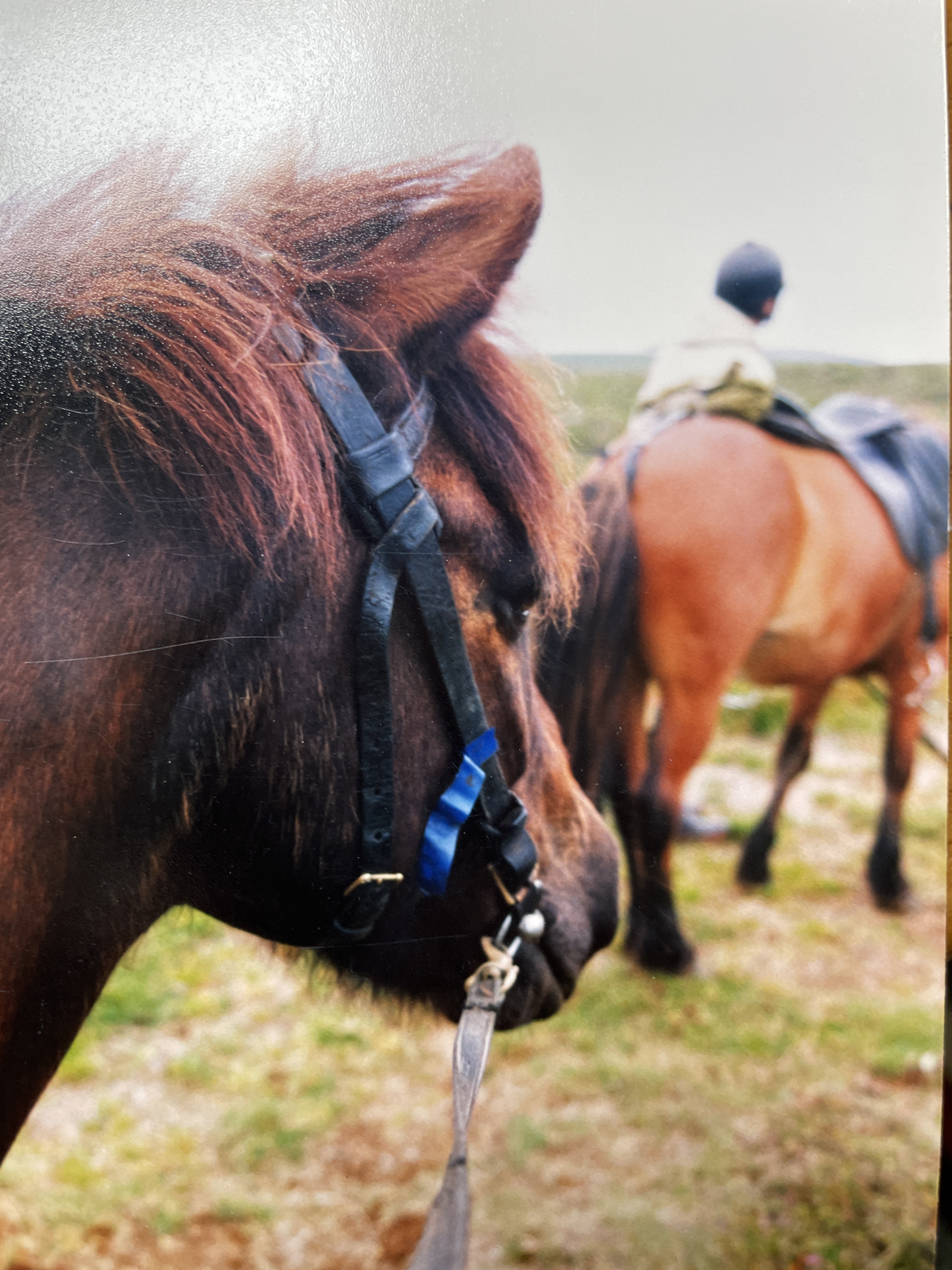
Stjarna, “Star” in English, my first mount.

To ride an Icelandic Horse, one must essentially unlearn every skill one has ever practiced on horseback. To slow down, you tip forward. To go faster, you lean back and hold the reins more firmly. One afternoon early in the tour, me and my new Swiss friend Gabi were run off with across a lava field. It took every conscious brain cell I had to not revert to instinct in order to regain control of my rogue mount (who I would later learn had only been “lightly backed”).

Here I am holding Mokollur (Blonde-Top, in English) and a friend at a rest stop. Mokollur was actually Gabi’s mount during the “run-away” incident; I rode him the day after and enjoyed him so much I rode him in the afternoons for the rest of the trip. Another fun fact is that every piece of gear I am wearing is borrowed– Iceland has no native horse diseases, and any riding equipment brought to the country must be brand new, with tags still on.

Iceland is not a large country, and its people are both friendly and worldly, despite what might seem like a relatively isolated existence on the edge of the Arctic Circle. Our riding tour left from a farm called Saltvík, which is situated on the north side of the island near the city of Akureyri. On the domestic flight up there, we met two young men who knew exactly where we were going and who we would be riding with once we arrived. They wrote their names and phone numbers on an anti-nausea bag, so we could look them up later (we didn’t take them up on that, I’m afraid).

After riding with a loose herd of spare animals over miles of jaw-dropping terrain—including sweeping meadows and volcanic detritus—I have immense respect for the ruggedness of the Icelandic Horse. More than one time, I looked at the trail ahead and thought, “We can’t possibly be headed that way” …and then off we went. They are truly amazing creatures.
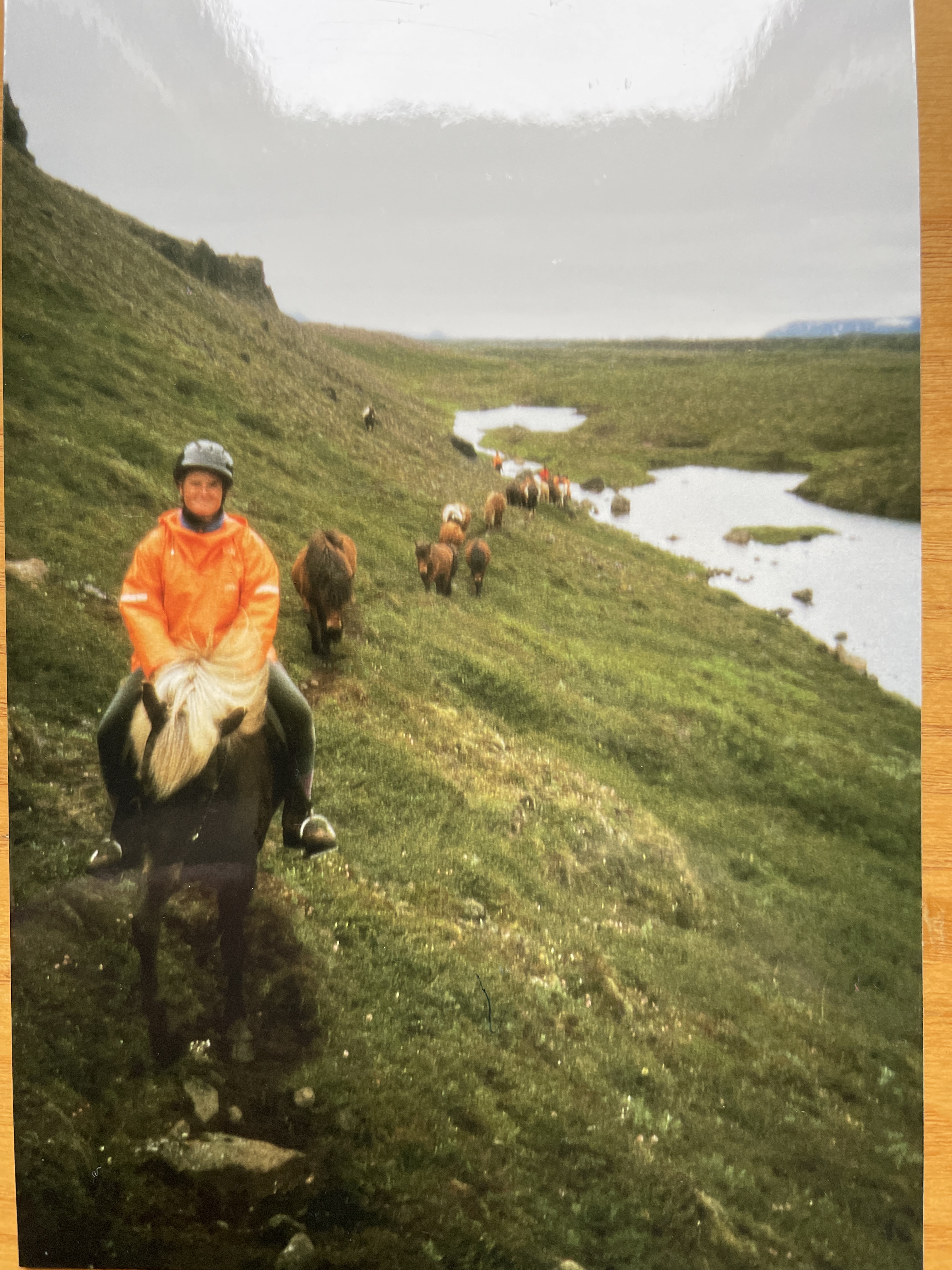
Mokollur and I hitting our stride. We each rode two horses per day, one in the morning and another after lunch. The extras traveled as a loose herd, with about half our riders leading the way, and the other half “sweeping” behind. Here, you can see the loose herd behind us, with other raincoat-clad riders driving the group in the rear. If you enjoy this sort of experience, you can visit Iceland during the annual sheep round up, which is also done on horseback!

If you should ever find yourself in Iceland, one tip—never call them ponies (although strictly speaking, most are well below the 14.2 hand threshold). The reason is, and I quote—“Men do not ride ponies.”

The Mustangs of the High Sierra (California)

At some point, one of my email addresses became subscribed to the University of California-Davis extension course catalogue, and every year, one of their offerings caught my eye. “Mustangs: a Living Legacy” was a four day horse-packing course, co-led by veterinarian/professional horsepacker Dr. Craig London, and extension veterinarian/professor, Dr. Janet Roser. Participants would ride and camp in the Montgomery Pass Wild Horse Range on the Nevada/California border, enjoy lectures and readings on mustangs and the region’s ecology, and hopefully, view the local mustang herd from horseback. It sounded utterly appealing—but with just one annual offering, logistically tricky.

But then one year, the stars aligned. I had a meeting to attend in Las Vegas, Nevada, that was scheduled to conclude just a few days before the start of the annual “Living Legacy” course. I rented a car and drove five hours from Las Vegas to join my fellow mustang enthusiasts in Benton Hot Springs, California (population 279, and that might include the quail).
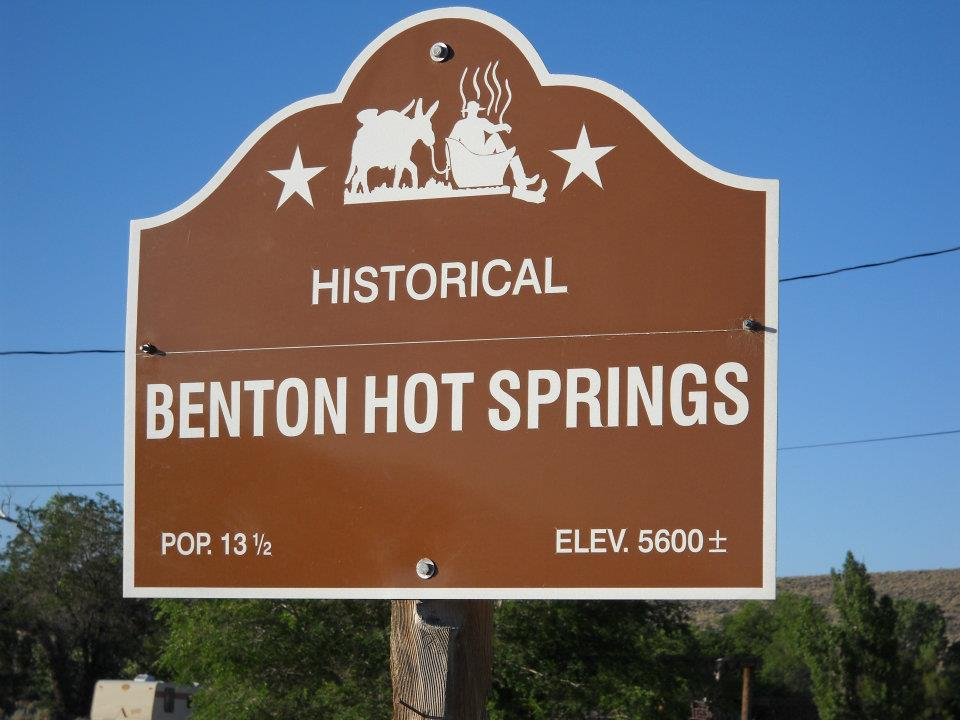
Partnered with a former county sheriff’s horse named Thunder, I had an amazing experience riding in the high desert of late spring. As I had in Iceland, I gained new appreciation for how well horses handle even some of the most rugged terrain. Additionally, every equine on Dr. London’s horsepacking string tied, and tied well (if they don’t–they don’t last long on his string). We rode for several hours at a time; when we needed a break, the horses simply tied to the nearest tree. Thunder knew the drill and would almost immediately close his eyes and take a nap.
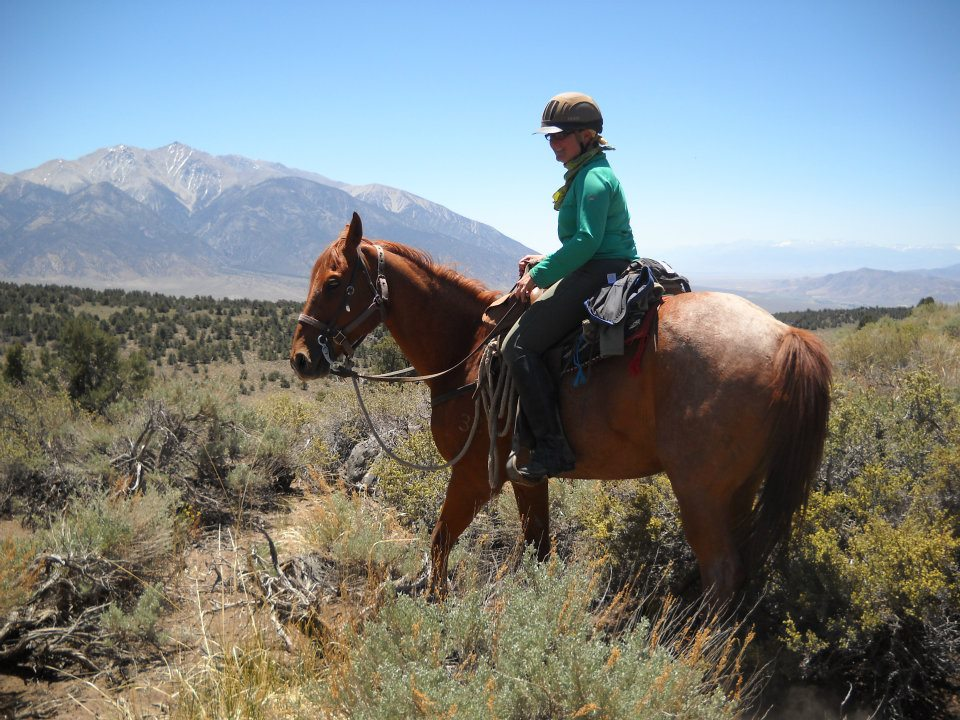
Thunder and I, with the White Mountains as a backdrop.

The Montgomery Pass mustang herd was, at least at that time, beloved by the local community, who seemed proud to have them living nearby. The herd was also famous for being one of the only naturally managed mustang populations, thanks to the area’s resident mountain lions. However, as their name implies, mountain lions tend to stay in the higher elevations, and the horses had gotten wise. With ample food and water available on the lower elevation Adobe Flats during the spring, herds could avoid predation.

The photo quality is not amazing, but this is just one snapshot of the massive herd of mustangs (comprised of many smaller bands) hanging out on the Adobe Flats.

According to local residents, the mustang population was growing every year; I estimate there were at least one hundred animals, perhaps more, when I visited in 2012. Early June in the high desert is still a time of abundance, but it was clear to me that the animals rate of consumption would quickly exceed the vegetation’s capacity to grow. It seemed clear to me that this herd was no longer being “naturally managed”, at least not by the mountain lions. (As a sidenote, in preparing this blog, I reviewed a 2021 article stating that the Montgomery Pass herd population has grown so tremendously that they are now pushing westward, into Mono Lake, California, where they are damaging fragile and unique habitats in their constant quest for food and water.)

As a native northeasterner, studying the dynamic issues surrounding the mustang populations of the west was eye opening, and witnessing firsthand the power of a massive herd as it turned as one unit to flee, emotionally inspiring. Thanks to the influence of UC-Davis, we benefited from peer-reviewed information and objective analysis of the situation; the inclusion of local ranchers and other residents in our conversations helped put a human face on the people impacted (both positively and negatively) by the mustangs’ presence.
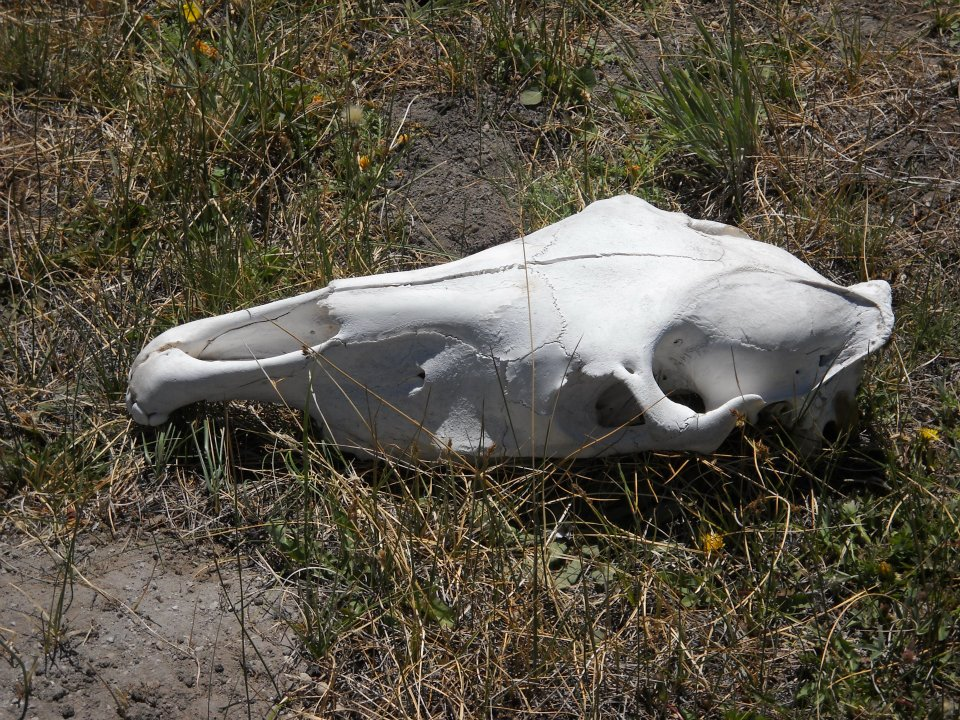
The aridity simply dries out the bones left behind. Note the incisors– this skull belonged to a youngster.

In 2012, the Montgomery Pass herd looked to be fairly healthy and in good weight; seeing mustangs in this condition could easily make one skeptical of arguments that many of these animals lead a marginal existence. But after the program was over, and I was heading back toward Las Vegas, a small band of five mustangs (including one scrawny foal) crossed the road in front of me. These animals were painfully thin, and moved with care and deliberation over the flat, rock-strewn terrain.  As far as I could see in any direction, the area was fairly barren, the only vegetation small clumps of sagebrush. They seemed oblivious of me and my rental car; as I watched them move away, single file, the shimmering heat made their image begin to dance and wave, until they simply disappeared from view.

The Gobi Gallop—Mongolia

And now, for my newest adventure— the world’s longest charity horseback ride, Mongolia’s Gobi Gallop! If all goes according to plan, I will travel to Asia in late May to join intrepid equestrians from around the world for this ride’s 10th anniversary, all in support of the work of the Veloo Foundation.

The following sentiment, excerpted from the ride’s Facebook page, summarizes one of my main motivations for wanting to participate:

“[The Gobi Gallop is] a chance to see Mongolian horsemen and women from the oldest unbroken horse culture on the planet managing the horses to go 700+km in 11 days…10 days of riding and a rest day. It’s like stepping back to when horses were the only means of transportation, and covering ground like our forefathers.”

But equally important is that my participation in this ride will directly benefit some of Mongolia’s most vulnerable citizens—the children of impoverished families living in Ulaanbaatar, the country’s capital. For generations, many of these families herded livestock on the Mongolian steppe, but modern day challenges combined with an increasingly harsh climate have made this traditional lifestyle more and more untenable. In Ulaanbaatar, these families eke out an existence rummaging through the local dump. The Veloo Foundation’s Children of the Peak Project runs a kindergarten to offer their children a safe place to learn, to grow, and to be mentored. It gives hope for a better future.

Mongolia is the land that gave rise to Genghis Khan (Chinggis to the locals), whose small population of mounted soldiers eschewed hand-to-hand combat and still managed to conquer lands covering modern-day China and Russia, as well as most of the Middle East, the Indian peninsula and as far west as Hungary and Poland. Later, his descendants would cause China’s Ming Dynasty emperors so much worry they would erect a structure now known as the Great Wall. Mongolians were and are master horsemen; their children learn to ride as toddlers, and the horse is fully entwined in the fabric of their nomadic history. It would be safe to say that without horses, Mongolia wouldn’t be…Mongolia.

This map image has been “borrowed” from the website of the Foundation for the Preservation and Protection of the Przewalski Horse. If you want to learn about these unique animals and the worldwide effort to save them– this is a great source!

While there, I also plan to make a quick trip to Khustain National Park, home of the wild takhi. The story of the takhi could fill its own blog, but suffice it to say they are the only remaining truly wild species of horse in the world. You might know them better as Przewalski’s Horse (named for the Polish explorer who “discovered” them in 1878), and for many years they were essentially extinct in the wild. But thanks to a captive breeding program located two continents away, the animals were successfully reintroduced, and now thrive on their native steppe.

As an additional fundraising project, I have been selling these super warm Mongolian yak wool socks– and I still have some left! The medium reindeer is sold out, but I have limited quantities available in all other sizes and styles. The reviews have been outstanding– please reach out if you think a pair or two will be just the thing next winter!

I am covering all my personal ride expenses out of pocket, and am still actively working to meet my ambitious fundraising goal of $10,000—100% of which benefits the work of the Veloo Foundation. I am just over halfway there, with only weeks left to go—if you are so inclined, please consider making a tax-deductible contribution to my ride! Truly, every little bit helps.

Ok, it’s your turn now—where have horses taken YOU? Or where would you like them to? Drop a comment here! Perhaps you will inspire me for my next adventure….

Riding Along the Pony Express

As I write this, a cold December rain is pelting the windows of my 1930’s farmhouse, escorted by vociferous wind gusts and soon to be followed by plummeting temperatures. It is the type of day best spent sequestered indoors, unless necessity or duty forces one out into the elements. And it is the sort of weather that recalls to mind the oft-repeated (though unofficial) creed of the US Postal Service: “Neither snow nor rain nor heat nor gloom of night stays these couriers from the swift completion of their appointed rounds.”

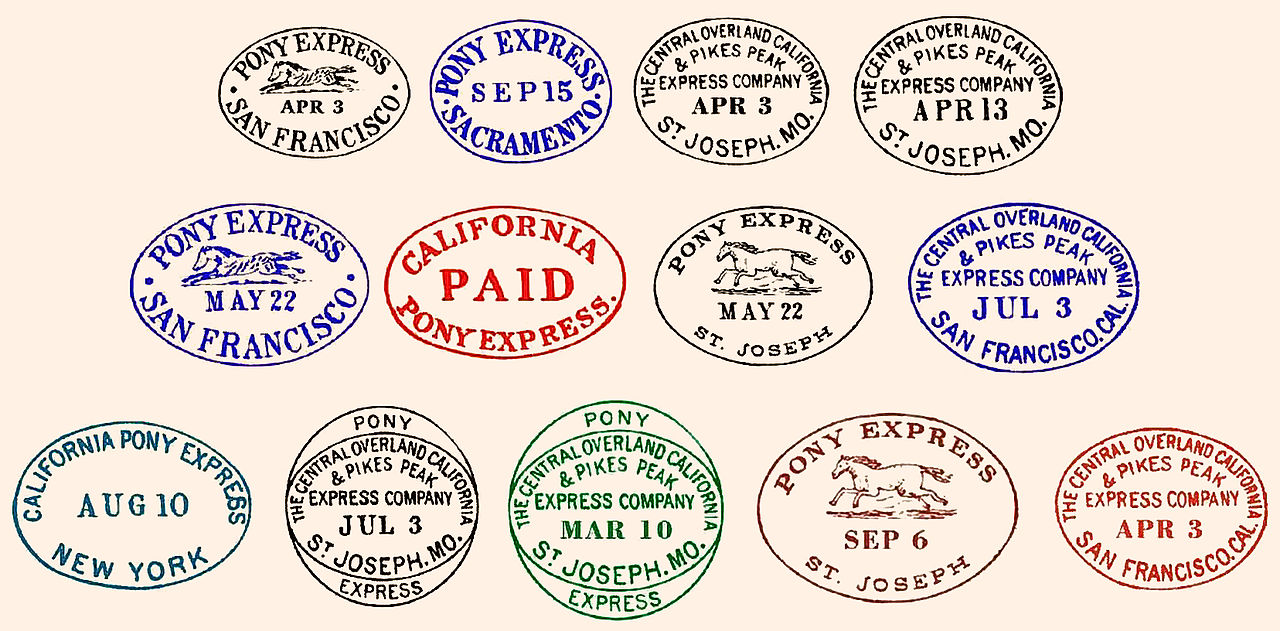
Though the modern-day USPS certainly does (and should) delay deliveries in bad weather, between April 1860 and October 1861, the riders and horses of the Pony Express faced these hardships and more, with just a handful of routes left uncompleted. Mail was tucked into one of four locked cantinas on an ultra-lightweight, Spanish-style mochila slung over a simple wooden saddle, and riders faced weather, terrain, rough footing, and during the Paiute War, hostilities from Native Americans. Operated by the Central Overland California and Pike’s Peak Express Company, a freight company based in St. Joseph, Missouri, the Pony Express was, during its run, the most efficient mechanism of bringing news from coast to coast.

Pony Express. (2022, December 13). In Wikipediahttps://en.wikipedia.org/wiki/Pony_Express

The first west-bound rider, generally believed to be a young man named Johnny Frye, departed from the company’s offices in St. Joseph, Missouri on the evening of April 3, 1860; just a few hours later, an east-bound rider left the Alta Telegraph Company in San Francisco, California, boarded a ferry to Sacramento, and continued from there toward St. Joseph. Over the next weeks and months, this ritual continued; in an average of just 10 days, the mail was carried some 1,950 miles from one terminus to the other. Individual riders completed segments of as many as 100 miles, changing out mounts at relay stations along the way, each change occurring in just under two minutes flat.

Pony Express mail included business and personal correspondence, newspapers, and even a transcript of President Lincoln’s inaugural address, all printed on special super thin, lightweight paper. By bringing important news from coast to coast faster than any other method available at the time, the Pony Express played a critical role in preserving unity when the country was on the precipice of the Civil War.

Though a success in the sense that the Central Overland route taken by Pony Express riders had previously been considered impassable in winter, the Pony Express failed to ever recoup its expenses. Due to the need for speed, ponies were not allowed to carry more than twenty pounds of mail, and the cost of sending correspondence– as much as $5 an item (the equivalent of about $150 today)—meant that only the most important of messages were sent via pony. The Pony Express effectively bankrupted its founders—William Russell, Alexander Majors, and William B. Waddell, the principals of the Central Overland California and Pike’s Peak Express Company —who ultimately had to use their personal fortunes to pay off creditors.

The final Pony Express run was on October 28, 1861, two days after the first transcontinental telegraph line was completed.

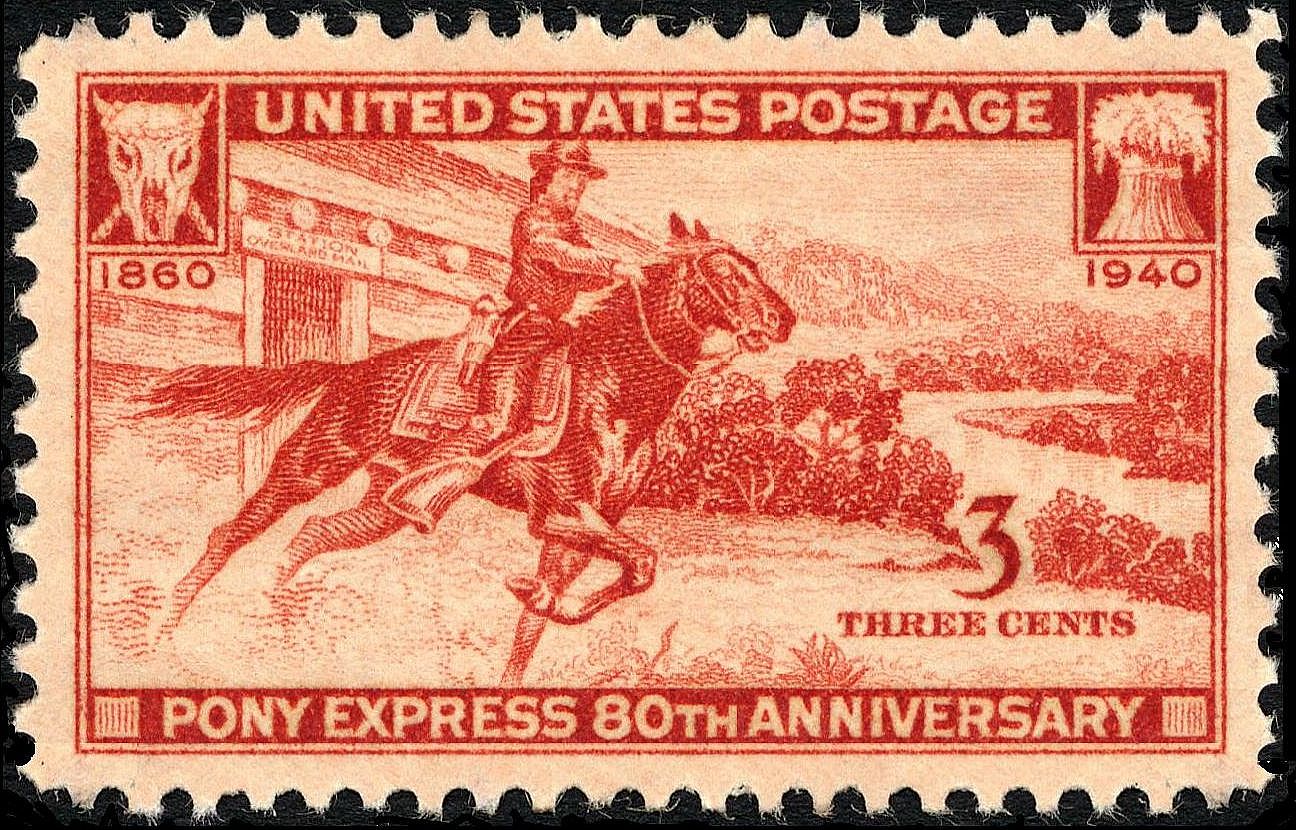
All stamps depicting the Pony Express riders and horses were issued after the Express had been terminated. This one commemorates the 80th anniversary, its issuance the result of the collaborative efforts of the St. Joseph (MO) Stamp Collector’s Club and the Chamber of Commerce. Previously, these organizations had requested a 75th anniversary stamp, which was declined. According to Loving in The Pony Express Rides On, the design of the stamp was deemed not historically accurate by experts in regards to the style of saddle and the manner of riding and dress of the rider.
Pony Express. (2022, December 13). In Wikipediahttps://en.wikipedia.org/wiki/Pony_Express

Despite running for just a year and a half, today the Pony Express carries a somewhat romantic legacy, perhaps because it embodies the rugged spirit associated with the Caucasian male of the American West. It has been the subject of television and film, as well as several historical novels; there have been commemorative stamps, parades, and dedicated statues erected as tribute at both ends. But despite the modern fascination with the Pony Express, many specific details—including the actual route travelled and the exact names of all the riders and locations of stations—have been lost to history. Those who study the Express and its legacy have had to sort truth from fiction, and even they don’t always agree.

I will admit that I am no US history buff, and my knowledge of the Pony Express was marginal back in 2020 when I signed up for the 1900 Mile Pony Express Challenge, sponsored by Warhorse Endurance as a benefit for the Pony Express National Museum. Conceptualized by endurance rider/photographer/podcaster Christina Hyke of Wisconsin, the Pony Express Challenge is an honor-system based “virtual” ride, with participants logging the miles they spend hiking, bicycling, walking, or, in my case, horseback riding. When participants log their miles into the database, they can chart their progress along the Pony Express route; upon completion, they earn a patch, sticker, belt buckle and, I suppose, bragging rights. As an avid distance rider, the challenge appealed to me on many levels, and I saw it as the perfect “pandemic project” to start on while most other activities were shut down.

I learned a lot about the Pony Express from this book, The Pony Express Rides On, by Mabel Loving. Mrs. Loving dedicated over forty years of her life toward collecting materials on the history of the Express, conducting her painstaking research via written correspondence, first- person interview (only rarely done on the phone), and through scouring library, newspaper, and company archives. Unfortunately, Mrs. Loving died in 1957 with the project unfinished. Mary L. Reichert, a friend of Mrs. Loving and a librarian at the St. Joseph Public Library, assisted in compiling her extensive notes and papers into this volume– although Chapters 26 and 29 were never found. As a writer who has easy access to online databases and search engines when completing research, I am truly humbled by Mrs. Loving’s dedication, perseverance, and cross-checking of details across sources, when every such action required such tremendous time and physical effort.

On Warhorse Endurance Podcast Episode 53, Hyke states that her inspiration in launching the virtual challenge was because “we believe the Pony Express Museum is a unique part of equine history, and one that is deserving of preservation.” When the pandemic hit, the Pony Express National Museum, located in the building that originally housed the Pony Express Stables in St. Joseph, was forced to close for 75 days, losing its main source of revenue (ticket sales) during that time. Warhorse Endurance contributed $5 from every entry fee for the virtual challenge to the Museum, and in 2021, a commemorative plaque listing the first 500 participants was hung in the museum’s front entrance.

For me, it has been fun to track my virtual journey, superimposed on a modern-day map; as of the end of 2022, I am just outside Eureka, Nevada, with 370.22 miles left to go. I have been working on the ride for three seasons, compared to the 10 days of the original Express– but back then, no single rider completed the entire Express route. Instead, each rider specialized in covering a particular segment, and when he reached his end point, he waited at that station a few days for the mail coming from the opposite direction before returning home. I am using four horses to log my miles, though the majority have been covered on my two veteran mares, Anna and Lee, and mostly at the walk; an actual Pony Express rider would change his mount every seven to fifteen miles, and travelled mostly at the gallop.

Anna and I finished our last Pony Express miles of 2022 the day before our first major storm in December. It was definitely not a seven to fifteen mile ride sort of day.

Despite the fact that many of the exact locations of the nearly 200 Pony Express stations have been lost to history, an approximation of the route was commemorated by Congress in August 1992, when it established the Pony Express National Historic Trail. This route travels through Missouri, Kansas, Nebraska, Colorado, Wyoming, Utah, Nevada and California, and tourists can visit the known locations of 50 stations along the way. Some sections of the trail are also still ride-able, if you are so inclined.

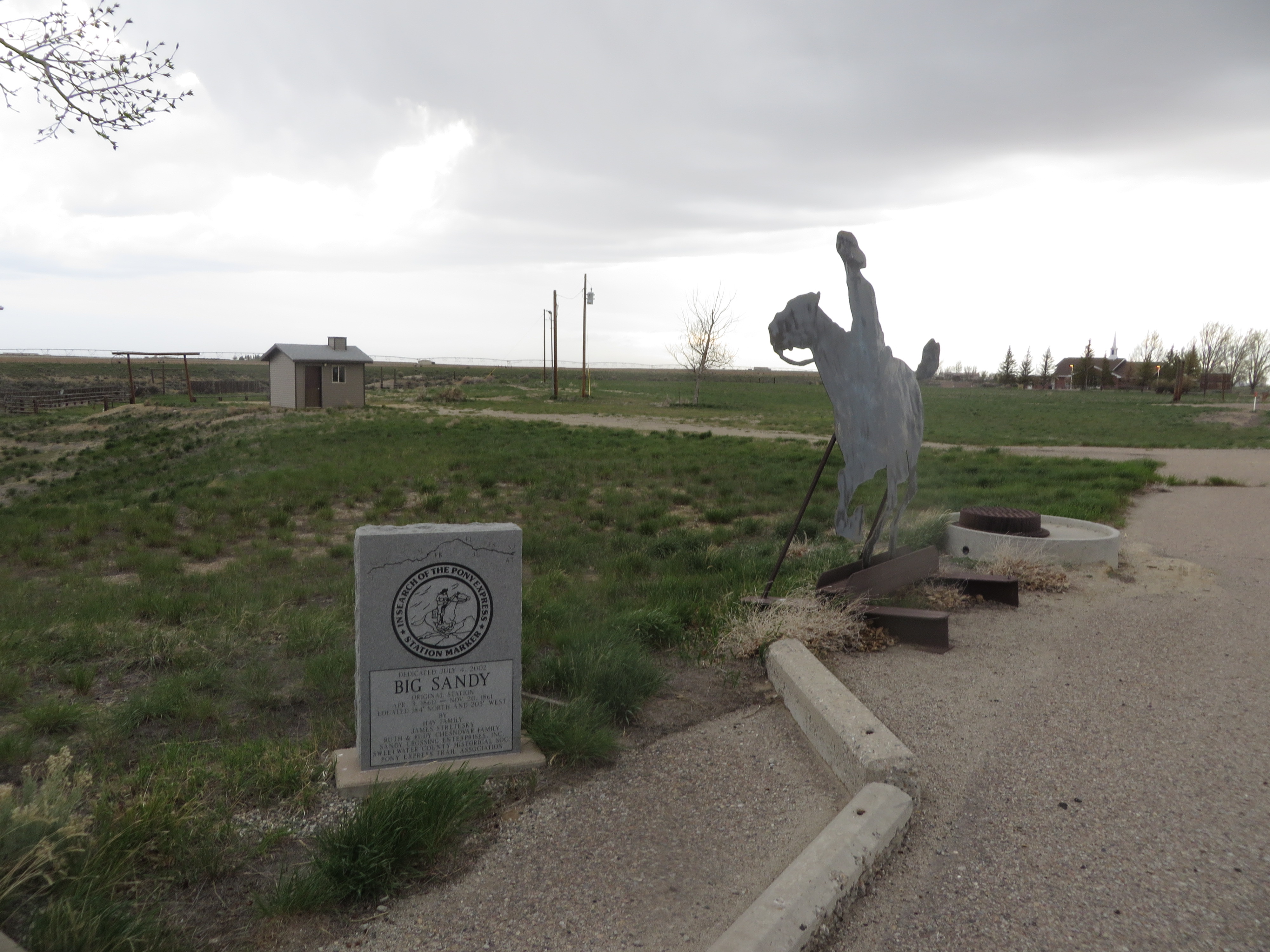
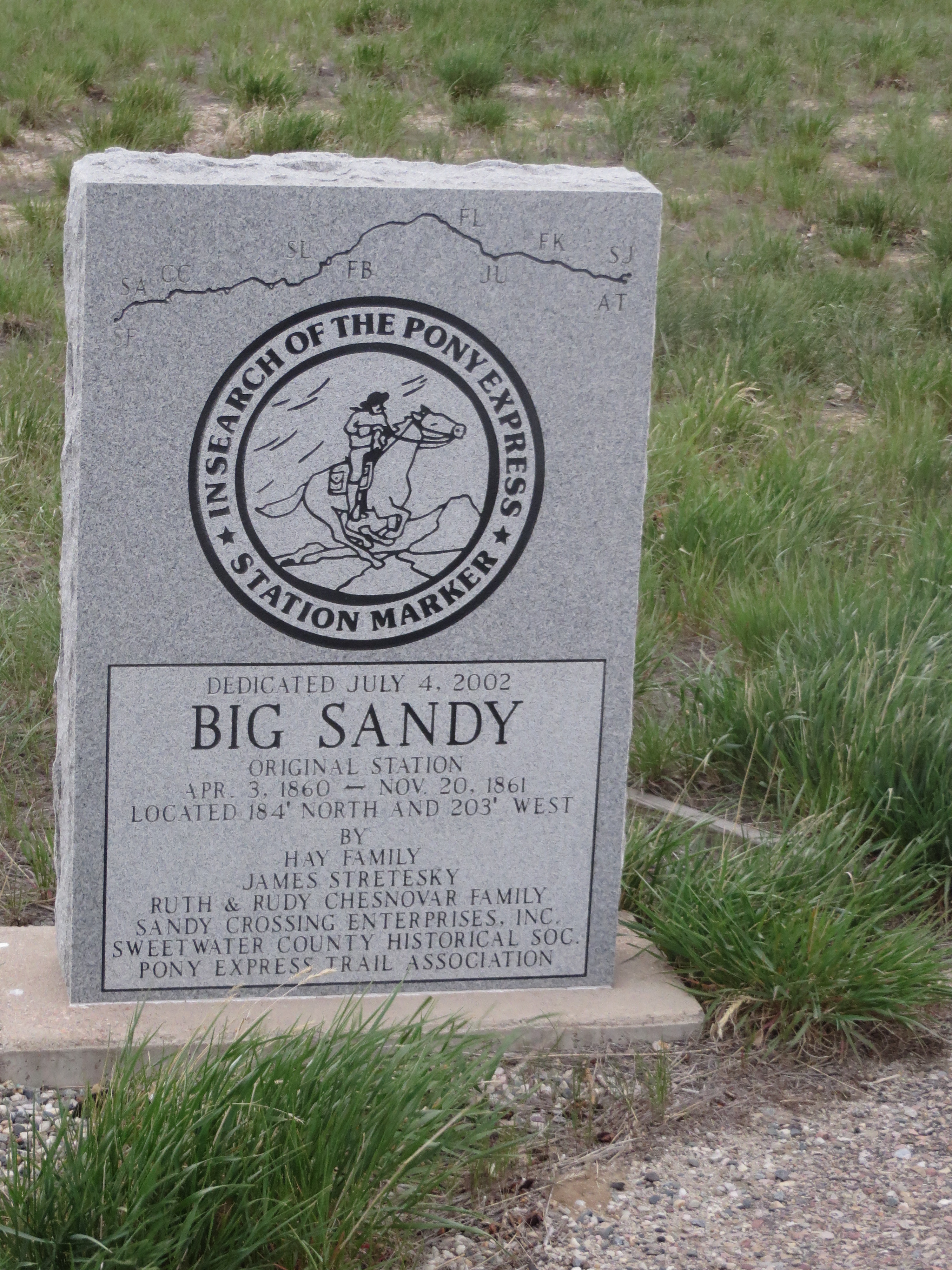
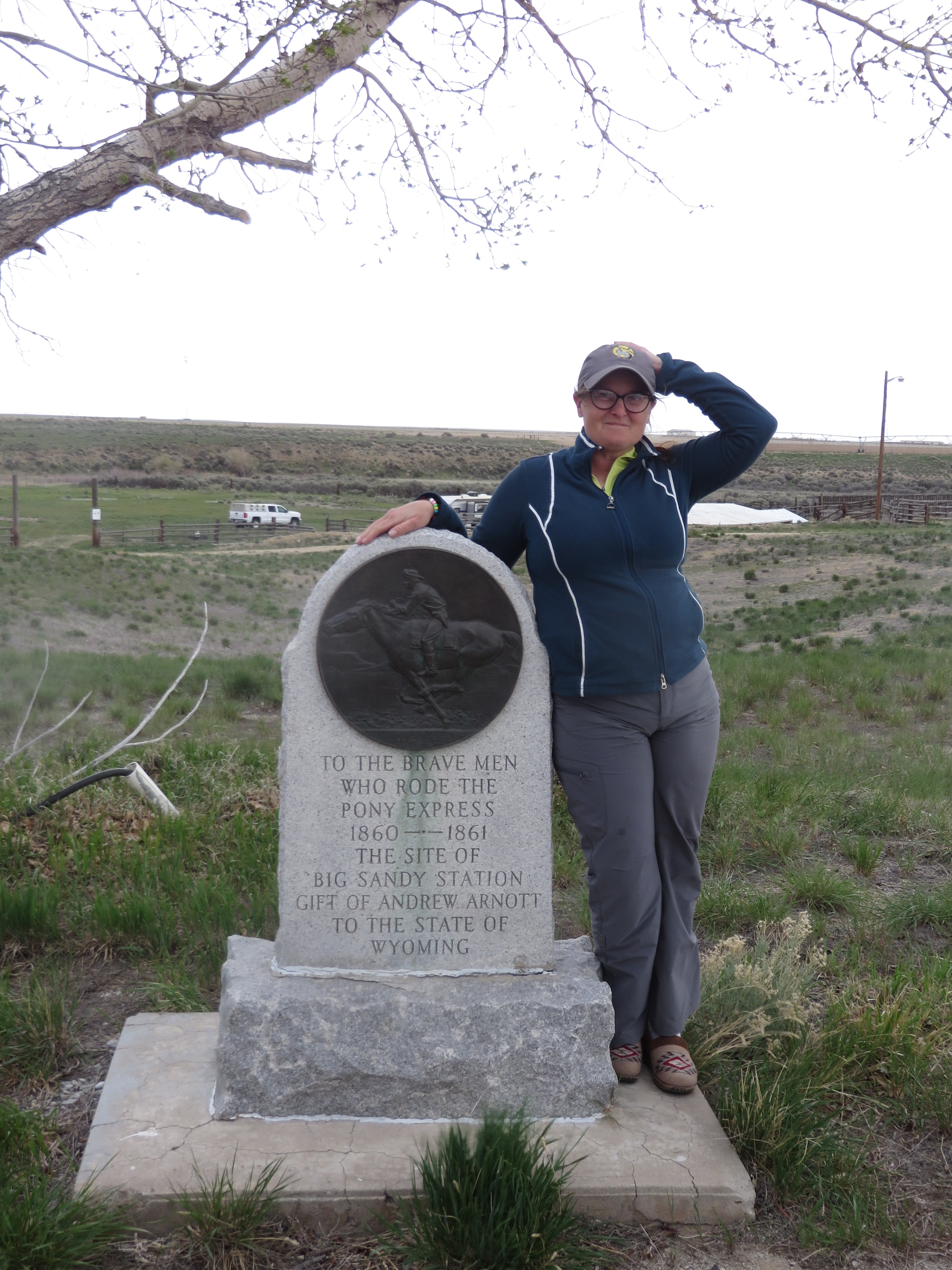
Above: Quite by accident, we came upon a memorial on the site of the Big Sandy Pony Express Relay Station, in Wyoming. Big Sandy was about the 18th stop on the route after departing St. Joseph, Missouri.

Earlier this year, I was returning east after an overland journey of my own, one that traversed many of the states included on the original Express. My partner and I decided to detour to St. Joseph to visit the Pony Express National Museum ourselves; on a sunny spring morning, we parked our camper in the lot behind the historic building. The construction of its brick exterior, with small, grilled windows and arched doorways, reminded me of the design of city mews stables, leaving little doubt as to the building’s original function.

I found this image of the Museum on Google, attributed to Steve Long.

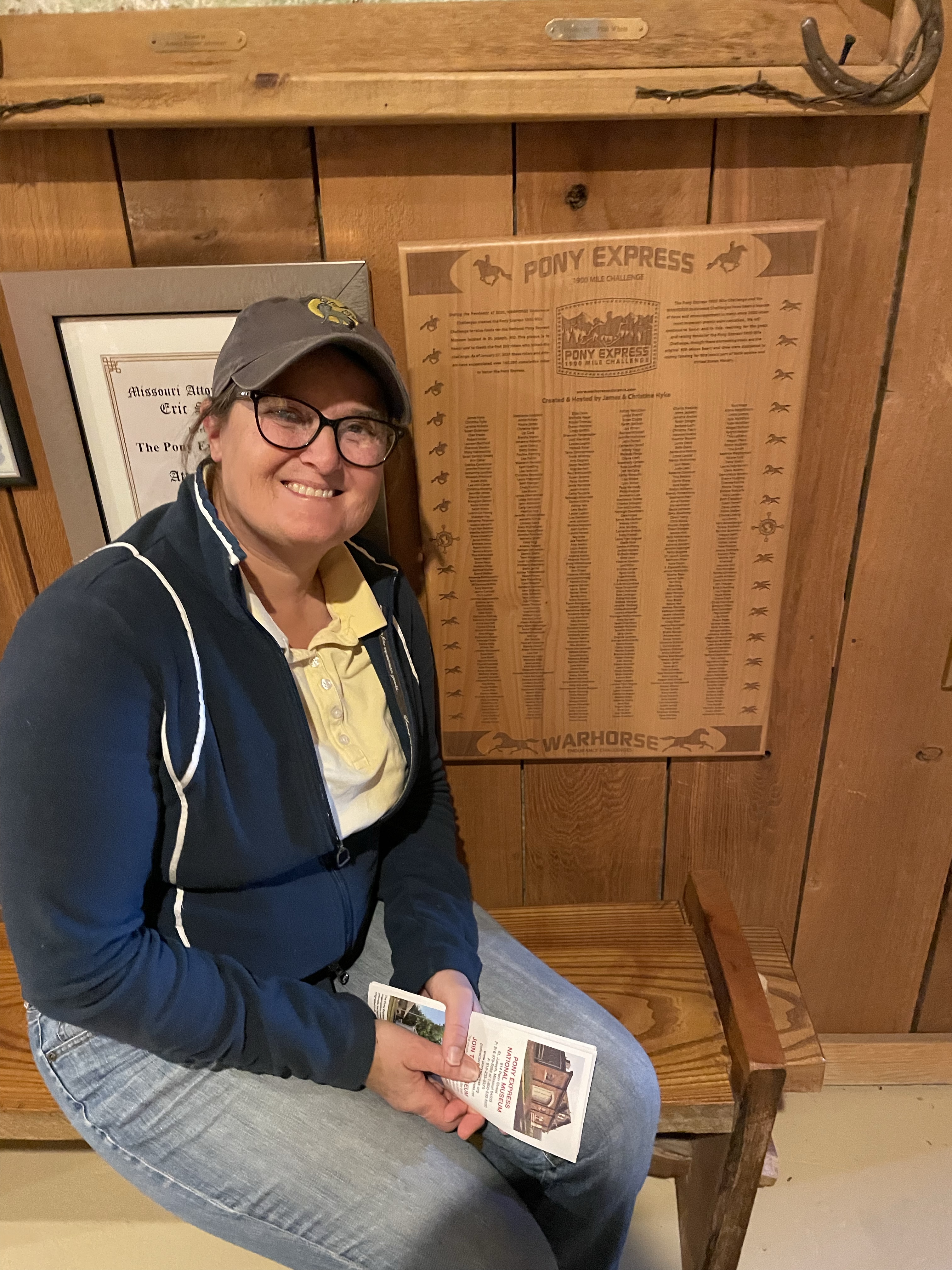
Inside, the uninitiated can learn more about the people and times of the Pony Express than perhaps they ever cared to know. Mannequins depict critical moments in Express history; murals and other artwork of the era or inspired by the Express add color to the interpretation. A Conestoga wagon dominates the middle of one room; in another, visitors can review a short film re-enacting the first Express ride. I especially appreciated an exhibit that shared the stories of several known Express riders and station-keepers, the latter of whose existence was arguably even more difficult and dangerous than that of the riders themselves. And in the lobby, I found a certain plaque that bears the name of 500 people who felt that the story of the Pony Express was one worth remembering.

I promise my name is on here!

In the podcast episode, Cindy Daffron, director of the Museum, states that what she finds most important about the story of the Pony Express is honoring the “ingenuity, hard work and dedication” of a “wonderful collection of people” who decided in January of 1860 that they would launch this ambitious project in April, just a few months later.

“It was a daring ride,” Daffron says with a laugh. She is talking about the trail itself, but she may as well also have been referring to the Pony Express as a whole.

And perhaps this is the enduring legacy of the Pony Express, and why its achievement still matters today. It is yet another reminder that even the most impossible-sounding of goals can sometimes be accomplished through a combination of grit, money, networking and good luck. Even in the challenges historians have found in establishing truth versus fiction in telling the Pony Express story, we can learn lessons about the importance of perseverance as well as accepting that we will not always know the entire truth about a situation. Most of all, the Pony Express is yet another stunning example of how when partnered with a horse, humans are capable of far more than they ever imagined.