Tag Archives: Denny Emerson

The Tamarack Chronicles: Volume IV

Event riders are different than other jumping riders in that they are not just able to jump outside of the arena, but look forward to it with a zeal that is almost religious.  But many people perceive cross country riding to be about going as fast as you can and jumping from any available distance (good or bad), all while wearing brightly colored gear.  Those who do not understand what it takes to ride cross country may also be heard to say that while an equitation rider is expected to look a certain way on her courses in terms of form and function, cross country riding is simply about getting to the other side of the obstacle and how the rider looks while doing it matters little.

Clearly, these individuals have never attempted to actually ride cross country.
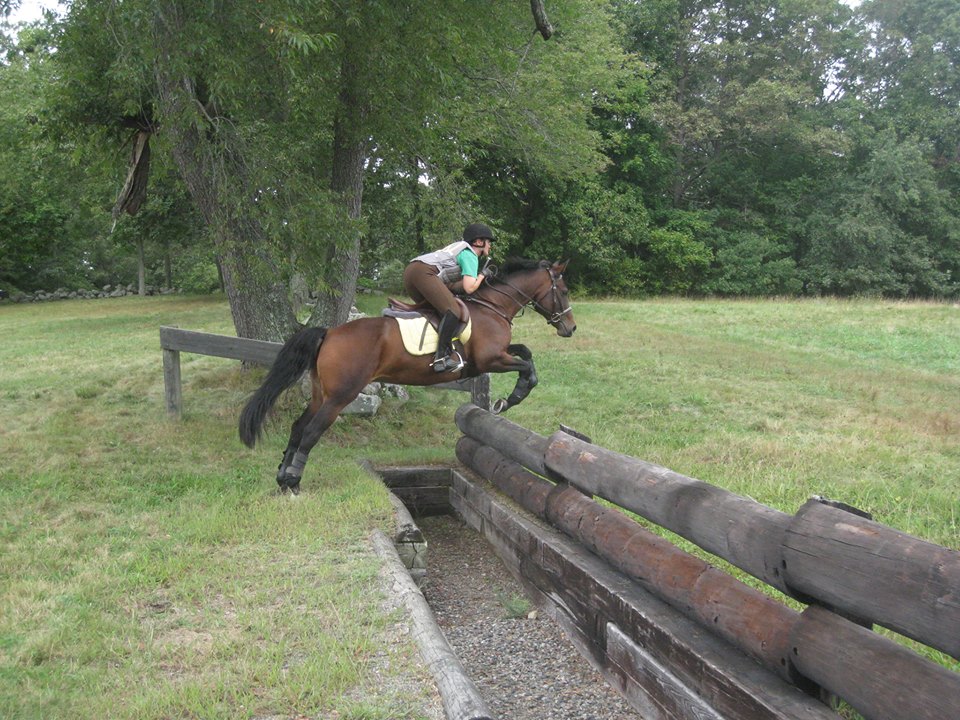
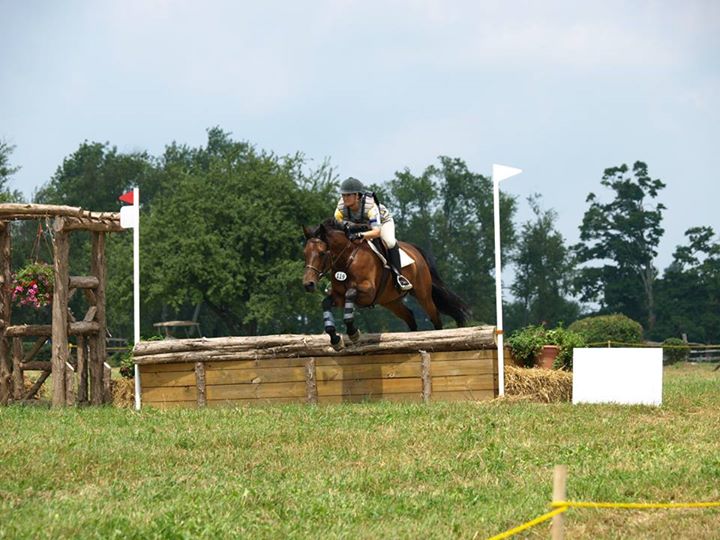
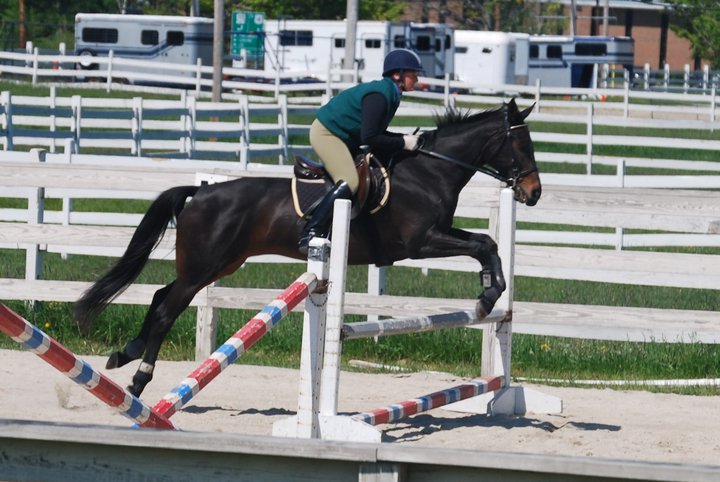
Anna jumping the ditch and wall at Ledyard.

In fact, one of the hardest aspects of eventing is learning how to ride cross country well.  It takes proper form, technique and a unique set of skills, some of which can be simulated in an arena but most of which require practice over actual cross country fences.   Learning about and practicing this unique skill set is probably the best, most effective way to increase safety (and fun) for horse and rider.   It also requires a certain degree of confidence and bravery that not all horses and riders have.  In fact, even the best horses and riders have their limits, and it is when you push beyond these limits that accidents are more likely to occur.

We have had several occasions to work on cross country technique this summer; those horses that are currently on the farm represent levels of expertise quite literally from “grasshopper” to intermediate level, so there is quite a range of capability.  However, in all cases, the same basics are emphasized.

Cross Country Variables

One of the hardest aspects of riding cross country is learning to handle changing terrain and its effects on your horse.  In addition, most cross country fences are meant to be jumped from a forward canter or gallop, so a rider must become aware of speed, not just in terms of how fast they are actually going but also in terms of its effect on the horse.  The faster horses travel, the more they have a tendency to go downhill with their balance and to get long and flat.  Of course, this is exactly the opposite of how the horse must be balanced in order to jump well.  Denny frequently quotes cross country master Lucinda Green in saying that when you come to a cross country fence with your horse, you want to feel like you are sitting on the heavy end of a teeter totter; in other words, your horse’s hindquarters are lowered and engaged and their shoulders are up.  Lucinda says that you want to imagine that 75% of your horse is up in front of you as you approach a fence.

Clearly you cannot travel around an entire cross country course in this balance; it would be exhausting for your horse and an inefficient way to travel.  Instead, the cross country rider must learn to master controlling their horse’s balance and speed throughout the course: while travelling between fences in the galloping seat, well off their horse’s back and with a following arm, and then to transition to a more organized and collected canter from which their horse can actually jump a fence.
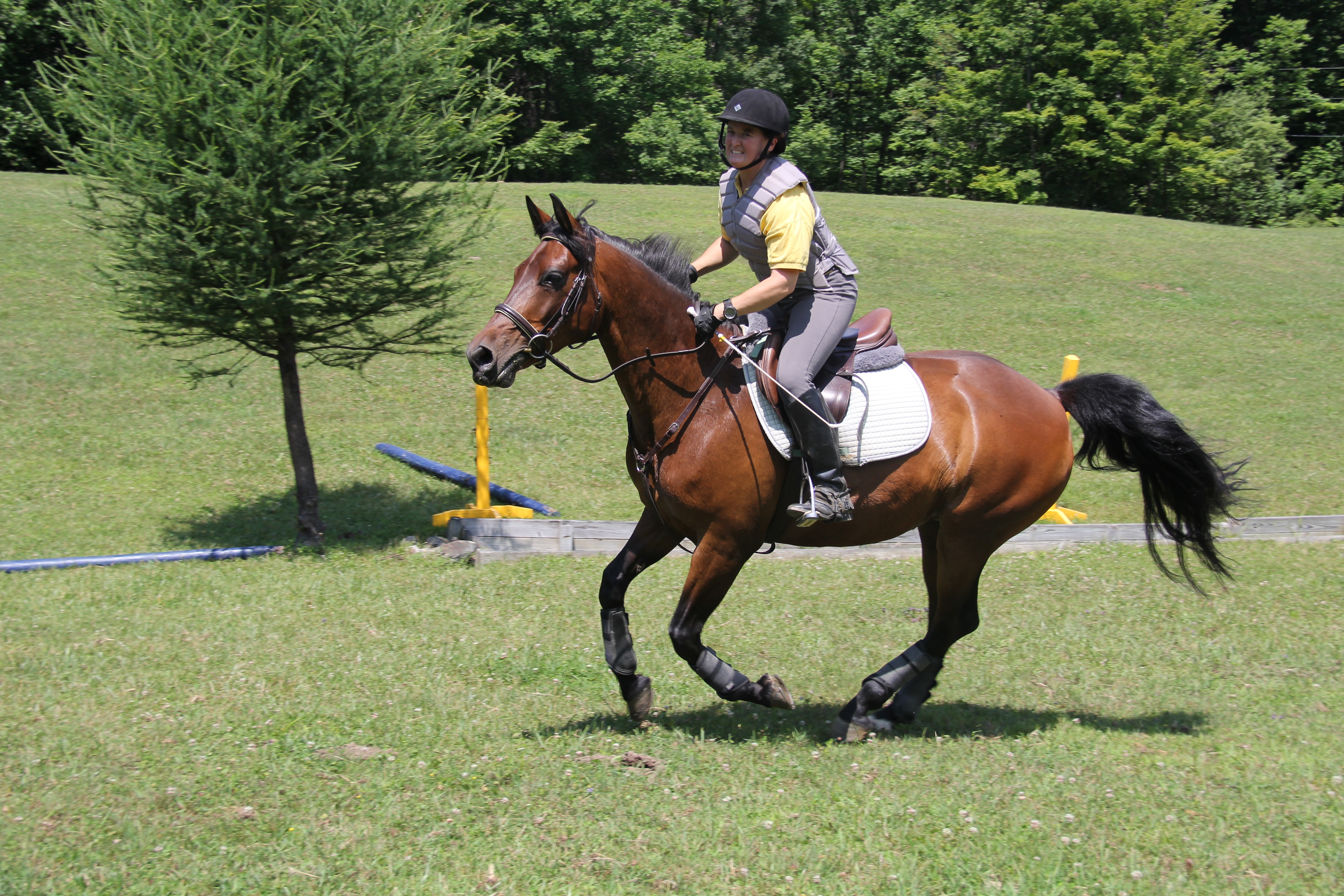
Schooling on Tamarack's course, 2014 (photo courtesy of Dr. Pat Erickson)
Schooling on Tamarack’s course, 2014 (photo courtesy of Dr. Pat Erickson)

Just as in arena jumping, the rider has three driving aids when approaching a cross country fence:  the leg, the stick and the voice.  The rider’s lower leg MUST be kept on during the approach in order to keep the hindquarters engaged.  Denny says that because most riders instinctively pinch with their knees, their lower leg swings back and is ineffective as a driving aid.  He says it can help to imagine that your knees and toes are pointing slightly “east and west” as you approach the fence, which is achieved by rotating the leg from the rider’s hip.  In addition, keeping your chin up, particularly while coming over a drop or downhill fence, will help the rider to stay centered and balanced with the upper body. And again, just as in arena jumping, the rider should SIT during the last several strides of the approach to help the horse come to the correct take off point.  Denny often coaches riders to even feel like they are staying a little too far back on the approach, with their feet just a little forward, as it is safer to be a little left behind than to be ahead of the motion.

A hairband on a schooling whip.

There are so many occasions when riding cross country that a rider may slip or even let go of a rein entirely, or simply lose their balance or tension on the rein.  When this happens, it is easy to also lose your bat, which means that you have eliminated one of your three driving aids.  Before coming to Tamarack, I had noticed riders who had elastic bands on the ends of their jumping bats, the heavy duty kind that you would need to restrain a thick a pony tail.  I am embarrassed to admit that I never knew that the reason for the band is to give you extra security in terms of hanging onto your whip while jumping cross country.  You simply wrap the band around your bat two or three times, then unloop one loop and twist it around your middle finger.  Voila!  You and your bat are now more securely connected.  I now want to do this with all of my whips, especially while hacking out.

Misc VT 006

The Glamour Fences:  Drops, Banks, Ditches and Water

If you walk enough cross country courses, you will eventually notice that most of the fences fall into three categories:  those which are solid fences designed like an oxer , combining height and width and often with an ascending shape(coops, roll tops, ramps, ascending rails, cordwood, etc); those which are solid fences designed like a vertical (suspended logs, regular logs, etc, overall a less common style on modern courses) and those which represent one of the varieties of what I call the “glamour jumps” of cross country—drops, banks, ditches and water.

Ledyard 2013.  Note my excellent facial expression. And incorrect arm placement.
Ledyard 2013. Note my excellent facial expression. And incorrect arm placement.

The glamour jumps are introduced in a quite basic form at the lower levels and are embellished as horses and riders become more skilled.  For example, at beginner novice, a water question is almost always just a simple “splash through”, while a novice horse may be asked to jump out of water, jump a simple fence which is set close to the water, or even to drop into the water, which is essentially combining two glamour jumps into one. Ditches start out as simple, unrevetted affairs and build into ditch/walls, trakheners and elephant traps.  And so on.  So if you have a horse that you are hoping is going to grow up to be an event horse, it is super important that they are calmly, systematically and clearly taught what they are to do at these types of fences.  Denny says that if in spite of this training approach a horse does not want to jump these glamour fences, they are simply not going to make it as an event horse.
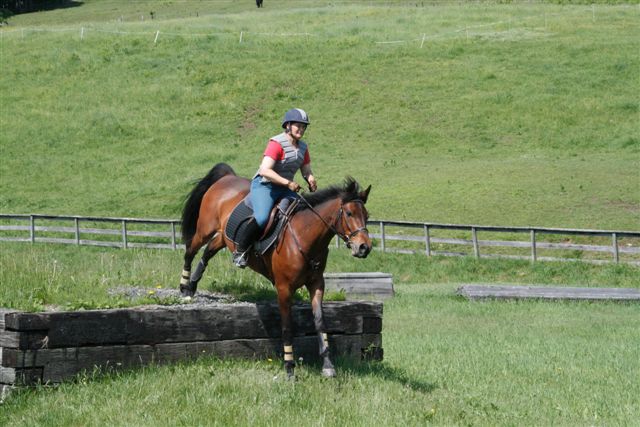
One of the drops at Tamarack, 2012.

During one school, I had the opportunity to watch Denny work with a green OTTB who is still learning about jumping ditches.  Even though she has jumped them successfully in the past, the mare was quite uncertain about going over the ditch located next to Tamarack’s main jumping arena.  We first tried using a lead horse, meaning that the green mare was to closely follow a more experienced and confident horse up to and over the ditch.  When this proved to be ineffective, and the rider was becoming a bit nervous, Denny switched to a different technique.  He had the rider dismount and attached a longe line to the horse.  Two rails were placed on standards and laid along the sides of the ditch to sort of give it a chute like effect, and two handlers with longe whips flanked each side of the ditch. Denny had the rider begin to lead the horse over the ditch, while the handlers very gently encouraged the horse with the longe whips ONLY if she began to back up and drift towards them.  While the mare was still uncertain, this approach gave her time to really consider the question, it gave her a leader to follow in the human handler, and when she chose to jump (a process that took less time than to set up all of the equipment) she was absolutely in no danger of being hit in the mouth, hit in the back or losing her rider.  Once across, they reversed the placement of all involved and jumped it the other way.  Back and forth they went, the horse unmounted, until it was truly not a big deal at all.  The horse became visibly relaxed and much more confident.

The rider remounted, the ground handlers stayed in position, and the horse was asked to quietly jump the ditch again, but now with the rider on board.  The handlers had to do nothing at all, as the horse had clearly figured out the answer to the question and calmly jumped the ditch.

I really want to emphasize here that the entire process took not more than ten minutes.  This was not a case of a horse being forced to jump over and over or being chased over the fence.  It was more a matter of presenting the question in such a way that the horse could figure out the answer on her own.  And when she did, it was No Big Deal.  This is an example of one of those “bazillion successes” which one needs to create a bold, confident horse.

Denny relayed a story of another mare, one who is now successfully competing at Training level, who also was quite unsure of ditches as a youngster.  I understand that her reaction to the question was quite negative and much more dramatic than that of the mare I watched them work with, but with the same calm persistence, they were able to encourage her to figure out the correct answer. Denny said that this was a pivotal turning point in that young horse’s training; he feels that if she had been made to jump the ditch through force, or if they had given up before the mare was successful, that the reluctance to jump ditches would have become a permanent and engrained habit.

Fence before water at Fitch's Corner, 2013
Fence before water at Fitch’s Corner, 2013

Denny says that the introduction of glamour jumps like small banks, drops, water and ditches can begin with a halter and longe line for horses three or four years old.  He says that introducing these questions without a rider, and in a manner in which the horse is certain to find the correct answer, is an excellent way of helping them to learn what is expected of them.

One last note about schooling “glamour jumps”—Denny says that during a cross country school, he always tries to visit the water complex last, as this is where horses seem to be most likely to pull a shoe.  That way, you will have had the opportunity to complete the rest of your school, and even if the horse does lose a shoe, you likely still will have already done most of what you needed to do that day.

The Huntington Schooling Horse Trials

On July 23, Huntington Farm in South Strafford, VT, held a schooling horse trials, utilizing several of the cross country courses from their recent USEA event.  As the farm is about five minutes from Tamarack, this represented the perfect opportunity for Anna and I to try to put all of our recently re-polished skills to the test.

I entered beginner novice, and my goal for the day was to give Anna a calm, positive ride throughout all three phases, without letting my intensity and anxiety take over.  I must say that on the cross country course that day, Anna felt the most positive and relaxed that I think she has EVER felt.  I was able to work on managing her balance and impulsion; I focused on my three stride eye and keeping soft, following arms with short reins.  We were able to find a steady balance and rhythm by fence three, and from there, I almost felt like I was riding a working hunter.  She remained confident and positive and willing.  One of the most effective techniques that I applied to that course was focusing on keeping my chin up, especially on fences with downhill landings.  Keeping my chin up helped to keep my own balance centered, and it also made it easy to pick a sight line with my eye that kept me thinking forward.

At Tamarack earlier this summer.

Anna finished in third place, on her dressage score of 29.0.  But even without a pretty yellow ribbon, the day was a huge victory as the day overall put “another quarter in the Coke machine” of positive experiences for my horse.

Blogger’s Note:  Denny told us a story of a clinic he taught at many moons ago on the West Coast.  The audience was mostly children, and he had been giving them a lecture on the topic of horse training, and the importance of being consistent and working hard.  He recollects that he wasn’t sure how much the children were really understanding, when one young man said to him, “I get it, Mr. Emerson, horses are like a Coke machine.”  Denny admits that he didn’t see the connection at first, but the young man went on to explain that if you want to get something out of your horse, you have to put the effort in first.  So training your horse is like putting the quarters into the machine when what you want at the end of it all is a refreshing drink.  Never underestimate the wisdom of youth!

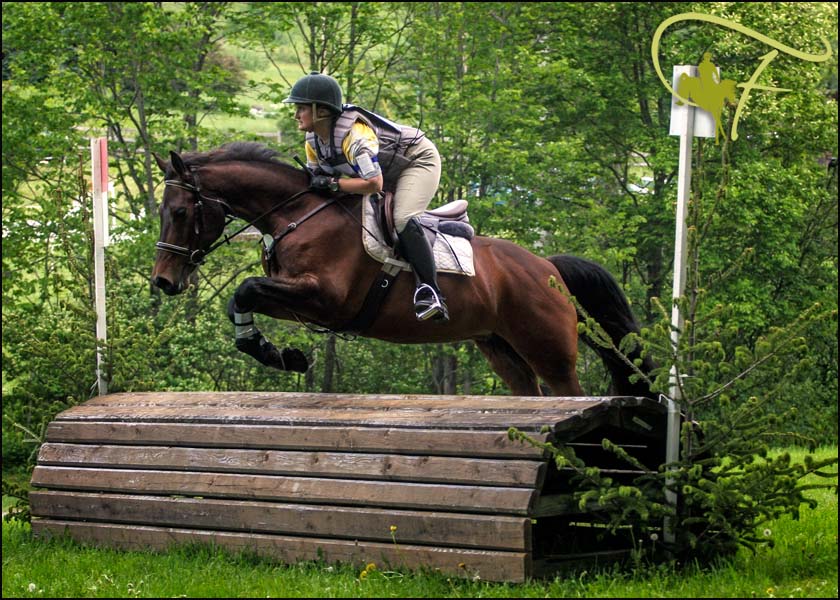
Additional Blogger’s Note:  The cover photo here is courtesy of Joan Davis/FlatlandsFoto and was taken at the 2013 Groton House Horse Trials.  Just want to make sure that this excellent photographer receives her due!


The Tamarack Chronicles: Volume III

I grew up taking lessons at the local hunter/jumper barn, and so I would guesstimate that I have been jumping horses for nearly thirty years, give or take.  While I have never aspired to the upper levels in any jumping discipline, there was a time in my life when I was fairly comfortable and competent over fences up to about 3’6”.  As a Pony Clubber, I passed my B rating and competed at the USPC National Championships in 1994 in Senior Girls Tetrathlon, which required a 3’7” show jumping course. In fact, through most of my USPC ratings, if I could manage to squeak through the flatwork, I felt quite competent in the over fences sections.  It was my forte.

But somewhere in my mid to late twenties, my feelings towards jumping changed.  It was a slow transition, so painstakingly unhurried that I was almost unaware it had happened.  I became less bold, far less brave and much more anxious.  I have taken falls, like everyone else, and I have ridden stoppers and horses with low confidence that don’t pull you to the fences, but (fortunately), there is no single event that I can point to and say, here, this is where it began.  The change was so insidious as to be almost invisible, but it occurred all the same.

When I bought Anna, she had been worked lightly under saddle at the walk and trot.  The rest of her under saddle education has been from me.  I took her on her first canters, taught her about dressage, and introduced her to jumping.  From the very beginning, she was a willing partner, if a little lazy, and only spooked at the occasional fence.  The first time she saw a ditch cross country, she just popped right over it; no fuss, no drama.  Banks, drops, water— same.  I competed her for three seasons of sanctioned eventing at beginner novice and novice, earning her USEA Silver Medal and taking trips to the Area I Championships at both levels (with clean cross country rounds).  Sure, we had a stop here and there; at her first horse trials at Huntington, she was in first after dressage ahead of several accomplished trainers but spooked her way around the cross country course.  She spooked at the glare on a freshly painted coop at Hitching Post one year.  But for the most part, I could rely on her to give me her best effort, and if she did take a peek at a fence, on the second presentation she willingly went right over.

Anna over the first fence at Fitch's Corner 2013
Anna over the first fence at Fitch’s Corner 2013

Fast forward to the fall of 2013.  For the more complete story, please read my earlier blog, “Reflections on Gratitude: Part I”.   But the short summary is that after completing (with only one penalty) three solid novice courses in a row (GMHA, Groton House, and Fitch’s Corner Area Champs), we were eliminated at King Oak in show jumping for three refusals, and then somehow scrambled around Stoneleigh Burnham two weeks later, in spite of refusals in both jumping phases.  Gone was my willing partner.  And gone was my sense of confidence or belief in the horse.  Jumping had become a real chore and ceased to be fun at all.   After several months of down time, I began working Anna over fences this winter in the indoor under guidance from my longtime coach.  She had me focus on being softer in my arms, trying to not “set” Anna so much for a takeoff point, and to stay lighter in my seat so as to not hollow her out before the fence.  Things were better—mostly.  Except for oxers.  And in and outs.  And anything new or unusual or unexpected.

I dropped back down to beginner novice for our spring prep outings in 2014, which should have made things super easy, given her accumulated experience over fences.  But at the shows, Anna got stuck, wouldn’t go, and stopped at fences for no apparent reason.  I was eliminated in show jumping at two combined tests (THANK YOU to the organizers of each who recognized the schooling opportunity and allowed me to complete my rounds anyway).  I was so, so discouraged.  It is hard to ride confidently towards a fence while in the back of your head you think the horse might stop.

Anna at Tamarack in 2012

When I arrived at Tamarack in May, I was seriously worried about how on earth I was going to get through the jumping lessons.  I felt so many emotions about it.  I was frustrated and embarrassed. I felt like I was a bad trainer and like I had messed up my horse and caused these problems.  I was worried about being overfaced or incapable of riding to the expectations of those around me.  I was embarrassed to have people watch me ride.

My first jump school here did nothing to assuage my worries.  We had the unfortunate luck to begin our school right as a thunderstorm was rolling in, forcing us into the indoor.  Anna had yet to settle into the routine at the farm, and was anxiously calling for her new BFF Lee, as well as reacting to the thunder and rain on the indoor roof.  During most lessons, Denny will call students over to him to discuss concepts relevant to the day’s exercises; while Denny was speaking that day, my horse was spinning, calling and in general acting in a disruptive and busy manner.   The other horses in our group were quite green over fences, so Denny had set up a teeny tiny vertical for us to school back and forth over.   The idea was to quietly trot to the fence with a soft rein and just sort of casually go over it.  Anna was so tense and distracted that our “quiet trot” was more of a “forward trot/canter”.  My “soft rein” was more like a steady rein as I tried in vein to keep her in the quiet trot.  We approach the teeny tiny vertical—and my horse stopped.

The truth was, my own anxiety level was through the roof—I was nervous about the jump lesson, my horse’s behavior was doing nothing to sooth my nerves and now I was unable to even jump this simple fence.  How much worse could it get?

Denny noted that I was (quite unconsciously) pulling back on Anna and holding tension through my arms as we approached the fence, and that when Anna did jump, she rushed over the fence.  We had just gotten into such a negative cycle with one another that in order to try to fix the problem, there was little option other than to go right back to the beginning.  So that is what we did.

“Earnest in a Box”

Something that has become clear to me is that when it comes to jumping, especially in public, I have begun to suffer from performance anxiety.  I am so concerned about being perfect that I work myself into an anxious state which is completely counterproductive for riding.   On the one hand, I know what I need to do and I know that I am physically capable of doing those things.  I have years of muscle memory on my side.  But in spite of this, the state of anxiety and emotional turbulence I get into are ultimately causing me to be less competent than I should be.  Even going to jumping lessons had become a big deal.  As in, we were going to Jump Today, instead of jumping being just a matter of course in our training.

Anna at GMHA in June 2013; Photo by Flatlands Foto and used with permission

Most of us are familiar with the term “earnest”.  According to its definition in Merriam and Webster, “earnest” is an adjective which means “serious and sincere; not lighthearted or playful”.  It would seem that for someone who wants to become an effective trainer and rider, being earnest in the study of horsemanship would be an admirable quality.  But Denny has brought up several times that being too earnest can actually interfere with a rider’s ability to be effective.  Being “earnest” can cause us to overanalyze and worry, which results in physical and mental tension. I absolutely fall into the category of “earnest rider”, and Denny has helped me realize just how much this earnestness has interfered with my desired success.

Denny coaches that there are certain aspects of ourselves that we almost have to “lock in a box” when we ride so that they don’t get in the way.  For me, earnestness is one of these qualities.  Each time I have a jump school, I have started to remind myself to lock my earnestness in a box, along with any feelings of performance anxiety or franticness.

Another critical concept that Denny brought forward is that ego has no place in horse training.  If you need to go back to rails on the ground to work on your horse’s canter, do it.  If you need to ride with a neck strap so that you don’t catch your horse in the mouth, do it.  If you have to jump 18” verticals for six months because that is where you or your horse is comfortable, do it.  Humility is NOT one of the qualities which should be locked in your box.

Furthermore, even though you might think that everyone around you is watching and judging (especially at a show), the reality is that at the end of the day, no one really cares about your performance except for you.   So learning to let go of what others think is an important quality.

Back to Basics

Horses will provide us with the responses which they have been conditioned to understand. Teaching a horse to jump is a matter of conditioning them to understand that when they are presented to an obstacle, they jump it.  But if they are punished by the rider for providing this response, whether through being caught in the mouth, pounded on their back, or being put too many times to an incorrect take off point with insufficient impulsion, then they are not going to be a willing partner.

It sounds so simple, right?

To start to rebuild both horse and rider confidence, Denny had me jump very small fences from the trot several times per week.  The idea was to make jumping much less of a big deal than what it had become.  This approach is what he uses when introducing greenies to jumping for the first time, as well as how he works to rebuild shaken confidence.  The intent is to create a situation that is set up for success. Keep the questions simple and repeat them until it is a confirmed response. A quote from former USET coach Jack Le Goff that Denny repeats often is the guiding philosophy here: “Boldness comes from confidence, confidence comes from success, so do a bazillion little things that guarantee success and you will have a bold, confident horse.”

To begin to instill this feeling of success, I would establish a forward but not rushing trot with Anna, and before the fence make sure that I was keeping my leg on, my eyes and chin up and not leaning with my upper body.  I also grabbed mane over every fence.  Denny wanted me to never ever catch Anna in the mouth and by so doing discourage her effort.  The reins were kept soft but not totally looped either.  He would have us ‘go play’ over the fences.  I only jumped the ones I felt okay with; there was no specific course or plan– very low pressure.  Some days, we only jumped maybe eight or ten fences, and if she stayed happy and relaxed, we went for a hack.  The pressure had totally come off.

A big turning point came one week when all of the farm’s horses were being schooled over gymnastics.  There were two lines set up, one which had several bounces in a row to a one stride, and another that was a vertical one stride to an oxer one stride to another oxer.  Obviously, each line was built up gradually.  The fences were kept low, as the intent was to work on the horses’ form and function through the exercise.  Gymnastics, and bounces in particular, are physically demanding on the horse and it is quite important to ensure that you quit while you are ahead.

On our first approach to the bounce line, Anna really backed off and though she went, it was sticky and lacked forward intention; this was the feeling which I had gotten so used to when she was faced with new and unexpected questions.  Denny had me make a fairly strong correction with my whip (we actually school her over fences with a dressage whip, as you can more easily touch the horse without taking a hand off the rein).  Then I reapproached—and he said something which for some reason really, really sunk in.  I had to ride to the fence EXPECTING THAT SHE WAS GOING TO JUMP, instead of riding assuming that she was going to stop.  So much in your body changes when you are thinking that your horse is actually going to jump the fence—you stay softer, you keep your leg on more, and if you have been coached enough, you wait with your upper body for the horse to throw you out of the saddle and close your angles.

Once I began riding EXPECTING THAT SHE WAS GOING TO JUMP, she actually did!  We had no trouble through the rest of the day’s exercises.

Several days later, the horses were schooled through the gymnastics again.  Denny’s wife May came out to help, as Denny was riding with us.  May has retired from riding herself but still has a sharp eye and uses her years of personal experience to note fine details in horse and rider performance.  She commented that during the grid line, I needed to keep my hands in a steady crest release, and not let them move around so much (where it is easy to start getting backwards pulling).  She suggested shortening my rein and lengthening my arm (something which I say to my students all the time, how funny), and then finding the crest release and just staying there.  When you come to the fence with your hands out ahead of you, it is SO MUCH HARDER to pull back.  This was a second turning point for me.  In addition to EXPECTING THAT SHE WAS GOING TO JUMP, I needed to remember to ride with SHORT REINS AND LONG ARMS, and to keep pushing her towards that contact, instead of the other way around.  I was rewarded for paying attention to this detail by a horse that happily skipped through the exercises.

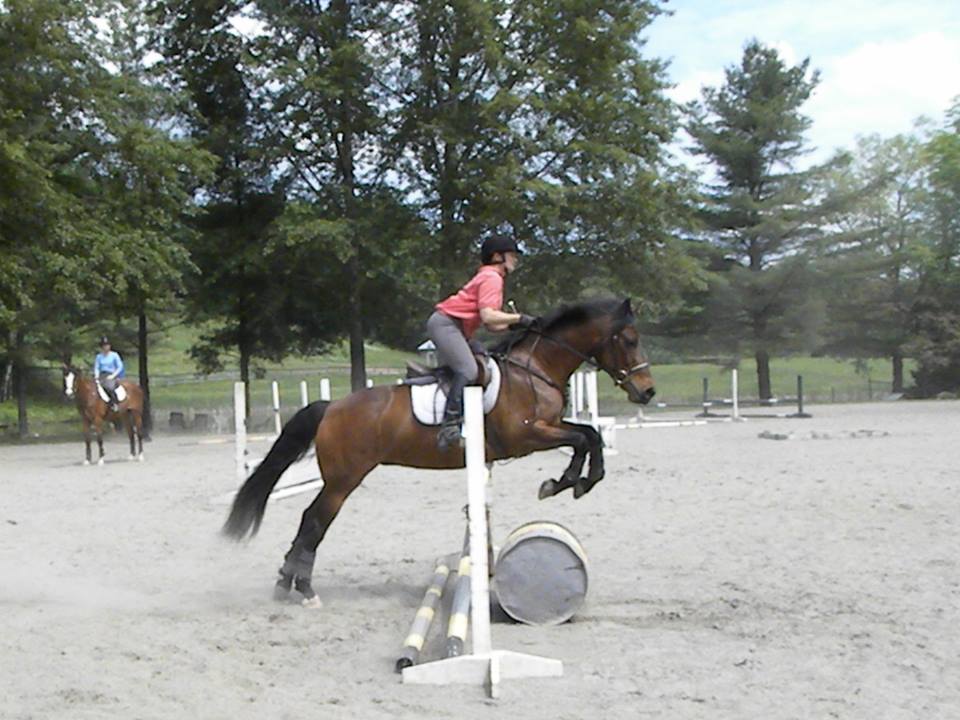
Being brave over the barrel (2014).

And in this slow, steady, methodical way, Denny began quietly increasing the questions we faced.  One day we jumped the barrel fence.  Another day we jumped some of the colorful panels (Tamarack has the most amazing array of beautifully painted fences).  Each time, we came to the quiet trot, and I rode like I EXPECTED THAT SHE WAS GOING TO JUMP.  And with each fence that she willingly popped over, a little boost of positivity went into our partnership.

Slowly, quietly, with as little fanfare as it had slipped away, I realized that my confidence was coming back, and that the horse that I had formerly trusted to jump was coming back too.

Using the Lower Leg—and What That REALLY Means

Anyone who has taken or taught a jump lesson should know that in order to encourage your horse to jump, the rider must apply leg.  “Add leg!”  “More leg!”

But riders (and coaches) must remember that the leg goes all the way from the hip joint down to the sole of the foot.  That is a lot of real estate.  Our quadriceps (thigh) muscles are usually our strongest in the leg, so when riders are coached to “add leg”, the common instinct is to squeeze with the thigh, which turns into pinching at the knee.  However, if you stand still on your horse and squeeze as hard as you can with your knees, your horse will not move. This is an incorrect use of the leg.

To be effective over fences, the rider must be able to apply her LOWER leg to the horse.  Denny quotes Bruce Davidson as saying that there is a control button on the horse, located just behind the girth and against the rider’s heel, which when activated will send the horse forward.  But even saying that you need to apply your LOWER leg is still not descriptive enough.  You must apply your leg at the location of the ankle bone/heel, and this must be positioned on the control button (just behind the girth).  In order to apply this part of your leg, you actually have to rotate your leg from the HIP joint.  And you also must SIT in the saddle.

Feeling braver (and with leg on).

When approaching the fence, the rider must shift the horse’s balance from forward and down to back and up (Denny likens this to cocking the pistol).  The LOWER LEG of the rider in the location of the heel/ankle bone must be on the horse in this phase, in order to keep the hindquarters engaged and the hind leg underneath the horse. An image Denny uses is to imagine your leg coming slightly to the east-west position on the horse’s sides. The rider sits in the saddle and adjusts back with the upper body to help the horse’s shoulders to lift.  The horse is the one who closes the angles of the rider’s hip and knee when he leaves the ground, while the angles of the rider’s shoulder and elbow open as she releases the rein.  The rider’s body is essentially shaped like a “?” mark.

Some trainers advocate approaching fences in a light seat/half seat in the final strides, but it is quite physically impossible to apply your lower leg at the ankle bone when your seat is out of the saddle.  One of the most common arguments against sitting is that it causes the horse to hollow his back; however, if you think of a dressage horse, riders sit all the time and the horse remains round and engaged.  The key to successfully sitting before the fence is to do so without locking the hip and driving.  The rider sits so that they can apply the leg and to ensure that they wait with the upper body.

3,2,1 Jump—Finding Your Canter

Denny frequently points out that most horses don’t have a jumping problem, they have a canter problem.  Riders need to know what quality of canter is necessary for successful jumping, and they need to develop their ability to adjust that canter slightly to get to a correct take off point.  He calls this “developing a three stride eye”.

Riders can work on this every single day, not by jumping, but by using hoofprints in the arena footing or other inanimate objects that are ahead of them in the ring.  Practice transitioning from a travelling canter to a jumping canter and count down, “three, two, one” in rhythm with your horse’s stride as you approach your mark.  If you are in jump tack, you can also practice the transition from a light/travelling seat to the sitting seat/leg on you need in front of the fence, asking your horse to shift his/her weight back and down while lifting the shoulders up.

AnnaUSETSuspension

Denny was helping me on the flat one day, and he asked me how many hoofprints I had jumped in my warm up.  I had to admit to him that I had “jumped” no hoofprints, as I wasn’t happy with the responsiveness to my leg in the canter and besides, we were doing flatwork, not jumping.  Denny said that working on the 3,2,1 exercise would actually IMPROVE the quality of the canter as well as my horse’s responsiveness.  So I started riding with that thought in mind; sure enough, the exercise of looking for the three stride approach caused me to use my leg more effectively, thereby bringing more thrust and jump to the canter.

I personally have an easier time using an object that is up higher or is broader in my field of vision than a hoof print as a focal point; I have been using jump standards or rails on the ground to work on the 3,2,1 concept.  The more a rider practices this during every ride, the sharper their eye becomes. The next step is to begin to figure out what the rider needs to do in those last three strides to affect the canter if they aren’t going to reach a perfect take off point.  If they are going to stand too far off (leave long), they need to add more leg and move up.  If they are going to come too close (chip/get deep), they need to half halt and further adjust the horse back.  These skills make a not perfect distance less problematic—but it requires knowing when you are three strides away from the fence as well as having a horse that understands and is responsive to the aids which adjust stride length.

The Show

The first test of my rediscovered connection with Anna came at the Tamarack Hill Farm Schooling Jumper Show on June 18.  THF offers these shows once/month in the summer time, seeking to fill a need for affordable, local, low intensity opportunities to practice jumping skills.  Denny is a HUGE advocate for supporting these types of shows and believes strongly that event riders should take advantage of them to improve their jumping skills.

As hard as it was for me to do, I had to lock both my earnestness AND (especially) my ego in a box when I chose to enter the 20” and 2’ classes.  This was a perfect opportunity for me to put all of the skills and mental focus I had been working on to the test, and to do that, I needed to keep the stakes very low.

My reward was that Anna was focused, confident, and wholly with me during both rounds and jump offs.  Both of us admittedly had more experience as a team than most of the other entries in those classes, but it was with a huge surge of relief and joy that I actually felt a sense of partnership with my horse return.  This was exactly what both the horse and I needed to be doing right then.

Prizes from the June 2014 THF show

“Boldness comes from confidence.  Confidence comes from success.  So do a bazillion little things that guarantee success and you will have a bold, confident horse.”

It is my “earnest” hope that this jumper show represents one of those ‘bazillion little things’, and that we will only continue to grow in confidence from here.


The Tamarack Chronicles: Volume II

The Tamarack Chronicles: Volume II

I think I may have found my new favorite horse sport—distance riding!  On June 8, Lee and I, along with Denny and his mare Cordie (Beaulieu’s Cool Concorde, a 9 year old Selle Luxembourg mare) completed the 15 mile competitive trail ride at the Green Mountain Horse Association (GMHA) in South Woodstock, VT.  It was such a great experience on several levels and I am excited that we are aiming for a second 15 mile ride this weekend, with the Hartland Riding Club in Hartland, VT.

If you love to be outside, love riding your horse, and enjoy spending time with other people who value these same things, then you may already be a trail rider.  Competitive Trail Rides (CTR) and Endurance give those of us who enjoy all of the above but also appreciate a bit of friendly competition a chance to put our horsemanship skills to a true test.

CTR How’s and Why’s

As a veteran now of TWO CTR’s, I feel MORE than qualified to explain the basics of how these rides work—haha! Just kidding.  Please take what I say here with a small grain of salt (or electrolyte) and understand that it comes from my limited personal experience and research only, not years of dedicated study and practice.

The CTRs that I have attended are by far more relaxed than any horse trials or hunter show, and nearly everyone—competitor, staff or volunteer—is quick to say hello and lend a hand.

Lee and her friend Ariat at GMHA Distance Days
Lee and her friend Ariat at GMHA Distance Days, 2013

As with most competitions, one of the first things to do upon arrival is to check in with the show office.  Here, you will sign up for your start time; at GMHA, entrants are usually sent out in small groups at two minute intervals.  You will also receive your entry number, and your horse will be marked on both sides of the hindquarter with their number in greased pencil.  This allows for easy identification of an entrant from a distance, and provides a marker that is hard to wash off when the animal is being cooled out at the completion of the ride.

The next order of business is the “vetting in”, where each entrant is carefully looked over by both a licensed veterinarian and the lay judge, who is a knowledgeable horse person.  The vetting in might be completed the day before a ride for a longer distance, or it can be done just before the day begins for shorter rides.  Rides that are sanctioned by the Eastern Competitive Trail Ride Association (ECTRA) provide feedback on the vetting in/out to competitors via a carbon copy sheet which clearly identifies several critical areas for assessment.  The purpose of the vetting in is to establish a baseline for the horse’s condition prior to completing the ride.  The vet and lay judge will palpate the topline, note any rubs/blemishes/swellings, check the legs and note filling, cuts, windpuffs, etc., check anal tone, do a pinch test on the skin, note the condition of the horse’s gums and check capillary refill time.   All findings are carefully noted on the horse’s sheet.  Finally, horses are jogged in hand, moving straight away from and straight towards the judges, as well as in a circle to the left and right.  Horses will start with a perfect score of 100, and points are deducted for changes to the horse’s condition at the end of the ride.

Once all the horses have been vetted in, competitors will attend a pre-ride briefing, during which various personnel are introduced, trail markers are described and general information about the route is provided.  Additionally, riders are made aware of the time for the route; rides sanctioned by ECTRA or running under its rules seem to adhere to an average speed of 6 miles per hour.  The officials also give consideration to the weather and trail conditions to come up with a window of time during which riders should aim to complete their route.  There is a thirty minute grace period during which riders may still officially finish with point penalty.  Exceeding the grace period will result in a team’s disqualification.  Finally, the vet and the lay judge will announce what the target is for the recovery pulse and respiration rates (more on this later).  For rides longer than 15 miles, information is also provided on the mandatory hold.  I will have to update more on what this means once I tackle a 25 mile ride!

At this point, competitors will return to their horses to prepare to move out on the trail.  The rides at GMHA allow competitors to sign up to go out with another entrant(s); this practice is almost encouraged for the simple fact that you will have someone nearby in case of emergency.  Once on the trail, it is really up to the rider to pay attention to many variables to determine an appropriate pace.  You must consider your mount’s condition and how they are feeling that day, the terrain in front of you (and yet to come), the temperature, etc., and then travel at an appropriate pace.  Because CTR’s DO have a time limit, it is important to be mindful of this and to aim to travel an average of 6 miles per hour. The walk is about three miles per hour, so completing a ride on time requires maintaining a pretty steady trot.   However, there will be times on the trail where conditions warrant a slower speed (walking) and it is more important to consider your horse’s well being than to make a specific time.

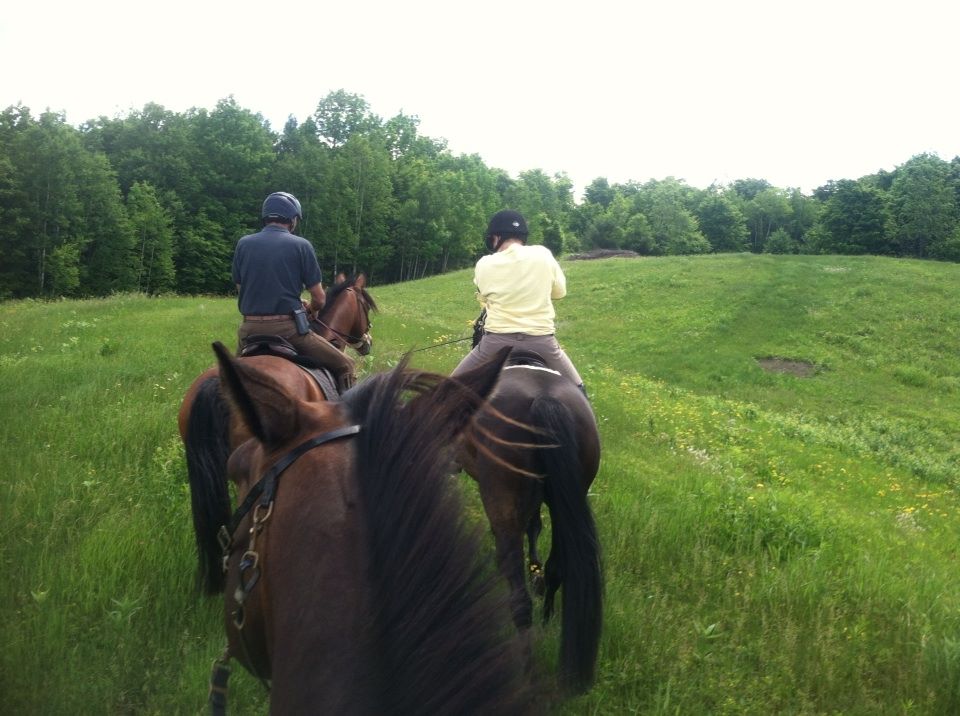
Conditioning ride with friends Cordie (back) and Roxie (in front, with Denny on board).

Next comes the best part—the actual ride!  Vermont in the late spring and summer is a simply breathtaking place, and so as you ride along, you are able to enjoy your horse, the company of friends old and new, and of course, exquisite scenery.  The June GMHA ride took us first part way up Morgan Hill Road, and led us past amazing properties, including one of the homes of endurance Hall of Famer Steve Rojek.  The road sections of the route are on town roads of hard packed dirt, which allow you to fairly comfortably trot out.  We passed homes that even Denny hadn’t seen before, including one that appeared to have a homemade polo field and another antique home which someone was painstakingly restoring to its original appearance.  (We learned upon our return that this particular property formerly belonging to the famous actor, Michael J. Fox.  It seems like everyone wants a piece of Vermont’s beauty!)

Yet another stunning vista in Vermont, looking towards Tunbridge.

Our June ride took us on about 50% trail and 50% road.  We had one ‘road crossing’ which required volunteers to police the traffic for safety.  During the course of our ride, we encountered a handful of vehicles on the roads, and every driver was courteous and respectful of our horses.  As someone who by and large avoids riding on roads when it is possible to do so, I appreciate drivers who pass horses slow and wide, and we were certain to acknowledge them with a friendly wave and smile.

One aspect that it is so important to remember is that in several instances, we were guests on private property.  GMHA sits on 65 acres and maintains an extensive trail network, with some routes on their own property but many others are only accessible through the generosity of private landowners.  Lack of space to ride is a major and critical issue facing the equine industry today, and all riders, not just trail riding enthusiasts, would be wise to take active steps to preserve the lands which they value.  This topic warrants its own blog post, so perhaps I will reflect on this more and do just that.  Visit http://www.gmhainc.org/trailpreservation.html for their thoughts on the topic.

As riders near the end of the CTR, many will try to slow their horse down to begin allowing their pulse and respiration to return to lower rates.  This is less true at an endurance ride, where the goal is to complete the distance in as quick of a time as possible while considering the well being of your mount.  Upon crossing the finish line, volunteers hand each rider a small slip noting the time of finish, and they also record the order in which each horse crosses the line, as this will determine the order for the vetting out.  Riders are then given twenty minutes to return to the stable area, remove their horse’s tack, and to sponge their horse with water to assist in lowering pulse and respiration rates.  Note that I said “sponge” not “hose”; hosing your horse is not allowed.  Competitors usually will set up multiple buckets full of cool water along with sponges and scrapers before they head out on the ride;  during the twenty minute window, riders will sponge and scrape, sponge and scrape, all in an effort to cool their mount out as efficiently as possible.  At the twenty minute mark, more volunteers will come by to measure each horse’s pulse and respiration, and then record it on the slip handed to each rider at finish.  Ideally, your horse has recovered to rates within the parameters set forth at the briefing.  Horses whose rates are still quite high will be rechecked, and horses whose rates do not drop to within normal limits within an hour will be disqualified (and checked by the vet!).

Once they have completed their P&R check, competitors proceed to the “vetting out”.  Horses are reviewed in the order in which they finished, but horses who are “friends” are usually allowed to come to the vetting out together and are reviewed in order.  The same vet and lay judge who completed the vetting in will re-evaluate the same parameters that were checked before the ride; careful attention is paid to any areas in which condition has worsened.  This may mean that the horse has acquired some rubs from the girth, or perhaps they have some swelling or scrapes from interference (shoes are permitted in CTR but protective boots are not).  Horses are also jogged out in the same manner as they were pre-ride to note any unsoundness.  Horses who show physiological signs of stress (changes in muscle or anal tone, increased capillary refill time, dry gums, etc) will have points deducted and in extreme cases might be disqualified.  Sometimes, an area might actually improve in condition; for example, a horse may have presented with windpuffs pre-ride but shows tight and clean fetlocks post ride.  Points won’t be given back for the improvement, but it is left to the judge’s discretion whether or not to deduct points for the initial blemish.  Again, all horses start the ride with a perfect score of 100, and points are deducted for exceeding the time allowed on trail, for not meeting the P&R recovery threshold and for changes to the mount’s condition at vetting out.

Some rides, like our June GMHA 15 mile, are scored on a “pass/fail” basis.  This means that no placings are awarded; it encourages riders to really consider their horse and use the ride as an opportunity to improve the horse’s fitness in the way which makes the most sense for that animal. Either your horse meets the minimum criteria and “passes” or they do not.  At a ride with placings, it will be the best conditioned and soundest horse that wins.   Therefore, the horse’s well being must always come first, as it should for all true horsemen.

Lee contemplates the view.  Or more realistically, the grazing options.
Lee contemplates the view. Or more realistically, the grazing options.

CTR Versus Endurance

I was a little shaky on the difference between a CTR and an endurance ride, but after doing some research my short answer is that in an endurance ride, the winner is the horse/rider team who finishes in the fastest time whose horse is judged sound and healthy post-ride.  Time of finish is not a factor in CTR, so long as you complete the ride within the time allowed.  One other difference is that in endurance, where the distances covered tend to be longer, forward progress can be made by an unmounted rider leading their horse.  In CTR, horses must be ridden for forward progress to count.

From the website of the North American Trail Riding Conference (NATRC; www.natrc.org):  “A competitive trail ride is similar in many respects to an endurance ride.  Both cover a set, measured course, and the veterinary judge closely monitors the horses in both sports.  Endurance rides must be completed within a maximum time, and the winner is the horse that finishes first and is judged fit to continue.  But in competitive trail riding, the horse and rider must finish the ride within a window of time, and speed is not a judging factor.  Horse manners are judged in competitive trail riding, as is horsemanship; these are not judged in endurance.  In endurance riding, horses are checked by a veterinary judge at certain points and are judged as fit to continue.  The veterinary judge in competitive trail riding will check the horse anywhere along the trail, and the horse is judged on whether his parameters have changed since the baseline established at Friday check-in.  Riders can proceed on foot in endurance riding, but for all forward motion in competitive trail riding, the rider must be mounted.  Endurance rides may be much longer than a competitive trail ride-some endurance rides go 100 miles in 24 hours!”

Preparing for the CTR: “Never Hurry, Never Tarry”

When Lee arrived in Vermont the third week of May, she was coming off a winter of steady work 5-6 days/week in the indoor arena and a spring which saw some work outside (finally) by mid April, including a few rounds of trot and canter sets.  I would tell you that she was in moderate work, but that she had not been doing the long, slow, distance style work that getting out on the trails can do for you.

Being at Tamarack is an amazing experience for someone who likes to ride out.  A local resident for over fifty years, Denny knows the land and landowners like no other, and works to help maintain a network of trails which I understand is shared with snowmobilers and cross country skiers in the winter.  Riding back on these trails is unlike any experience I have had at home; there is no traffic, no road noise, no airplanes overhead, no trash in the woods.  It is as though you have ridden back in time.  And when you ride out with Denny, he tells stories of the places you ride through, gets to open vistas and identifies landmarks and towns and points out historical markers and other features that one might otherwise not notice.

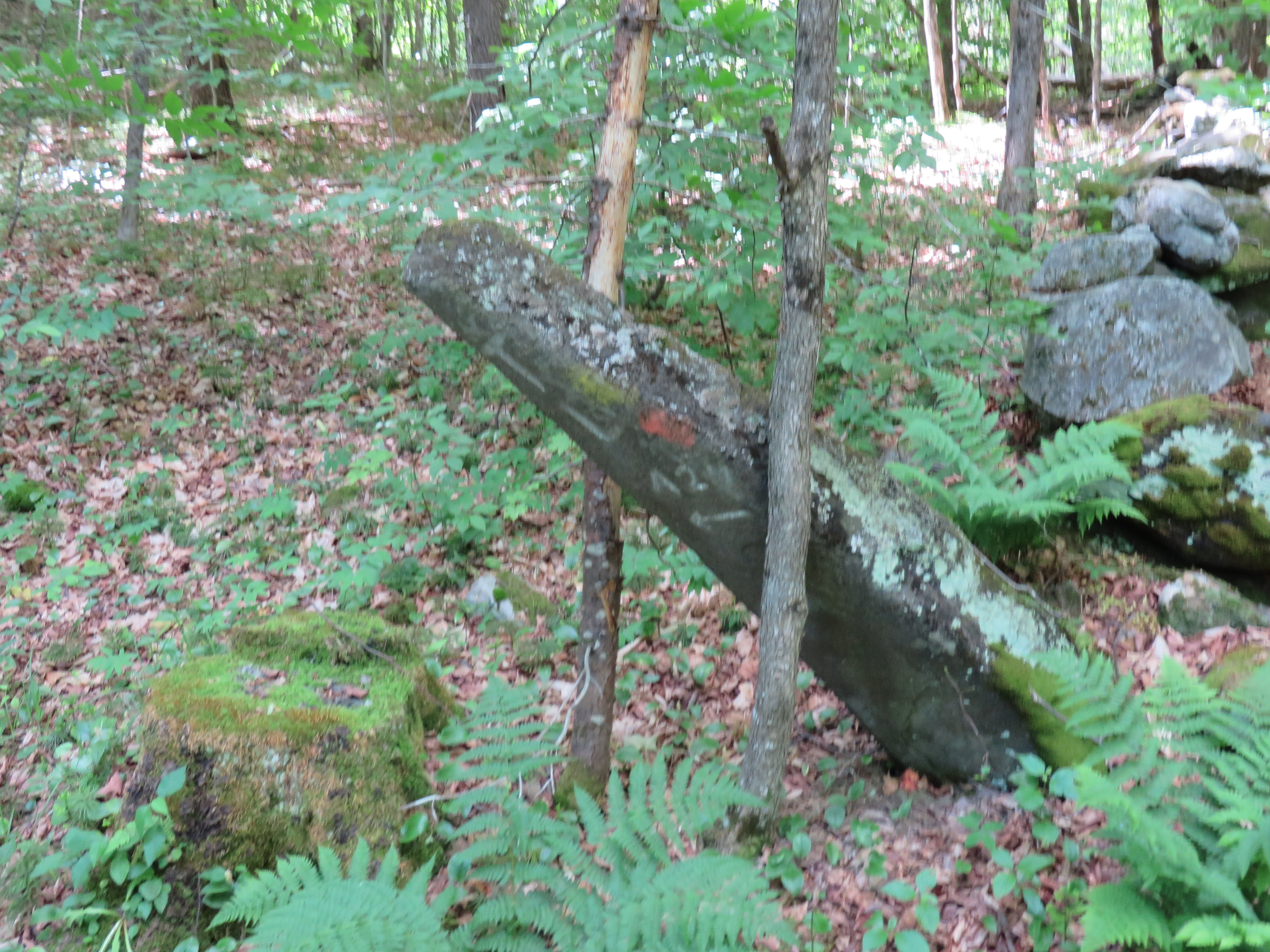
Old post marking the townline (TL) between Strafford and Tunbridge, VT

In getting ready for our first two fifteen mile rides, Denny put our horses on a schedule of hard days followed by easier rest/recovery days.  Some days, we would ride as long as two to two and a half hours, mostly walking, but also riding up some steep hills; these are hills which surely put positive stress and strain on a horse’s cardiovascular system as well as work the topline and hindquarters.  To aid my horse, I would also assume the two point position, making me a stronger rider as well!  Easier days might include an hour on flatter trails, or even light work in the arena.  As someone who is accustomed to a steady five-six exercise days/week schedule (usually four in the ring, one on the longe, one as a hack), it was a different concept for me to consider conditioning a horse by pushing a bit harder/further and then giving them a day or two of complete rest in between.  In addition, the week before a ride is usually a bit lighter, overall, so that the horse arrives to the competition feeling fresh and fit.  Though I am just beginning to learn about conditioning horses for distance work, and Denny says most of what he does he has learned through trial and error,  we have been told that this type of progression is used by serious endurance riders.  It is exquisitely important to listen to your horse—if you give them a hard ride (whether in terms of distance, terrain, speed, humidity or some combination) then your next day might be a light ride or no ride at all, to give the horse’s systems time to recover.  If you plan to ride, and the horse feels tired, then you back off even more.  Of course, over time you steadily increase the demands on your horse so that they are stronger in mind and body to hold up to the longer distances on rides.

CTRs themselves can serve as part of the conditioning process, as they offer riders a chance to work their horses under a structured format over longer distances.  In fact, you will often see these rides called conditioning distance rides (CDRs) when they are ten to fifteen miles in length.  Veterinary evaluation offers clear feedback as to how your horse coped with the demands of the ride, and a smart trainer can use this to sculpt their conditioning plan as they move forward.

When we were on the ride itself, Denny shared with me a piece of wisdom that he had gained from a serious endurance competitor; when on the trail, “never hurry, never tarry”.  You want to be more like the tortoise and less like the hare, I suppose.  Keep your horse moving at a steady, consistent pace; trot where the footing is good, walk where it isn’t or the trail is too steep (up or downhill) to trot safely.

Looking forward.
Looking forward.

Distance Planning, or, Setting Long Term Goals

When planning the career of a distance horse, you need to think long term.  Not just in terms of the actual rides you plan to attend, but for the overall health and well being of the horse themselves.  One endurance blogger reports that he believes it takes three years to put enough conditioning work into a horse before they can be a serious contender at 100 mile rides; this is not to say that they might not be fit enough to compete before then, but they will be competing for mileage/experience as opposed to try to win.  And this is assuming that no setbacks occur to horse or rider.  Denny says that preparing for distance riding is largely a question of time and place; you need the time to put in the saddle, and you need a place to do that riding (ideally a place with hills, which maximizes your conditioning time).

It is easy to get caught up in Denny’s enthusiasm for everything horses and riding related, and he has been favorably impressed with Lee’s performance so far, calling her, “one tough horse”.  He thinks that she has the capability of completing a three day 100 mile ride like the one they host each fall at GMHA, but to do something like that would require planning NOW.  In other words, instead of coming out of the indoor next spring fifteen mile fit, she needs to be twenty five or thirty mile fit.  And then next summer would be focused on continuing to gradually build the muscle, joint and organ systems to handle the increased demands required of a ride of that length.  He has me excited to try to go for it, or to at least seriously consider prepping for it, with the option of re-routing to a shorter distance if she doesn’t feel ready.

So the plan for this summer will be to continue to gradually build and to see where we end up; the Hartland Riding Club 15 mile ride is this Saturday, and based on how our horses feel, we hope to go to the GMHA 25 mile ride in early August.  Time will tell whether Lee will truly make it to a three day one hundred mile ride, but as in other horse training endeavors, I shall just keep adding layers to the onion, never hurry/never tarry, and see where we end up.

Leebacksidehacking
Roxie and Lee, from Cordie’s perspective.

The Tamarack Chronicles: Volume I

This year marked the first of a new contract for me at the University of New Hampshire, and with the contract change came a shift in scheduling—I now only work during the academic year, leaving the summer months free for other pursuits.  So what is a girl to do?  Idly sit on her back porch with her feet up, eating bonbons?  Not for this one (what is a bonbon, anyway?)…I chose to do what any nearly 38 year old equine professional would do… I chose to become a working student.

For the past three years, I have had the opportunity to make brief trips to ride at Denny Emerson’s famed Tamarack Hill Farm in Strafford, VT.  Denny is a horseman who needs no introduction, and he is the mentor of my own longtime trainer, coach and friend, Rachel Greene Lowell.  Each year, these trips have proven to be some of the most effective edits to my progress as a rider and to my horse’s education.  I figured that it was worth it to take a chance and spend the summer focusing on my own growth as an equestrian. I asked Denny if I could come up for the summer.  I found a summer sublet in cute South Royalton (So Ro, to the locals) and two days after submitting final grades for spring semester, Pug Dog, several cats and two horses in tow, I headed to Vermont. Image

Anna schooling at THF on a previous visit.

I will say that there is a significant difference between doing something like this when you are closer to forty than when you are closer to twenty…it is a humbling experience to take that step back into the role of full time student, rather than being the one who is responsible for calling the shots and making the decisions.  However, it is also heartening to hear concepts that I use in my own instruction and training reiterated by someone with the experience and wisdom of Mr. Emerson, to confirm that I am on the right path.

Having now completed my first three weeks, I will admit that there have been some outstanding high points as well as some significant lows.  This is sort of like the horse world in general, I suppose.   But overall we (horses and human) have settled into our new routine and I am so glad that I took this step.

Summer Goals: AKA, What I Did on my Summer Vacation

My two horses are quite different, and I came with different goals for each for the summer.  I have had Lee for longer and during our time together she has been a jumper, a dressage horse, a sometimes IHSA mount and most recently, a fun trail/hack horse.  Lee took her maiden voyage into the world of competitive trail riding at the 2013 Green Mountain Horse Association (GMHA) Distance Days, and she proved to be a real pro.  Her forward thinking trot and desire to follow the leader served her well and she breezily handled the 10+ mile ride, nearly breaking away from me at the final inspection and prompting the vet to comment, “Next time, perhaps a longer ride might tire her out more?”.  Denny has logged many hours in the sports of competitive trail riding and endurance, and has completed the rigorous Tevis Cup (is there anything this man cannot do?).  He has been a tireless advocate for the trail activities held at the Green Mountain Horse Association in South Woodstock, VT.  I want to learn much more from Denny about what goes into conditioning a horse for longer rides over terrain, and perhaps try my hand at some rides over greater distance with Lee this summer.

After three weeks at Tamarack Hill, Lee (at age 15) is learning to be a Real Horse, living outside in a field on a hill, seeing cows, dealing with bugs, and falling in love with my pony Anna.   I even caught her LAYING DOWN out in the open, with Anna also laying down by Lee’s side.  Just for some perspective, in nine years of being Lee’s human, and I have personally seen her lay down exactly ONE other time, and it was in a dark stall.  At night.   With Denny leading on one of his three mares (Atti, Cordie or Roxie), Lee has become a real solid citizen on the trails, just so long as someone else goes first.  The hills here have brought her Thoroughbred body into strong physical shape quickly, and she has happily handled muddy, slippery spring trails, creek crossings, rocks, hills, and even narrow gaps like an experienced pro.  I had the privilege of taking her on a nearly two and a half hour ride up to the Sunnyside property, also owned by the Emersons, which afforded breath taking views of the Green Mountains to the west and the White Mountains to the distant east.  It is so exciting to see this horse so happy and content and willing in her work.

Image


Lee many years ago, warming up for a jump clinic with Joe Forest at UNH.

As far as Anna goes, we have been struggling with confidence and communication issues over fences (see my previous blog, “Reflections on Gratitude”).  Over the winter, I still had the notion in my mind that I might be able to compete at the novice level three day event at GMHA in late July (which is something that has definitely been on my “rider’s bucket list”), but after several false starts this spring it is clear that this is simply not a reasonable expectation at this stage in the game.  Right now, competing over fences with Anna is just not as important to me as is trying to fix what has become broken in terms of confidence and faith.

So for Anna, I hope that a summer of confidence building and more regular jump schooling—as opposed to my once weekly sessions at home—might help to re-establish some of the ‘mojo’ we once had as a team.  I hope that the hacking here will allow me to condition her more successfully than I have been able to do at home with sets in the ring.  I still do hope that we can make it to an event or two later this season—but only if our communication and confidence has returned to a degree that such a challenge would be fair and reasonable.

Overall I am encouraged because in the short time that we have been here, there already has been a huge improvement in our work over fences.  I will go into more detail on this in a future post.  Anna’s work on the flat has already come forward tenfold; Denny actually got on her for me one day, and worked to create a softer jaw and increased throughness.  He feels that there is a fancy mover hiding within her, and watching him work with her showed me that there is the capacity for much growth in this area.  Exciting!

ImageAnna (left) and Lee (right) enjoy being Real Horses outside on the hill.

“Do you see the grass growing?”

One of the more persistent themes which is coming clear to me already from my time at Tamarack is a reiteration of the fact that in training horses, it is usually faster to go slowly.  This applies to increasing fitness, introducing new concepts and aids, rebuilding confidence…pretty much anything you can think of.

During several flat work sessions, Denny has discussed with us his process for introducing a horse to the mechanics of the rein aids, in particular teaching horses to give to pressure at the poll and the jaw and to remain mobile in the neck.  A horse’s ability to understand these aids is instrumental to being able to achieve throughness and engagement.  Many of the horses which Denny has worked with are OTTBs, and he points out that these horses are programmed to do one job—to run fast.  They understand the cues which help them to do this and know how to move their bodies well in one way: shoulders down, weight to the forehand and powerful hindquarters driving them forward.  When these animals begin the process of learning how to be a sport horse, the trainer must be tactful, patient and clear with the new aids.  These horses must essentially be “unprogrammed” from their old job and have a new operating system installed.   This in many ways is a harder job for the trainer than starting with a horse who knows no aids whatsoever; however, the process taken to accomplish the end goal in either case is the same.

Image

Spring at Tamarack Hill

All work sessions start with about ten minutes of walk on the loose rein, putting no pressure on the horse and just allowing them to loosen their bodies and mentally begin to turn their focus to work.  The next stage of the warm up is a period of low pressure trot and canter with light contact, but not yet fully asking the horse to bend, be entirely round or as actively pushing from the hindquarters.  The first canters are usually in the light seat, allowing the horse’s topline to loosen and stretch before being asked to fully carry the weight of the rider.

For horses that are not yet fully clear about the basic aids, Denny talks about “puttering”.  He says this is certainly not a term that you would read in the classical works, and he acknowledges that this technique is perhaps not how he would always have proceeded with the training when he was an ambitious and competitively minded young trainer—but it is what he now believes to be indispensable in his training.  Essentially, “puttering” is about gently introducing new aids to the horse, and waiting to reward a correct response by releasing the pressure.  So if you are asking the horse to step away from the leg, the leg would be applied lightly until the horse at some point moved away.  The rein aids are important, diverse and best introduced at the walk.  Denny says that you almost want to think of the aid as a gentle “pestering” of the horse, and when he responds, the pressure releases.  He is not a fan of short cuts like draw reins, leverage bits and other tools used by some trainers; these create a response through the infliction of pain, and he says that such a response does not really teach the horse.  Remember that a horse can feel a fly, or the lash of your dressage whip gently tickling the back of his ear.  For certain they can feel a gentle pressure on their mouth, or a push from the rider’s leg.  The horses who don’t respond to these gentle aids have probably never been taught to do so.  So instead of becoming stronger or more aggressive, you “pester” with the aids until the horse accidentally comes up with the correct answer, which you then reward.

Image

Lee working in the indoor at UNH.

Denny says that teaching horses these responses to the aids is like teaching them a language.  Imagine that someone is trying to tell you something, but they are speaking in a foreign tongue.  If you don’t know Spanish or German or Pig Latin, it isn’t going to matter if they whisper, speak or yell—you are not likely to respond correctly.  Why do we expect our horses to respond to aids that we have not correctly or properly taught them?

The other important point about “puttering” is that the trainer remembers that the process will take whatever time it takes.  Perhaps you introduce a concept on day one, and the horse only sort of is able to respond.  But you come back on day two, and in a short window of time the horse responds to the aids better and more clearly than on day one.  Instead of pushing for more at that moment, the wise trainer rewards the horse and leaves the lesson behind for the day.  The horse feels successful, the training has been moved forward and the horse learn to perceive that the work in the ring is not a matter of being drilled.

This is such an important concept that I need to repeat it again.  It is a theme that keeps coming back during nearly every lesson whether on the flat, over fences or on the trails.  Training takes time.  It takes whatever time it takes.  Horses should not be drilled.  The wise trainer stops MUCH earlier than most of us do, rewards the horse, and puts them away feeling mentally relaxed and physically tired but not exhausted or drained.  Trainers must be patient, they must be clear, and they must be consistent.  It sounds so, so simple, so why do more of us not adhere to this philosophy?

Denny tells a story of a clinic which he was auditing.  The rider was a well-known Olympian, riding under the direction of a world renowned trainer, on her Olympic mount.  The rider was becoming frustrated and more intense in her use of the aids (as many driven and focused people can tend to do).  After watching for a bit but saying little, the clinician finally asked the rider, “Do you mow your lawn?”.  Frustrated and confused by the apparent lack of relevance, the rider responded, “Of course.” “Well, do you see the grass growing on your lawn?” asked the clinician again.  “No,” replied the rider, still not making the connection between the questions and the situation at hand.  “You need to mow your lawn because the grass has grown,” says the clinician. “But yet you do not see the grass grow.  So it is with training your horse. Each lesson builds upon the previous one.  You do not all of a sudden have a trained horse.  It takes time.”

Denny also compares training to the layers of an onion.  Each one is built upon the layer before it.  You cannot leave steps out of the process or rush through it.  To do so will ruin horse and rider confidence, compromise physical well-being and limit the progress which could be gained otherwise.

I am learning that like many other trainers, I can be too driven and push for too much at once from my horses.  I need to be even quicker to recognize that the horse has done what they needed to do in a day’s work and let them leave the ring for a hack.  I think sometimes we are so results driven that we don’t realize that it is the summation of many small, small forward steps that will create the best outcome.

The results of this training program are plain to see when you watch the Tamarack horses work and compete.