Daniel Stewart “Pressure Proof” Your Riding!

The question of “mental toughness” as it pertains to equestrian sport is one which has been of increasing interest to me in recent years, for several reasons.  First, as the coach of an intercollegiate riding team, I have often noticed that what seems to separate those who win from the rest is not simply equitation skills; of course, you must find your fences, but equally important is the rider’s ability to maintain focus and self-confidence.  Secondly, as an instructor, I have seen so many riders whose progress is stifled because either they don’t believe that they are capable of being better than they are, or they don’t care to be better than they are.  Finally, “mental toughness” is an area that I find that I now personally struggle with as a competitor.  Nerves plague me far more today than they ever did when I was younger, and these jitters sometimes turn into a level of anxiety which causes me to feel utterly exhausted before I have even set foot in the stirrup. The question of how to build a rider’s “mental game” is one which has intrigued me and prompted me to begin investigating the topic further.

This summer, I was fortunate to be able to participate as a rider in a clinic focusing on “pressure proofing your riding” with equestrian coach and sports psychologist Daniel Stewart.  The clinic was hosted by Lauren Atherton Eventing and was held at our facilities at UNH in Durham, NH.

The participants and auditors from the Daniel Stewart clinic at UNH July 2013.  Photo credit: Lauren Atherton Eventing
The participants and auditors from the Daniel Stewart clinic at UNH July 2013. Photo credit: Lauren Atherton Eventing

Prior to the clinic, I was moderately familiar with Stewart (he has been a frequent guest speaker at the USPC Annual Meeting) and had read his first book, Ride Right, which focused a bit more on combining physical exercises with mental imagery.  His new book, Pressure Proof Your Riding, was just released this fall, and after riding in the clinic, I found myself pre-ordering a copy.

As it happens, the book arrived as the fall semester was beginning, and it was moved to the shelf, waiting for that mystical “free time” in which I would “focus” and “really absorb” the book.  Hmm….

A few weekends ago, I was able to hear Stewart speak again, this time at the Area I Annual Meeting in Northampton, MA.  The lecture he gave was similar to the one he provided at the clinic this summer (and a hearty “atta boy” to Stewart for being able to maintain the same high octane energy level and enthusiasm he did presenting this lecture, which he must have given at this point on countless occasions), but it did help me to reconnect with some of the important concepts that I learned about in July.  As we continue to move forward into the Year of Gratitude, it seems like a good opportunity to “focus” and “really absorb” some of his key concepts, even if I don’t actually get to that “free time” where I will sit and read the book from cover to cover.

Developing a Solution Focused Mindset

One of Stewart’s first points is that being nervous means that you care about what you are doing, and overall, nerves are a good thing!  However, nerves can get out of control, so learning to manage your nerves is a critical skill to master.  To quote Stewart, “Perfect position won’t help you if you can’t focus”.

Stewart also discussed learning to develop a “solution focused mindset”, as opposed to a problem focused mindset. Of course, this can sometimes be easier said than done.  Therefore, he proposes several unique yet interconnected strategies to help riders learn to control their arousal level and thereby maximize their performance.

Music Motivation

We all know that music can affect our emotional state—so why not use this to our advantage?  Stewart suggests choosing several songs which you personally find “pump you up” (if you need that type of encouragement) or “calm you down” (if you are someone who tends to get hyper under pressure).  Look up those songs’ lyrics—do any of them contain motivational messages? You are basically looking for positive affirmation sentences within the lyrics.  Stewart then says you should narrow your play list down to just one or two songs whose anthems really help you get into a positive and focused mental state.

Listen to your music at the beginning of the week before an important ride or competition, and imagine yourself having the ride you are hoping for.  Stewart likens this to creating your “personal highlight reel”.  You can listen to the music on your way to the barn or in the aisle as you groom.  Spend some time really feeling your ride as you let the positive motivational messages seep into your psyche.

Anna on approach under Daniel Stewart's eye during the "playground" exercise at the July 2013 clinic.  My "pressure" would have increased exponentially if these jumps had been about five holes higher.... Photo Credit Lauren Atherton Eventing
Anna on approach under Daniel Stewart’s eye during the “playground” exercise at the July 2013 clinic. My “pressure” would have increased exponentially if these jumps had been about five holes higher…. Photo Credit Lauren Atherton Eventing

Cue Words

Stewart points out that when under pressure, it is easy to forget what it is you are supposed to be doing—does anyone remember watching David O’Connor looking for the next jump when the Olympic gold medal was on the line?  He calls this “stress induced amnesia”.

We all know that there are certain pieces of our riding that require extra focus—maybe you need to keep more weight into your heels, or look where you are going, or establish a forward canter with your horse before the first jump.  But add a bit of pressure, whether as intense as competition or as basic as someone you want to impress starts to watch you ride, and those skills go out the window.

To help riders stay focused and motivated, Stewart suggests coming up with a personalized “cue word”.  A cue word is a three to five letter acronym which triggers your long term memory about important information.  He gave several examples—STAR (Sit Tall And Release), LUCKY (Look Up Cluck Kick Yell), there were more… but you get the idea.  This cue word will help you to remember the one or two most important physical or mental things you can do to ensure your success. Most of the words he gave as examples also carried a positive message or image in and of themselves.

Stress Stoppers

Stewart says that a “stress stopper” is a pre-competition ritual that can be used to regain focus when you have lost concentration.   It puts your attention back onto something that you can control, and helps to stop the perception of stress.  Apparently professional athletes in more conventional sports do this all the time—a particular dribble of the basketball before taking a foul shot, knocking the bat against a cleat before matching up with a top pitcher, etc.

In riding, a stress stopper can be as basic as taking deep breaths and smelling the “aura” of a horse or stroking a ‘lucky’ braid, even wearing a special pair of socks.  It really is a personal ritual or action that you find gives your brain something to do, to calm down and re-focus when needed.  Many of these rituals are almost superstitious, but they allow us to take our brain’s focus off of the pressure or nerves and onto something else.

An interesting concept that comes up a lot in sports psychology (and education, as well) is “flow”.  When someone is in a state of “flow”, they are totally immersed in whatever task they are doing, and it is as though no time passes at all.  They are focused, intense, and wholly engulfed in the work at hand.  Stewart spoke of “flow” and that it is important for a rider athlete to be in a state of flow in order to “get in the zone”.  When a rider is “in the zone”, they are able to focus on the present, and to identify solutions to problems by being aware of the skills that they have and what they are good at.  The ride at this point becomes automatic.

Here, Anna and I were "in the moment" and the exercise became easy and fun-- like bring on the playground is supposed to be! Photo Credit Lauren Atherton Eventing
Here, Anna and I were “in the moment” and the exercise became easy and fun– like bring on the playground is supposed to be! Photo Credit Lauren Atherton Eventing

“Targeting” is when you use an auditory target to help achieve a state of flow.  In horseback riding, Stewart says that focusing on repetitive sounds such as you or your horse’s breathing, or the sound of the horse’s footfalls, works really well.  This is a form of “cadence training”, where you focus your attention on the rhythm of your horse’s gaits (one-two, one-two), which can help you to achieve harmony with the movement of the horse.

Stewart explained that this type of auditory cue can almost become like a chant, a positive affirmation or a mantra that can help riders to maintain focus.

Focus for a rider really is everything—humans are not good at “mental multi-tasking”, says Stewart, meaning that in spite of what we might think, we cannot focus on two things at once.  I know that I can’t watch TV and also attend to the person on the phone (so don’t expect an answer if I am watching one of my favorite shows), and I also know that I can’t focus on my placing in a class and my show jumping course, or wonder what score the judge just gave my centerline while still riding a balanced and flowing corner.  The rider must choose what she wants to focus on, and that is why these techniques which can help us to “stay in the zone” become so critical.
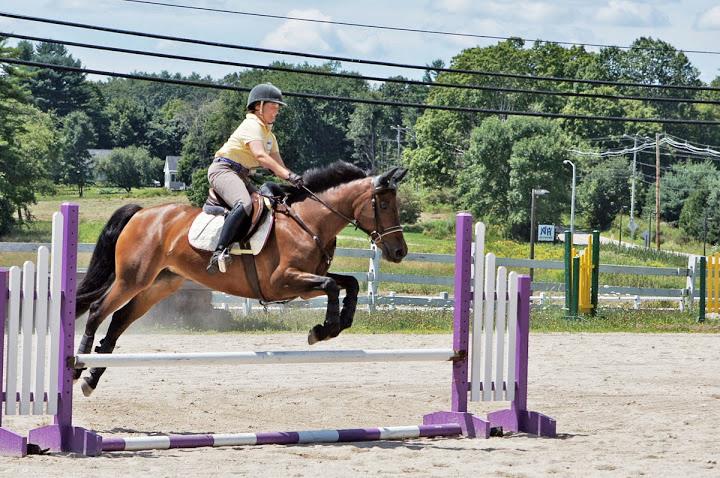
Staying focused when the unexpected happens (like clearly missing your distance) takes practice and "mental toughness".  Photo Credit Lauren Atherton Eventing
Staying focused when the unexpected happens (like clearly missing your distance) takes practice and “mental toughness”. Photo Credit Lauren Atherton Eventing

Building Your Brand

Stewart’s final theme of the lecture was on “building your brand”, and my take away is that this is a way of combining all that you have been working on into one effective strategy to gain control of your focus.  Actually, writing this blog is part of my own “building my brand” process.  Stewart reminded us that up to 80% of what we hear in a day will be forgotten; to just sit in the lecture and not do anything with the material will not allow the listener to really absorb it.  However, we DO remember 90% of what we teach to others—so in listening to the lecture twice and now summarizing it for you, I definitely feel as though I personally am beginning to internalize Stewart’s message. Whether you, gentle reader, will do the same is up to you!

To “build your brand”, Stewart says that you must take your four pieces of homework (music motivation, cue words, stress stoppers and cadence training) and connect them together.  He gave many examples of how previous clients had done this; the only one that I really remember was the LUCKY girl, whose horse’s name was Lucky, she rubbed a horse shoe for luck before mounting, had the word “lucky” in her music, etc.  By making all four of your pieces “fit” together, they become a system which is easy to remember and to apply.

Laugh Learn Love

In spite of our best mental preparation, things do not always go the way we had hoped for.  And so, a final message from Stewart—and so relevant in this Year of Gratitude—is to remember to LAUGH (even if you don’t feel the laugh for real, faking it with ‘strategic laughter’ will still release feel good hormones, and since your brain can’t focus on two things at once it will respond as though you meant it), LEARN (when things don’t go your way, figure out what went wrong and look for the solution) and finally, LOVE—there is a reason we do this sport, after all, and I doubt for most of us it is for a $2.00 ribbon.
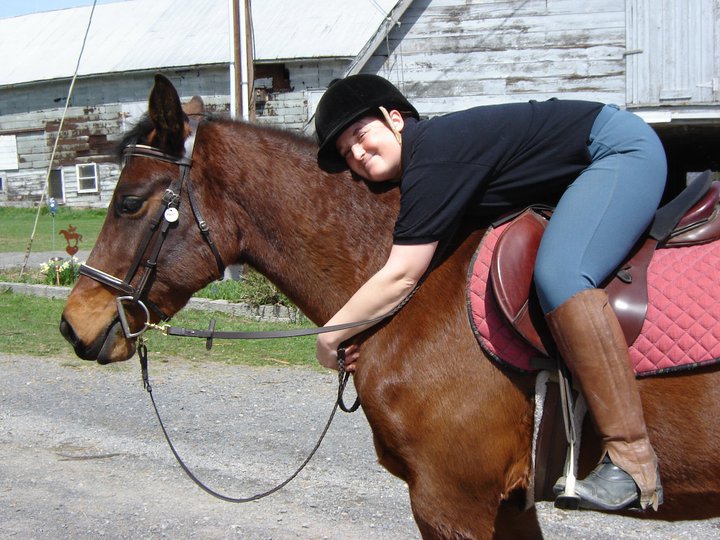
Our first ride-- already a match!
Our first ride– already a match!

Final Thoughts

So what is my “brand”?  I am not quite sure yet; actually, I don’t even have a clue.  I do think that much of what Stewart is teaching really makes sense to me—and some of his concepts are ones which I have already (unwittingly) used.  For me,  it is all about being able to push the other thoughts aside and to find that state of ‘flow’; those moments when it is just you and your horse, and you aren’t worrying about what people think about your style of riding or whether you are going to embarrass yourself or make your horse look bad.  I guess these are some of the worries that go through my mind, anyway.  When I can just feel my horse, feel the rhythm, and really ride, all the rest of that goes away.
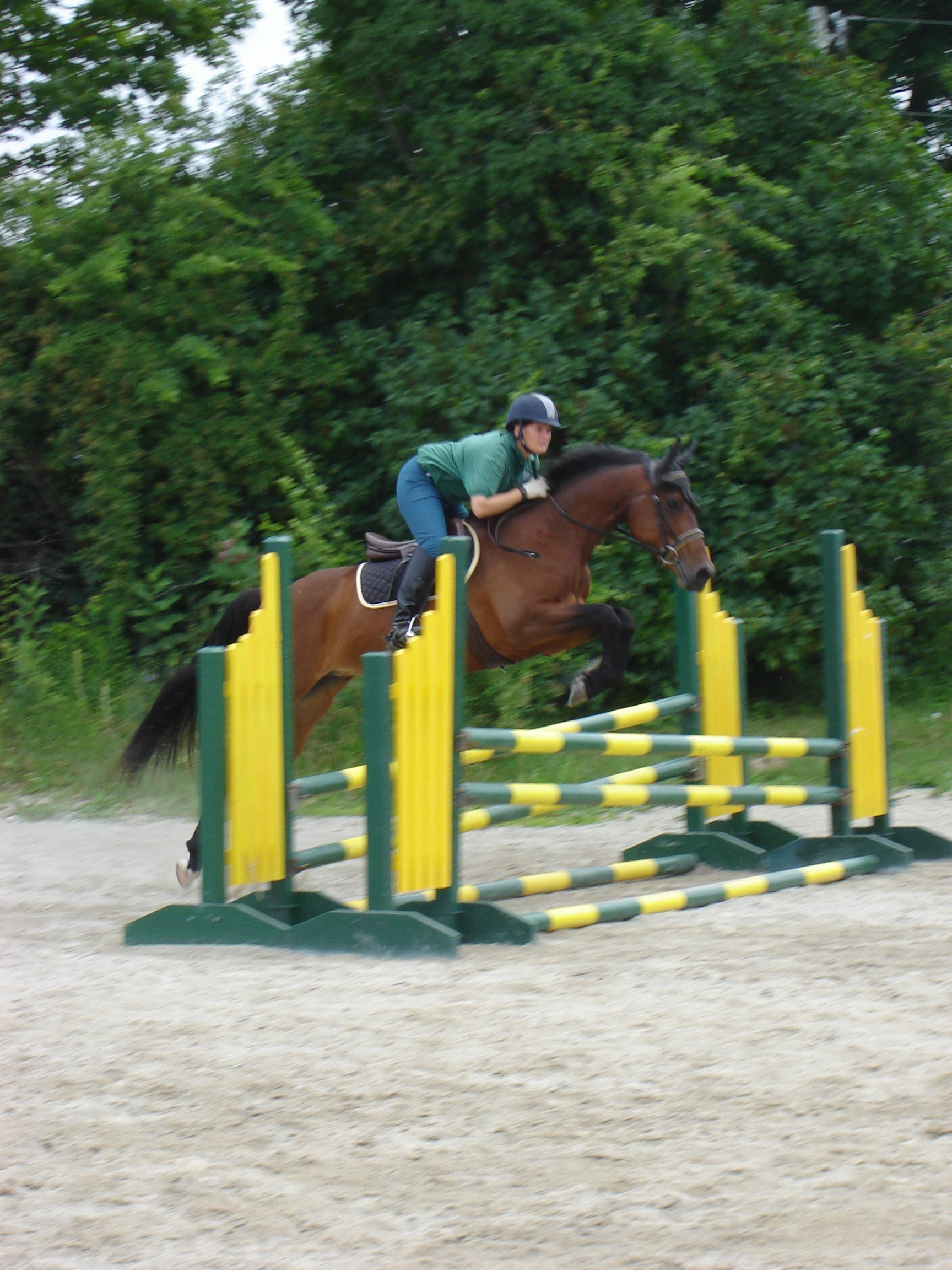
Anna schooling at UNH Event Camp, 2011

Winter Training Session: Mini Pro Style

I have just returned from Ocala, FL, where I participated in a Winter Training Session.  No, not one of THOSE training sessions—a more personal one, targeted for someone whose ambitions are currently a bit less lofty than those on the High Performance List.

Over the past year and change, I have had the opportunity to reconnect with clinician Verne Batchelder of River House Hanoverians in Williston, FL (formerly of Piermont, NH).  Along with wife Jeanie Hahn and daughter Nora, he runs a successful breeding and training business whose products are competing successfully through the Grand Prix level in dressage and elite levels in show jumping, eventing and hunters as well. We are lucky to have a lovely mare named Morocco in our program at UNH who is by their former stallion, Maronjo.

The trainers at River House regularly incorporate schooling on the longe, on long lines and in hand into their horses’ training programs, and in our lessons Verne has frequently made reference to how one technique or another would be of assistance to me.  I feel quite proficient with single line longeing, and have used it somewhat regularly with the Dark Mare (Lee) to help better develop the strength in her topline, the swing in her back and self-carriage.  However, my exposure to other techniques, such as double longeing or long lining, has been relatively limited.  When my schedule caused me to be in the Ocala area anyway, I invited myself over to their farm in order to learn more about how these trainers use unmounted training techniques to improve under saddle performance.

I should preface this discussion by saying that any errors contained within are likely mine, and also that I believe this subject to be one of those on which horsemen tend to be divided, depending on your training philosophy.  So please take these comments at their face value; not gospel but rather my observation and notes.

Verne explained that the development of a horse’s ground training is progressive, and begins as you might imagine at the most basic level when you teach a youngster how to lead.  Young stock should be regularly handled from both the left and the right hand sides, though Verne admits that at a busy breeding operation this can be hard to monitor.  He jokes that the easiest way to ensure that babies learn to lead from both sides is to lead two at a time, and to trade off on which horse is on which side!  I think that to do that you need to be a bit braver than I am.

The next step is to teach the young horse to safely longe on the single line.  There are many well established and effective techniques for doing this, but at a fairly early age (less than two full years old) the young horse should be able to wear a cavesson and surcingle and be able to maintain their rhythm on a longe circle.  Side reins can be introduced but not until the youngster has some concept about what is being expected of them, and they are not used to force a frame in the neck.  In many training programs, this will mark the end of a horse’s ground training, which closes the door on other opportunities to develop the horse.

An interesting note here—Verne insists that all of his youngsters are longed off of a cavesson or even a tightly fitted halter, either on their own or over a bridle.  He feels it is of paramount importance that when they make a “young horse mistake”, such as slipping, scooting, shying, etc, that they are not then jerked hard in the mouth.  Even once the bit has been introduced, a halter or cavesson is worn over it and the line attached here rather than the bit directly.  River House’s young stallion, Spot, is currently just beginning his under saddle training, and while Verne rides him off of a snaffle bit, the horse wears a halter over the bridle, with a second rein attached to it where the crossties would go, which he uses to stop Spot if he gets scared.  Of course, safety is paramount, and if the young horse is behaving in a dangerous manner, then a stronger means of control may be needed and the bit can be used.

I had the opportunity to watch Nora longe River House’s two and half year old colt; he had had several days off.  I was impressed with his overall good behavior on the line, especially given the impending arrival of the ‘polar vortex’, which was bringing rapidly dropping temps and strong winds to the area.  This horse was able to stay quite steady walk, trot, and canter and was confident with his side reins, which were attached to a halter worn over his bridle.

Sometime in the two year old year, most horses are ready to begin “double longeing”.  Double longeing is similar to long lining, except that for the most part the demands and expectations are more basic, and the horse remains on the circle.  Using two longe lines, you attach one to the inside ring of your cavesson or bit (depending on the horse’s experience) and one to the outside.  Your horse must become accustomed to feeling of the outside line around their haunches, but once they do, this technique is quite effective in helping them to understand the concept of an inside and an outside rein.  This technique can also be used to help review this concept with horses that resist the connection.

Double longeing is helpful for other purposes as well.  I observed Verne work with a client’s mare on the double longe, and his goals for her were to use the ground work to improve the quality of her rhythm, increase the activity of the hindquarters and to increase the horse’s overall level of suppleness.  Having used this as a warm up, when he began the day’s work under saddle, the horse was ready to work at a higher level of activity and engagement.  In addition, work on the double longe can help to increase the horse’s submission.

Long lining is a logical extension from double longeing, and can begin to be introduced from a horse’s three year old year on.  The River House trainers sometimes use side reins with their long lines, which helps to increase the horse’s degree of straightness, but for other horses only the lines are used.  I was only to get a taste of long lining during my stay, but the ladies were kind enough to show me work on the lines with three quite different horses, all of whom are schooling Grand Prix.  So basically in terms of long lining training, we went right to the college level!

Prior to beginning their work on the long lines, the horses were each longed on the single line in side reins to allow them to warm up their bodies.  Long line work can be quite concentrated and focused, and as I learned, timing is everything—timing in giving the right aid at the right time, timing in terms of ensuring that the work is long enough but not too long. Knowing to quit when you are ahead is a mantra that all excellent trainers subscribe to, but unfortunately sometimes the ability to recognize that moment only comes from having missed the moment at other times.

Each horse was worked with Jeanie at the head, holding a lead line clipped to the bit, while Nora expertly managed the long lines and the driving whip.  The long liner stands much closer to the horse than they would as a longer; most of the time she walked just off the horse’s flank, where the contact could be maintained quite steadily and the whip used as a tactful aid. This trainer team works all of the upper level horses on the long lines weekly, and it was clear that they have developed quite a partnership.

The first horse, in retrospect, seemed to be the least confirmed in his work, though this could just be my impression, as I did not see any of these horses go under saddle during my stay.  On the lines, Nora explained that they were mainly focusing on trying to develop better rhythm in the passage work.  On this day, they had left him in shorter side reins, a technique which had worked well on their previous school.  Today, however, this horse still seemed confused and wanted to swing the haunches or get ‘hovery’ in his movement, rather than maintaining his rhythm.  “Oh well,” shrugged Nora.  “Back to the drawing board.”

The second horse they brought out was a lovely, refined, tending towards hot mare who is aiming to show in the developing Grand Prix this year.  The difference in her level of confidence and focus from the first horse was remarkable, and her ability to truly sit to collect herself in this work was impressive.  The ladies worked the mare in both directions, not more than ten or fifteen minutes total, and through the work there was a clear improvement in quality.  I noticed here that the handler at the head tended to bounce in the rhythm she was looking for from the horse, whether consciously or not I don’t know!

The third horse they worked was a big, expressive mover.  In his work, the trainers emphasized the development of increased rhythm, impulsion and straightness, as well as the quality of transitions in and out of each movement.  Some work was done with transitions between the movements, as well as transitions from the walk.  This horse at times showed his power by trying to push away from the women, who needed to quickly coordinate their efforts to steady him but also provide a release from the pressure.  As he came to a better place in terms of clarity, impulsion and cadence, the trainers stopped work for the day, even though they had only gone in one direction.  Mentally and physically, the work had taken him to the edge and he had found his way back, so it was the moment to “quit while you were ahead”.

Overall I was quite impressed by the quality of the team work and the accuracy of the timing demonstrated by Jeanie and Nora.  As Jeanie later emphasized during a lesson, the most important aid a trainer can give is the release.  How many times have we heard this, and how hard is it to always effectively do it?

The pinnacle of the ground work is the work ‘in hand’, which Nora demonstrated as a warm up with their stallion, Bretone (Tony to his friends).  Using just a cluck, a dressage type wand and a light feel of the reins, Nora showed Tony’s piaffe and passage; he is clearly quite well schooled in this work and knows what is expected, and it was an excellent demonstration of the fact that these movements initiate with the hindquarters, not the reins.

I had the opportunity to work Tony in hand myself the next day, which was quite a thrill.  Tony is a big fellow, but quite a gentleman and rather tolerant of my attempts to tell him what I wanted him to do.  Working the horse in hand should not be begun prior to their 5 year old year.  It requires a fair degree of coordination on the part of the handler.  You carry the whip (which is a longer, driving style whip) in your dominant hand, and hold the lead line close to the bit, all while walking backwards.  Using your lead, it is possible to half halt the horse as well as elevate the poll, while the whip cues the hindquarters.  Ultimately, though, the majority of the cues should come from the handler’s body language and the length of your step.  We began with the piaffe, which you initiate with a touch of the whip at the hock and a cluck.  To transition to the passage, the whip is raised and can touch the horse at the point of hip, along with an increase in the handler’s length of step.

A few notes on side reins—the adjustment in terms of both length and height is quite important, and the trainer should not hesitate to adjust them as necessary.  For younger horses, the side reins should be set higher on their sides, while more advanced horses can handle the lines being set lower.  The horses at River House that I watched work all warmed up in their side reins on the longe, a technique that I myself prefer, though I can imagine many scenarios in which this would not be safe or sensible.  Clearly, these horses are accustomed to their ground work and are conditioned both mentally and physically to the use of the side reins.

Another useful piece of equipment that the River House trainers use (we used it on Tony, in fact, during my in hand practice), is what Verne nicknamed the homemade Willi Schulteis bridle.  This is a basic cavesson to which a bridoon sliphead (what the snaffle bit on a double hangs off of) is added.  It is then possible to easily add a bit to your cavesson, which then allows much flexibility in the training along with a close fit.

I am most grateful to Verne, Jeanie and Nora for taking time out of their busy schedules to accommodate me and my questions and for sharing a glimpse of their training with me.  If you want to learn more about them, visit their website at www.rhhanoverians.com.