David O’Connor at the Area I (USEA) Annual Meeting: Minutes of Mr. O’Connor’s Remarks

On January 11, 2015, my colleague and I had occasion to travel to Mt. Holyoke College in South Hadley, MA, to attend the Area I Annual Meeting.  While our true purpose was to attend the annual organizer’s meeting, held just before the business meeting, an added bonus was to listen to keynote speaker and current eventing chef d’equipe David O’Connor.

As most of the sport’s enthusiasts know, O’Connor has had a long, successful career in the eventing world.  An Olympic gold medalist and Badminton winner, he also spent nearly ten years as the president of the US Equestrian Federation before stepping down in 2012.  A 3*/4* course designer, O’Connor served as the International Technical Advisor to the Canadian eventing team before “assuming the reins” as the US team coach in 2013.

O'Connor's individual gold medal winning mount, Custom Made.  Photo taken from O'Connor Eventing's website (http://oconnorequestrian.us/)
O’Connor’s individual gold medal winning mount, Custom Made. Photo taken from O’Connor Eventing’s website (http://oconnorequestrian.us/)

O’Connor’s remarks ran the gamut, from his predictions for future US team development to remembering his time training in New England with LeGoff to his hope for the creation of more “destination events” to promote the sport.  Here, I will provide a summary of some of his key points.

Thoughts on Coaching, Training, and Getting an Education

O’Connor began his speech with an anecdote regarding a cross country trip from Maryland to Oregon which he, his older brother Brian and his mother Sally all took by horseback when O’Connor was eleven.  He said that it was on this trip that he really learned how to ride, because it was when he began to understand how horses think.  O’Connor says that he feels it is critical for riders to learn about horses before they begin to compete and get specialized.  “Riders specialize too early,” said O’Connor.  “It is not a good thing.  I believe that riders benefit from a multi-discipline base.”

O’Connor says that being open to diversity in training can only enhance your skills as a rider.  “You will learn something on a reining horse that will improve your turn on the haunches,” said O’Connor. “Too many riders want to learn to compete before they learn to ride.”

O’Connor says that to be a good event rider, one has to have a balance of education and experience.  He encouraged instructors to think innovatively, and to get their riders out of the ring.  He also spoke to the fact that he believes that the educational system in the US needs to be stronger.  To this end, O’Connor promoted the US Eventing Association’s Instructor Certification Program (ICP). O’Connor feels that it is better for the industry to set its own parameters regarding what makes a good instructor, rather than having those guidelines dictated to them by an outside entity.

http://useventing.com/education/icp

“I predict that at some point everyone will need to be licensed, and that this will be driven by the insurance companies,” said O’Connor.

O’Connor made some general remarks regarding the current status of the US High Performance team, who collectively had a disappointing 2014 season.  He acknowledged that ideally, the team should be riding American-bred horses, but right now we are in a gap between buying everyone else’s horses and developing our own.  He says that within the next few years, there are several exciting younger American-bred horses which should be arriving on the international stage, ready to be competitive.

In addition, O’Connor emphasized the importance of the developing rider programs to help spot and support young talent within the sport.  He specifically referenced Ariel Grald, a native Vermonter, as being a rising star.

O’Connor emphasized that in order to become competitive, the high performance squad members must continue to push out of their comfort zone, and ride and compete in new places which many not be comfortable or familiar to them.  In a related vein, he remarked that the riders must arrive thinking of themselves as real players, not just as someone who is there simply to compete.  It would seem that such advice is relevant to all riders who wish to expand their horizons, not just those interested in high performance!

Eventing, “One Sport”:  We are All Under the Same Blanket

New England, and Massachusetts in particular, was once upon a time the epicenter of American eventing.  O’Connor called the era of LeGoff, in the 1970’s and 1980’s, a time when the northeast was the “intellectual center of eventing”.  Competitions at Ledyard and nearby Groton House, Flying Horse, and others where “the” places to go in this emerging sport.
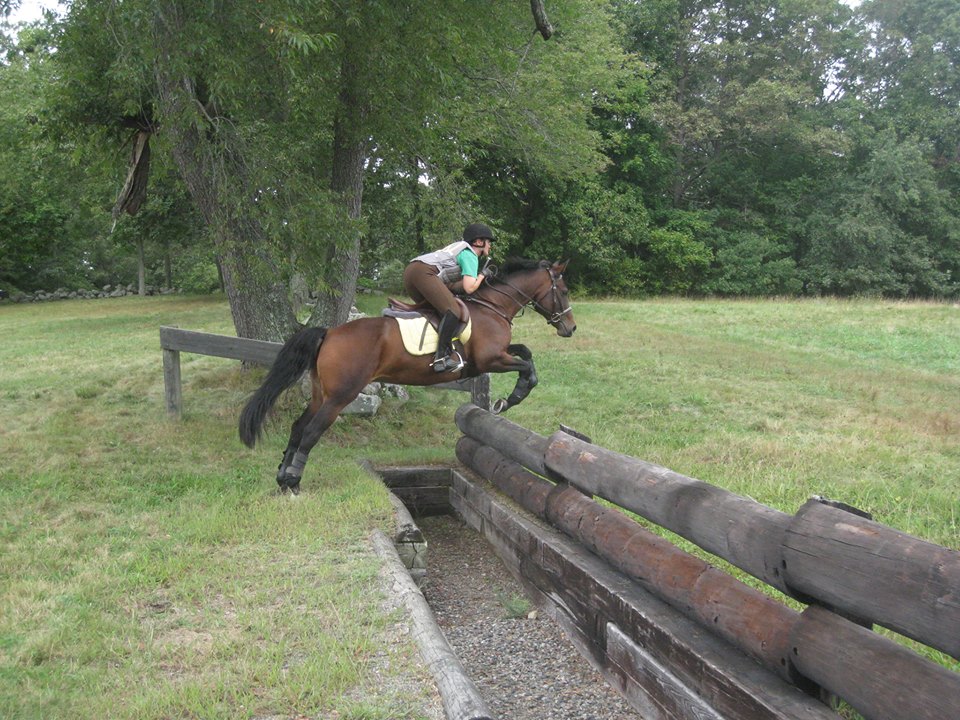
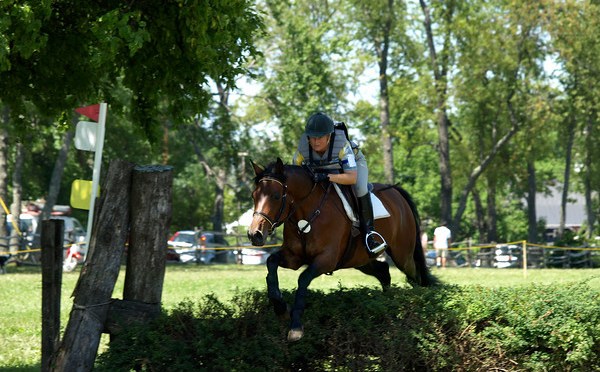
Anna jumping the ditch and wall at Ledyard.

O’Connor referred to that era as the “philanthropic” era of eventing, because the sport was essentially bankrolled by several wealthy families who were able to turn these competitions into destinations.  Today, however, eventing has become a business; O’Connor points out that other horse sports, such as show jumping, have grown even further, from being a business to being an industry.  Such growth, while not necessarily inevitable, does contribute towards the long term viability of a particular sport.

O’Connor acknowledged that eventing has been a sport with an image problem, with those outsiders perceiving event riders to be just crazed, adrenaline seeking junkies.  The reality is that in our highly interconnected world, bad news travels fast, and global issues can suddenly hit close to home.  These remarks were made specifically in reference to several high profile catastrophic accidents which were widely broadcast in the mainstream media.  “We are all under the same blanket,” said O’Connor.  “Global issues affect us locally and vice versa.”

While he agrees that eventing is not without danger, to train/compete in the sport is to take a “calculated risk”, not dissimilar to that assumed in the sports of skiing or cycling.  “Our risk management is strong,” said O’Connor.  “And our safety record, especially at beginner novice and novice, is good.  This sport is not dangerous but it has a calculated risk that you must respect.”

The more the “business” side of the sport of eventing grows, the greater the angst related towards it, with a rift being perceived between the upper level and lower level riders.  O’Connor commented that while we all were sitting in that meeting on a chilly New England winter day, over five hundred horses were competing at an event in Florida.  Such an occurrence would have been nearly inconceivable even twenty years ago.  O’Connor went on to say that from mid-January until early April, there will be in an event in Florida or Georgia every weekend with four hundred entries each.

Area1logosmall

In spite of this growth, eventing is still a niche sport.  The USEA currently has about 14,000 members, only 9,000 of whom compete.  O’Connor says that he looks at the sport as having three levels:  high performance, who are the ambitious, almost manic riders who want to compete internationally; the professionals, who are usually under-recognized and under-utilized, but who provide coaching, training and other services to the third category, the enthusiast.  The enthusiast is the grassroots, bottom of the pyramid rider/competitor who simply enjoys the sport as a means of recreation; this is not to say that they are not serious about it, but they are not deriving their income from the sport.  Often, the professionals are grouped with the high performance riders, instead of being recognized independently for the important niche which they fill.

O’Connor says that due to the overall small size of the sport, we do not have the luxury of being divided between upper and lower level niches.  “We are passionate,” said O’Connor.  “This [passion] encourages but also consumes.”

O’Connor emphasized that those who care about eventing are entering a critical cross roads.  “We are custodians of the sport but we also need critical thinkers,” says O’Connor.  “We are hitting the ceiling of a bubble economically.  We have to allow all of the levels to flourish.”

Goals for the Future and Olympic Fever

O’Connor closed his remarks with some of his ideas regarding the next steps which eventing must take in order to continue to thrive as a sport.  He described events as falling into one of three categories:  the local event, which primarily draws off the resident eventing community and makes up the largest percentage of events held; the ‘goal-oriented’ event, which is usually a more prestigious, demanding or upscale event that is being used as preparation for something else; and finally the ‘destination event’.  The main crux of his discussion centered on his vision for these “destination events” and what they could mean to the sport.

Essentially, a destination event as defined by O’Connor is one which is meant to be an “entertainment product” and is geared heavily towards the enjoyment of the spectators.  Ideally this event should be FEI-sanctioned so that it will draw the major players of the sport.  It should be so enticing that it can attract an audience from far away, and induce them to pay for tickets; therefore, its location must be accessible.  This revenue can then be turned into prize money for the “players”.  “A destination event has the ability to change and support the sport outside of ourselves,” said O’Connor.

In O’Connor’s vision, each area of the country would have its own destination event, enough so that they are available but not so many that they become run of the mill.  Currently, events such as Rolex, Carolina Horse Park, the fall Plantation Fields and Great Meadows (VA) all are at or are working towards ‘destination event’ status.

O’Connor challenged the audience to consider where such an event could be held in New England.  He emphasized the significance of such an event in that it would draw riders back to New England, the former center of eventing.  “It would return New England [eventing] to its roots, the destination events at Ledyard,” said O’Connor.

To make such remarks to an audience who have just heard that their local big city, Boston, has been selected for consideration for the 2024 Olympics, was well calculated, in my opinion.   The room was quickly filled with chatter about where the equestrian events could be held in conjunction with these Games, and whether such a site could be tested first by becoming a New England destination event.

Earlier in his speech, O’Connor had reflected upon his own experience as an Olympian, saying that although he won his gold in Sydney (Australia), it was really the 1996 Atlanta (GA) Games which were his “Olympic experience”, because they were held on US soil.  “The Olympic Games are the only moment that everyone believes in, when religion, beliefs, etcetera, don’t matter,” said O’Connor.  “At the end of the day, only one person gets to stand on the podium, but being part of the process stays with you forever.”

In regards to continued discussion by the International Olympic Committee concerning the long term viability of horse sports in the Olympic Games, O’Connor had this to say.  “With horses at [the Olympic level] costing over one million dollars, equestrian is not remaining as a sport which anyone can do,” said O’Connor.  “That is a real risk for continued inclusion in the Olympics.  At least the sport has historical inclusion on its side.”

For the 2012 London Games, the cross country phase of eventing was held right in Greenwich Park; O’Connor said that within two days of the competition’s conclusion, over 90% of the fences were cleaned up and the park was re-opened.  “In this way, we have shown that cross country can be portable,” said O’Connor.  “We could hold cross country in Central Park, which would be a great thing for the sport.”

Summary

Overall, O’Connor is an engaging speaker, equal parts politician and story teller.  It was clear that his passion for the sport of eventing is as strong as ever, and that he is committed to a long term vision for the sport which will allow it to have a more secure niche within the horse industry for the long term.

Blogger’s Note:  I hope to not offend the excellent photographer whose work appears in the Area I website’s banner (www.area1usea.org), which I have borrowed here for my featured image.  All of the work in the banner belongs to Joan Davis/Flatlandsfoto,  an artist who generously compiles and sells an Area I eventing calendar each year to benefit the activities of the region.  I include the images here only to promote Area I eventing and encourage all riders to support the official show photographers who dedicate so much time and passion to our sport. 
A Clinic with Nancy Guyotte

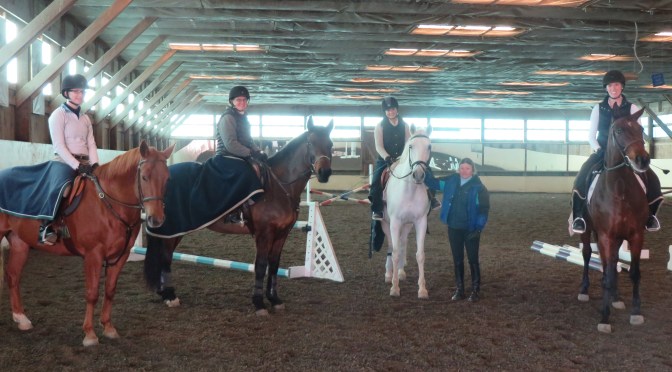
On December 15, 2014, the U of New Hampshire Equine Program hosted a jumping clinic with eventing veteran Nancy Guyotte.  Nancy, of Hill, NH, is a graduate of the UNH Animal Science program and was involved with the early years of its now well established horse trials.  Of course, Nancy also went on to great personal success of her own as an eventing rider, coach and breeder.  Our students very much enjoyed having the opportunity to work with her; I was also able to squeeze myself into one of the groups, which was great fun and a positive experience!

Getting Started: Connection and Suppleness

In my personal experience, taking a clinic with someone new can be a nerve wracking undertaking, particularly when the focus is work over fences.  I have absolutely had the experience of riding with a clinician who simply raised the fences higher and higher, assuming I guess that it is everyone’s goal to jump large obstacles, even if they do so poorly.  I like to be challenged and to learn new exercises, but I don’t want to find my horse overfaced with the questions in front of us.

I think it is hard for clinicians as well, especially when they are coming in cold and don’t totally know for sure what the expertise level will be of the riders they are working with or the caliber and training of the horses.

Therefore, I wholly appreciated that after a brief round of introductions and review of equipment, our session with Nancy began working with cavaletti and flatwork.  Nancy wanted our group to focus on suppleness, responsiveness, adjustability and connection in our flat work, which are also important qualities to bring forward into the work over fences.  In my own instruction, I try to help my students to make this association as well—because for many riders who like to jump, flatwork is just what you do to warm up, not the main focus of a ride.

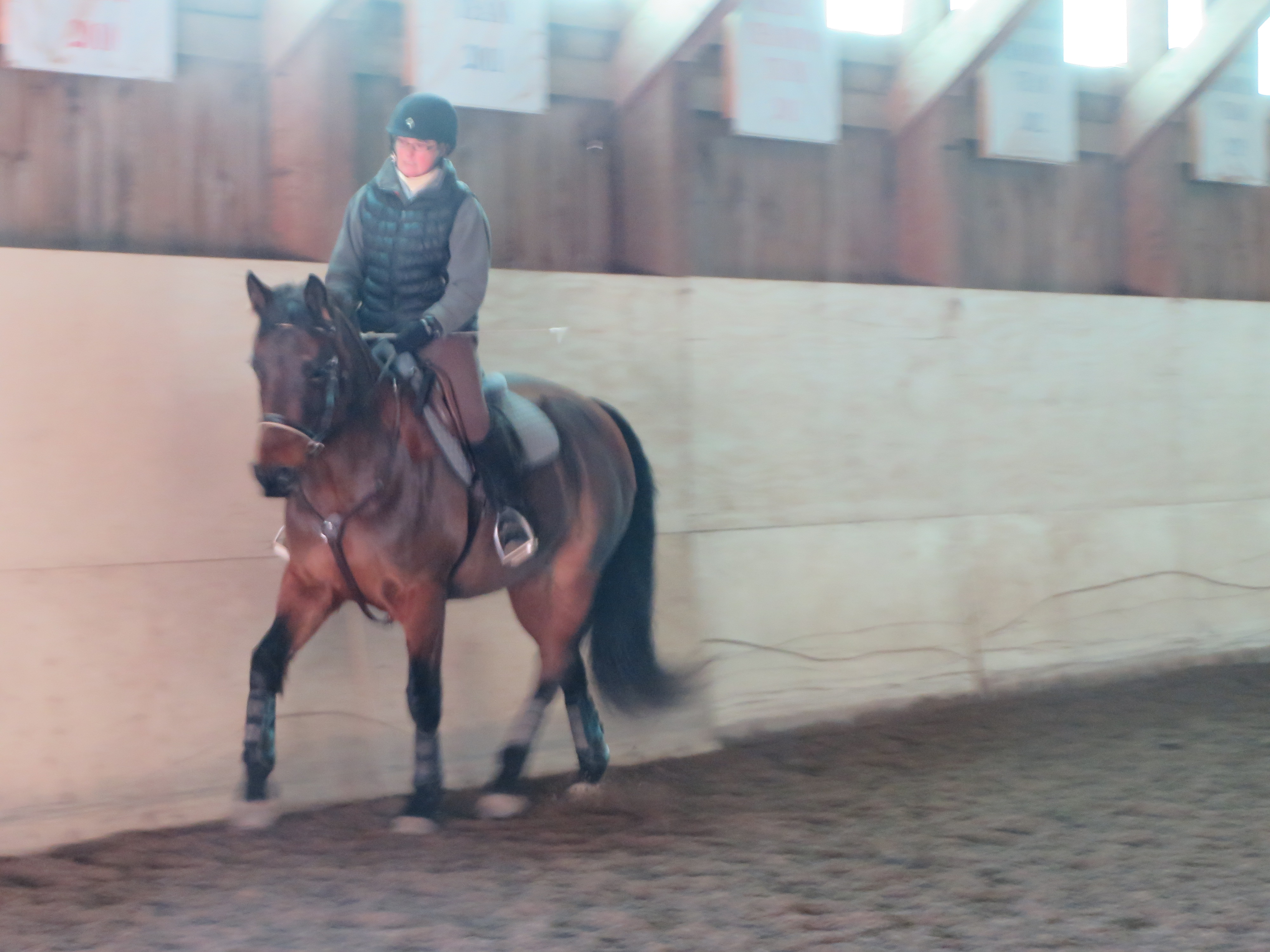
Anna warming up.
Anna warming up.

After a working in phase of work in walk, trot and canter, Nancy began to focus more directly on each horse’s lateral and longitudinal suppleness as well as the overall connection from hindquarters to the bridle.  Two exercises were particularly helpful for me.  The first was using a bit of counter-flexion with a leg yield of just a few steps to the inside to get Anna more even between both reins, as opposed to overflexed in the neck without bend through the ribcage (a favorite evasion).  This mini-exercise is used as a microadjustment, a rebalancing of the aids, and it is super effective.  Another exercise that Nancy had the group work on was turn on the forehand.  I don’t school this movement frequently, though I do use other forms of leg yield and turn on the haunches.  Turn on the forehand can help improve the connection to the outside rein as well as the engagement of the inside hind.  If your horse gets stuck, you should step forward for a few strides and then return to the turn.  You can also think about riding a small circle with the hind legs, and a smaller circle with the front ones, rather than making the turn be completely “on the spot”.

As our group rode the turn on the forehand, most of us would do 180 degrees and then leave the movement.  Nancy reminded us that you can go 360 degrees around, or even just keep your horse in the movement until you are satisfied with the result.

An Eye for Detail

Once the horses had worked in, we began working over a straight row of four cavaletti poles.  If you do not have traditional cavaletti (the kind with an “x” at the end), it is important to try to use square poles which cannot roll or to brace round rails with plastic blocks or other similar tools.

Nancy set up a row of cavaletti at a distance of 4’6” on centerline; we walked through the rails first and then proceeded to the trot. At this distance, the horse should put one trot step in between each of the rails.  The advantage of using centerline is that you can reverse directions after each approach and therefore work the horse equally on both sides.  The challenge is that it then becomes harder to keep the horse straight.

Working through the cavaletti.

I have usually allowed my horses to stretch and reach a bit over cavaletti rails, but Nancy pointed out that when Anna did this, she was taking advantage of the rails as an opportunity to become disconnected.  Nancy encouraged me to take a bit more time prior to coming through the rails to really get Anna through and over the back, and then reminded me to keep my lower leg on as we came over the rails.   With successive repetitions through the rails, Anna began to more consistently remain connected and increased her activity.

Next we moved on to work over a fan of three rails.  In a “fan” pattern, the rider approaches the rails with bend through the horse’s ribcage, as opposed to the straighter line taken through rails on the center line.  The inside rails of the fan are closer together, while the outside rails are spread further apart.  In this case, Nancy placed the rails such that the center to center approach was at 9 feet.  This meant that the horses could trot through the rails, taking two steps in between each, or canter through in a bounce stride.  Depending on the horse’s natural length of stride, fading to the inside of the fan or pushing towards the outside might make the exercise easier.  However, Nancy emphasized the importance of being able to create the middle canter, and to be able to maintain the bend, balance, connection and energy through the center of the rails.

Coming through the fan.

Though this sort of exercise sounds as though it should be rather easy, the reality is that to keep each component of the horse’s gait and body position wholly under control of the rider is actually quite difficult.  The horses in our group tended to start over the first rail straight (so, perpendicular to the center of the rail) but then veered off on a tangent, rather than remaining connected, bent and engaged through the inside hind leg.  With successive repetitions, each of the horses became more consistent through the exercise.  Nancy remarked that she actually keeps an exercise like this set up in her arena most of the time, so that it can remain a regular component of her schooling.

Eventually, the center element of the fan became slightly elevated, and we began to approach the first rail in trot but then ask for the canter as we crossed the third rail.  Finding the timing for this aid was most possible when the approach into the exercise was correctly executed.

What I most appreciated during this segment of our session was Nancy’s impressive eye for detail.  It was always the most subtle things which made the biggest difference— for example, lowering the hands slightly or supporting with the lower leg more consistently. As always, the constant focus and attention on basics is essential for success.

Moving on to Jumps

These preparatory cavaletti exercises were actually quite demanding on the horses.  On the one hand, work over cavaletti can be less arduous than actual jumping and therefore represents an excellent method to work on jumping related skills without adding wear and tear on the horse.  On the flip side, these kinds of exercises require the horse to consistently and deliberately flex and then engage the hind limbs, as well as add greater elevation to the forehand and shoulder.  The stress of the exercise is cumulative.  Muscles become fatigued and then mistakes can be made, which is when injury might occur.  So it is important to find the balance.

After our preparatory cavaletti work during this session, we moved on to working over a few fences.  Essentially, we began over the fan, and then maintained the bouncy canter which the exercise had created to a modified oxer.  From there, it was an immediate bending line, then a related distance on the diagonal.

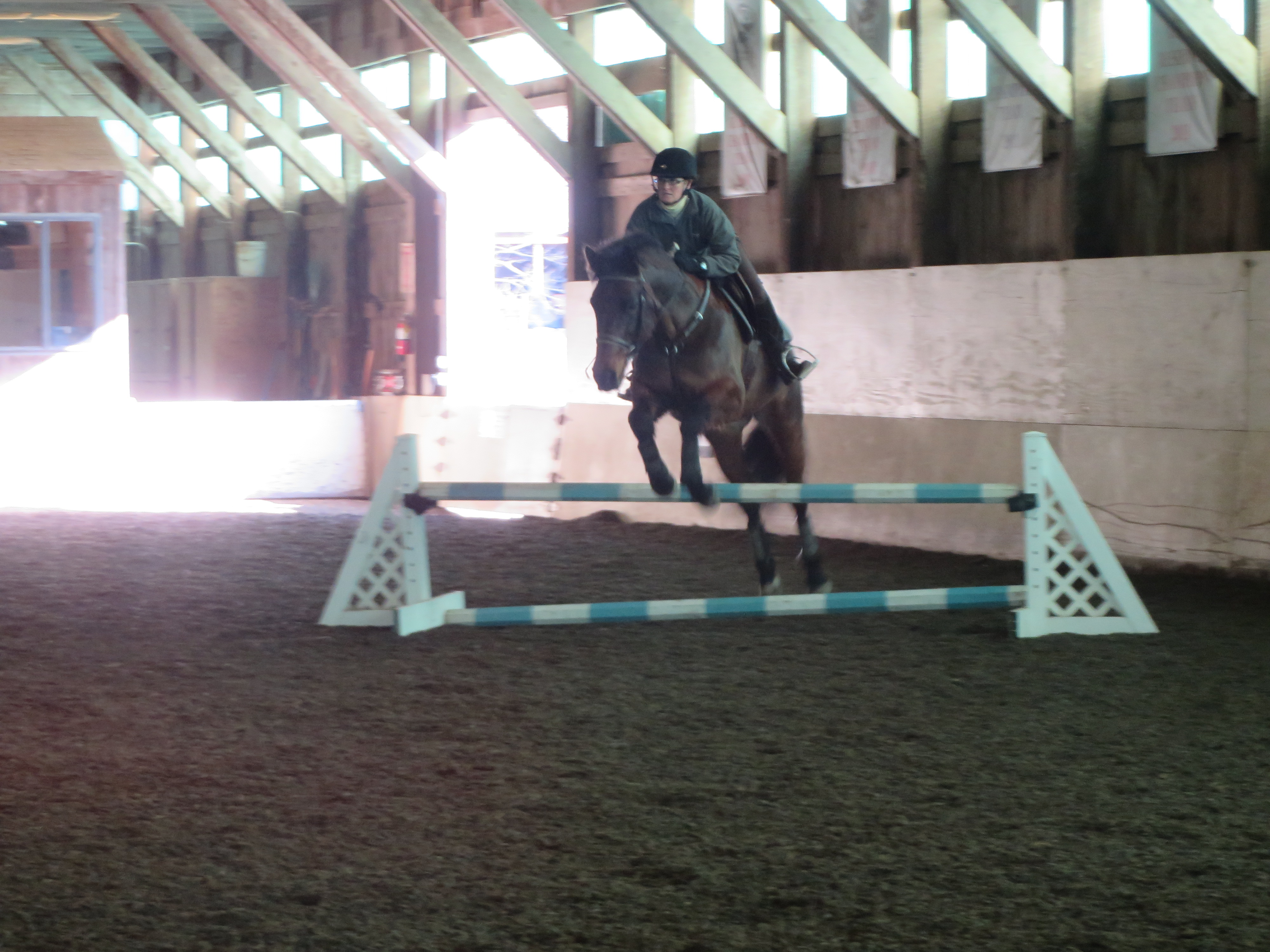
On course!
On course!

Again, few repetitions were necessary but details were important.  Nancy pointed out that though Anna has a lovely flying change, sometimes she uses it as an excuse to not remain connected, and has a tendency to try to swing the haunches.  I have a bad habit of raising my hands on the approach to a fence, which of course just ruins the canter, and Nancy reminded me to keep the hand low and allow Anna to come forward at the fences.

Take Home Thoughts

At this time of the year, when we are stuck indoors and usually are sharing our ring space with other users, it can be a real challenge to keep jumping skills tuned up or set a full course.  The use of exercises such as those which Nancy used in this clinic can be a great way to provide some relief to the monotony of the arena while also helping to polish jumping skills.  In fact, most of the exercises we practiced would be quite appropriate for any horse and rider, whether they jump or not, to help maintain fitness, improve the development of a correct connection and build strength.  I have already begun incorporating one day per week of cavaletti work into my routine and hope that through its use I can further improve Anna’s connection and swing.

My Equine Bucket List 

Happy New Year!  Tis the season for resolutions large and small, for those promises to ourselves and others that this year we will finally take those steps towards positive change.  Here in New England, it is also the beginning of the most challenging riding season of the year, with bitterly cold temps alternating with ice or snow storms—these are real impediments when you have to ship your horse to an indoor to ride, as I do with Anna.  Therefore, it is a great time to pause to reflect upon your goals for the upcoming season—short, medium and long term.

After my summer in Vermont working with Denny Emerson (see the Tamarack Chronicles, Volumes I- VI), I came back inspired and full of new energy and ideas regarding what I want to do with my riding and within the equine industry in general.  In preparing my goals for the 2015 season, I realized that it would be a huge help to step back and really evaluate the Big Picture—to think about those goals which seem so outlandish and so far out there as to be almost unattainable.  Because the reality is, if you don’t think about those kinds of goals in a Big Picture way, you almost certainly won’t backtrack and make the changes or seek the opportunities necessary to try to take them from being a dream to a certainty.  And then someday you are likely to reflect upon your career and say, gee I had always wanted to [fill in the blank]…but it is too late now.

Lee at the awards ceremony for the 25 mile ride at GMHA Distance Days, 2014.

Therefore, this year I have formally created Chris’s Equine Bucket List, a short collection of goals, dreams and experiences that I wish to have with horses.  I maintain that this list is subject to revision and editing as I see fit, and I reserve the right to add, remove, alter and/or otherwise modify these Big Picture destinations.  However, as of right now, these are some actual goals that I want to achieve before I hang up my spurs, in no particular order.

Chris’s Equine Bucket List

  • Drive a big hitch. At Equine Affaire in Springfield, MA, this year, I was treated to a performance of the Fantasia show.  This spectacle features performances from riders and horses representing an array of breeds and disciplines.  This year, by far my favorite exhibitor was the six horse Belgian hitch from the Morrisville College Foundation.   The quiet power of each of these amazing animals combined into one suddenly small arena was just awe-inspiring.  The metal fittings on the harnesses gleamed, and the air hung heavy with the sound of their powerful feet rhythmically striking the soft footing.  I probably should start with a refresher on how to drive just one horse.  But boy, it would really be amazing to be directing that much power.
    The lead pair of a six horse hitch of black Clydesdales.  By Blodyn (Own work) [CC BY-SA 3.0 (http://creativecommons.org/licenses/by-sa/3.0)], via Wikimedia Commons
    The lead pair of a six horse hitch of black Clydesdales. By Blodyn (Own work) [CC BY-SA 3.0 (http://creativecommons.org/licenses/by-sa/3.0)%5D, via Wikimedia Commons
  • Raise a foal. There is a true problem in our country with there being more horses than appropriate homes for them.  In spite of this, I have not so secretly had the desire to breed one of my mares, a desire which to date I have been able to keep reasonably in check.  That said, I still would like to have the experience at least one time of raising a foal from the very beginning, whether I am the breeder or not, and bringing them through the training process.  I have had the pleasure of working with my current horses from a very green place in their lives, but someone else had done all of the early work. I want to have the experience of raising, developing and nurturing the horse from their first days through to their time under saddle.   I also believe that this route might be my only option when it comes to getting to the FEI levels in either dressage or endurance.
  • Train my own horses. In general, I am more interested in training my own horses than I am in buying or leasing a schoolmaster to get me to a certain goal.  I think that schoolmasters are AMAZING and I am so grateful for the ones that I have had the opportunity to learn from in the past.  I also fully believe that I will seek their wisdom in short doses as I move forward in my career.  However, I take a great deal of pride (and humility) in knowing that the horses I ride and work with are the product of my own effort and time.  It is more meaningful to me to develop the relationship with each individual horse along the way. See entry # 2 for more info on this point.

    Anna and I schooling July 2011.  To date, I am the only rider to ever school her over fences.
    Anna and I schooling July 2011. To date, I am the only rider to ever school her over fences.
  • Earn my USDF Gold Medal. This one kind of relates to #5; before I can compete at a CDI, I need to actually get a horse to the FEI levels. If I am riding at the FEI levels, maybe even on a Connemara or a half bred (how cool would that be?), my goal would be to attain the scores for the silver and gold medal rider awards—two scores of 60% or higher at Fourth and Prix St. Georges for the silver, and two each at Intermediate and Grand Prix for the gold.  One of my favorite classes to compete in with my former mount Worldly (show name: Weltinus) was the musical freestyle, and I already have bronze bar scores for First and Second Level from my time with him.  The “bar” award is for freestyle performance, and is only awarded after the regular rider award for that level has been attained.  So let’s add earning the bronze, silver and gold bars, too, to this item.  What the heck.

    Worldly (Weltinus, on the left) after winning the 2006 Region 8 Second Level Freestyle championships.
    Worldly (Weltinus, on the left) after winning the 2006 Region 8 Second Level Freestyle championships.
  • Compete in a CDI. So this is definitely a huge end goal. I don’t care if I even place.  I just want to have the chance to compete in an FEI competition, and I think that dressage is the most likely niche for me to do it, maybe on my fictional Connemara, who I have also raised and trained myself.  It’s a wish list, don’t judge.
  • “Do the Florida thing”. I would really love to have the chance to see what winter in Florida is all about.  I have heard so much about it—and it seems like it would be like going to equine Disneyland.  So many talented horses, riders, instructors and clinics are available in a condensed place.  Whether riding, competing or auditing, I can’t imagine that one wouldn’t return from the experience a new horseman (and with a much lighter checkbook, I understand).  And I never object to getting out of the cold.

    (Kristen M. Clark / The Palm Beach Post)
    (Kristen M. Clark / The Palm Beach Post)
  • Keep my horses at home.  This has been a lifelong dream of mine—to have my own farm, with my horses wholly in my care.  I have been very fortunate to board at wonderful facilities but there is just nothing quite the same as being able to do everything the way you want to.  Related to this, I have a strong interest in sustainable living and sustainable agriculture, and how we can apply those concepts to horse facility management.  Having my own place would allow me to begin to experiment with these principles first hand.

    On this day, I had forgotten something at home and stopped in en route home after a clinic.  Not quite what I mean when I say that "I want to bring my horse home" but it is the closest I have gotten so far....
    On this day, I had forgotten something at home and stopped in en route home after a clinic. Not quite what I mean when I say that “I want to bring my horse home” but it is the closest I have gotten so far….
  • Trail ride in Acadia National Park. I am told it is amazing—a breathtaking area, with trails specifically designed for horses. Parts of Acadia used to be owned by the Rockefellers, who have had equine enthusiasts in their family for years and who were critically involved in building the miles of carriage roads in the 1930’s.  With my newfound interest in competitive trail and my wonderful and now reliable mount Lee, I hope that a visit can be arranged in the near future.
  • Train in Europe I am not talking anything on the level of taking my own horses over and training like I am going to make a team or something like that. However, the tradition of horsemanship in countries like England, Germany or even Portugal and Spain is rich, and I think it would be greatly informative to have the chance to see how horses are managed and trained and riders are coached.
  • Complete a classic three day event. This one has been on the list for a long time, pretty much since I first learned about the novice and training level educational three day event options being held at Green Mountain Horse Association (GMHA) in Vermont. When the lower level classic format events began, I didn’t have an event horse and was mostly riding dressage, but I thought, “Perhaps someday”.  What I didn’t count on was the fact that after taking a few years off from jumping and then returning to the eventing scene, I am not quite as brave as I once was.  So I am not sure if the reality of actually doing this is going to happen.  But for the time being, it remains on the list.  See the clause above regarding editing of the list at the owner’s whim.

    Anna at King Oak Farm, September 2014.  Photo courtesy of Flatlandsfoto/Joan Davis and used with permission.
    Anna at King Oak Farm, September 2014. Photo courtesy of Flatlandsfoto/Joan Davis and used with permission.
  • Complete a 100 mile ride. This one is a fairly recent addition to the list. I am secretly hoping that Lee might be able to complete the three day hundred at GMHA before her career is done, but if not, at some point this is something I wish to have accomplished.  As they say in the sport, “to finish is to win” and the opportunity to connect with your horse on the level which is required to prepare them and help them to get you through such an effort is a true testament to a rider’s horsemanship skills. I would be so bold as to say that someone who completes a one hundred mile ride on a horse which they have prepared themselves is not just a rider; they are a true horseman, which I consider to be the highest compliment.

    Crossing the finish line at GMHA Distance Days 2014, completing the 25 mile ride.
    Crossing the finish line at GMHA Distance Days 2014, completing the 25 mile ride.
  • Save a horse. This is not a goal which is wholly defined in my mind; it is more that I think it is of the highest importance that those who love horses remain advocates for the promotion of humane education and training. So whether attaining this objective might be quite direct, in terms of getting a horse out of a situation that is dangerous or inhumane, or indirect, in terms of providing continued education to horse lovers and support for rescues, I think it is absolutely critical that we as a community remain ever vigilant.

    It is imperative that anyone who loves and cares about horses be an advocate for their protection and well being.
    It is imperative that anyone who loves and cares about horses be an advocate for their protection and well being.
  • Ride a reiner. In the vein of stepping out of my usual comfort zone to have new experiences with horses, I have secretly had the desire to learn a little bit about—and try my hand at—riding a reiner. Mind you, my experience in riding in western saddles is limited almost exclusively to my horse packing trip out west.  I have some friends in the Intercollegiate Horse Shows Association (IHSA) who are western specialists, and just the other day I asked if it was reasonable to ask someone to teach a rider like myself some basics of reining on an experienced horse. She gave me some northern contacts, and then explained to me the basic aids for beginning a spin to the left.  The cues are subtle and, of course, totally not what I would do to initiate a pirouette left.  It sounds like it could be fun, and totally out of my comfort zone.  I am not looking to change disciplines, just to try it out.

    The sliding stop.
    The sliding stop.

This version of Chris’s Bucket List represents some of my thoughts as of today, early January, 2015.  I think I will see what the year brings in terms of progress towards knocking a few of these off the list, and perhaps I will check back in a year’s time to see where I have come to.

So what is on your Equine Bucket List?

Where are you going with your equestrian pursuits?