When we were kids in school, most of us were told to keep our eyes on our own papers. Ostensibly, this was a punitive measure for not studying, designed to prevent us from getting a leg up from the students around us who we perceived to be smarter than ourselves or more likely to have the correct answer. However, it is quite often the case that we in fact do know the right answer, and keeping our eyes on our own papers is a means to demonstrate our own skills, knowledge and strengths.
I have long struggled with feeling insecure about my riding, probably because it is the one thing above almost anything else which is tied to my self-identity. Riding is a humbling sport, in so many ways. How many times have we equestrians said that horses are our best teachers? Every single day, we can learn new things about ourselves, our own horses, and about horses in general, if only we are willing and able to listen. But sometimes our eyes stray, and we take in the movement of another horse, the skills of another rider, the amenities of a different facility, and we begin to doubt the value of what we have in front of us.
Annapony and Dark Mare (Lee) at Tamarack Hill Farm last summer.
This happens to me all the time. But I am slowly learning the value and technique of riding your own ride.
This spring has been a time of real growth for the dark mare, Lee. As we progress towards our season’s goal of completing the three day 100 mile ride at GMHA in early September, I have been gradually stepping up her competitive distances. This May, we rode our first one day thirty mile ride. It was full of new adventures—we had to camp the night before, with Lee spending the night in a three sided cow stall at a fairground in rural Maine, while I slept in my horse trailer (the part the horse rides in, not a tack room or LQ). We didn’t know anyone there, but the other riders and organizer went out of their way to be helpful and friendly to the rookie rider and horse. The morning of the ride was cold, in the thirties, and as I hand grazed Lee before the ride started she was leaping about at the end of the line. I am sure that some who witnessed her behavior wondered how the rookies were going to fare that day.
Lee enjoyed the cow-free cow barn in Maine.
We rode out with another rider, a gentleman on a lovely Dutch Harness Horse who was doing day one of the three day eighty mile ride. Lee has overall gotten much better about going out on her own, but has a hard time leaving other horses if they are around. So for the first several miles, we stuck with the gray gelding and his veteran rider.
As both horses began to loosen up and get moving forward, they seemed to be staying at a steady pace consistent with the training rides I had been doing with Lee. The terrain on this ride was mostly flat, which meant that it was easy to sort of just motor along. This rider told me that he had more recently been doing endurance competitions (which is essentially a race) and so was needing to readjust his sense of pace to suit competitive trail, which requires riders to finish within a set window, neither too slow or too fast. He used a combination of trot and canter, and for a while I kept pace with him.
But then I looked at my watch, and I realized we were averaging five minute miles. I knew that this was not a pace that Lee could sustain, nor was it necessary to do so to finish the ride on time. So I gradually held Lee back, allowing the gray horse to push further and further ahead, eventually leaving our field of vision altogether. For the first time in her competitive trail career, Lee and I were riding alone.
Between the ears– riding Lee in Vermont summer of 2014.
Without a friend to lead her, Lee was a little less confident, spooking or shying more than usual, but she gradually settled into her own rhythm and continued steadily forward. We continued like this for nearly ten miles, and as we traveled along, I reflected on the truth of needing to do what is right for your own horse. In endurance riding, the tag line is, “to finish is to win”, and experienced riders talk about the importance of building a horse up for years before they get to the level of strength and experience that they can actually race and attempt to win at rides. Competitive trail is assessed by more subjective criteria than endurance, but the overarching theme is that your horse must be well taken care of before, during and after the ride if you are going to achieve a good result. That means that you, the rider, must make good choices for your horse in terms of when and how hard you push them onwards, which requires that you have an excellent awareness of both their fitness level and condition as well as how they are handling the ride that day.
Lee and I caught up to other riders at the half way hold, including our friend on the gray. She quickly pulsed down to recovery criteria and continued on in good form. But I don’t think this would have been the case if I had tried to keep up with the other horse. It wasn’t a question of his horse being ‘better’ than mine, or he being a savvier rider. She simply wasn’t as fit as he was, because the two horses are currently on different training paths. The gray horse’s pace was inappropriate for Lee. It was important for me to stick to what I knew was right for my own horse, and to ride my own ride.
Lee went on to win the Maine 30 CTR with a perfect score of 100.
This June, I had the amazing opportunity to officiate in the Connemara division at the Upperville Colt and Pony Show, held in the heart of Virginia horse country. This year was the 162nd anniversary of the show, and my first time officiating as a licensed USEF judge. No big deal—just one of the most prestigious “AA” shows in the country, and the largest sanctioned Connemara division. I admit I was nervous to be a part of such a cultured history in horse showing.
The show grounds are incredible, and overall the quality of the horses there matches the atmosphere. One doesn’t bring the average workaday hunter to compete at Upperville. This is a land of quality breeding, high end care and all the accoutrements that go along with it. There are classes running on both sides of the street, countless vendors, spectators everywhere and golf carts galore. The evenings each feature some sort of marquee class, one night a grand prix, the next a $25,000 Hunter Derby. Ringside parties are attended by richly dressed members of the social elite; the old money just oozes off of them, in the most non ostentatious way possible. I am confident that the amount that most competitors spent on their week of showing would send a family of four on a decent vacation.
It would be so easy to become jealous of the riders there, to long for a pair of their custom field boots (made by someone whose name I can’t pronounce), to covet their high end tack, their amazing, highly trained jumper (the one who TOTALLY ignored their cues to leave a stride out at the combination and who instead smartly touched their feet down just so and carried that rider straight into the jump off).
But instead, I am learning to ride my own ride.
Instead of getting overwhelmed by the sheer affluence of the horse show, I found myself able to look at it with new perspective. We can spend our time bemoaning the “things” or the assets which we haven’t got, or we can spend that same life energy focused on using our resources to their best advantage. My pocket book may not be anywhere near as deep as that of the average Upperville competitor, but that doesn’t mean that I am not making steady progress towards my own goals. Being a successful rider means different things to different people, and for me, my own success is not dictated by the caliber of the competition which I am able to afford to attend. We each have to set those goals which make the most sense given our unique set of variables. We need to know which goals are most important to us, and by identifying the destinations which matter the most, we can better prioritize whatever resources we have at our disposal towards reaching that goal.
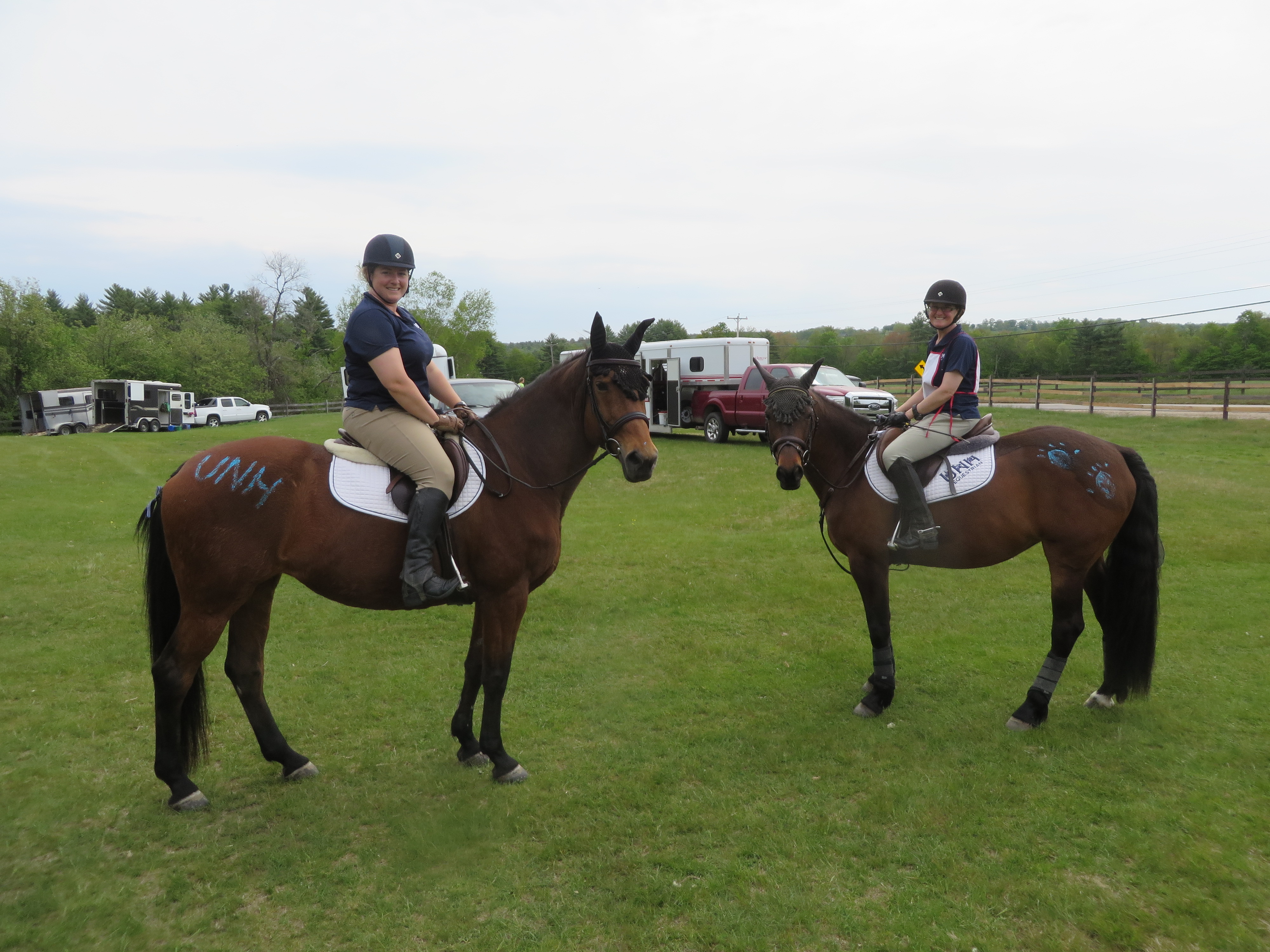
Anna and her friend Izzy show U of New Hampshire Wildcat pride at the Wentworth Hunt Hnter Pace in May.
Finally, I have a sneaking feeling that there are people who I know, who I am friends with on Facebook, who I see out and about, who are looking at me and saying, “gee, I wish I had what Chris has…she is really living the dream”. I have two horses, a truck and trailer, a great job which allows me the freedom to pursue some of my own equestrian goals as well as the opportunity to be doing “horse things” for my paid work. I appreciate how truly fortunate I have been to get to where I have gotten to, with the support of so many friends and family members that I couldn’t even begin to name names. Sometimes I wasn’t as grateful to them as I should have been, for which I am sorry but I am trying to be better. And I am trying to be better about keeping in perspective the fact that there are aspiring riders who would love to be standing in my shoes.
So the next time you find yourself saying, “if only…” stop and ask yourself instead why you think that what the other person has or is doing is better than you. Consider if the answers you have put down on your own paper are, in fact, valid and correct for you.
The musical freestyle is by far the most accessible display of the sport of dressage; even non riders can appreciate the harmony, joy and majesty of the horse and rider partnership when it is set to music. A well-designed freestyle is truly a work of art, melding athletic performance with creativity in ways limited only by the rules of the USEF or FEI.
The Equestrian Center at Pineland Farms (the facility itself is a thing of beauty) in New Gloucester, ME, hosted a continuing education weekend for judges focused on the musical freestyle on May 30-31, 2015. Led by longtime USDF Freestyle Committee member and Klassic Kur founder Terry Ciotti Gallo and supported by USEF “S” judge Lois Yukins, day one of the clinic covered in comprehensive detail a system by which judges can objectively assess the elements on the artistic side of the scoresheet.
Terry Ciotti GalloLois Yukins
This program is just one of several being offered across the country; the goal is to help to create a more consistent standard of evaluation for the freestyle by giving judges an objective method of evaluating a subjective performance. In addition, it is hoped that riders will be inspired to work towards the creation of better, more effective freestyles—or perhaps even to try it out for the first time!
In this blog, I will review the elements of the artistic impression score, as considered by the judge. Information about creating a freestyle, the focus of clinic day two, will be handled separately. There was so much content shared over this weekend that it is simply too much for one article!
Five Categories of Assessment
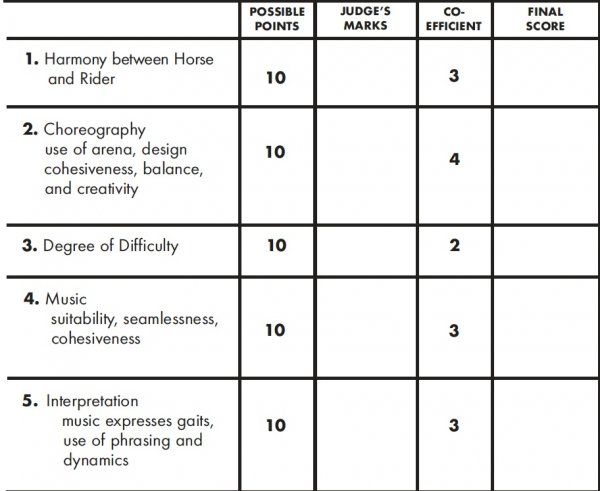
For the USEF levels, there are five categories of assessment on the artistic impression side of the musical freestyle scoresheet. They are (in order on the scoresheet):
Harmony between horse and rider
Choreography (design cohesiveness, use of arena, balance and creativity)
Degree of Difficulty
Music (suitability, seamlessness, cohesiveness)
Interpretation (music expresses gaits, use of phrasing and dynamics)
For FEI freestyles, each category has a coefficient of 4 (and they combine music and interpretation into one mark, and add a category for rhythm, energy and elasticity), but for the national test levels, the coefficients vary. Understanding that the biggest coefficient score will come from choreography can help riders to prioritize this score over degree of difficulty. While “harmony between horse and rider” might sound like something which should be on the technical side of the scoresheet, it is scored artistically in USEF tests because harmony reflects the “artistry of the rider”.
Understanding the score for “Music”
In presenting the analysis for each category, Gallo chose to begin with music, as this has to do with selection and preparation, factors which are taken care of before the show. This score is the only artistic impression mark which should not be affected by the technical execution of the freestyle, unless a horse is feeling so naughty that they don’t demonstrate their basic gaits. The score for choice of music should not be influenced by the personal likes or dislikes of the judge, but rather by evaluating the suitability, cohesiveness and seamlessness of the music chosen.
Suitability is the most important aspect of the evaluation, and in judging methodology it represents the basic element for the score; the other qualities can modify the score higher or lower. Suitability means that the music enhances the horse’s way of moving, and should fit the character of the horse. Gallo says that a wide range of genres of music can be suitable -dance music, not surprisingly, can work well for many horses- but it must be level appropriate. Lower level horses are going to be overwhelmed by big, powerful music better suited for pirouettes, half pass or tempi changes. Yukins used the analogy of a supermodel that could look good wearing anything, including a burlap sack, but the average woman must more carefully consider cut and fit. Some horses are so expressive, so beautiful, that nearly any music will work. However, for a more average horse or one that is a flatter mover, well-chosen music can elevate the performance. If the musical selection is suitable, the score for the mark should start at a 7.
Cohesiveness is a modifier to the base score for music, and it means that the pieces of music chosen for each gait have a unified feel. This may be due to genre (all one style, like jazz, classical, rock and roll, etc.), theme (an underlying quality or idea, like all Elvis, all children’s music, and so on) or instrumentation (all pieces are played on piano, or with full symphony, etc). Yukins and Gallo both emphasized the importance of not making the theme too hard to understand—judges have too much to analyze during the five minute performance of the freestyle to make more obscure associations. As Gallo put it, when the theme is so obvious that the judge doesn’t have to think about it, the score goes up; she encouraged judges to give the rider the benefit of the doubt if the music seems sort of cohesive but the judge isn’t sure why.
Seamlessness is the final music score modifier, and this has to do with the editing of the music. The music must flow together, with no jarring shifts which disturb the ear. Editing can be done within a song, or between songs, and is needed in order to have appropriate music for each gait. Basic editing can be done with the use of downloadable software or riders can work with professional editors. Abrupt cuts and overly long fades should be avoided, but short fades can be helpful to create smooth transitions between pieces for each gait. Gallo advises against using a fade out on the final center line, preferring instead to end the freestyle with a closing note or chord in the music.
If all three aspects of the music score are done well, the final mark should be above an 8. The mark for music carries a coefficient of 3.
Understanding the score for “Interpretation”
The score for interpretation of the music is largely determined by what happens during the performance itself. Considered in this mark is how well the music expresses the horse’s gaits, as well as if the rider has coordinated movements with the phrasing and dynamics within the music. Getting a good mark for interpretation requires both advance planning and on pointe execution. It also requires the understanding of some basic musical terminology.
The term beat is used to describe the underlying pulse of the music; it is what your foot wants to tap to as you listen, if you are so inclined. In a horse’s gait, the beat is a footfall. Most riders understand that the walk has four beats, the trot two and the canter three (though for freestyle planning it only has one, which I will discuss in my next blog). Rhythm in musical terms is a repeated pattern of sounds, while for the horse rhythm is the timing and sequence of the footfalls. Tempo is the rate or speed of the beat in music or the rate of the repetition of the rhythm for the horse.
In my second blog related to this weekend, I will discuss how knowing the tempo of your horse’s gaits is related to choosing appropriate music.
When you hear each piece of music, its rhythm and tempo should suggest the gait which it is being used for. While neither the FEI nor the USDF require that riders match the beats of the music to their horse’s footfalls, Gallo says that the smart rider will try hard to do so. That being said, it can be hard to stay right with the beat of the music, especially at the lower levels, as the horses here lack the strength to stay off the ground in the new movements introduced at each level (the leg yield at First Level or the shoulder in at Second Level, for examples). Gallo says that music must at least suggest the gait which it is being used for to get a good mark for interpretation.
If the music is well chosen, it will have clear phrasing and dynamics. Phrasing is a musical unit; at the end of a phrase, the music changes in some way. Dynamics relates to the loudness or the softness of the music; Gallo explained that a forte or crescendo of louder music would indicate a bigger movement (like a lengthening or extension) while softer music suggests circles or pirouettes.
To help judges, Gallo presented the minimum requirement of “Six Point Phrasing”. Basically, a rider who demonstrates their initial halt or salute, their first movement change, their trot and canter lengthenings or extensions, their gait changes and their final halt or salute with musical phrase changes should get at least a 7 for interpretation. Judges should try to note each time the rider goes beyond these six basic points and can add to the score accordingly. If the rider executes the six point phrasing and also matches the footfalls to the beat of the music, the score should be at least an 8. If the rider can also take advantage of the dynamics, then the judge should add a few more tenths of a point. The score for interpretation carries a coefficient of 3.
Understanding the score for “Degree of Difficulty”
The degree of difficulty mark is only worth a coefficient of 2 for the USEF tests First-Fourth, and a coefficient of 1 for Training level, for a reason: attempting to add difficulty that results in poor technical execution makes for bad freestyles. Gallo and Yukins both emphasized how important it is to be totally confident that your choreography will work well for your own horse. “Consider carefully,” says Yukins. “Only do what you can do reliably and well.”
Gallo reminded judges that in a freestyle for a specific level, they should expect to see transitions and movements which correlate to the requirements for the highest test of that level; she even suggested reviewing this test before watching the freestyle. It then is easier to evaluate whether the freestyle performance reflected what the judge was expecting to see (“met” expectations for the level) or exceeded them.
One thing which riders need to be aware of is that they cannot use movements “above the level” to increase degree of difficulty. Judges must be mindful of this and deduct 4 points for any above level movements which are intentionally executed. However, there may be movements which are not traditionally included in standard tests that are permissible for that level of freestyle. On the lower left of each scoresheet, there is a list of movements which are allowed for that level; note that some of these lists changed for 2015.
Examples of ways to increase the difficulty include: a movement at a steeper angle than for a standard test at that level; unusual placement of movements (like a shoulder in off the rail or movements on the center line); demanding transitions (like a canter lengthening to the walk on the same line); challenging combinations (such as a leg yield zig zag); reins in one hand; tempis on a broken or curvilinear line; doing greater than the required number of flying changes.
In terms of scoring, a freestyle that matches the basis for the level should receive a 6 for degree of difficulty. If the freestyle matches the highest standard for the level (such as the movements in the highest test), the score should be a 7. The judge can then add to the score for each element which exceeds their expectations.
Remember that the score for degree of difficulty is linked to the quality of the execution. If a rider tries to do something ambitious and does it well, then they will receive both a high technical mark and a high mark for degree of difficulty. Passable execution will result in no deduction but also no credit. However, if the rider tries for something complex and the quality of the performance falls apart, they will receive penalties in several areas.
Borrowed from “The Chronicle of the Horse” Image uncredited.
Understanding the score for “Choreography”
The choreography relates to the “construction of the patterns”, according to Gallo. There are four criteria which fall under this score: design cohesiveness, use of arena, balance and creativity. Of these four, design cohesiveness is the most important and is the basic score.
Design cohesiveness relates to the clarity and logic of the movements used in the freestyle. It does not need to be symmetrical, but the design should never leave the judge wondering, “what was that?”. If there is clarity in design, the score for choreography should start at 7.
Use of the arena is a modifier to the score. The choreography should use the arena in its entirety, distributing movements around the ring. Freestyles which have all the elements at the far end, for example, are not using the arena well.
Balance in this case refers to the relative equality of movements on the left versus right rein.
Creativity is a modifier which many judges and riders think is the main criteria. Creativity is important, and it refers to combining the elements in interesting ways, or using uncommon lines. Creative choreography is imaginative and not test-like. This does not mean, though, that the choreography is brand new/one of a kind/totally unique. “Not test-like” means that the choreography is not like the movement configurations of any tests currently being used at that level. It does NOT mean that a configuration that was part of a test at that level in years past is off the table. Let’s face it—at the lower levels, there are just not that many movements required and there are only so many ways to put them together.
Choreography really is one of the areas in which both judges and riders need to release their usual concerns regarding test riding and learn to think creatively. Transitions should be made with musical phrases, not at letters. The halt and salute can be done anywhere on the center line so long as they are facing the judge at C. Gallo likes doing diagonal lines that end on centerline, which then allow riders to turn in either direction.
Gallo says that the relationship between the execution of the movements and the score for choreography is indirect. Riders must show lateral movements over a minimum of 12 continuous meters (18 is better); trot extensions must be done on a straight line (mediums may be done on a 20 meter circle) and canter pirouettes must have straight strides into and out of the movement. The only time where execution can really detract from choreography is when a horse has a strong reaction and the judge cannot tell what they did. It is also important to make sure than in an attempt to show creativity, a movement does not appear to be ‘above the level’ (haunches in on a diagonal line looks much like half pass, for example).
Understanding the score for “Harmony between Horse and Rider”
Harmony is something which every dressage rider should aspire to, and watching a well-made freestyle in which horse and rider appear to seamlessly dance to the music can give you chills. The score for harmony reflects the trust between the horse and rider, and the horse’s confidence in both the rider and his own ability to execute the demands of the test.
Getting a high mark for harmony requires that the horse stays calm and attentive and that the performance shows ease and fluidity. This is actually another area in which the FEI and USEF differ—the FEI considers harmony to be about the submission to the aids but the USEF considers it an artistic criterion because it goes into the relationship between the horse and rider.
Harmony takes into consideration the challenges of a good freestyle: staying to the beat of the music, aiming for musical interpretation, the extra demands of increased difficulty and the great number of adjustments that riders must make relative to a standard test. To quote Gallo, “judges should truly appreciate and reward a harmonious freestyle”.
Click on the link above for a visual representation of “harmony between horse and rider”.
Tips for Judges
Gallo and Yukins both emphasized that evaluating the artistic impression of a freestyle is not a matter of simply taking a percentage of the technical mark and calling it good. Judges must use the same kind of system by which to fairly evaluate a ride and arrive at consistent scores that they do to judge regular tests. The “L” program teaches learner judges that to arrive at a score, one must use a formula:
Basics + criteria +/- modifiers= score
By using this same methodology, even something seemingly subjective like artistic impression can be evaluated in a more objective manner.
The artistic impression scores are interrelated with each other, but not all of them relate to the technical performance. Harmony and degree of difficulty are directly linked to the quality of the technical execution. Choreography and interpretation of the music are independent of but modified by execution. Only the music score is not affected at all by the execution of the test.
Judges must be mindful of a few critical rules that pertain to freestyles. For Training through Fourth levels, rides have no minimum time but cannot exceed five minutes. Any movements performed after the time ends are not judged, and a one point penalty is taken from the artistic impression score.
Gallo has a few words of advice for judges. First, in regards to “creativity”, it is important to remember that even if a combination of movements has been done before, or is done the same way by a number of riders, it can still receive positive marks for creativity. The idea is to compare each rider’s performance to what is seen in regular tests, not to what is seen in other freestyles. Secondly, Gallo hopes that judges will continue to learn more about using a standardized system to assess the freestyle. She points out that most judges are experts in dressage first, and have had to learn about freestyle after the fact, and so are going to need time to adjust to a new system.
Yukins cautioned that the judge’s comments on artistic impression are really important, as they will help to shape the future of freestyle. She reminded participants that the role of the judge is extremely difficult, as they have so much to consider. “Judges have six minutes to evaluate a product which riders could have been working on for years,” says Yukins.
Gallo suggests that judges practice their freestyle judging skills by utilizing videos on You Tube. Judges should work to develop a note taking system which allows them to keep track of phrasing and other artistic elements without losing track of the technical score. Another technique is to create a personal “cheat sheet” which can help the judge to keep track of the various elements.
Next up: Creating a Musical Freestyle: Tips from the Top
Celebrating the incurable addiction which is being an equestrian




 The Academic Equestrian