December Clinic Weekend

Notes on Sessions with Verne Batchelder and Cindy Canace

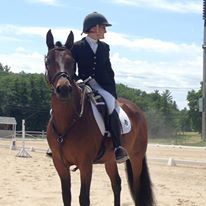
Annapony and I enjoyed an educational weekend in mid-December, riding twice with Verne Batchelder and once with Cindy Canace, within four days.  I have had the opportunity to work with both of these talented clinicians before, so I was excited to get some new exercises and feedback as we head into the indoor schooling season.

Verne Batchelder and the “Circle of Submission”

My two sessions with Verne came first, and were held at the lovely Fresh Creek facility in Dover, NH, home to Chesley Brook Stables.  Their insulated indoor was a welcome haven from the unseasonably cold temperature and omnipresent wind, and the GGT footing made Anna feel positively springy.

I hadn’t had the chance to connect with Verne for almost a year, and he was super positive about the progress which Anna has made in that time.  She tends to always be more forward thinking at a new venue, which is helpful, but Verne noticed that she was also moving with a greater degree of acceptance and throughness since the last time he had seen her go.  After I had done a little warm up at the basic gaits, we started to work Anna on what Verne calls “the circle of submission”.

Anna at Verne 2016 009.JPG
One of our many “circles of submission”.

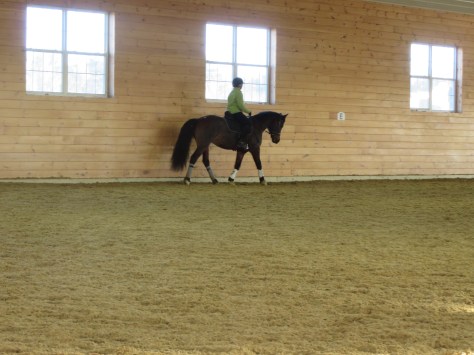
The “circle of submission” is a tool which Verne frequently uses to help horses to unlock, to improve connection and to get better acceptance of the outside rein.  Usually, it is done either at the walk or trot, on a smallish (in our case ten meter) circle.  With Anna, I asked for an exaggerated flexion in her neck to the inside, and then asked her to turn her chest towards the middle of the circle, while keeping my outside elbow bent but giving.  I continued to ride her forward and encouraged her to engage the inside hind leg so it reached further over and under.  Once she started to soften her jaw, I increased the straightness by taking more bend into my outside elbow and following with the inside hand.

Anna at Verne 2016 013.JPG

When riding the “circle of submission”, one of the important end goals is being able to swivel the horse’s head at the poll, with a response of willing acceptance from the horse. In Anna’s case, the circle allowed her to connect more consistently to the outside rein.  I rode a 10 meter circle, then rode out of the circle in a lovely uphill shoulder in for several strides down the long side, then straightened her and rode forward in the rising trot.  After moving through this sequence, Anna was better able to carry her weight over the topline and actively push into the consistent connection.

The “circle of submission” can be returned to at any point the rider feels they have lost the requisite degree of connection, and/or the ability to swivel the horse at the poll.
Anna at Verne 2016 026.JPG

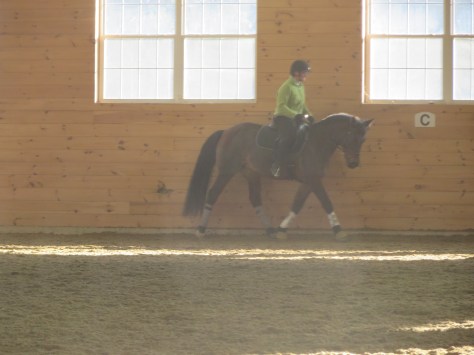
We then moved on to some work with haunches in and half pass. After riding a ten meter circle, I rode down the long side in haunches in.  In both the shoulder in and haunches in work, Verne cautioned against developing too much angle.  Because my goal with Anna next season is to show Third Level, Verne also reminded me that the haunches in is a preparation for the half pass. “Don’t work to perfect the haunches in,” he said, as this movement is not required above Second Level.  “Use it to develop your half pass.”
Anna at Verne 2016 028.JPG

We did several sequences of ten meter circle to haunches in on a diagonal line (which is essentially half pass).  I was thrilled to feel Anna fluidly move forward and sideways with a consistent connection and lifted shoulder.  She felt like a “big” horse!

In the canter work, we touched on the flying changes.  On my own, I have been working quite a bit with the counter canter to develop greater strength and straightness.  Anna learned clean changes through her jumping work and tends to throw them in, unasked, during the counter canter.  Verne said that in terms of laying the groundwork for Third Level, it would be appropriate to begin asking for the flying change more frequently. Using the ten meter circle again as preparation, I then rode the short diagonal and asked for a change on the line.  Verne emphasized that the short diagonals were better than long at this point, so that there are fewer strides for the horse to begin to anticipate the change.

Despite the short distance, Anna still anticipated her change, and gave one fairly exuberant effort from right to left, during which she actually kicked the bottom of my left boot!  I think we have some homework to do in terms of “calm acceptance” of this movement.

Anna at Verne 2016 106.JPG
I love that this exact moment is caught on film.

We ended the first day’s session by playing with adjustability within the gaits.  Within the trot or the canter, Anna needed to get bigger or get smaller, but always while keeping her nose in—if I allowed the reins to slip, she would slightly poke her nose forward, causing me to lose a degree of the connection and the ability to swivel the poll.

We covered a lot of ground during this session, and I left feeling thrilled by Anna’s performance.  I had felt a degree of connection, thrust and throughness which I have not experienced with her before. Verne was highly complementary of both the progress since last year and the work during our session, and I very much looked forward to day two.
Anna at Verne 2016 050.JPG

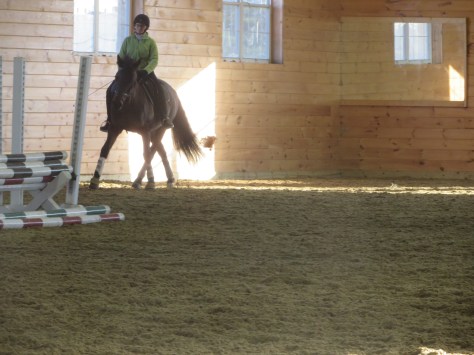
The next morning was one of the coldest so far of the season, which only meant that Anna was even more energetic, despite her hard work the day before.  We started again working with the “circle of submission”.  Verne added to his description from day one that depending on the horse, the rider can think of riding shoulder in on the circle, or ride it more like a moving turn on the forehand, or even a leg yield out of the haunches.  He emphasized, again, that no matter how you approach the “circle of submission”, its purpose is to get the hind end of the horse active and free, to get the inside hind leg under the horse’s body, and to take the horse’s neck out of the cycle of resistance.

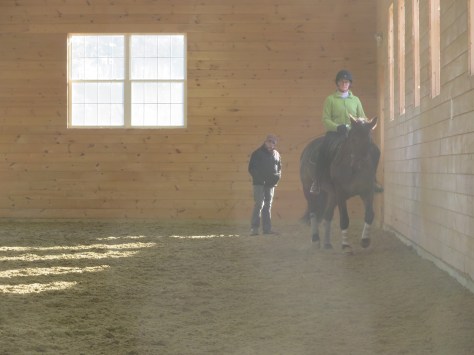
From here, we moved onto work with haunches in and half pass in the trot.  Verne cautioned again against creating too much angle in the haunches in, which causes the horse to lose their forward intention.  In the half pass, Verne reminded me to keep a bent elbow on the outside, and to allow Anna’s shoulders to move ahead of the diagonal line first, and then to put the haunches in on the diagonal.
Anna at Verne 2016 031.JPG
Schooling haunches in.

Allowing the shoulders to come out ahead of the line was a new idea for me, and I found that it helped Anna to say more up into the outside rein during the half pass.  By focusing first on the shoulders and then adding the haunches in, the half pass became even more fluid and effortless. We have a lot of work to do to strengthen and improve her reach and carrying power, but we definitely have some new tools to use to develop the movement this winter.

In the canter work, we worked on a twenty meter circle and played with the idea of increasing pressure, then backing off. Because horses naturally tend to carry their haunches to the inside of the circle, we allowed Anna to start this way, while simultaneously increasing the activity in her hind end and increasing the weight in my outside elbow.  I then straightened Anna’s body for a few strides, allowing her to increase the collection, then softened and let the haunches slide back in.  The idea here is to just touch on the increased collection without asking for it for too many strides in a row.

Anna at Verne 2016 124.JPG
I just love this moment in the canter!

Overall, I was so excited and encouraged by the work Anna offered during our time working with Verne.  I came away with new tools to play with this winter, and Anna has shown me how much more she is capable of doing in this work.  On to Third Level we go!
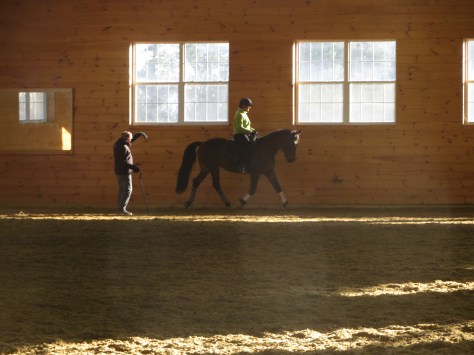
anna-at-verne-2016-042
Thanks to Cayden for coming with us on Day 1 and taking all of these great photos!

Cindy Canace:  “Be a Better Backpack”

After our two days with Verne, Anna had a much needed Sunday off, giving me the opportunity to audit several sessions with USEF “S” judge and USDF Gold Medalist Cindy Canace.  Cindy came up from New Jersey to spend two days working with riders at the University of New Hampshire Equine Program.  Anna and I had worked with Cindy back in June, and we had a session scheduled again for Monday.

Watching Cindy work with our riders allowed me to observe certain themes to her teaching.  She is incredibly detail oriented, and works hard to help riders to both understand important concepts and to feel the horse underneath them.  Cindy expects the rider to keep their hands together and in front of their body, allowing the horse to reach to the bit to seek contact.  She also works to correct posture and alignment issues in the rider which impact the horse.  One of my favorite quotes of the day was that the riders needs to “be a better back pack”, in reference to the fact that our horses must essentially relearn to balance under our weight.  It is incumbent upon us to try to make that burden as easy to bear as possible.

CindyCanaceFall16.jpg
Cindy works with two of my students, riding UNH’s horses Morocco and Ticco.  Photo from the UNH Equine Program Facebook Page

Cindy has judged me on Anna several times in competition, in addition to working with us this summer, so she has a decent idea of her strengths and weaknesses.  In our Monday session, Cindy wanted to work on helping Anna to lift more in her shoulders and truly elevate her poll.  The exercises we did were perhaps not the most interesting for the auditors, but Cindy’s laser beam focus on excellence in the basics helped Anna to show some good progress.

Cindy first had me dramatically slow down Anna’s walk, making each step extremely deliberate, by slowing down my seat while keeping a following, elastic elbow.  She then had me execute a series of walk to halt transitions.  In each downward transition I made sure to keep my leg on, and then I released Anna from the halt by pressing with the seat bones and softening the leg and hand.  Cindy only allowed us to take two walk steps before I asked Anna to halt again.  We remained in the halt, with my leg on, until Anna began to soften in the jaw and raised her shoulders.  Cindy encouraged me to give Anna a gentle tap on the shoulder with my dressage wand to get a better response to my request for elevation or if she was inattentive.

From this work, we moved into a turn on the forehand.  Just as in the earlier exercise, Anna was allowed to take two walk steps and then I asked her to halt, holding it as before.  Cindy was particular that to initiate the turn, I needed to press with the calf muscle, not my spur, and once Anna began moving, I needed to keep the march of my seat in a walking rhythm to follow.  Cindy reminded me that even though we are emphasizing the responsiveness of the horse to the inside leg in this exercise, my outside leg and seat bone are also important and must remain active.  Ideally, in the turn on the forehand, it should take four steps to get the horse facing the opposite direction.
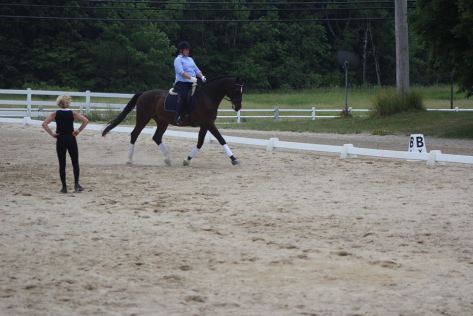
lizandcindy
Cindy worked this summer with my colleague Liz Johnson, here riding Santa Fe ISF.  Liz coordinated Cindy’s whirlwind visit to the frigid north for all of us.  Thank you Liz!

After working on the turn on the forehand, we did a few turns on the haunches, which Anna executed with a more elevated shoulder than before. I also noticed that she had developed a degree of “lipstick”, one of the visual indicators that the horse has begun to soften the jaw.  I hope the auditors saw that Anna had become softer in the jaw as the result of the work we had done to improve responsiveness in the hind end and lift in the shoulder, and not because we had done anything at all to manipulate or pull her into a position.

We then moved on to work in the trot and canter, and Cindy helped me work with the position of my left leg.  Due to now chronic knee pain, I have a great deal of trouble keeping my left leg fully internally rotated, with the knee and toe pointing forward.  Instead, my toe tends to angle out, and I have a difficult time keeping my left spur off Anna’s side without hurting my knee.  After so many months of knee pain, I have really developed some compensatory behaviors with the left leg, especially when I am tracking left and need to use the inside leg to position Anna correctly.  Cindy had me try bringing my left heel down and forward, allowing my left knee to rotate off the saddle slightly.  She then had me rotate my shoulders slightly toward the right in order to engage my outside hip.  This positioning of course felt somewhat unnatural but it did allow me to keep Anna correctly bent without my spur ending up stuck on her side.

Cindy had me do many transitions, especially walk-trot-walk and trot-halt-trot.  In each transition, Anna needed to stay up in the shoulder.  Cindy had me ride a slight step of leg yield out in each transition to help engage the inside hind and keep Anna into the outside rein (a little bit of a similar concept to the “circle of submission” discussed above).

Back to the Laboratory

After our super educational weekend, I have plenty of new material to work with for the next several months in the indoor.  I appreciate having fresh eyes on our progress and to come away with ever increasing clarity as to next steps.  Now we go “back to the lab” to experiment with our new exercises and tools.  Stay tuned for further developments….

Relationship

Over the recent Thanksgiving holiday, I spent some time catching up on a ton of fellow blogger’s posts.  I am now the new owner of an iPad, and with shorter, colder days, curling up on the couch to catch up on other’s thoughts and activities is a welcome pasttime. One blog I follow is called “Green to 100” and it chronicles a newish rider on the quest to complete a 100 mile endurance ride.   As a rookie to the sport of distance riding myself, I find I can often relate to her stories.  But another theme which is present throughout her blogs is that of relationship, specifically with her horse.  She seeks to be a leader that her horse wants to follow, rather than to dictate to her horse about what is going to happen.  Approaching her relationship with her horse in this manner means that certain things take longer.  But it is clear that the reward of arriving where she wants to go, united as a team with her horse, is more important than getting there fast.  Quality is more important than quantity.

Reading a whole series of her blogs in a row gave me the opportunity to reflect on the nature of the horse/human relationship on a number of levels, but especially in regards to the bond I share with each of my own horses.

AnnaUNH2015
Annapony, June 2015

In preparation for the winter season, Annapony has relocated to the university, which has an indoor, so that she can remain in consistent work.  I have big goals for her next season, which will require us to use the winter to train and to build strength and suppleness. She is happy enough there, and well cared for.  But I was really quite reluctant to bring her back, and kept delaying her departure from Cold Moon Farm.  It wasn’t hard for me to realize that I simply wanted her to be at home with me and with my other horses.  I genuinely enjoy being the main caretaker for my horses.  I know them so intimately that it is easy to notice when something is off.  By bringing Anna to another facility and putting her day to day care in someone else’s hands, it feels almost like a wedge is driven into our relationship.  That isn’t entirely true but I still resent the intrusion.

Raptors Settling In 018.JPG
Supervising Anna eating breakfast this spring.

Anna is a calm horse, most of the time. She seems to enjoy human attention (especially if there is food involved) but also likes other horses.  Her rank in the herd is towards the top but her style of leadership seems to be more threat than attack.  Anna is pretty tolerant; nervous horses on trail have run right into her hindquarters and she has never so much as flicked an ear.  That being said, I find the best approach with Anna when tackling a new skill or question is to ask, then wait a moment.  If I am too hasty, and try to force her…she resists, sometimes with great vigor.  If I give her a chance to look and understand, then she usually will comply.

The other night, I took Anna for a hack onto the cross country course right as the sun was setting.  We have already had some snow here in New Hampshire, with some mild melting, leaving the ground a hodge podge of bare spots mixed with snow covered rocks, footprints and other hard to discern anomalies.  The air was cooling off and a fairly steady breeze had picked up.  Overall, conditions were not ideal for a relaxed hack, but I was determined to get out of the ring after several days of solid arena work.  In the woods, the light was dim and features unclear, yet Anna remained mostly calm and confident.  We completed a meandering loop around the course and returned to the main facility along the edge of the reservoir, past the observatory and down a trail which was now nearly completely obscured in the fading light of day.  When there is no artificial light, it is pretty amazing how much you can still see, once your eyes adjust.  A Canada goose broke the stillness with a series of loud honks, but even this didn’t cause Anna to tense or become unsettled.  It was so calming and soothing to be riding in the near darkness, and to have nearly complete trust that my horse would keep me safe.

Fall 2016 023.JPG
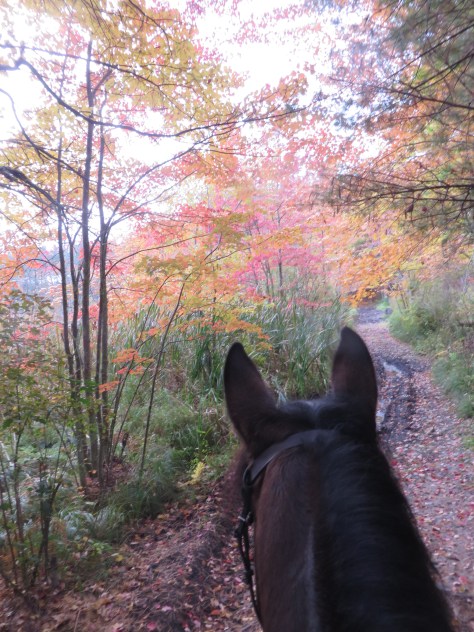
A different hack. But those are Anna’s ears. From Fall 2016 at Cold Moon.

While Anna is back at school, Lee and Marquesa have remained behind at Cold Moon Farm, now living side by side instead of sharing a paddock.  Lee is so submissive to Marquesa that it can make feeding complicated, so having them separated makes management much easier.

Marquesa comes to Cold Moon 020
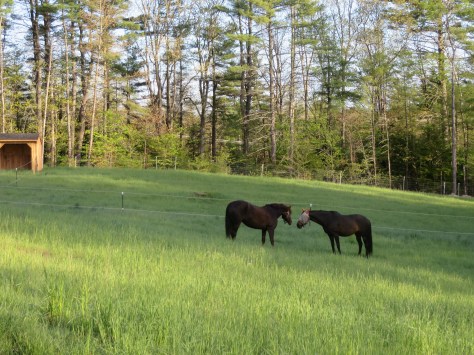
Marquesa and Lee, out together for the first time this May.

I wasn’t entirely sure how the transition was going to go, and overall, it was far less eventful than it was bringing everyone home this spring.

Lee and I have had a long history together—twelve years, to be exact.  I think she likes me as well as she likes any human, but she has never been a cuddly horse; she isn’t going to nicker to you (unless you are carrying her grain), and during her long residence at UNH she was known to intimidate many an inexperienced crew member with her grumpy expressions.  Lee is aloof.  But she is also an absolute bottom dweller on the equine hierarchy, and I think a lot of her behavior is only posturing to try to convince you to just go away and leave her be. Lee isn’t going to come over to you in the field; but she is unlikely to run away from you, either.  If you so much as raise your voice at her, she will recoil in horror.  Lee is insecure.

LeeatWT.jpg
Snack break at the Warren Tessier 20 mile ride, October, 2016.  Photo credit to Robin!

When Lee and I moved to Cold Moon Farm last September, she spent nine months with no other companion save me and the goats which live next door.  During that time, she really impressed me with her steadiness and composure.  This year, Lee overwhelmed me with her grit and attitude on the GMHA three day 100 mile ride.  But if I think back, there are SO many occasions on which Lee has stepped up to a challenge, and most of the time I think our relationship with each other has been one of mutual respect.

leeday32016100
Lee heading home after 90 miles; GMHA Three Day 100 mile CTR, Fall 2016 (photo courtesy of Spectrum Photography)

One of the best examples of this happened two winters ago, during Lee’s last season at UNH.  I had taken to including at least one day of longeing per week into her routine, often incorporating work over cavaletti, just to break things up and give her a new mental challenge.  At the end of a session, I usually hopped on bareback to cool her out.  One night, we were alone in the indoor working on the longe.  Each session followed a similar pattern, and Lee started to head out in the new direction without much prompting from me.  I was struck by an inspiration, and so instead of stopping her, I just unclipped her longe line.  For the next ten minutes or so, I longed Lee at the walk, trot and canter, all without the aid of a longe line.  In the indoor.  She could have gone anywhere in the ring she wanted, but instead she chose to stay with me and follow my direction on a twenty meter circle.  It was pretty amazing.

LeeDressageySalisbury2008
Lee looking dressage-y at the beach in 2008.

Our newest horse, Marquesa, is different from either Anna or Lee.  For eighteen years, she has been a horse which was used in lessons that I and others taught at UNH.  I relied on her to give confidence to new cross country riders, to assist the timid jumpers, and to teach experienced riders that they still had a thing or two to learn about how ride on the flat.  She certainly respected me as the authority figure in the ring, but like many school horses I think she had become somewhat guarded about who she chose to really interact with.

Nikki and Marquesa 026.JPG
Cold Moon Farm Fall 2016 intern Nikki with Marquesa.

Marquesa is a dominant horse. She has a highly developed sense of fairness, meaning if you try to use force to correct her, she just stubbornly refuses to comply.  She can be pushy, and I think being used too many times for “equine facilitated learning sessions” has made her fairly intolerant of humans trying to use their body language to coerce her into doing their will.   However, she appreciates clear direction and boundaries, and when you treat her with kindness and fairness, she is quite sweet.  When she starts to get pushy, if you can lower your energy instead of getting upset, and then explain what you want her to do, she will usually be willing to go along with you.  Now that she is on her own side of the fence line, I find that she is more willing to interact with me directly.  Before, she was mostly concerned with continuing to exert her dominance over Lee.  Her relationship with the other horse was most important; I was just in the way.

Raptors Settling In 011.JPG
Marquesa keeps a close eye on her herd. 

Marquesa is still figuring out her own way in terms of post lesson horse life.  She still has several different riders, but not more than three at a time, and has been doing a mix of ring work and trail riding.  This fall, my friend Linsey took Marquesa out for a ride with me and Lee.  There are several stream crossings out on the trails, which the horses are used to.  After a recent period of heavy rain, though, one of the crossings was unexpectedly quite a bit deeper than usual.  The water came right up to Marquesa’s belly, and drenched her rider’s feet.  Marquesa froze for a moment, perhaps shocked by the sudden depth of water, but then she just kept right on going.  To get home, we had to make the same crossing going the other way, and I wasn’t sure if she would be willing to do it again.  I needn’t have worried.  She plunged right in and stormed across, as if to say, “I got this”.  Not too shabby for a horse who has lived in one place for eighteen years and has mostly worked in the ring. I think perhaps that she is starting to sort out that life here is okay.

Having two horses at home is hard in terms of relationship.  Despite centuries of domestication, horses are hard wired to want to be with other horses.  Solo horses feel vulnerable and show their distress through an array of behaviors.  Since Anna’s departure for the winter, I have continued taking Lee out for solo rides, and going for duo rides whenever someone else is available to ride Marquesa.  I haven’t quite gotten brave enough to pony one off the other just yet.

Fall 2016 035.JPG
Did someone say snacks?

This puts all of our relationships to a real test.  I can tell that Lee feels a little torn about who she should be listening to—me or Marquesa.  Marquesa screams at the top of her lungs when I take Lee away; she actually starts when I am just grooming Lee, something I do in the paddock to minimize the length of the separation.  On the one hand, I want to be able to work with each horse independently.  On the other, I respect the genetics which have kept horses as a species alive for generations.  Horsemen must work with these instincts, not against them. For her part, Lee usually walks out quietly and almost never answers Marquesa’s calls.  But as soon as we turn for home, Lee starts to bounce and jig.  Once Marquesa is in sight, she settles down.  It is like she is trying really hard to be good, but can’t quite pull it off all the time.

leeinwoods
Lee trying really hard to be good while I fumble with my new iPhone for a photo.  December 2016.

Listening to Marquesa scream and dealing with Lee’s jigging can try my patience.  But we are in the winding down time of the season.  Nature in New England prescribes a period of rest or hibernation for most species, a time when aquifers refill, deciduous trees go dormant, and soils take a break from producing.  The equine community similarly slows down, with fewer activities, reduced travel and less intense work outs.  There is nothing to get ready for and nowhere to go.  It is the perfect time to focus on relationship; to reconnect with what makes each horse unique and to enjoy the feeling of mutual respect which can be developed by responding to each horse as an individual.

‘Tis the Season

So I may have missed #GivingTuesday with this blog, but in the spirit of the season I wanted to take a few minutes to reflect on some of the amazing non-profits which I have had the opportunity to be involved with this past year.  Any or all of them would be worthy recipients of a seasonal donation, should you be so inclined.  Alternatively, choose a group that YOU believe in and support, close to your own home.  Donations don’t have to be monetary (though I am sure that is always appreciated)…donations of goods and services often also fill a need.  And so many non-profits rely upon the dedication and commitment of good volunteers.  Really, there is just no excuse to not get behind a cause that is important to you!

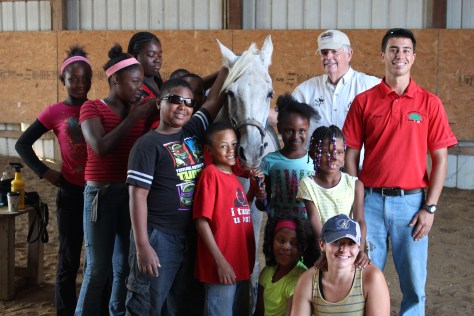
Earlier this year, I wrote a piece for UnTacked magazine about Detroit Horse Power, a 501(c)3 nonprofit founded by David Silver.  DHP’s mission seeks to use horses to provide opportunities for Detroit’s underserved youth, and in the long term, to establish an equestrian center within city limits which will provide the residents with a center for community events and equestrian services.  The story of the path which led David to the creation of DHP was really inspirational to me; I have so much admiration for people who identify a problem, see a solution, and then actively set themselves on the path to put the plan into action, despite some seemingly insurmountable hurdles.  You can read more about Detroit Horse Power here or visit their website at www.detroithorsepower.org.

DHP1
Detroit Horse Power Summer Camp participants from a 2015 session; founder David Silver is in the red polo on the right.

The United States Pony Club is still a group near and dear to my heart.  USPC states as its mission that it “develops character, leadership, confidence and a sense of community in youth through a program that teaches the care of horses and ponies, riding and mounted sports.” USPC is represented by its graduates in many walks of life, from the upper levels of equestrian sport, to related fields such as veterinary medicine, to leadership roles in various equestrian organizations.  Perhaps as significantly, USPC graduates cite their experience as Pony Clubbers as being influential in contributing to their success in other, non-equestrian, ventures.  Visit www.ponyclub.org to learn more.

ponyclublogo

The Equine Land Conservation Resource (www.elcr.org) is one of the most organized and effective advocacy groups supporting the cause of equestrian land preservation.  Since 2007, the organization has assisted in protecting more than 200,000 acres of land and more than 1,200 miles of trails.  They maintain an online resource library, with free information on topics such as conservation tools for horse lands, best management practices, and more.  The ELCR keeps tabs on local threats to equestrian access across the country, and helps to provide solid facts and figures to present to key stakeholders.  Through their partnership with My Horse University, the ELCR provides free webinars on topics such as manure management, developing a private trail system, and more.  As a community, we MUST be attentive to the long term management of public and private lands which allow equestrian use.  We can all list places where we used to ride; once equestrians have lost access, it almost never returns.

elcr

Just recently, I had the chance to write a Charity Spotlight on the Standardbred Retirement Foundation for an upcoming issue of UnTacked.  This group was founded in 1989 by two women closely affiliated with the Standardbred racing industry, and since its inception they have helped to place over one hundred horses per year.  As with many racehorses, some animals are left with injuries and other limitations which make them unsuitable as riding horses; the SRF will retain ownership of these animals and provides them with care for the rest of their lives.   The organization remains involved with all of the horses which it places, requiring twice yearly follow ups on the animal’s health and well-being, signed by the owner’s veterinarian.  In addition to saving literally thousands of horses in its twenty six year existence, the SRF has assisted with programs for at-risk youth, exposing them to the sweet, gentle personalities of the Standardbred horse.  Executive director Judith Bokman commented in her interview with me that their limiting factor, always, is funding.  With more funding, they could take in more horses and expand their youth programming.  To learn more, visit www.adoptahorse.org.

standardbreds-300x300
Standardbreds are uniquely identified via their freeze brand, seen here.  Their gentle personality and willing nature make them wonderful riding and companion horses.

Finally, an introduction to All Better Pets, a Manchester, NH, based nonprofit with the mission of providing care to abandoned and homeless pets. This organization is affiliated with the Center for Advanced Veterinary Care, a small animal emergency and referral hospital. Many of the animals which come to the clinic are in need of medical attention for treatable conditions; without intervention, however, euthanasia would be the only option.  Since 2010, the organization has helped over 200 animals get well and find new homes, and has provided assistance to hundreds of others through affiliations with other groups.  I am a little partial to All Better Pets because my cat, Nieva (nee Willow) is an alum.  She is pretty much perfect. Visit www.allbetterpets.org to learn more.

Nieva being adorable 004.JPG
Nieva

These are just five worthy organizations for your consideration this holiday season.  Please comment with information about YOUR non-profit organization of choice.  Even small donations add up, and in this season of giving please do not forget to consider the importance of supporting the efforts of these grassroots groups.