Keeping Up With the Jones’

I think every other photo or post on my social media stream is of someone’s baby horse doing some amazing accomplishment.  Whether they are winning on the line, learning to wear tack, or being taught groundwork basics, these youngsters just seem to be high achieving go-getters.

For one example, here is an excerpt from a recent sales post for a 2 year old Connemara cross (same age and cross as my Izzy):

“…Training so far has included all ground manners (cross ties, clips, loads on trailer and trailers well, leads, lunges, stands for farrier and vet, bathes, free jumps).  She has had a lot of saddle work as well as bridled (and longed in tack with no drama)…”

The mare looks lovely and has obviously had a busy spring.  But as I read the ad in early July, I have to admit that I felt, well, inadequate, in terms of my own work with Izzy.   At that time, Izzy’s resume was nowhere near so robust.

img_0964
Look, we cross tie like a grown up horse.

It’s not because she lacks the aptitude or temperament.  Izzy is simply the sweetest youngster I have ever interacted with. She is friendly, inquisitive and confident.  She arrived from Wisconsin the day before an authentic winter blizzard, and she settled right in. “No drama”, to use a recent quote.

Izzy is by the Connemara stallion Skyview’s Triton and out of a Thoroughbred mare named Honest Wit.  She was foaled on May 30, 2015, and so by my thinking she is a “young” two year old—when she arrived here in March, she wasn’t even quite two by the calendar.

img_0502
Fresh off the trailer on a very cold March morning in NH!

I spent time this spring just getting to know her better.   In working with Izzy, I want to make sure that each step of the process is taken as it comes, without hurry and with as much clarity of expectation as possible.  Izzy’s breeder, Janet M. Johnson of Dayton Ridge Farm, spends time with all of her youngsters and they work on learning “age appropriate” skills.  Izzy was already familiar with leading, grooming and having her feet handled when she arrived.  But even so, certain things were new.  The first time my farrier worked with her, Izzy regarded the foot stand with quite a look of horror and wanted nothing to do with it.  She is always a little funny with her right front hoof and sometimes pulls it away.  We just kept patiently handling her feet daily until it became routine.

One day in April, I was grooming Izzy in the barn aisle, holding her lead.  She was a little fussy and almost before I knew it, the lead had slid through my hands and Izzy was galloping down the driveway.  After a (terrifying for me) gallivant all about the front side of the property, and with the help of my housemate Lisa and a bucket of grain, she was back in hand.  But clearly we needed a better system.
img_0942

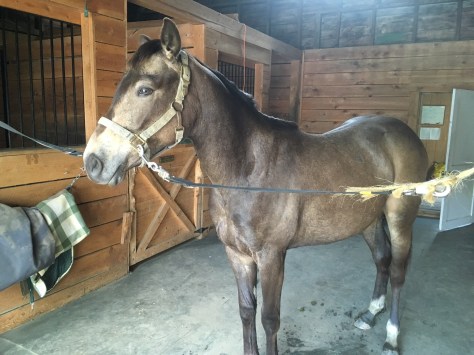
So I began introducing her to the cross ties.  I did one tie at a time, clipping the lead to the opposite side of the halter and holding it while I worked on grooming.  She explored the boundaries, and the first day that she hit the end of her tie I held my breath, not sure of what to expect.  Izzy pulled for a moment, and then just stood there.  Once I knew her response to the pressure seemed reasonable, I added the second crosstie.  And just like that…we crosstied.

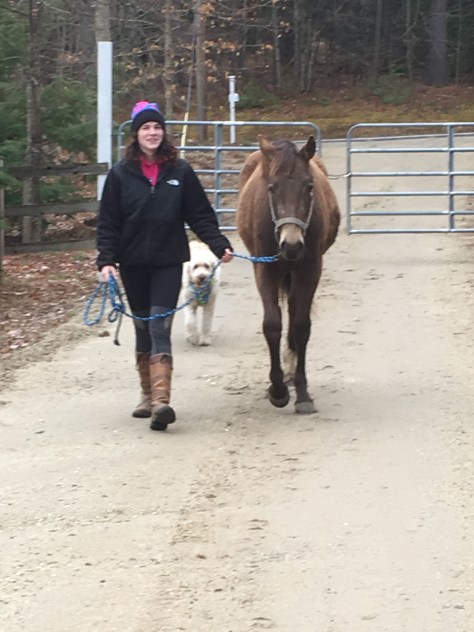
While I was dealing with my knee issues this spring, intern Kelly handled most of the “walk Izzy around the property” duties.  But after recovering from my surgery, I began doing more “walk abouts” myself, taking Izzy up and down the driveway, leading from both sides, practicing transitions between the halt, walk and eventually the trot.  I added voice commands and started carrying a short bat, then a dressage whip.
img_0743
Intern Kelly, with her canine assistant Fox, take Izzy for a walk about.

As the black flies emerged in April, Izzy learned to wear a fly hat.  Bug spray made her very nervous at first, but with calm repetition you can now spray her while she stands loose in the field.

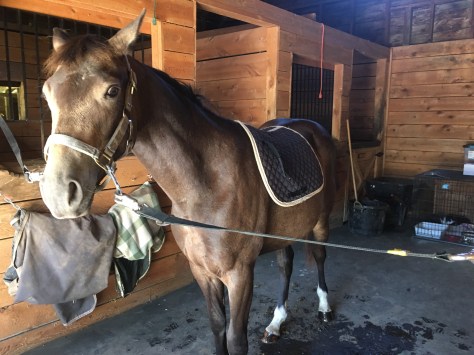
In late spring/early summer, I introduced Izzy to wearing a saddle pad.  I let her smell it, rubbed it on her body, and let her see it come up and over her back from both sides.  “No drama”.  From there, it was an easy step to wearing the soft cotton surcingle, even if I have to adjust it to the absolute smallest setting. Izzy still isn’t a fan of having it tightened, but once it is set, she seems unconcerned.
img_1031
First time wearing a saddle pad. 

I set a few further goals for her for the summer.  When presented in hand, two year olds must wear a bridle with a bit, so I felt it was appropriate for her to learn how to do that.  I wanted her to load onto and off my straight load two horse trailer quietly, and then go for a few short rides.  And I wanted to introduce her to the basics of longeing; in hand, we had started with the voice commands, but I wanted her to understand the concept of moving in a circle, responding to the handler’s voice and body cues, and to be comfortable with the equipment on and around her body. I wanted to do all of this through a series of short playful sessions, so that she enjoyed interacting with humans and remained her confident, inquisitive self.

img_1131
First day in a bridle.  Still sorting out the bit.

I am pleased to say that we have achieved all of that and more.  On each step of the journey, Izzy has remained fairly willing and mostly obedient.  Like any youngster, she has her moments of silliness and lost focus, but more often than not she stays mentally on task.  Izzy calmly wears her bit and bridle, she does transitions in hand and on a longe circle, and has happily walked and trotted over low cavaletti in hand and on the longe.  She ate several meals on the trailer and went for four short rides, two with a friend and two on her own.  And as an added bonus activity, she has been ponied off her turn out buddy Marquesa around the farm.  Maybe if I get brave I will take the pair of them out on the trails to see more of the world!

img_1301
Learning to “pony”– all three of us together!

It is funny, though, because in spite of all this success, when I see a post about someone else’s overachieving baby horse, it is hard to not compare.  Izzy doesn’t free jump (I have no where to do that, anyway), and I can’t really say that she is confirmed on the longe (she certainly doesn’t canter), and what the heck is that contraption they are longeing that youngster in anyway?  Should I be using some contraption?  I haven’t taken her off property to any breed shows, young stock shows or in hand future intergalactic performance horse testings.  She has yet to wear a saddle.  Am I doing this right? My friend’s two year does [insert accomplishment here].  Is this what human parents feel like when they find out that little Susie down the road went to elite swim camp or Johnny across the street just won a ‘budding artist’ award, while their own child is playing in a puddle and eating dirt?

img_0954-1
When learning, it is important to have good role models.

But then I remind myself to take a step back.  Because it really doesn’t matter what all of those other youngsters are doing.  The journey we are on with our own animals is just that—ours.  Izzy has successfully stepped up to—and exceeded—my expectations for her learning and development this summer.  In spite of the transition into the school year, and available daylight growing shorter, I will still have the opportunity to play with her more before winter settles in, to confirm her basic longeing, and maybe even experiment with some basic long lining to learn about steering and pressure on the bit.  But there is no hurry, no rush.  If all Izzy does this fall is continues to mature and develop physically, the time which we already spent laying a foundation this summer will be like “money in the bank” next spring.

Horses do not progress on our schedule.  My mentor Denny Emerson says all the time that the day you come into the ring with an agenda is the day you are not going to get where you want to go.  There is a difference between making progress towards your set goals and making progress, no matter what.  So I guess I will try to worry less about what everyone else’s baby horses are doing and just listen to mine.

She is pretty darn persuasive.
img_0864
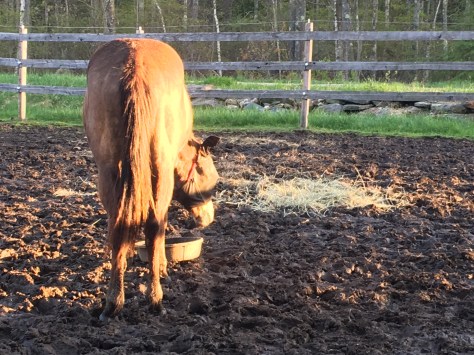
The “golden girl”.

Bernie Traurig: a Solution to Every Problem

Clinicians that have trained and competed at the elite levels in multiple disciplines, have a depth of knowledge and experience that is the accumulated wisdom from countless types of horse and mentors.  Bernie Traurig, founder of www.equestriancoach.com, is just such a clinician, and he has made it his mission to give back to equestrian sport by improving access to top notch instruction, exercises and lessons.

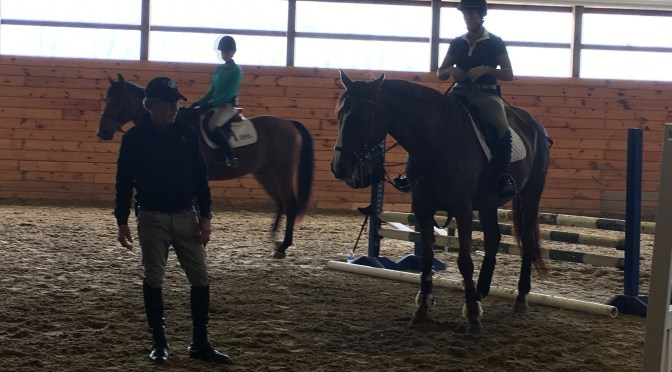
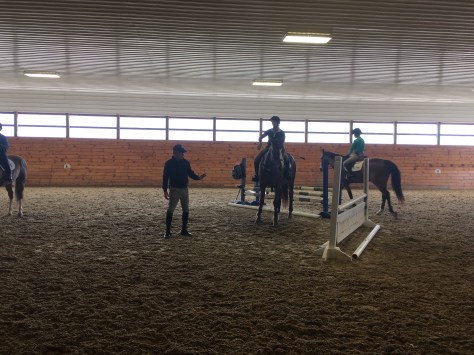
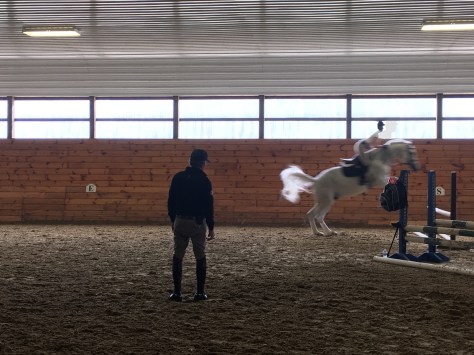
Traurig recently gave a three day jumping clinic at Ridgeway Stables in Dover, NH, where he engaged auditors, riders and even his ring crew with tips, theory, questions and feedback.  Regardless of the level of horse or rider, Traurig’s advice and instruction centered on the importance of correct basics, equine responsiveness to appropriately applied aids, selecting the best equipment for the job and of course, always thinking like a horseman.

Here are five of the recurring themes Traurig emphasized throughout sessions which ranged from 2’9” to 3’6”.

#1: Basic Bitting is Best

Traurig believes that the best bit for each horse is the one which will offer the rider sufficient control and effectiveness in the aids in the mildest way possible.  “I don’t care what bit you have in the horse’s mouth, so long as it isn’t abrasive and works for the horse,” said Traurig.  “School in the mildest bit suitable for the horse and rider.  The horse has to accept pressure in a comfortable way.”

In fact, Traurig travels with a ‘bit bag’ and made frequent adjustments throughout the weekend to many horses’ equipment.  Every change was made on an experimental basis, with a willingness to adjust again if the change wasn’t working.

“I like to start with a single jointed bit and see how the horse responds,” Traurig said.  “If the horse has an extremely low palate, they may need a double joint.  I don’t like when [riders] just go to the gadget.  People tend to go wrong with gadgets and sharp or thin bits.”

While Traurig is not opposed to the use of leverage bits when they are required, he thinks there is a real art in finding what level of pressure a horse is happiest with on their bars.  “Stick with classical bits,” said Traurig.  “Tack rooms and tack stores should have walls and walls of Bert de Nemethy bits, not walls and walls of whatever the latest bitting fad is.”

img_1077

#2 Constantly Improve Responsiveness

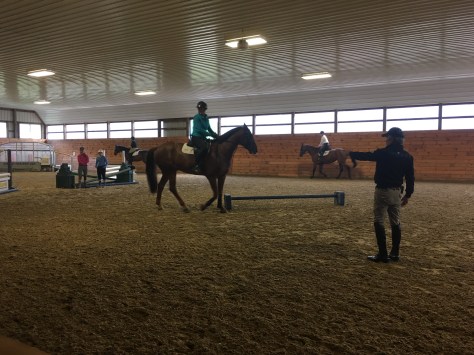
Regardless of experience level, each group’s warm up began with a period of establishing an energetic and active walk.  “This is the first step in putting the horse on the aids,” said Traurig. “Your horse must always march forward from your leg, with their nose reaching forward.  The rider must have a soft contact, not loose reins.  There are two ways to walk—totally off the contact or on a correct rein.  When going between them, you do not want to disturb the walk or the movements of the neck.”

Traurig reminded riders that their leg must always be on the horse’s “go” button, and that the horse’s response to forward is most important. “Never increase the pressure from your leg unless you want a response, whether asking the horse to move forward or sideways,” said Traurig.  “Otherwise, your leg should hang passively.”

In their warm up, most groups performed a variation of an exercise which helped to improve the horse’s responsiveness to both their rein and leg aids.  At the trot, Traurig had them perform a “shoulder yield”, guiding the front of the horse towards the rail with an opening outside rein away from the neck and an indirect inside rein at the neck.   Both hands were taken out to the side, in the direction to which the shoulders should move.  “Use very little leg,” coached Traurig.  “This is mostly a rein cue.  You are looking to displace the shoulders. ”

The more riders practiced the rein yield, the more subtle their aids became.  “Eventually the horse responds so well that you don’t see the aids, and you can use a subtle opening rein to shift the horse’s line without slowing them down,” said Traurig.  “This is excellent for a hunter class.”

Traurig reminded riders that the inside rein shapes the horse’s neck.  “Inside leg to outside rein is good but there is no shape in the neck,” said Traurig.  “Every book you read says indirect rein goes to the opposite hip.  But Littauer says that this depends on the effect desired.  When used toward the outside hip the indirect rein affects the whole body, but when used towards the other hand it only affects the head and neck.  The rein aids and the leg aids must be blended together.  You have two legs and two hands.  They all have to work together.”

img_1071

Riders next performed a leg yield away from the rail, then back to the rail, first in the walk and then the trot.  “Sitting trot works best for this,” saidTraurig.  “If you feel you can’t use your leg, then drop your stirrups.”

Traurig reminded riders that how their mount responded to the aids on the flat would translate into the jumping.  “You have to know if you see a forward distance that your horse will react,” said Traurig.  “The horse has to be in front of the leg.  If your horse ignores the aids, it’s okay to be a bit firmer once in a while.”

#3 Constantly Improve Position

“You should fix your position flaws not because of ‘good equitation’ but for correct basics,” said Traurig.

Traurig gave riders well balanced feedback, quick to offer praise even when some elements of an exercise went wrong.  In particular, he helped the riders to learn to feel when their positions were hindering their ride.

“The goal in the walk is to have elastic arms, allowing the horse to accept a soft feel and reach long over their backs,” said Traurig.  Several riders struggled at first to find the right balance between holding the reins too much or not enough, and Traurig helped them to find the middle ground.

In the warm up work, riders were told to stretch out at the two point in the trot, creating a 30 degree angle in the hip. Many riders felt their lower legs slide back when they transitioned into two point.  “When the leg goes back too far, you have to exaggerate holding it too far forward for at least thirty days,” said Traurig.  “Then it will be normal.”

img_1076

Traurig helped riders to become more aware of their release style.  “A crest release on a hunter is fine, and the long crest release is fashionable, but it has a longer recovery time when you need to correct the line,” said Traurig.  “The automatic release allows more refined use of the rein aids in the air.  Riders can start using an opening rein to take their horse out to the rail before they even land.”

Even experienced riders can benefit from position checks.   On day two, Traurig challenged the most advanced riders to warm up without their irons in the counter canter.  He then had them raise their outside arm above their head, then drop the arm to hang behind their knee, all while maintaining the counter canter.  After returning to sitting trot, the riders were told to use their inside hand to grab the pommel to really pull their seat down.  Finally, they were asked to post without their irons for ten feet, then hold two point for ten feet, continuing this around the arena.

“When I was on the Team, we were each longed at least once per week,” said Traurig.  “Longeing is the best way to develop increased independence in the seat, and daily longeing will help make anyone a better rider.”

img_1061

#4 Perfect Practice Makes Perfect

A lot of becoming an effective rider is about knowing what to do and when, in just the right amount.  To achieve this end requires hours of practice; but as we all know, only correct practice will build the long term responses we want in horse and rider.

One young horse became hot and excited when approaching the fences.  “Repetition of schooling exercises which decrease anxiety and the aggressive approach to the jump are in order,” said Traurig.  “It is tedious, but necessary.”

For this horse, Traurig prescribed trotting jumps with plenty of halts after fences, with an emphasis on a gradual rather than abrupt transition.  “Take a few strides,” said Traurig. “As you practice it more, you can expect the halt to become more prompt.”

Once the horse jumped more quietly, he was allowed to canter a few fences, followed by a halt.  Eventually this would build to cantering into a line and trotting out.  “Be a horseman,” said Traurig.  “Always quit when the horse has been good, especially when they are young and green and have done well.”

Another experienced horse had a habit of stopping at new fences.  Traurig told the rider that she must carry a crop that is “worthy of a correction”.  “Do not change how you ride at a show,” said Traurig.  “Do not be intimidated by the crowd.  If the horse stops, you must give the correction.  Ride your horse absolutely quiet unless they stop.  Then you make the correction.  And then you ride like they are the best horse in the world.  You cannot ride a stopper aggressively.”

img_1066

#5 Details Matter

To be a truly excellent horseman, the rider must always pay attention to the smallest elements of precision, whether it is in terms of care, tack adjustment, or ridden performance.

Traurig’s sharp eye missed no detail and gave all participants a sense of the type of attention required.  For one example, he reminded everyone that spurs must be worn on the spur rest, or else it is not possible for the rider to apply their leg without using the spur.

img_1082

In another correction, Traurig told riders that they must be precise with the timing for the flying change.  “Do not do the change on a curved line,” coached Traurig.  “Hold them straight.  There are three fundamentals to riding a good change.  First, you need impulsion which you can balance, straightness produced by holding the line with an opening rein on the outside, and the correct timing and intensity of the leg aid, which is determined by who you are riding.  If the horse is hot or sensitive, you may have to stay in half seat to help them stay quiet.

If a horse has not yet learned the flying change, and especially when there is little room on the recovery side of a fence, riders should plan to trot at the corner no matter what.  “It is better to do this than to allow the horse to start swapping in front without changing behind,” said Traurig.

Knowing what is expected for your specific jumping discipline also falls in this category.  “For example, if there is a bending line on your hunter course, most of them are smooth so both holding the counter canter or doing a change is acceptable,” said Traurig.  “In lower level equitation, the same is true, but in higher levels you must either land on your new lead or do the flying change.”

img_1069

Even knowing how to ride a line well comes down to details.  “See your jump first, then look beyond it,” said Traurig.  “Approach management is key.  For example, knowing where to come to on the in of your bending line to effect the distance is a skill.  The trick is to hold your line on the landing so as to not put you on a half stride.”

Traurig told riders that for any line which requires a turn, the best technique is to look for the approach to the second fence first, then back up the line to where you have to make the turn from.  “Whenever you don’t see [a distance], stay out further and shorten the stride a little to buy some time,” said Traurig.

Finally, Traurig reminded riders that every horse has their own “right” canter, a speed at which they jump the best out of.  “You can jump any course in the world with good track control and the ability to adjust the length of stride,” said Traurig.

Final Take Aways

Traurig is an attentive and enthusiastic educator, passionate about communicating with all present the fundamental basics which underlay any successful equestrian performance.  Blending a commitment to correct basics with his precise ability to customize exercises and tools to suit each unique pair, Traurig is a master at giving riders the information they need to know, right when they need to hear it.

Traurig’s final piece of advice?  “The most important part of your body when you ride is your brain,” said Traurig.

This blog was previously posted on Horse Network.  Thanks for sharing!