
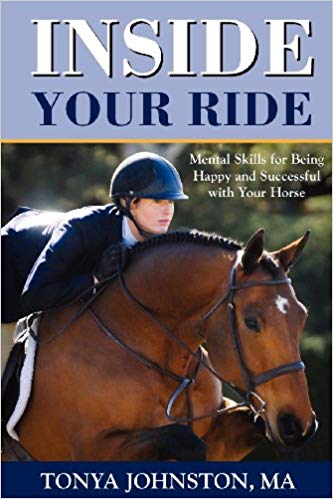
Inside your Ride: Mental Skills for Being Happy and Successful with your Horse by Tonya Johnston
c 2012 Cruz Bay Publishing/Equine Network: Boulder, CO. 263 pages.
ISBN 9781929164615
If you have ever struggled with: nerves, worry, fear, anxiety (performance or generalized), coping with pressure, etc., and it has affected your riding in a negative way—I would stop reading now and go pick up a copy of Inside Your Ride: Mental Skills for Being Happy and Successful with Your Horse. Author Tonya Johnston is a specialist in equestrian sports psychology, and her insights have increasingly appeared in articles, blogs and podcasts, with good reason. Inside Your Ride is well organized, coherent and broken down in such a way that any equestrian needing to “up their mental game” should find some helpful guidelines.
The field of sports psychology has grown exponentially in the past ten to fifteen years, going from being almost like the secret weapon of the elite athlete to a tool that even casual riders can use to move past any number of mental/psychological impediments to their goals. Today, many sports psychologists focus on specific sports. This is to our benefit, I think, as we all know that horseback riding is a sport unlike any other, due to the fact that our powerful teammates can and often do have an agenda which is different from our own. Each author has their own tools, strategies and systems which help equestrians to move through their personal blocks, and I appreciate being able to read each professional’s take on the subject in books like this one. But to be effective, the content must be clear and structured in a way that you can work through it on your own—and Johnston has hit that mark in Inside Your Ride.

While this particular book does slant towards concerns common amongst riders that compete, I think there is plenty in here for any rider who has set more fundamental goals for themselves, goals as seemingly basic as getting more time in the saddle. In fact, the first chapter is dedicated to motivation, with Johnston acknowleding that people ride for many different reasons—and she helps the reader to identify for themselves what it is about riding that makes them choose to pursue the sport. From there, the book includes chapters on confidence (who doesn’t need more of that, right?), focus, energy, attitude, resilience and more. There is even a chapter on returning to the sport, whether it be after a fall, a significant break from riding, or a break from competing.
Johnston has included many personal anecdotes and fictionalized scenarios which help prevent the book from becoming too text-booky. Instead, it reads a little bit like the script to a TED talk—“here’s how I did it, and you can do it too!”.
She has also included quotes and feedback from top professionals, which I think is a good way of showing that even the best in the world have had their self-doubts and techniques like these have helped. The only downside to this—and this is going to sound trite but it is true—is that “celebrity status” in the horse industry can be fleeting, and if an author makes reference to too many former stars it can date the book.

Many of the individuals she quotes—Bernie Traurig, John French, Leslie Howard, for a few—are icons of the sport, but I know from personal experience as a teacher/educator that if I bring up these names, I am often met with blank stares from my students. Never mind those individuals whose time at the top was even more fleeting—the Olympic medalist who doesn’t have a string of horses and so faded back into the tapestry when their top horse retired, or the equitation champion whose transition to the adult divisions has not led to the same degree of success. On a weekly basis, I am left giving my students “Google homework” to look up someone who just a few years earlier would have been on the cover of every pre-eminent equestrian magazine.

So unfortunately, even for me, someone who recognized the names and respects their experience, some sections of this book felt dated, while others felt a little too “a la minute” in that the rider referenced sort of came and went so quickly that they don’t seem a relevant source. I am not sure that the 2019 equestrian is going to recognize that all of these sources have experience worth listening to. And I don’t think I needed them to make the book work.
But maybe none of this will bother you, and you will just take note that an “experienced horse person says that this technique works” and you will go try it for yourself. Which is the real point, I think.
I suspect that this is the sort of book you can read once, take away a few key concepts, then pick up again a year later and absorb a whole new insight. Mental preparation is sort of like developing riding skills—it takes practice and some commitment, and you get better at it with time. And I think our needs change over time, too—just read this forthright piece from Steffan Peters (and if you don’t know who he is…you have Google homework, too…).
4/5 stars


 The Academic Equestrian