
Through my work as a writer, I have been fortunate to encounter equestrians and horses who have overcome great odds to achieve some measure of success. I love telling these stories and take my responsibility as their curator seriously; sometimes the obstacles overcome are deeply personal or downright cruel, others the result of nothing more than fate or circumstances or luck (and whether luck is good or bad, it seems, is only known to the mind of the beholder). I try to write the truth of someone else’s lived experience with humility, compassion and respect for their willingness to share a piece of that life with a broader audience.
At the same time, these stories practically write themselves. When I was working on my M.F.A., an instructor shared his secret for writing compelling profiles: choose a subject who is “a loser with a dream on a quest.” I know the word “loser” could be interpreted with a negative connotation, but read it in this context as simply being the opposite of “winner”. As in, life has kicked them around a bit and other people in the same circumstances might justifiably have chosen to give up. As in, there are an awful lot of them out there, because in most contests (literal or figurative), there is only one winner.
Think about it. This formula is pervasive throughout popular literature and film. The entire Harry Potter series is essentially about a loser (an orphan whose adopted family scorns him) with a dream (to become a great wizard) on a quest (to defeat Voldemort). For a fictional horsey example, the movie Hidalgo (extremely loosely based on the life of Frank Hopkins, a real person whose real life story is a matter of debate) tells the story of a disgraced, mixed-race cowboy in turn of the century America (definitely a loser) with a dream (to save a herd of mustangs) on a quest (to win a long distance horse race). Bonus points here because the quest is literal (as it also is in the Lord of the Rings, with protagonist Frodo and his friends taking three rather lengthy books/movies to finally arrive at Mt. Doom).
We look for these “losers with a dream on a quest” in real life, too.
For a stunning example, recall the story of Seabiscuit, a cranky, nondescript, poorly conformed Thoroughbred racehorse whose shy trainer, Tom Smith, was shunned for his unorthodox methods; whose jockey, Red Pollard, was a semi-blind immigrant and whose owner, Charles S. Howard, was a successful entrepreneur whose ticket to riches (the automobile) also caused the death of his son. When this hardscrabble horse defeated regally bred champions like War Admiral in the late 1930’s, his success inspired a beleaguered nation, its citizens desperate for joy in the aftermath of the Great Depression.
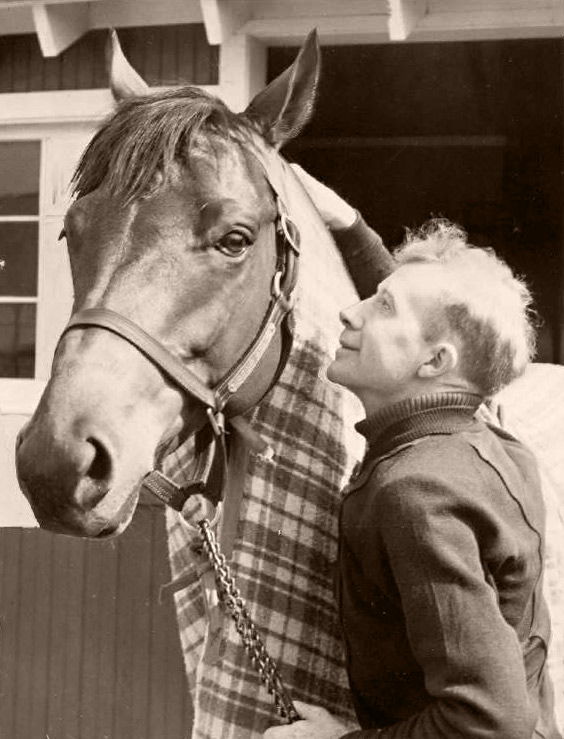
In 2001, Seabiscuit’s story enjoyed a renaissance with the release of Laura Hillenbrand’s New York Times’ best-selling book. Not only did the written narrative garner too many awards to list, in 2003 it was turned into an Academy Award nominated feature film that grossed $148.3 million at the box office. (Laura Hillenbrand herself could also qualify as a loser with a dream…read this amazing essay to learn more about her own journey).

To reach such broad popularity, obviously the story of Seabiscuit resonated with a wider audience than just the horse-loving public. On its surface, Seabiscuit is a cool story about a successful racehorse. But really, it is much more than that—it is a classic underdog story, and it is as much about the people surrounding the horse as it is about the horse himself.
I think the reason for this appeal is that, each in our own ways, most of us see ourselves as losers. I know I do. Every single day, there is a tape that plays in my brain telling me that I am not good enough. It tells me that I will never be enough of a trainer to start not one but two young horses. It tells me that I will never successfully pitch my book, land an agent, and see the project through to completion. It tells me that there is always someone out there who is better at what I do than I am, and because of that, maybe I shouldn’t even bother to try.
In these dark days of winter, approaching the start of pandemic year two, that voice has been exceptionally loud.

Perhaps it is in these times especially that we most need our underdog stories— stories about losers who are so often just regular people, people like you and I, who faced adversity in whatever form but had the strength, determination and grit to persevere. People who had a dream, whether a seemingly simple one or maybe one so big and crazy that they were embarrassed to share it out loud, and yet who still took those small steps along the path to making that big and crazy dream a reality. Sometimes the path led them exactly where they hoped it would. Sometimes it didn’t. But the point is that despite the negative, the dark, that d**m voice in all of our heads whispering this is not possible, these underdogs kept shuffling, limping or crawling their way forward. And in their own ways, they prevailed.
I tend to think that underdogs are not the exception among us, but the rule, and that underdog stories are about normal people able to push past the resistance that slows each of us down. Underdog stories will always be popular because they appeal to the loser living inside each of us, the one who needs to be reminded that (in the words of the late, great Tom Petty) “even the losers get lucky sometimes.” But with all due respect to Mr. Petty, I don’t think underdogs ever prevail due to luck alone. Somewhere along the way, they turned obstacles into opportunities and adversity into strength, and told their inner critic to take a long walk off a short pier.
Here are some of my favorite underdog stories I’ve written from the past year or so:
Quinlan Shows Us How to Lose our Leathers, No Matter the Obstacles
Learning to Trust Gave Satin’s Angel Her Wings
Back from the Brink: Kilkenny Cairo Heals at her Home on the Range
From $400 Racetrack Reject to Hampton Classic Tricolor
Author’s note: The cover image is of Seabiscuit winning the 1940 Santa Anita Handicap with Red Pollard up. You can watch the race here.



 The Academic Equestrian