The Green Guide for Horse Owners and Riders by Heather Cook
c 2009 Storey Publishing (North Adams), 231 pages
ISBN 978-1-60342-147-8
The Green Guide for Horse Owners and Riders is a super easy to read and well organized book which represents the most comprehensive summary of the concepts of “sustainable practice for horse care, stable management, land use and riding” in one place to have crossed my desk. Depending on your previous level of knowledge on the subject of eco-friendly horse management practices, this book might alternately be too basic in some areas or too detailed in others. In either case, though, you are likely to find references to supplemental sources which can direct you to more information.
I have long maintained that the equine industry needs to get on board with more sustainable management strategies. Too many farms are overstocked, with destroyed paddocks/turnouts, unsightly and unsanitary manure piles and out of date protocols. This book helps take the reader through the steps necessary to establish a different paradigm, whether starting a farm from scratch or working with facilities and layouts already in place. Cook does an excellent job of balancing general guidelines with more specific detail. For example, each chapter concludes with guidance to be considered for various climate regions in the US and Canada.
Some of the strategies covered in this book include techniques for “harvesting” water from rainspouts for use as wash water or for irrigation (which, interestingly, is illegal in Colorado); several methods of composting manure; selection of sustainable and healthy building materials; reducing the use of fossil fuels, and reclamation of muddy paddocks. In addition, there is an extensive resource list compiled in an appendix which is clearly divided into sections such as green energy, grant sources, recycling, trail riding resources, helpful government and non-government organizations, etc.
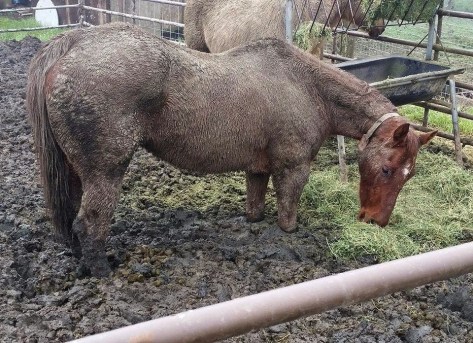
Management strategies which reduce mud will prevent your paddocks from looking like this one.
This book really is a “must read” for anyone who is interested in being a good steward of their land, or in providing guidance to someone else who is in that role. The onus is on all of us as concerned and conscientious citizens to do a better job of implementing management practices which consider the local and regional environment. A healthy farm means healthy horses.
5/5 stars
Blogger’s Note: Cover image is taken from Sustainablestables.com, another great resources for assistance and tips on better horse and farm management strategies.
I picked up Snyder-Smith’s book in preparation for my successful first time attempt at completing a three day 100 mile competitive trail ride. The author is an experienced horsewoman with a broad background and successful Tevis Cup completion on her resume; while the focus of the book was more on endurance riding than competitive trail, I found that more than anything, it was a book about good horsemanship, and there is something which riders of any discipline can take away from it.
In this book, Snyder-Smith takes a comprehensive look at the details of how to prepare a horse and rider team for success in the sport of endurance. Full chapters are dedicated to riding in balance, gymnastic development of the horse, conditioning and feeding the endurance horse and the merits of various types of equipment. The book concludes with a look at the requirements for crewing at an endurance ride and then the dynamics of a ride itself.
What struck me over and over in reading this book was how so much of what the author stated applied to not just endurance horses, but to all equine athletes. For example, she outlines the requirements for a successful endurance horse as follows: “good feet, a good respiratory system, a good mind, to be an efficient mover, the desire to do it” (Snyder-Smith, p. 8). However, these are ideal qualities for ANY performance horse, though perhaps certain other disciplines could be more forgiving to a horse which does not have the best attributes in some of these areas.
Lee and I on the last day of the three day 100 mile ride at GMHA (VT), fall 2015.
In her chapter on the importance of rider balance, Snyder-Smith goes into great detail on the importance of body awareness, symmetry and correct riding position and their collective effect on the horse for better or for worse. If a rider is expecting a horse to carry them over tens of miles of terrain, it is critical that the rider is doing their part to be efficient and to maintain their own balance and coordination. Horses can cope with rider asymmetry or weakness to a point, but adding in the cumulative stress of a long ride to the mix means that an inefficient rider can make the difference between a completion or a pull. Lest anyone think that trail riders need not be attentive to the performance of their mount, Snyder-Smith states that “Riding that is comfortable and productive for both horse and rider is based on the rider’s ability to feel the horse and what it is doing with its body” (Snyder-Smith, p 22). In other words, riding well, and riding correctly, matters!
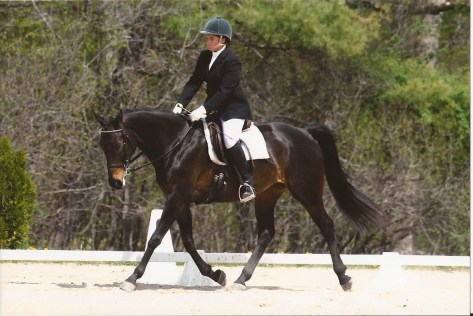
Lee at the Wentworth schooling show in 2010. Photo Credit to Mystical Photography, used here with permission.
In her chapter on preparing the endurance horse, Snyder-Smith addresses the difference between conditioning and training, and emphasizes that both are required for success in endurance. Snyder-Smith explains that endurance horses need to spend time in the arena in order to develop their flexibility, suppleness and strength. In fact, she proposes that basic dressage training is an excellent way to introduce a “systematic, gymnastic training program…to enable horses to perform to the limits of their athletic capabilities without injury,” (Snyder-Smith, p 63). Another especially important concept for successful conditioning is that “if you are not able or willing to listen to your horse and learn from him, your success as an endurance rider will be limited” (Snyder-Smith, p. 84). Again, the author is specifically referencing conditioning for the sport of endurance, but the reality is that this idea applies to all disciplines across the board. Another universally applicable statement is that “commonsense is the single ingredient that, when missing, causes the greatest damage to horses” (Snyder-Smith, p 87).
Throughout the book, Snyder -Smith inserts tips and helpful hints from her own experience as a distance rider. For example, she suggests mixing electrolytes with baby food like strained carrots or applesauce to make them more palatable. She also discusses the experience of how having a vet make a comment about your horse’s soundness at a check can cause even an experienced rider to doubt the animal’s fitness to continue. Having personally had this experience at a few rides, I know how much it gets under your skin and infiltrates your consciousness, even when you are really fairly confident that the horse is okay and what the vet saw might be just fatigue or the result of a misstep.
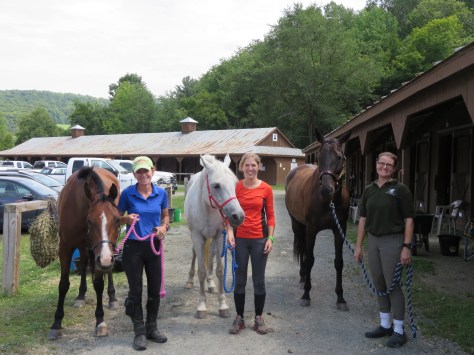
Three happy distances horses at the end of a successful ride!
Overall, I found Snyder-Smith’s writing easy to follow and the concepts clearly explained and well-articulated. This book was immensely helpful to me in my own preparation for the 100 mile ride, and to help me as a novice to become more familiar with the requirements of the sport. But more than anything, I found the author’s perspective on horsemanship refreshing. Simply put, if you take your time, do your homework and only ask of the horse that which you have properly prepared them for, you can expect their best effort. For this reason, I would recommend the book to riders of any discipline who are reaching out of their comfort zones for a larger goal.
“If your horse has it in him, you’ll be able to get it out of him if you don’t ask for too much too soon and use him up,” (Snyder-Smith, p 175).
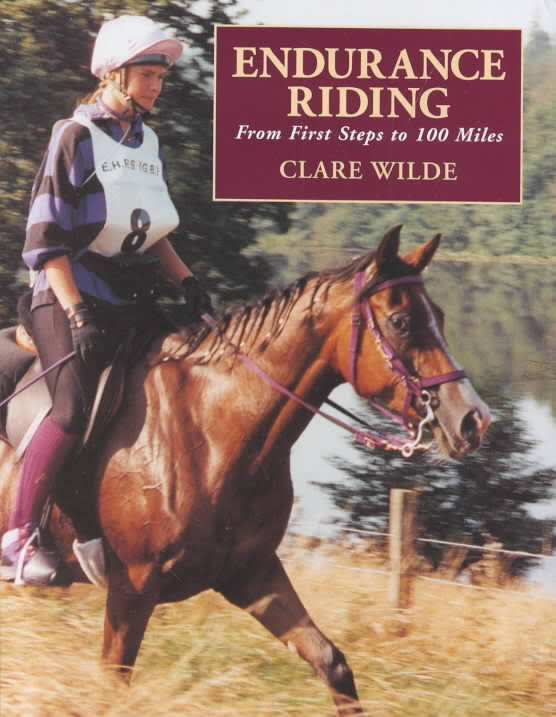
Endurance Riding: From First Steps to 100 Miles by Clare Wilde
c 1996 Kenilworth Press, Buckingham (Great Britain) 170 pages
ISBN 1-872082-83-1
This past winter, I dedicated my equine reading to a selection of titles related to endurance and distance riding. I knew that for 2015, I wanted to try to bring my horse up to a level of condition which might make it possible for her to tackle a 50 or even 100 mile ride, but I really didn’t know how to go about doing that. It was with this mindset that I picked up Wilde’s book. Wilde is an experienced endurance competitor whose love for the sport, and for riding and horses in general, is apparent throughout the book.
This book covers many aspects of the sport of endurance for the novice, tackling everything from horse selection to tack to schooling to what it takes to crew at a ride. One of the sections that I enjoyed the most was called “Basic Schooling and Education,” and I liked it because it reviewed critical basics of training for any horse. For example, Wilde discusses the fact that in order for a horse to stay sound and sane over a long distance ride, they must move in an “economical, balanced yet dynamic motion” (Wilde, 1996, p. 45). To achieve this, the rider must be conscientious in both their own posture and position and also work to develop suppleness and strength in the horse. Horses must be encouraged to work correctly from back to front so that on the trail they can be supple and balanced. In endurance riding, where competitive riders move at fast speeds much of the time, this preparation is essential. “The versatile, supple horse will be able to move away from your leg to enable you to open gates quickly, avoid hazards and move off rough ground. He will also be able to corner efficiently, particularly at speed” (Wilde, 1996, p. 46). This information is so critical; a successful distance horse must be a true athlete, which requires paying attention to all forms of physical conditioning.
Wilde also points out that the endurance horse is the marathoner of the horse world, and the end goal of conditioning should be “to produce a supremely fit, laid-back equine athlete in the peak of physical condition” (Wilde, 1996, p. 49). To do this requires not just attention to their workload, but also their overall stable management. There is a big difference between the casual trail/pleasure horse that goes for a leisurely walk every now and then and a horse that is in preparation for a serious distance undertaking. The horse’s stable management therefore must be of a higher standard than for a horse not in such intense training. This is an important area of consideration which is sometimes overlooked.
Endurance and competitive trail riding can be enjoyed by riders of all ages and with all breeds of horse, with the proper conditioning.
Just like in other equine sports, Wilde reminds distance riders that the horse needs a warm up and cool down phase in each work set. It is important to actively walk a horse for at least ten minutes before asking for faster gaits, and then to ease into the trot and canter. Riders who are looking to start their race time at speed must budget in this warm up prior to the start.
The section titled “Conditioning for Competition” was especially enlightening. Wilde says that once her horse has been built up to a base level of fitness which allows for easy completion and recovery from 20 mile rides, she rarely rides more than 15 miles in training. One of the big challenges in distance riding is doing enough work to bring the horse to a fit level of condition but not doing so much that they become sore or unsound, or that their attitude becomes unwilling. Learning how to “peak” your equine athlete at just the right time is both an art and a science, and certainly the ability to do this well separates the best from the also ran’s in any horse sport, not just endurance. Wilde offers several sample conditioning and training schedules which can work to help horses develop for various distance rides, but also cautions readers to remember that each horse is an individual.
The final chapter which I thought was particularly well done was titled “Personal Preparation”. Here, Wilde discusses the care and feeding of the rider as an athlete, as well addresses the critical importance of rider fitness. “In the most basic terms, your horse will find himself unable to perform, no matter how well he is prepared, if you are a hindrance to him rather than an asset” (Wilde, 1996, p. 95). This last statement would seem to be true regardless of your chosen discipline, and is a concept which more riders need to take to heart if they truly want to progress in their riding.
Overall, Wilde’s book is an easy read with relevance to riders who want to improve their level of awareness on the subject of conditioning across the board. While the author is certainly focusing on conditioning for the discipline of endurance, so very much of what she says relates to any equine endeavor that I would recommend it for anyone who wants to do a better job of preparing their equine athlete for their goals. In this book, Wilde is essentially preaching practical, good horsemanship. My only criticism is that at this point, the book is nearly twenty years in print, and photographs and certain references could use an update if there were to be a newer edition released.
4/5 stars
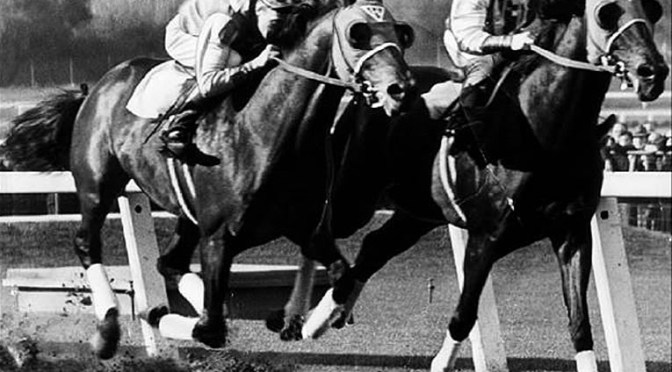
Blogger’s Note: The featured image is from the first Tevis Cup ride. Started in 1955 by Wendell Robie in California, the Tevis Cup 100 mile ride is regarded as one of the hardest in the world. Wilde credits Robie with being one of the inspirations for the spread of endurance riders world wide, and especially within the United States.
c 1991 Sport Horse Publications, Mason, MI, 256 pages
ISBN 0-9695720-0-X
Still referred to by many as the “Bible” of equine conditioning principles, I picked up Clayton’s 1991 work, Conditioning Sport Horses, this past winter as I was beginning to think seriously about the demands of conditioning for long distance riding. I was worried at first that the book might be a bit dry or too technical for me, a non-scientist, to understand. However, Clayton is skilled at breaking down complex concepts into manageable pieces and I found it a fairly pleasurable read.
Dr. Hilary Clayton Photo taken from her promotional poster.
Conditioning Sport Horses is divided into three chunks. Part One looks at the major systems involved in the process of preparing a horse for athletic work and devotes full chapters to the cardiovascular and respiratory systems, energy production, muscles, thermoregulation and fluid and electrolyte balance. Part Two delves into the “practical aspects of conditioning” and covers concepts such as general conditioning principles, cardiovascular conditioning, strength training, increasing suppleness, and managing these elements in a horse’s overall training program (including using a heart rate monitor and providing adequate nutrition). Finally, Part Three shows how to use these concepts to prepare a horse for the specific demands of various disciplines; Clayton addresses the traditional sport horse disciplines but also several western sports as well as polo, endurance and chuck wagon racing (!).
These polo ponies show how much a horse will naturally lean onto the inside forelimb and shoulder when turning. Polo is a fast moving sport, requiring speed and agility (Clayton, 1991, p 229). “Polo3-1-” by Ems (Emanuel Sanchez de la Cerda) – de.wikipedia.org: 18:50, 16. Mär. 2006 .. Ems .. 800×520 (292.111 Bytes) (* Bildbeschreibung: Sal. Oppenheim Cup Finale 2005 * Fotograf/Zeichner: Emanuel Sanchez de la Cerda (~~~) * Datum: 26.06.2005 18:00). Licensed under CC BY-SA 2.0de via Wikimedia Commons – http://commons.wikimedia.org/wiki/File:Polo3-1-.jpeg#mediaviewer/File:Polo3-1-.jpeg
I read this book much like I would a text book, underlining key concepts and passages and pasting sticky notes on others. Doing so really helped me to dig into the material. While I have studied conditioning concepts in the past, I have never done so with the intensity or scrutiny that I have brought to my work this season, and Clayton’s writing included many important concepts and principles that I am not sure I have truly ever heard before, as well as reminded me of old favorites.
Conditioning Sport Horses, by Hilary M. Clayton (cover).
For example, we have all been told that we shouldn’t feed our horses immediately following a hard work because the blood supply has been shifted away from the digestive organs. Clayton includes a graph which shows that during exercise, just over 75% of the cardiac output and distribution of blood flow is shifted to the horse’s muscles, and less than one quarter is dedicated to all of the other organs in the body. A horse at rest is nearly opposite of these values. Seeing the ratio so clearly visually depicted really drove the point home (see Clayton, 1991, page 14).
Another relevant question was answered in the chapter on thermoregulation. Here in New Hampshire, winters can get downright frigid, and the question “when is it too cold to ride” is often raised, in particular in reference to whether or not conditions are safe for the horse. Clayton settles the point clearly: “Compared with horses exercising at normal temperatures, horses undergoing strenuous exercise at -25* C(-13* F) have no significant changes in heart rate, lactate production, blood gas tensions, gait or lung tissue morphology” (Clayton, 1991, p 70). So next winter when I choose to not ride when the temps are in the single digits, I will know that it is for me that I am staying in the warmth, not for my horse!
My horse, Carmel, after the New England Blizzard of 2015.
Perhaps one of the most interesting segments of Conditioning the Sport Horse is the section on general conditioning principles. When most riders think of conditioning, it seems that their minds immediately go to the concept of “sets”; going out and riding at a certain speed or pace for a specific period of time, then allowing the horse to partially recover before completing another round. I am not sure that riders in non-aerobic disciplines (dressage comes to mind) often think hard about their horse’s “conditioning plan”. Clayton explains in great detail that the term conditioning encompasses far more than just improving the horse’s cardiovascular capacity; in fact, this system is the fastest one to improve with exercise, while other equally critical systems (such as the musculoskeletal system) lag behind. If a rider fails to address each of the critical areas of conditioning, their equine athlete’s performance will be compromised (at best) or they will risk injury or breakdown (at worst).
There are three components to the volume of exercise which a horse is in: intensity, duration and frequency. Smart riders are able to gradually increase the horse’s capacity in each of these areas, though not in all three at once (Clayton, 1991, 80-81). Strategically incorporating the various forms of conditioning with these principles will allow for the most consistent and safe increase in athletic capacity.
This book is full of practical and useful tips, everything from how to make your own electrolytes (3 parts sodium chloride to one part potassium chloride—see page 72) to how to introduce fitness concepts to a green horse in any discipline to feeding strategies for animals in endurance sports which will maximize performance. In the chapters on specific disciplines, Clayton provides clear and do-able formats for conditioning in each sport, attending to each of the major categories of conditioning. I learned a lot from reading each chapter, even for those disciplines which are not my specialty.
If you are going to consider yourself a serious student of the correct and conscientious development of the equine athlete, you simply MUST have this book on your shelves. Read it, underline it, dog ear it, and refer to it regularly as you create a conditioning plan for your athlete— and whether they are a dressage specialist, a reiner, a show jumper, or something else, your horse will thank you.
Cavaletti for Dressage and Jumping by Ingrid and Reiner Klimke
c 2014 J.A. Allen London, UK, 151 pages
ISBN 978-1-908809-19-3
The name “Klimke” is, I am pretty sure, the German word for “amazing horseman”. The late Reiner Klimke is regarded as a legend, and the written work he left behind after his untimely passing in 1999 remains as relevant today as it did when first published. Daughter Ingrid has carried on in the family tradition and today successfully trains horses to the highest international levels in both eventing and dressage.
The 2014 English translation of Cavaletti for Dressage and Jumping is an updated version of the 1969 publication of the same name written by R. Klimke. Ingrid has modernized the illustrations as well as the phrasing of the original text. I believe she has also inserted her own perspective here and there, though it is clear that her father’s work serves as the main inspiration.
As I planned to be stuck in the indoor for the foreseeable future (as I write this we are experiencing yet another round of 8”-10” of snow), I picked up Cavaletti in order to better understand how these exercises could be used to improve my horses’ strength, spring and suppleness as well as to break up the monotony of the indoor. Klimke’s book takes the reader through how cavaletti work is incorporated into her training regime from start to finish, to the point where the text could be used as a template for any training program.
Klimke’s training philosophy is based on classical principles, and what I really appreciated in this book was how often the importance of slow, gradual and incremental increases in the horse’s training program was emphasized. I have read in other articles by Klimke that she always begins and ends each training session with at least ten minutes of walk on the buckle; I have been trying to be religious about giving my horses a solid ten minute free walk prior to beginning work, which I think has been beneficial. This practice allows the rider time to become focused and present, and allows the horse to limber and loosen their body prior to being asked to complete any real work. I notice that it is at about the seven or eight minute point in the walk that my horses begin to, of their own initiative, swing more freely through their topline and reach with a longer stride. For each stage of the training program, Klimke reminds the reader that the horse must also have a period of “working in” before being expected to tackle new tasks.
Ingrid with her now retired Olympic eventing horse, FRH Butts Abraxxas. Her love of horses is evident here, I think. Photo has been taken from her website, http://www.klimke.org
Another aspect of this book that appealed to me was the emphasis on the importance of having a methodical, organized, planned progression to training, which includes consideration for the mental health of your horse. “Many training problems can be solved far more easily if you do not rely solely on riding experience, but have a plan for how to go about the training before you start it…In addition, you must take responsibility for the wellbeing of your horse. Only a healthy horse, whose condition and musculature have been carefully developed, can reach his full potential,” (Klimke, 2014, p. 11).
No matter what the intended discipline, Klimke says that cavaletti work can benefit all horses as part of their basic training. Through modifications in the exercises, training challenges unique to specific disciplines can be addressed.
In Cavaletti, detailed discussion is included regarding free longeing in general as well as the use of cavaletti work during free longeing. Klimke also discusses cavaletti exercises which are appropriate for the horse on the longe line. The illustrated diagrams which are provided for basic to advanced cavaletti set ups are such that anyone with a tape measure and the basic required equipment can assemble the exercises. Included are ridden exercises both on straight lines and circles.
The examples of ridden cavaletti exercise ideas show how a horse can be taught to move with a longer or a loftier stride, as well as how they can be taught to think about where to place their feet by removing a rail from a sequence. As Klimke reminds us, “the aim of dressage is that the horse, through systematic gymnastic training, is made more beautiful and powerful and his natural movement is improved” (Klimke, 2014, p. 58). That is the purpose of utilizing many of these exercises, as far as the horse is concerned.
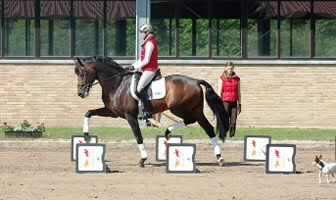
This photo shows one of the exercises which has had a cavaletti removed. It is designed to help improve the horse’s concentration. Photo by Julia Rau/Hindernisbau Rumann
Finally, Klimke provides an excellent overview of the introduction and progression through basic gymnastic jumping exercises, something which should only be presented to the horse once a basic foundation has been firmly established. Klimke states that gymnastic jumping is not just for the jumping horse, “Gymnastic jumping is excellent for improving the relationship between rider and horse. It covers a wide variety of schooling areas that are relevant to all the disciplines—dressage, show jumping and eventing—and for both horses and riders” (Klimke, 2014, p. 71). Klimke also emphasizes the importance of tailoring the jump exercises to the individual horse and rider, which is true of the cavaletti work as well. The distances included throughout the book are meant to be guidelines but of course should be edited to suit the stride length of the specific animal you are working with.
I must say that Klimke is a far more creative grid setter than I have ever been, and I look forward to introducing some of her layouts in my classes and personal schooling sets.
The book concludes with three model outlines for four to six week training schedules for three types of horse: for a horse in basic training, for a dressage horse and for a jumping horse. These schedules provide a glimpse into how these exercises can be incorporated into a more comprehensive training plan.
Overall, I think this book is destined to become a true classic text and is a worthy addition to any sport horse trainer or rider’s library. You can read it cover to cover then leave it handy to serve as reference for specific exercises or phases in training.
5/5 Stars
For more information about Ingrid, her schedule and her training program, you can visit her website at http://www.klimke.org/
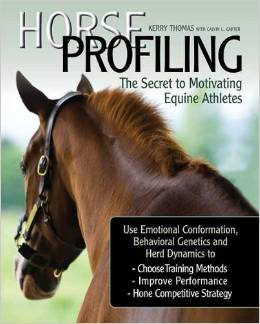
Book Review: Horse Profiling: The Secret to Motivating Equine Athletes
By Kerry Thomas with Calvin L. Carter
c 2012 Trafalgar Square Press, North Pomfret, VT 170 pages
ISBN 978-1-57076-508-7
I was attracted to this book two years ago when I saw it at Equine Affaire in Springfield, MA , by the words in the title of “motivating equine athletes”. I thought perhaps it would offer me some insight into the quirky and unique personality of the Dark Mare, and it also seemed like an equine topic which was a little bit new and fresh. Those who know me recognize that I hoard books and I am a slow reader, particularly on equine-themed topics (overall a tough combination of variables), so it was just this fall that I finally got down to really reading this book and understanding what author Kerry Thomas is all about.
Thomas is a self-proclaimed “pioneering researcher and service provider in the field of Equine Athletic Psychology” (from the book jacket). He has spent time studying the behavior of the American Mustang as well as that of domestic horses in a number of settings. Thomas has developed a system of assessing a horse’s “emotional conformation”, which looks at the psychology of the horse as opposed to the anatomy of the horse, as in an evaluation of a horse’s physical conformation. Thomas assesses the social tendencies and behavioral dynamics of each horse as an individual, which then can help to predict their performance capability. It would seem from reading the examples he provides in the book that a large percentage of his clientele comes from the Thoroughbred racing industry, which does make sense. If I were about to invest thousands in a racing prospect, I would sure appreciate knowing whether or not that horse wanted to race.
There is a need for experts who can analyze the why’s of what horses do and who understand that horses don’t act in “bad” ways to make their owners upset. We need experts who are patient enough to get to the root cause of why horses act in the ways that they do and for why they fail to meet the owner’s expectations, once physical issues have been ruled out. Thomas and his “Thomas Herding Technique” (THT) aim to fill this need. Most horsepeople would agree that horses don’t always live up to their conformation and pedigree, in both positive and negative ways. We can give plenty of examples of horses that had all the necessary raw material in terms of conformation, bloodlines and genetics to be an upper level or elite contender, but who mentally couldn’t handle the pressure or demands of that kind of ridden work. On the flip side are horses that look like an assemblage of spare parts, horses which have no business doing anything remotely athletic or sporty, who are accomplished, successful competitors. Thomas tries to get at the root of why this is such a common situation in the performance horse world.
Thomas advocates the importance of breeding horses not just for their physical conformation but for emotional conformation as well. He says that by considering this quality, we are breeding horses more in keeping with the way intended by nature. Not every horse is meant to be the leader of the herd, but every horse plays a distinct and critical role within it, and these roles contribute to the overall survival of the group. “Every family member has to be able to fill a role to make the equine herd a success, and it is the diversity of behavior that allows the herd sustainability over time and in changing environmental circumstances” (Thomas, 2012, p. 57).
I had high hopes for this book, but for me personally it became too bogged down in customized terminology (for some examples: “emotional conformation”, “emergent properties”, “individual and group herd dynamics”, “P-type grading”, “Focus Agility”, etc) which became hard to follow. Additionally, I felt like the book had a heavy emphasis on the training and performance of Thoroughbred race horses, which did not feel as applicable to the performance of riding horses. However, I did appreciate that Thomas uses many specific case examples from his personal work to help highlight his concepts, and it is quite interesting to read how he problem solves various behavioral issues in the horses he is asked to evaluate.
While I don’t think I am capable of going out and assessing my horses’ personalities using Thomas’s system after reading this book, there were several positive aspects and messages that made me appreciate reading it anyway. First, Thomas emphasized throughout the book the critical importance of good equine management in terms of maintaining the mental and physical well-being of your horse. In Chapter 9, Thomas discusses “The Broken Circle: Potential Withholds and Equine Mental Illness”, and in the ensuing pages, details eight key causes of behavioral problems. Many of these issues are the direct result of less than ideal horse management, including lack of exercise/excessive confinement, improper weaning, separation from herd mates, and the stress of a change of career (i.e., a horse used to full work or showing/performance is abruptly transitioned to a retirement setting). Thomas emphasizes the importance of movement, social interaction and mental stimulus in maintaining a horse’s overall health and happiness.
One more concept which I took away from this book is a reminder that the horse is a creature of movement, and movement/action is part of their mechanism of communication within a herd. We as trainers need to bear this in mind when working with our horses. Thomas uses the term “Focus Agility” to define the natural ability of the horse to interpret stimulus while in motion (Thomas, 2012, p 114). A horse may be physically athletic but if they cannot maintain their mental focus at the same time, their performance will be diminished. Additionally, horses must be able to interpret stimuli while in motion—i.e., is that thing over there a threat or not, is that thing something worthy of my attention. To help horses develop this skill, Thomas advocates incorporating simple management strategies to help continuously challenge your horse through “mental stimulus exercises” (Thomas, 2012, pp 43-47). For one example, on a daily basis, change how your horse enters and leaves his paddock.
Overall, I found Horse Profiling to be easy to read, well-illustrated with current photographs and clearly organized. I think that the book gets weighed down with terminology that is unique to Thomas’s system; it would have been helpful to have some way of continuously reviewing the terminology and its definitions as you moved through the chapters, or perhaps a glossary of these terms. The examples cited in the book for the most part come from Thomas’ own experience, and they do help demonstrate how his theories work in practice. However, I would have liked more specificity in terms of examples of “how to try this at home”—how to classify your own horse’s emotional conformation.
In general, I would recommend this book as worth a read if you have an interest in equine behavior. But be prepared to study it with care before the pieces come together.









 The Academic Equestrian

