Tag Archives: Thoroughbred

Liatris 1999-2024

On November 4, 2024, under a shower of tears and with so much love and gratitude, Lee, our most wonderful of warhorse mares, was laid to rest here at Cold Moon Farm after a period of declining well-being. She was 25.

It has taken me nearly three weeks to even begin to think about how to share her story, which is really our story, as for almost 20 years, Lee was perhaps the most constant being in my life. She was a creature of dichotomies: quirky and brave; sensitive and tough; light and soft physically and yet somewhat mentally inflexible. When I met her as a green-backed 6 year old, I never imagined our partnership would evolve as it did, or endure for so long.

Lee and I getting ready to start the 2015 GMHA 100 Mile Competitive Trail Ride.

Genetically speaking, Lee was meant to be an athlete. Her Thoroughbred sire, Denny Emerson’s Loyal Pal, was a warhorse himself– a multiple stakes winner who placed top three in 70 of his 124 races. Her dam, a Holsteiner/Thoroughbred cross named Lakshmi (Petunia), was a successful sport horse in several disciplines, including eventing and the hunter and jumper arenas. Although Lee looked like a full Thoroughbred, I always joked that tiny dollop of Holsteiner blood was just enough to cool her off.

Lee at the Wentworth schooling show in 2010. Photo Credit to Mystical Photography, used here with permission.

For many years, Lee and I concentrated on the jumpers, before switching to dressage. However, Lee had an inherent caution to her that was as integral to her being as her very DNA, and in competition, she often struggled to give her best performance. At times, I (unfairly) called her a “heartbreaker,” because it felt like she would let me down when it counted the most. There were moments in our early years together that she frustrated me to no end, and made me doubt my abilities as a trainer and horseman; I wondered sometimes if another rider, someone “more capable,” could better help her to fulfill her athletic potential. Yet I worried what might happen to my sensitive, quirky mare if I sold her somewhere else—how would it be for her, if she failed to thrive in a “program”?

Schooling at Rachel Greene Lowell’s Harvest Hill Farm, 2010.

Despite struggling in competition, Lee shined at clinics, where there was typically less “hustle and bustle,” and she had more time to settle into her space. In these settings, she truly showcased her athleticism and scope, and we had the opportunity to ride with some of our sport’s best, including my childhood idol, Greg Best. During my years as an intercollegiate coach, Lee also became a team favorite when she filled in at flat practices. In intercollegiate shows, in her home ring and on the flat, she was an unflappable, elegant, reliable draw who was pretty happy to simply follow the rail and ignore any drama that might be unfolding elsewhere in the ring. One year at our home show, nearly every rider who drew Lee won their class, including the high point rider championship. A longeing master, she also helped several Pony Clubbers meet standards at the C3 and B levels in this phase of the test. It filled my heart to see Lee experience success in these ways.
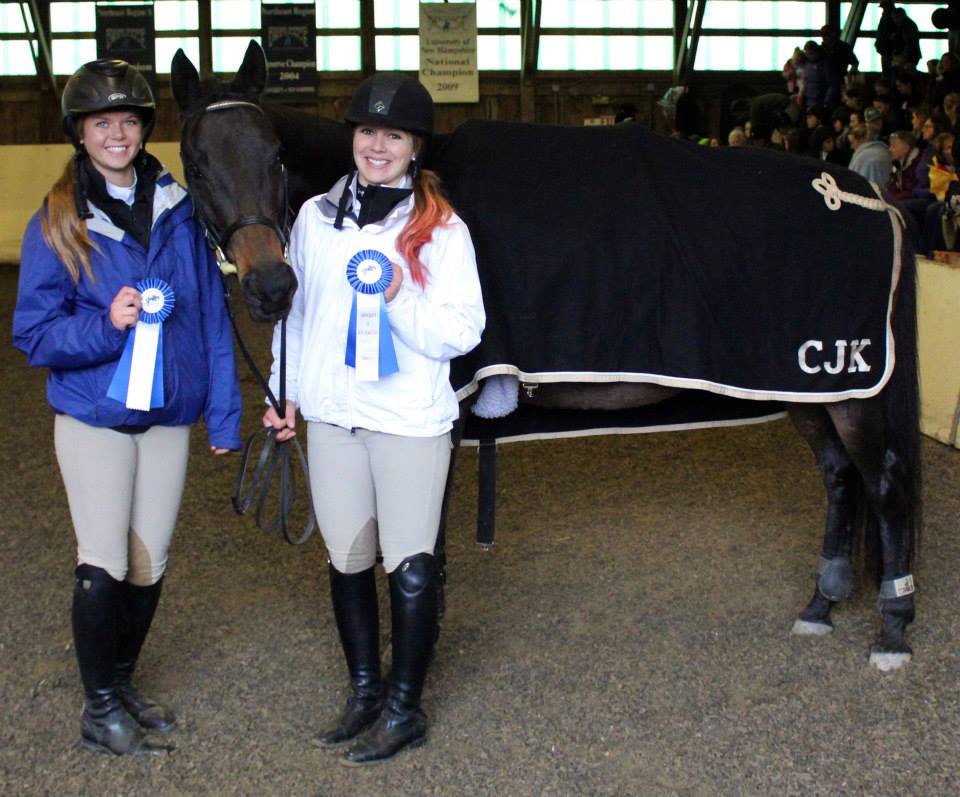
My horse Lee and two intercollegiate riders from my team, each of whom won a flat class on her at the home show.

Through lessons and clinics and hours of practice, Lee became quite an educated horse, both on the flat and over fences. Our relationship became stronger, and though she always remained cautious and sensitive, I also came to know exactly what to expect from her and how to support her when she became worried. Yet despite all of this growth, I still often felt Lee was a horse who had not found her true purpose.
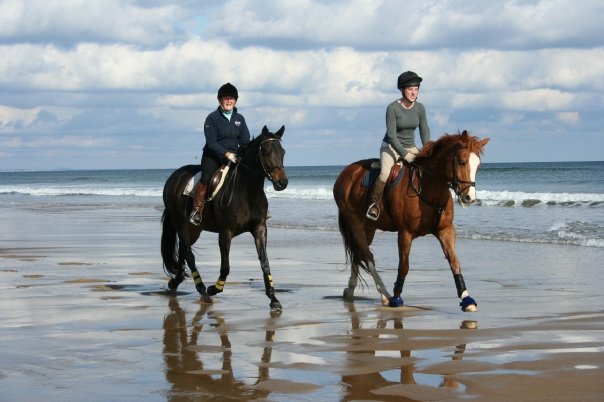
Lee and her friend Lefty at the beach, 2008

In 2013, a friend of mine was preparing her draft cross (emphasis on draft) for a run at the Waredaca Classic 3 Day event, and Lee and I joined them on several long, slow distance conditioning sets that summer. When my friend decided to sign up for the 10 mile introductory ride being held in conjunction with the GMHA Distance Days in September, I decided we would tag along.

To say that Lee was “unfazed” by the trail that day is, perhaps, an understatement. At the final jog out, she leapt into the air, bucking and farting (somewhat out of character for her), and the judge chuckled and said, “Perhaps next time, a longer distance might tire her out more?” And with that casual comment, the seed of an idea was planted. Maybe Lee, at 14 years old, could become a distance horse.
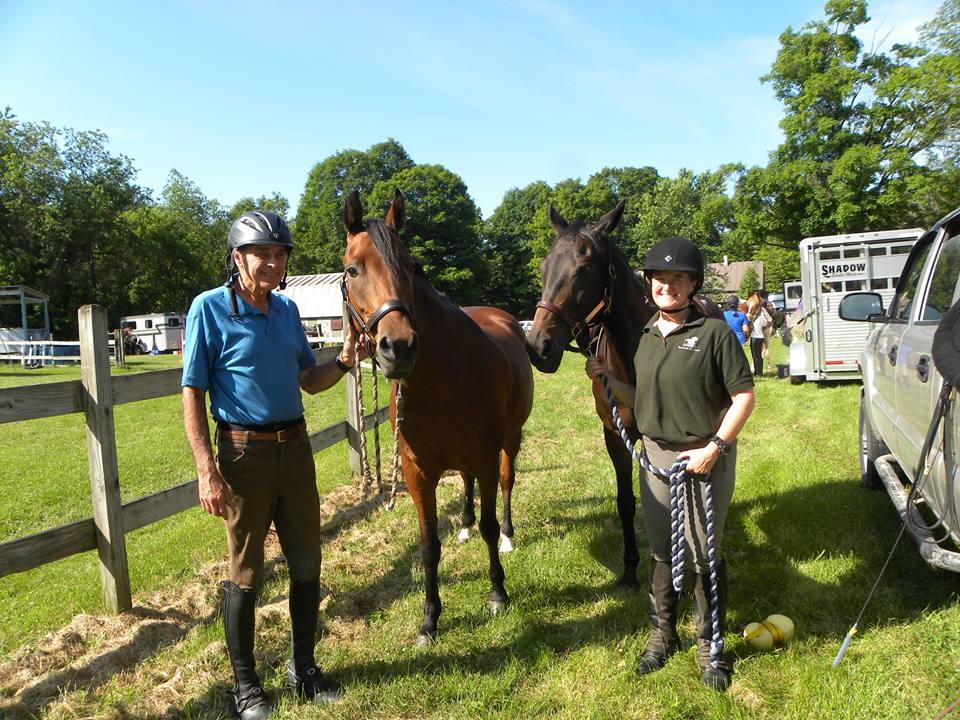
Denny and Roxie, Lee and I after completing the Hartland Riding Club ride in June 2014.

The next summer, Lee and I worked at Denny and May Emerson’s famed Tamarack Hill Farm in Strafford, Vermont. On the Vermont hills, Lee proved how tough she was– and so long as we didn’t have to get too close to the cows living nearby, she was happy and relaxed on trail, no matter how long or how far we rode. She completed her first 25 mile competitive distance rides that season, always feeling like she had more miles in the tank. So for 2015, I set a (somewhat ridiculous) goal of completing the 79th Annual GMHA 3 Day 100 Mile Ride with her at Distance Days in September.

To try to put this goal in perspective, at that point in time, Lee and I had completed perhaps five competitive distance rides, ever. I didn’t even know what I didn’t know in terms of conditioning, feeding, shoeing, electrolyte management and tack selection for a three day 100 mile ride. I didn’t know how distance riders on longer rides supported their horses on trail, during holds, and on the nights in between. Setting this goal was a bit like a First Level rider declaring she would enter the Grand Prix next season, or a beginner novice eventer announcing she would go advanced.

Clearly not a fan of having her face washed in during the 20 minute recovery time, post-ride.

But what Lee and I lacked in practical experience in the sport, we made up for in relationship. We had already spent thousands of hours together; she was sound, fit, and athletic. I knew how to research and ask questions and find mentors. And as we began to implement our conditioning and ride plan, Lee stepped up to answer every single question I asked—first, a 15 mile ride in May, followed by her first 30 mile ride later in the month (the only competitive ride she would win). In June, her first back to back rides, 25 miles on day one, and 10 on day two. In August, a two day 50 mile ride. With each outing, she became fitter and more confident, and when we returned home, she pranced around her paddock like a cocky athlete who had just scored the game-winning point. As distance horse, she was thriving. When I sent in the entry for the 100 mile ride, despite being rookies, I knew we were up to the challenge.

Coming out of the final hold on day 3, with about 15 miles to go, on the 2016 100 mile ride. One of my favorite photos of Lee, ever, captured by John Miller of Spectrum Photography.

Nearly a decade has passed since we entered GMHA’s White Ring at the end of day three, 100 miles in our rearview mirror, tears in my eyes. I think for Lee, it was just another day on trail. But for me, it was a validation—that my belief in this horse, a horse so many had suggested I pass along, was justified. Together, we had evolved, and Lee had finally found her purpose.

The 2015 GMHA 100 Mile Awards ceremony. A job well done.

In 2016, she finished the GMHA 100 Mile ride again; she earned the Perkion Award for Best Thoroughbred/Thoroughbred type both years, Top Rookie Horse in 2015, and the Spinner Award for Best Non-Registered Trail Horse in 2016. Her name is on the perpetual trophy that lives in the GMHA Youth Center. For the next two seasons, we completed several rides at shorter distances before she formally retired from competitive distance riding at the age of 19. In 2018, we checked off an Equine Bucket List item together, visiting Acadia National Park in Maine and covering nearly 50 miles of trail over several days.

On Rockefeller’s famous carriage trails in Acadia National Park, Maine, 2018.

Nine years ago, Lee became the first equine resident at Cold Moon Farm, spending six of those years in semi-retirement. She was never going to be a horse who could just stand around idly; Lee was far too much of an athlete for that. For Lee, “retirement” looked like going on hunter paces and other organized rides, visiting state parks, and still spending many hours on trail, just at a slower rate than what is required for a competitive distance horse. But even at the walk, she often outpaced her equine friends, and we had to pause and wait for them to catch up.
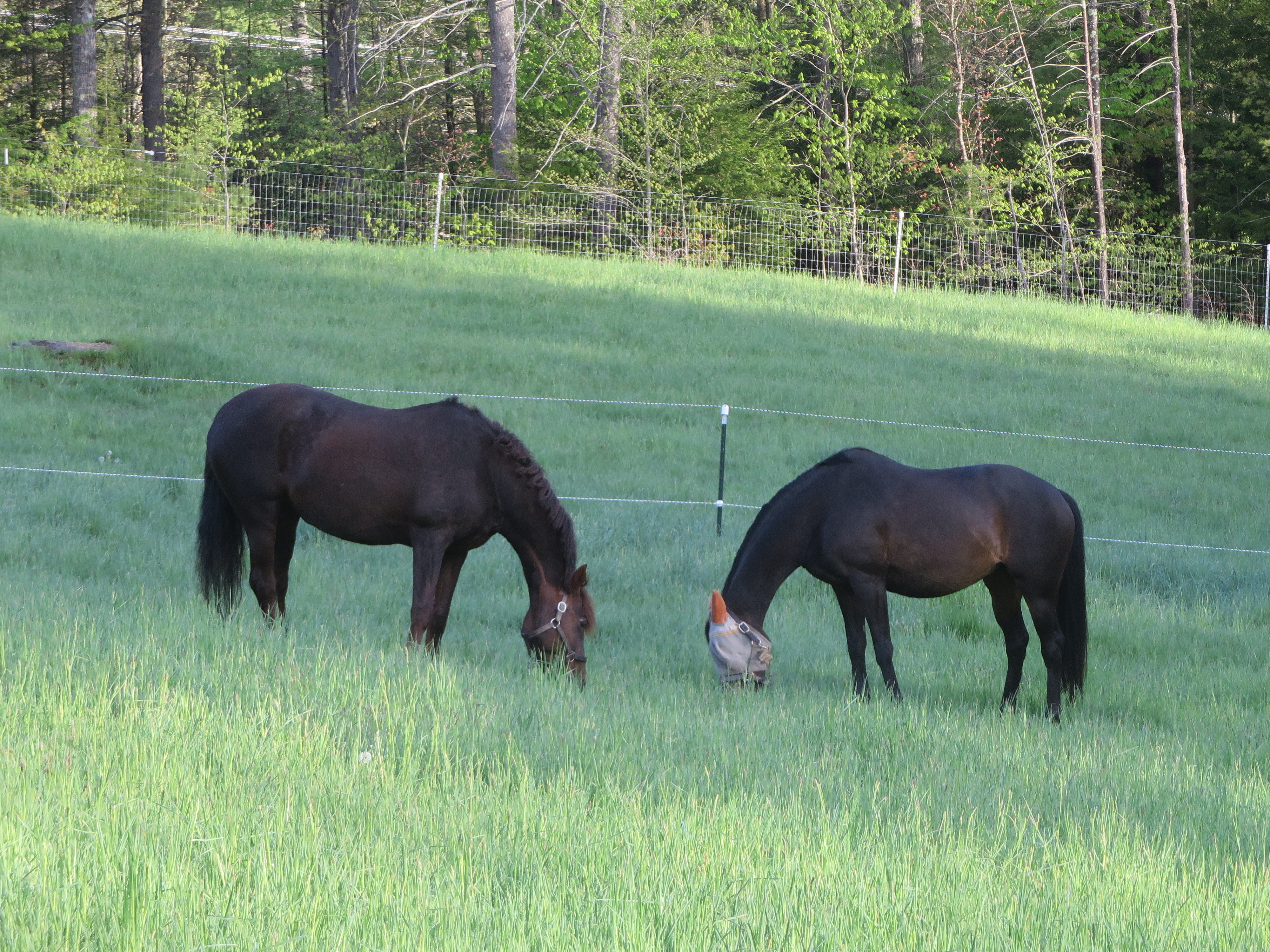
Lee and her sometimes friend Marquesa enjoying summer grass at Cold Moon Farm.

When I think back on the many memories and experiences Lee and I shared, I am both humbled and overwhelmed to recognize how much this horse taught me. More than anything, Lee reinforced that what is most important is to really understand the horse standing in front of you. Their breeding, their training, their previous experiences all count, but to truly honor the horse, you need to look past those details, and consider where that horse’s joy can shine the brightest.
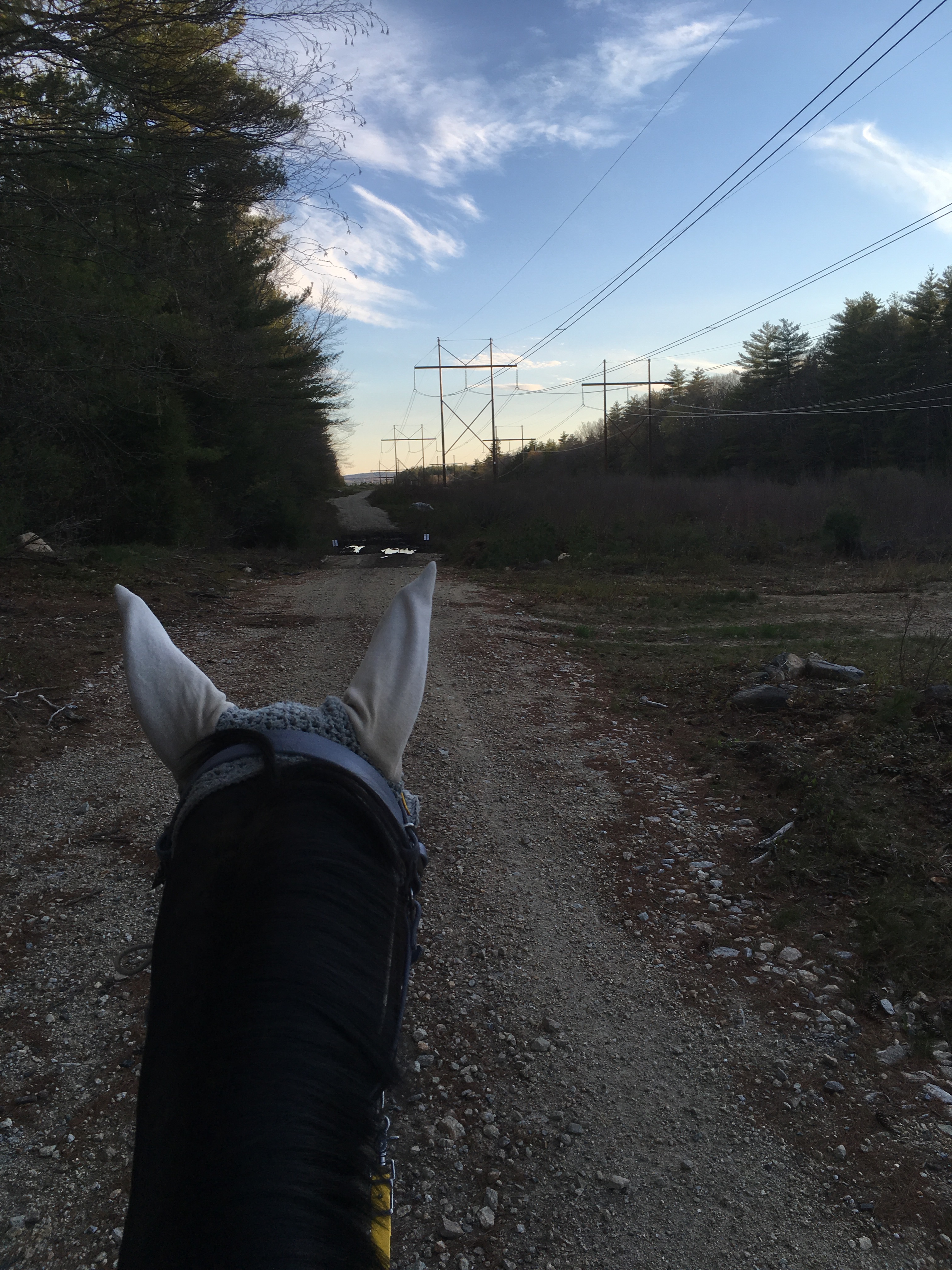
To my Dark Mare, the original “quirky girl,” I will love and miss you forever. I will never be the same for having cared for you and for having you be a part of my live, and for that, I am grateful. Thank you for everything.

Here are a few blogs featuring Lee and her adventures:

Reflections on Gratitude, Part II

A Journey of One Thousand Miles…or One Hundred

Trusting the Untrustful Horse

The Tamarack Chronicles, Volume II

Ya Gotta Know When to Hold ‘Em…and When to Fold ‘Em

The Breaking Point

I am cheering with my whole heart and soul, screaming really, my throat becoming raw, jumping up and down, urging the beautiful bay filly to keep surging forward.  She is stunning—raw power, gleaming coat, the crooked stripe on her forehead and bright yellow of her jockey’s silks distinguishing her from her older, more sedately adorned rival.  They are in a tight duel—they have led the pack since leaving the starting gate—and now as they crest the top of the stretch, my favorite has started to pull out in front.  I am yelling and kicking and riding my own ride down the stretch, as though my life depended on it, as though by sharing my own energy I can help her to cross the finish line in front.

I am in my parent’s living room, hundreds of miles from Belmont Park in New York, where the Breeder’s Cup is being held.  It is October 27, 1990 and I am 14.  My cheers and encouragement are heard only by my mother and my cat, who quickly left the room as soon as she felt the pulse of my frenetic and overly wired energy.  Until that summer, we had lived just outside of Saratoga Springs, NY, and I had spent many blissful August days standing track side, admiring Thoroughbreds, learning about pedigrees, and cheering for my favorites.  I dressed as a jockey every Halloween, wearing handmade pale yellow and purple silks.  I kept scrapbooks of newspaper clippings about anything Thoroughbred, each article I found about horse racing carefully filed and labelled in a series of big red books which lived in my closet.  On major stakes race days, I listened to the call on WGNA AM radio, religiously watched every Thoroughbred race televised on NBC,  and in the age of the VCR, dutifully recorded the Triple Crown series every year, a true disciple of the sport waiting for a return of the king who would once again wear the Triple Crown.

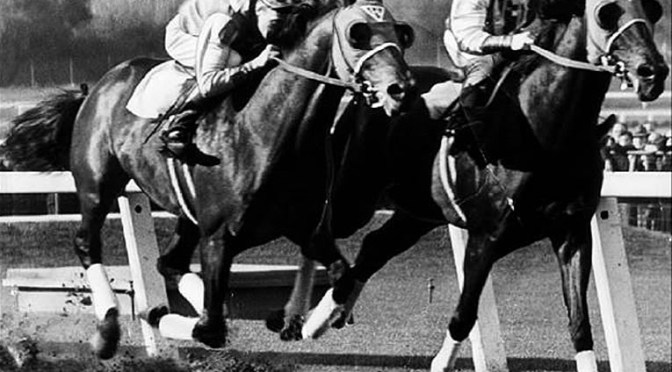
I am watching the 1990 Breeder’s Cup Distaff, a race for champion fillies and mares aged 3 and up.  The race was largely billed as a showdown between the race’s defending champion, Bayakoa, the six year old phenom and two time American Champion Older Female Horse, and Go for Wand, who had already been voted the recipient of the 1990 Eclipse Award for Outstanding Three Year Old Filly.  It was Go for Wand who I was pulling for—and with just about 100 yards left in the race, it looked like she had it.  She had a nose in front and was still pushing forward.

Go_For_Wand_BC_615_X_400_orig
Go for Wand

And in a split second, her forehand dropped, her neck rolled, and she flipped over, throwing her jockey Randy Romero to the ground before standing and trying to limp her way down the track.

And in that same split second, as surely as I had ever known anything in my whole fourteen years, I knew that I had just watched a horse sign her own death certificate on national television.  Bayakoa went on to win; Go for Wand suffered an open fracture to her right cannon bone.

If you can stomach it, here is a video of the race. 

My screams of enthusiasm became screams of horror, and I felt something come from deep inside my chest which I had never felt before.  I thought my insides were actually going to come out like a scene in Poltergeist— I was screaming and crying and shaking and wanted to throw things.  I was so, so, so angry and on the verge of losing control.  My mother came running, turned off the TV and tried to understand what had happened.  But I just couldn’t speak.

I know now that what I had felt that day was rage.  The flame burned so intense and so hot that after the emotion quelled, I realized that it had taken from me any desire to ever watch a live horse race again.  In one fateful moment, I went from being a devoted fan of the sport to someone who could no longer watch a horse race without first knowing that all of the horses made it back to the barn at the end.

A 2016 article featuring recent research on understanding catastrophic breakdowns in racehorses.

Refusing to watch has prevented me from seeing more contemporary horrors like Barbaro break his right hind leg in the 2006 Preakness, or Eight Belles fall at the end of the 2008 Kentucky Derby, the result of the same exact type of fracture as Barbaro but in both front fetlocks.  But not watching has not prevented me from hearing about these horrible tragedies and then once again replaying the fall and death of Go for Wand where it is seared into my memory.

eightbelles
I found this image of Eight Belles, who fell after finishing second in the Derby, on Pinterest, and I have been unable to find who originally took it….but it is one of the most haunting images.  Jockey Gabriel Saez tries to keep her calm.

This might not be a popular opinion right now, but I have felt the same way about upper level eventing for years.  I have been an event rider since 1997 and have organized at least two USEA horse trials per year since 2006.  But I am tired of trying to defend the sport when it feels like every time there is a major international contest, one of the participants does not come home.  I have never competed at preliminary level or higher, and I never want to.  I am in no way a part of the upper level eventing community; I can barely even be called a passing fan.  But I am a member of the greater eventing community, and so the loss this past weekend of the talented Thoroughbred cross gelding Crackerjack, and subsequent online civil war about both that specific situation and the greater questions of safety in the sport of eventing, affects me too.

Crackerjack and Boyd Martin at Pau (Dressage)– I haven’t/won’t watch the other video– I just can’t stomach it knowing what will happen.

In recent years, I have spent a lot of time ruminating on what is fair for us to ask our equine partners to do, and how far we should push them.   I am sure I still don’t know the answer. Horses are amazing, powerful, strong and yet so fragile. People will offer trite clichés when a horse or rider dies in the course of sport such as, “well, at least they were doing what they loved.”  But these are hollow and empty words, and are just a way to fill the void left when a vibrant, athletic and enthusiastic spirit departs us in a shocking and sudden manner.  Does anyone really take comfort in them?  I doubt it.

People also like to point out that horses have a propensity to harm themselves even in what seem to be the safest of environments; everyone (including me) can tell the story of a horse fatally injured at pasture or in a stall.  But can we agree that there is some sort of difference between losing a horse through a freak barnyard mishap and an accident in competition?  I think so.

SaratogaTimesUnion.jpg
Saratoga Race Track through the lens of an uncredited Times Union photographer. 19 Thoroughbreds died during its 2017 meet, the most since 2009.  Eight died in competition, nine while training, and two from “non-racing related issues”.

It might seem like a stretch to believe that one incident can change someone from loving a horse sport to hating it.  So if I am honest about my feelings regarding Thoroughbred racing, the seeds were there before Go for Wand’s death.  I had seen horses go down before, and their memories still haunt me.  In fourth grade, I wrote a short story about one, Foundation Plan, a dark bay colt foaled in 1982, who died at Saratoga while I watched from the rail.  Seeds can sit and wait for the right set of variables to present themselves so that they can grow into a fully formed thought or emotion.  Maybe value-driven emotions need to germinate for a while before they can come to flower. When the conditions are right, your true beliefs will appear before you in their full intensity.

In an October 29, 1990 New York Times article titled, “Breeders Cup: Track Life Goes On After a Day of Death”, writer Steven Crist notes that that year’s races claimed the lives of three horses and caused the forced retirement of a fourth, Adjudicating, who finished the Sprint but was found to have a repairable fracture later that night.   From the article:

“Go for Wand’s trainer, Billy Badgett, was inconsolable immediately after the death of what he called the “horse of a lifetime” but spoke about it yesterday morning.  “She had never been challenged that way,” he said.  “She just tried too hard.”

Earlier in the piece, Crist notes:  “Casual fans, who had come to Belmont on a rare outing or tuned into the national telecast of the $10 million racing card out of curiosity, were left seeking explanations, while industry insiders tried to explain that this was a horrible concentration of a rare aspect of the sport.”

Twenty seven years later and not much seems different.  While immediate connections grieve, the greater community recoils in horror.  And an industry is left trying to pick up the pieces.


Book Review: Horse Profiling: The Secret to Motivating Equine Athletes

Book Review:  Horse Profiling: The Secret to Motivating Equine Athletes

By Kerry Thomas with Calvin L. Carter

c 2012 Trafalgar Square Press, North Pomfret, VT  170 pages

ISBN 978-1-57076-508-7

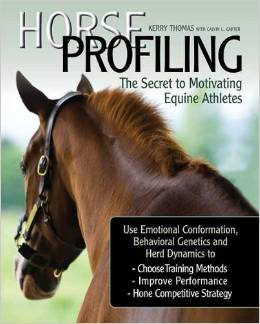
Thomas Cover

I was attracted to this book two years ago when I saw it at Equine Affaire in Springfield, MA , by the words in the title of “motivating equine athletes”.  I thought perhaps it would offer me some insight into the quirky and unique personality of the Dark Mare, and it also seemed like an equine topic which was a little bit new and fresh.  Those who know me recognize that I hoard books and I am a slow reader, particularly on equine-themed topics (overall a tough combination of variables), so it was just this fall that I finally got down to really reading this book and understanding what author Kerry Thomas is all about.

Thomas is a self-proclaimed “pioneering researcher and service provider in the field of Equine Athletic Psychology” (from the book jacket).   He has spent time studying the behavior of the American Mustang as well as that of domestic horses in a number of settings.  Thomas has developed a system of assessing a horse’s “emotional conformation”, which looks at the psychology of the horse as opposed to the anatomy of the horse, as in an evaluation of a horse’s physical conformation.  Thomas assesses the social tendencies and behavioral dynamics of each horse as an individual, which then can help to predict their performance capability. It would seem from reading the examples he provides in the book that a large percentage of his clientele comes from the Thoroughbred racing industry, which does make sense. If I were about to invest thousands in a racing prospect, I would sure appreciate knowing whether or not that horse wanted to race.

There is a need for experts who can analyze the why’s of what horses do and who understand that horses don’t act in “bad” ways to make their owners upset.  We need experts who are patient enough to get to the root cause of why horses act in the ways that they do and for why they fail to meet the owner’s expectations, once physical issues have been ruled out.  Thomas and his “Thomas Herding Technique” (THT) aim to fill this need.  Most horsepeople would agree that horses don’t always live up to their conformation and pedigree, in both positive and negative ways.  We can give plenty of examples of horses that had all the necessary raw material in terms of conformation, bloodlines and genetics to be an upper level or elite contender, but who mentally couldn’t handle the pressure or demands of that kind of ridden work.  On the flip side are horses that look like an assemblage of spare parts, horses which have no business doing anything remotely athletic or sporty, who are accomplished, successful competitors.   Thomas tries to get at the root of why this is such a common situation in the performance horse world.

Thomas advocates the importance of breeding horses not just for their physical conformation but for emotional conformation as well.  He says that by considering this quality, we are breeding horses more in keeping with the way intended by nature.  Not every horse is meant to be the leader of the herd, but every horse plays a distinct and critical role within it, and these roles contribute to the overall survival of the group. “Every family member has to be able to fill a role to make the equine herd a success, and it is the diversity of behavior that allows the herd sustainability over time and in changing environmental circumstances” (Thomas, 2012, p. 57).

I had high hopes for this book, but for me personally it became too bogged down in customized terminology (for some examples: “emotional conformation”, “emergent properties”,  “individual and group herd dynamics”, “P-type grading”, “Focus Agility”, etc) which became hard to follow.   Additionally, I felt like the book had a heavy emphasis on the training and performance of Thoroughbred race horses, which did not feel as applicable to the performance of riding horses.  However, I did appreciate that Thomas uses many specific case examples from his personal work to help highlight his concepts, and it is quite interesting to read how he problem solves various behavioral issues in the horses he is asked to evaluate.

While I don’t think I am capable of going out and assessing my horses’ personalities using Thomas’s system after reading this book, there were several positive aspects and messages that made me appreciate reading it anyway.  First, Thomas emphasized throughout the book the critical importance of good equine management in terms of maintaining the mental and physical well-being of your horse.  In Chapter 9, Thomas discusses “The Broken Circle: Potential Withholds and Equine Mental Illness”, and in the ensuing pages, details eight key causes of behavioral problems.  Many of these issues are the direct result of less than ideal horse management, including lack of exercise/excessive confinement,  improper weaning, separation from herd mates, and the stress of a change of career (i.e., a horse used to full work or showing/performance is abruptly transitioned to a retirement setting).   Thomas emphasizes the importance of movement, social interaction and mental stimulus in maintaining a horse’s overall health and happiness.

One more concept which I took away from this book is a reminder that the horse is a creature of movement, and movement/action is part of their mechanism of communication within a herd.  We as trainers need to bear this in mind when working with our horses.  Thomas uses the term “Focus Agility” to define the natural ability of the horse to interpret stimulus while in motion (Thomas, 2012, p 114).  A horse may be physically athletic but if they cannot maintain their mental focus at the same time, their performance will be diminished.  Additionally, horses must be able to interpret stimuli while in motion—i.e., is that thing over there a threat or not, is that thing something worthy of my attention.  To help horses develop this skill, Thomas advocates incorporating simple management strategies to help continuously challenge your horse through “mental stimulus exercises” (Thomas, 2012, pp 43-47).  For one example, on a daily basis, change how your horse enters and leaves his paddock.

Overall, I found Horse Profiling to be easy to read, well-illustrated with current photographs and clearly organized.  I think that the book gets weighed down with terminology that is unique to Thomas’s system; it would have been helpful to have some way of continuously reviewing the terminology and its definitions as you moved through the chapters, or perhaps a glossary of these terms.  The examples cited in the book for the most part come from Thomas’ own experience, and they do help demonstrate how his theories work in practice.  However, I would have liked more specificity in terms of examples of “how to try this at home”—how to classify your own horse’s emotional conformation.

In general, I would recommend this book as worth a read if you have an interest in equine behavior. But be prepared to study it with care before the pieces come together.

3.5/5 stars

http://www.thomasherdingtechnique.com/index.php

From this site,  you can read more about Thomas and his work.  Also, you can download a free excerpt from the book!