Motivating the Lazy Equine Athlete

Further Learnings from the Area I Scholarship

In 2015, I was lucky enough to be one of ten recipients of an Area I Eventing Scholarship.  In my application, I indicated that I planned to focus on training rather than competing Annapony this season.  I used funds from the scholarship to pay for lessons with Verne Batchelder, Denny Emerson and Nancy Guyotte (see Another Clinic with Nancy Guyotte).  Throughout each session, one theme became abundantly clear:  Anna is a capable, but somewhat lazy, athlete, and nagging her for “more” will get you nowhere. My lesson with Nancy focused mostly on show jumping, while Verne tackled dressage and Denny, cross country.  In this blog, I will discuss the main exercises and techniques learned in the sessions with Verne and Denny.

Verne Batchelder:  Using Double Longeing to Improve Suppleness and Impulsion

Verne Batchelder of River House Hanoverians in Williston, FL, gives clinics regularly in New Hampshire.  I have really enjoyed working with him over the past several years both with Anna and Lee.  One of Verne’s great strengths is his ability to find many different approaches to correcting deficiencies, all while staying within a clear training system and progression.  Verne is also an expert with work in hand, including double longeing and long lining; he regularly includes such techniques in the training programs of his own horses, which I had the opportunity to witness on a visit to his farm several years ago (see Winter Training Sessions: Mini-Pro Style).

RiverHouse

Having worked with Verne a number of times previously, he is well familiar with Anna’s tendency to be generally lacking in impulsion.  Some of this he attributes to her inherent mellow nature, but some of it is due to a lack of suppleness.    We have worked on improving her suppleness in a variety of ways, including improved neck control, the use of traditional lateral exercises such as shoulder fore, leg yield and haunches in, as well as longitudinal stretching work like long and low or lengthenings.

This spring, Verne decided for the first time to incorporate some work on the double longe into our session. His intention was to provide increased support through the outside turning aids while improving control of the curvature of her neck.    I remained mounted while Verne ran two lines; the outside line was simply attached to the bit ring and ran over my leg and around Anna’s hindquarters, while the inside line was set up as a sliding longe.  This meant that the line ran through the inside bit ring and then attached to a loop on the girth, underneath my inside foot.  With the sliding longe, the ground handler can smoothly achieve correct inside flexion.  The outside line allows for a clear and consistent support through the entire arc of the horse’s body while also providing a mechanism to apply a traditional half halt.

Here is a video which shows a little bit of basic long lining.

It is quite a strange feeling to essentially have one’s horse ridden from the ground while one remains mounted!  Anna has longed only a little bit, and I was definitely mildly (well, greatly) concerned that she might not be a model citizen when put into these boundaries.  My job was to essentially hold the reins evenly and to remain centered, adding leg to support Verne’s body position and voice.  At first, Anna was somewhat resistant to the idea of accepting the newly imposed limits.  It is important for a trainer to remember that resistance is only the horse’s way of expressing their displeasure.  If the question the trainer is asking the horse is fair given their physical condition and previous training, and the aids are appropriate, usually the rider’s best response is to simply ignore the resistance and remain consistent in using the aids to ask the appropriate question.  In fairly short order, Anna relaxed into the new parameters established by the double longe and began to more actively engage the muscles of her topline as well as increase the degree of thrust from her hindquarters.  In addition, the connection further stabilized and the quality of the bend improved.

After this session with Verne, I incorporated the use of about ten minutes of warm up on the double longe with Anna on dressage days, with the inside line set up as a sliding longe.  When the horse is unmounted, side reins set just a little bit on the longer side will help to maintain straightness; as always, they should not be adjusted in such a way that the horse’s head is forced down or in. In working with this technique independently, I noticed that Anna could find her own balance and begin to develop looseness throughout her back more rapidly than when warmed up under saddle.  When I rode her after this style of warm up, she was much more willing to stay “hotter” off my leg and therefore I could use a much quieter forward driving aid.

Here is a video of some double longeing.

One of the other huge benefits of using the sliding longe technique to warm up was that the overall work session could remain “short and sweet”.  Because she had already loosened up her muscles, it was possible to keep the actual “work” session much more focused and organized.  I think this is super important with all horses, but especially those which don’t have an unlimited reserve of energy.  If you can get in the ring, do what you need to do, and then go out for a hack, the horse’s attitude will stay fresher and more enthusiastic than when they anticipate a long session of drill work.

Denny Emerson: Jumping Fences off a Forward Stride

Anna and I spent the summer of 2014 up at Tamarack Hill Farm, where we worked hard to rebuild our confidence over fences (see The Tamarack Chronicles: Vol III).  We left in August with a renewed sense of harmony and assurance in our jumping work and completed the fall season with placings at King Oak and Stoneleigh Burnham Horse Trials.
Keim-C-090714-3765
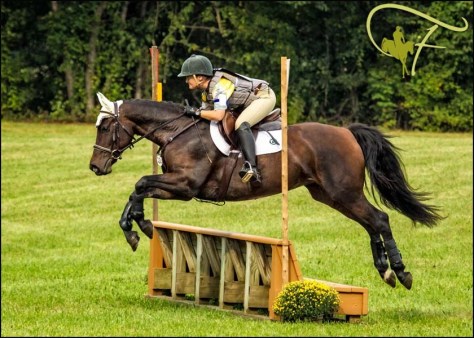
Anna at King Oak Farm, September 2014. Photo courtesy of Flatlandsfoto/Joan Davis and used with permission.

Overall, I was able to continue to apply the techniques I had learned at Denny’s to our regular schooling routine and keep Anna’s jumping skills tuned up while working on my own over the winter.  In general, I keep the fences low enough that “mistakes” are not a big deal.  I have focused a lot of energy on further refining my jumping “eye” and improving the quality and consistency of Anna’s jumping canter.

Denny always says that when under pressure, all riders will show a tendency to either “choke” or “chase” their eye.  What he means is that we all have a preference for pushing a horse to lengthen their stride, perhaps leaving a bit too long, or to overly compress the horse, causing them to jump from a deep spot.  While either option might be the best one in a given circumstance, neither is ideal as a method of riding to every fence; this is why most of us have to develop,  through practice, the ability and habit of organizing the horse’s canter to arrive at the  “ideal” take off spot.  It is my opinion that horses, too, have a tendency to prefer to leave long or to jump deep, and they also need to be conditioned to be able to jump from a variety of different reasonable points.

IMG_5190

Anna would be a “choker”.  She can be carrying a decent amount of energy and power in the canter, and then in the final few strides before the fence, drop behind the leg, compress her stride, and calmly decelerate to the base with increasingly shorter strides.  It isn’t quite the same as a “chip”, which is when the horse will squish one extra small stride right in front of the fence.  With Anna, it is a steady deceleration which allows balanced but small strides to be fit into the space where a few longer strides would have been better.  She is simply more comfortable jumping from a slightly tighter distance off a shorter stride.

For a long time, I have allowed Anna to manage her fences in this way, as it seemed to be the place from which she was most confident.  It is also incredibly difficult to prevent her from doing it, and when I try to address the issue, I feel like I am beating her with my legs and/ or crop to keep the canter going.  I have participated in clinics (most notably with Kim Severson) where the entire focus became trying to eliminate this change in the canter, to get Anna to jump more “out of stride”, but I always end up feeling like both Anna and I are frustrated.  She also will begin to shut down if you really push her on it—her response seems to be, “hey, I jumped your fence, lady, what more do you want?”

BankTHF14

The major issue is that there are some fences which simply do not ride as well when jumped from this tighter spot, including upright verticals like planks and wider oxers.  In addition, she will often quit when faced with this deep distance and a tough question.  Yet when I push her to maintain the same canter to avoid this situation, she will obstinately ignore my aids and put herself into the not ideal take off point.  It is just yet another manifestation of her tendency to not stay in front of the leg.  Story of our lives!

So if I rode like Michael Jung or Ingrid Klimke or any of the other equestrian elite, my horse would never have gotten to this point.  But as I am a mere mortal, and have made a ‘deal’ with my horse, I am now faced with trying to change the terms of our established contract.

My session with Denny started in the show jumping arena.  After a brief warm up on the flat, I began popping over a few of the smaller fences in the ring.  Anna was obedient but also performing her signature “I change my canter on the approach” maneuver.  Denny decided that the focus of our session was going to be keeping her much more forward overall, but especially in those critical last few strides before the fence.

JumpingtheCows
In this lesson at Tamarack in summer of 2014, we were racing an impending storm– the energy in the air came through into the pony and we finally found some forward intention!

Still in the show jumping ring, Denny had me kick Anna up into a cross country style canter—as much of a gallop as Anna will do under saddle (have I mentioned that she is not a very forward thinking animal?).  My job was to do whatever it took—growl, flail, kick like a D2 Pony Clubber—to keep her not just in a jumping canter but a forward, cross country canter, to each and every fence I aimed at.  I really did feel just like a 10 year old whose legs don’t clear the saddle flaps, both in technique and overall effectiveness.  For her part, Anna did stay much more forward, but it wasn’t coming from within her—it was the result of my motivation.

So in spite of seeing this glimmer of improvement, Denny decided that we needed to go out onto the cross country course to seek more energy.  Most horses show an intrinsic improvement in their forward intention when they are out in the open, and the terrain of Vermont would also provide some assistance.  Denny hoped that by adding in these variables, Anna would begin to better ‘self-motivate’ in her approach to the fences.
OneStrideBank
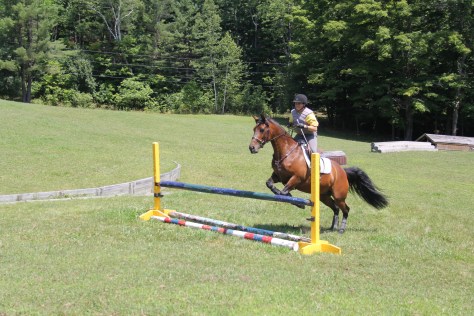
Working on a similar exercise at Tamarack in the summer of 2014, we had jumped up a bank and then were looking for a bounce to this vertical.  I must be trying to pick her up off the ground here!

The exercise seemed simple—pick up a positive canter at the bottom of a slope, kick on up the hill, then ride a gradual turn over the crest of the hill and allow the momentum of the descent to carry us forward down to a tire jump at the bottom.  The objective?  To maintain the positive, forward energy up to and across the fence, with no change in step.

It was really, really hard to not “check” Anna on the descent down the hill.  The tire fence we were tackling at the base was small, and so no matter where we came to, Anna would be more than able to cope with getting us up and over.  In spite of that, it took everything in my power to not try to come to a specific take off point.  For the first several attempts, I did pretty well at the roll down the hill but when Anna began her typical slow down at the base, I did little to prevent it.  It was truly amazing how effortlessly she could check all of that forward energy and then insert her little microstrides in before the jump.
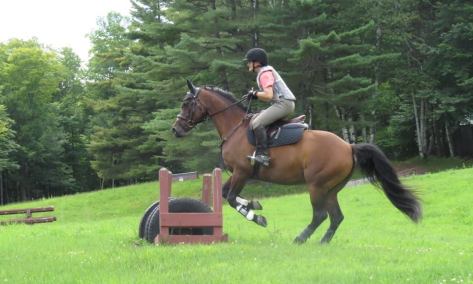
THFAug4

I ended up having to channel that inner ten year old girl again, and basically kick and flail and feel like we just galloped down the hill, before Anna FINALLY jumped the tire fence directly out of stride.

Left to my own devices, I don’t think I would ever have been brave enough to ride Anna so aggressively.  I still have hunter equitation roots, where aids such as visible kicking or moving out of harmony with the horse are certainly frowned upon.  I think I would also have worried too much about getting her out of balance and causing her to make a dangerous mistake.  But Denny made two comments regarding these thoughts:  1) The fences MUST be kept low and straightforward, so that jumping them is a given almost regardless of the horse’s balance and 2) he almost never ever coaches riders to ride like this either.  Anna is just that lazy!

THFAug5
Finally getting it right!  Photos by Denny Emerson.

My major take home from this session was that no matter what, I NEED to practice remaining assertive and positive with the forward driving aids up to and away from each and every fence.  I don’t think that I have been passive with my aids at all; it is just clear that in some circumstances with some horses, it is possible to be even bigger and louder with your aids than you might think is appropriate!

I would really to thank the members of the Area I Scholarship for choosing me as one of the 2015 recipients.  I feel that I definitely benefitted from the instruction I gained from the scholarship, and I hope that through these blogs, other riders with lazy horses might gain some additional ideas or insights into techniques which can help them, too!

Book Review: The Complete Guide to Endurance Riding and Competition


By Donna Snyder-Smith

c 1998 Howell Book House, New York, NY 244 pages

ISBN 0-87605-284-7

I picked up Snyder-Smith’s book in preparation for my successful first time attempt at completing a three day 100 mile competitive trail ride.  The author is an experienced horsewoman with a broad background and successful Tevis Cup completion on her resume; while the focus of the book was more on endurance riding than competitive trail, I found that more than anything, it was a book about good horsemanship, and there is something which riders of any discipline can take away from it.

EnduranceRidingCompetition

In this book, Snyder-Smith takes a comprehensive look at the details of how to prepare a horse and rider team for success in the sport of endurance.  Full chapters are dedicated to riding in balance, gymnastic development of the horse, conditioning and feeding the endurance horse and the merits of various types of equipment.  The book concludes with a look at the requirements for crewing at an endurance ride and then the dynamics of a ride itself.

What struck me over and over in reading this book was how so much of what the author stated applied to not just endurance horses, but to all equine athletes.  For example, she outlines the requirements for a successful endurance horse as follows: “good feet, a good respiratory system, a good mind, to be an efficient mover, the desire to do it” (Snyder-Smith, p. 8).  However, these are ideal qualities for ANY performance horse, though perhaps certain other disciplines could be more forgiving to a horse which does not have the best attributes in some of these areas.

LeeCookieHill
Lee and I on the last day of the three day 100 mile ride at GMHA (VT), fall 2015.

In her chapter on the importance of rider balance, Snyder-Smith goes into great detail on the importance of body awareness, symmetry and correct riding position and their collective effect on the horse for better or for worse.  If a rider is expecting a horse to carry them over tens of miles of terrain, it is critical that the rider is doing their part to be efficient and to maintain their own balance and coordination.   Horses can cope with rider asymmetry or weakness to a point, but adding in the cumulative stress of a long ride to the mix means that an inefficient rider can make the difference between a completion or a pull.  Lest anyone think that trail riders need not be attentive to the performance of their mount, Snyder-Smith states that “Riding that is comfortable and productive for both horse and rider is based on the rider’s ability to feel the horse and what it is doing with its body” (Snyder-Smith, p 22).  In other words, riding well, and riding correctly, matters!

LeeWent2010MysticalStretching
Lee at the Wentworth schooling show in 2010. Photo Credit to Mystical Photography, used here with permission.

In her chapter on preparing the endurance horse, Snyder-Smith addresses the difference between conditioning and training, and emphasizes that both are required for success in endurance.  Snyder-Smith explains that endurance horses need to spend time in the arena in order to develop their flexibility, suppleness and strength.  In fact, she proposes that basic dressage training is an excellent way to introduce a “systematic, gymnastic training program…to enable horses to perform to the limits of their athletic capabilities without injury,” (Snyder-Smith, p 63).  Another especially important concept for successful conditioning is that “if you are not able or willing to listen to your horse and learn from him, your success as an endurance rider will be limited” (Snyder-Smith, p. 84).  Again, the author is specifically referencing conditioning for the sport of endurance, but the reality is that this idea applies to all disciplines across the board.  Another universally applicable statement is that “commonsense is the single ingredient that, when missing, causes the greatest damage to horses” (Snyder-Smith, p 87).

Throughout the book, Snyder -Smith inserts tips and helpful hints from her own experience as a distance rider.  For example, she suggests mixing electrolytes with baby food like strained carrots or applesauce to make them more palatable. She also discusses the experience of how having a vet make a comment about your horse’s soundness at a check can cause even an experienced rider to doubt the animal’s fitness to continue.  Having personally had this experience at a few rides, I know how much it gets under your skin and infiltrates your consciousness, even when you are really fairly confident that the horse is okay and what the vet saw might be just fatigue or the result of a misstep.

25MileRideAug2014 005
Three happy distances horses at the end of a successful ride!

Overall, I found Snyder-Smith’s writing easy to follow and the concepts clearly explained and well-articulated.  This book was immensely helpful to me in my own preparation for the 100 mile ride, and to help me as a novice to become more familiar with the requirements of the sport.  But more than anything, I found the author’s perspective on horsemanship refreshing.  Simply put, if you take your time, do your homework and only ask of the horse that which you have properly prepared them for, you can expect their best effort.  For this reason, I would recommend the book to riders of any discipline who are reaching out of their comfort zones for a larger goal.

“If your horse has it in him, you’ll be able to get it out of him if you don’t ask for too much too soon and use him up,” (Snyder-Smith, p 175).

5/5 stars


Hilary Clayton:  Biomechanical Interactions Amongst the Rider, the Tack and the Horse

Dr. Clayton shares her thoughts at the University of New Hampshire Equine Program on October 27, 2015

There is no doubt that how we ride our horses, the tack we use on them and the manner in which the horses carry themselves has a cumulative effect on their well-being over time.  Whether that effect is positive or negative is one of the questions considered in the study of equine biomechanics, which combines the disciplines of physics and physiology to study how forces and work affect the body of the horse.  Dr. Hilary Clayton is well known for the work she has done in this field, and she visited the University of New Hampshire in October of 2015 to share her thoughts on some of the more common interactions which occur amongst the horse, the rider and the tack.

HilaryClaytonPortrait
Dr. Hilary Clayton (Photo taken from her promotional poster.)

Equine Topline Mechanics 101

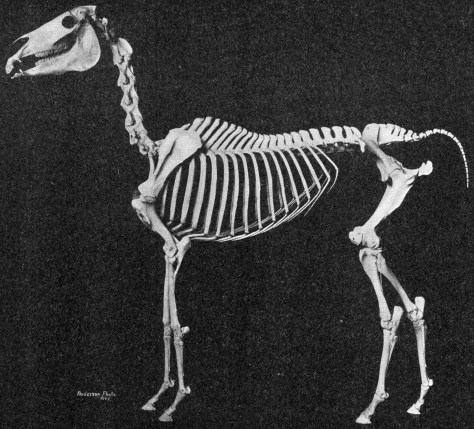
Clayton started her presentation with an overview of the structure of a horse’s vertebral column and how it works.  Just like in humans, the horse’s spine is made up of bone, ligaments, muscles and discs; equine discs are relatively thin compared to a human’s, and therefore horses don’t suffer from slipped discs and disc pain like humans can.  Even though the horse’s spine is horizontal, it loads similarly to a human’s in that it compresses together when force is applied.

Arabian_horse_skeleton
In this skeleton of an Arabian, it is easy to see the difference in the bones of the cervical and thoracic spine.  Note also the proximity of the spinous processes.

Each intervertebral joint has a small degree of mobility; when taken in totality, this allows for considerable movement along the entire length of the horse’s spine.  The degree and type of movement which the topline displays varies with each gait. In the walk, there is some bending and rotation in the topline, but little flexion or extension.  At the trot, there is more flexion and extension and the back is stabilized.  At the canter and the gallop, there is a great deal of flexion and extension, particularly in the lumbosacral joint, and the back is stabilized.

The Horse in Motion by Eadweard Muybridge

Instructors and trainers will often tell their clients that their horses need to move with a swinging back.  Clayton explained that this statement is not wholly accurate.  When in locomotion, the horse’s back must actually remain stable in order to support the horse’s weight and to transmit propulsive forces from the limbs. Clayton says that when the horse moves at liberty, they are not actively moving their back.  The back movement we see is due to gravity, inertia and the propulsive forces of the hind leg. In fact, excessive mobility of the bones in the spine during motion is never the goal—it is the muscles which need to be supple into order to control the movement of the spine.

Charlotte_DUJARDIN_JEM2014
Charlotte Dujardin and the incomparable Valegro.  Photo by Florence Skowron, via Wikimedai Commons.

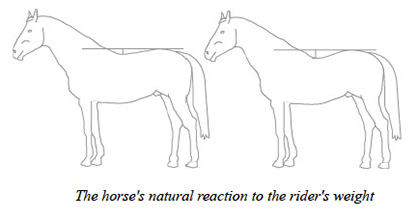
Clayton compared the structure of the articulated vertebrae of the horse’s spine to a beam which has a support at each end.  In the horse’s case, the “beam” tends to sag a bit in the middle, due to the weight of the internal organs and other viscera.  When we add the weight of a saddle and rider to this region, we increase the hollowing of the spine and the “dip” in the middle of the beam.  Clayton explains that with a rider, the range of flexion and extension is the same but the entire cycle of the motion is more extended.

Through the above description, it should be immediately apparent that the weight of the rider is inherently causing stress on the horse’s topline.  More troubling, though, is that when the horse’s back is hollowed as result of this weight, the dorsal spinous processes are approximated, which can lead to the development of the degenerative condition known as kissing spines.  Clayton’s research has shown that far more horses are affected with kissing spines than just those which show overt symptoms; however, even at a subclinical level, the syndrome can cause the horse discomfort and reduce the quality of their performance.  The good news is that when the back is rounded, the opposite effect occurs—the spinous processes are spread out. Therefore, regardless of your discipline, you horse should learn to work with a round topline.

kissingspines
In this image borrowed from a fellow wordpress user, the kissing spines can be clearly seen.

Round Backs and Development of the Horse’s Core

Clayton compared the mechanism which causes the horse’s back to be round to a “bow and string”.  The “string” is comprised of the muscles on the underside of the bones of the back, in this case the abdominal and sublumbar muscles.  The “bow” is therefore made up of the muscles located above the vertebrae.  Rounding their back requires the coordinated action of the horse’s core muscles.

Athletes of all species can achieve more optimal performance with a strong core.  These muscles are important both for balanced movement and coordinated stabilization.  Clayton divided the muscles of the horse’s core into three groups:  the back muscles, the sublumbar muscles and the abdominal muscles, and the groups work in concert to achieve the maximum mobility of the horse’s spine.

horsereactiontoweight
Image from http://www.equinechronicle.com

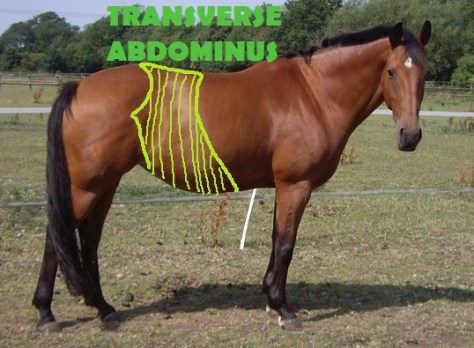
The back muscles make the topline hollow, round or bend right and left.  The sublumbar muscles flex the lumbosacral joint and the pelvis, which helps to bring the hind legs forward and underneath the body.  Finally, the abdominal muscles wrap all around the horse’s belly, running many different directions.  This group of muscles includes the transverse abdominal, the obliques and the rectus abdominus.  Collectively, they literally help hold the horse’s ‘guts’ in place, as well as stabilize the spine and assist with lateral bending.

Clayton explained the function of the back muscles in more specific detail. First, she discussed the longissimus and iliocostalis muscles, which are the long mobilizing muscles of the back.  They are made up of long fibers and cross many joints. These muscles are able to move the entire back of the horse.

The multifadi muscles serve the function of stabilizing the horse’s back.  These muscles are located right against the spinous processes and are comprised of short fibers which cross only a few joints; therefore, they work on only a limited area of the horse’s spine.  However, the condition of these muscles can have a profound effect on the shape of the back in a specific area.  More will be said on this later.

horse_anatomy_the_muscles_by_wiggle_chicken
Image from jenpenjen.deviantart.com

Clayton pointed out that most muscles work in pairs or layers; therefore, the deep stabilizing muscles are as important as the long mobilizing muscles, as they help to prevent vibration in the horse’s bones.  They also have a low activation threshold, which means that they will contract (along with the transverse abdominal muscle) simply in anticipation of locomotor activity.  They then serve to stabilize the horse’s spine as the limbs move.

Limited research has been done on the many effects of the horse’s stabilizing muscles on the spine.  However, research done on humans has shown that chronic back pain is often associated with atrophy of the deep stabilizing muscles, as joints then become too mobile.  Impaired spinal stabilization is an important risk factor and a predictor of recurrent back pain in humans.  Based on her research, Clayton extrapolates that a similar connection exists in horses.

core.stability.muscles
Notice how the same muscles provide stability to the human spine.  Image found on http://www.appliedpostureriding.com.au

Human research has also shown that even when back pain is resolved, the deep stabilizing muscles do not resume normal activity on their own.  Physiotherapy exercises are necessary to re-train the pre-activation of the stabilizing muscles.  In human patients who underwent this therapy, the one year recurrence rate of pain reduced from 80% to 30%.

When it comes to back pain, Clayton says that horses go through a similar cycle to humans.  When the back hurts, the deep stabilizing muscles become inactive, resulting in atrophy.  This causes the long mobilizing muscles to compensate, but since they are not equipped to stabilize the spine, these muscles spasm and cause further pain.  Therapeutic exercises are needed to reactivate the deep stabilizing muscles and to break the cycle of compensation and pain.

Developing Your Horse’s Core with Dynamic Mobilization Exercises

Clayton has developed a series of core strengthening exercises and sequences through her research, and she goes into illustrated depth about these in her book, Activate Your Horse’s Core (Sport Horse Publications, 2008). She gave a brief synopsis during her presentation.

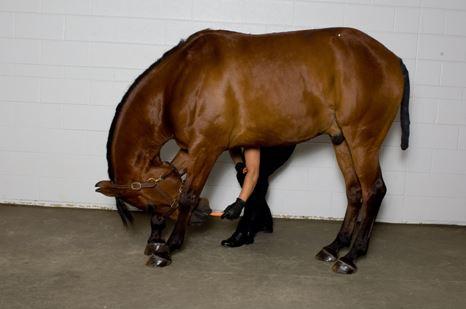
Dynamic Mobilization Exercises are those in which the horse follows a controlled movement pattern which strengthens the muscles that move and stabilize the back.  They are comprised of rounding exercises and bending exercises.  In the rounding exercises, most of the flexion comes from the poll (high position) or the base of the neck (low position).  In the bending exercises, most of the movement comes at the base of the neck.

pilatesmobile1
Image from http://www.horseyard.com.au, from an article related to Dr. Clayton’s work.  

Clayton described a protocol which provided positive results in several “couch potato” school horses.  Using small bits of carrot to motivate the horse, they did three rounding exercises (chin to chest, chin between the carpi (knees) and chin between the fetlocks) and three lateral bending exercises (chin to girth, chin to hip, chin to hind fetlock).  For the lateral bending exercises, the human stood next to the horse, making them bend their neck around the human.  Horses did five repetitions/day and on left and right sides, if appropriate.  The exercises were repeated five days/week for three months.  Even with these stretches as the only form of exercise, the horses showed a positive development in their deep stabilizing muscles.

One of the benefits of these exercises is that the horse will only stretch as far as they are comfortable.  Ideally, the handler should encourage the horse to hold the stretch for as long as possible, but even stretching for a short period will help improve the strength of the multifidus muscle.   The best benefits are seen when these exercises are performed before the horse works each day; regular inclusion of them in a training program will help equine athletes throughout their career.  In addition, these exercises can be used in youngsters to help develop the deep stabilizing muscles before they begin under saddle training and are also especially beneficial for horses recovering from colic surgery, with appropriate approval from the attending veterinarian.

Transverse-Abdominus
Image from http://www.classicphysiotherapy.co.uk

The Role of Equipment and Rider in Equine Back Pain

When it comes to saddle selection and fit, it is clear that both the horse and the rider must be comfortable.  While the rider can simply vocalize their discomfort, the horse must express it in other ways, and it is important for riders and trainers to remain sensitive to this communication.  Unfortunately, the manner in which horses display the existence of back pain is as variable as the causes.  However, both the saddle and the rider can contribute to discomfort in the horse’s topline, and certain issues are almost sure predictors of pain in the horse.

horse-and-rider

Clayton has made extensive use of an electronic pressure mat which sits on the horse’s back in her research on saddles.  This specialized mat has 256 sensors (128 on each side of the spine) which measure force distribution on the horse’s back.  Her research has shown that the total force placed on the horse’s back varies with the size and weight of the rider and saddle as well as the gait of travel.

For example, in the trot, the suspension phase has minimal pressure, while the stance phase of each stride has the maximum force.  This is when the horse’s body is starting to rise up, but the weight of the rider is still down.  The mean force placed on the horse is at least equal to the rider’s weight in the walk; in the trot, it is two times the rider’s weight and in the canter it is three times.

equetrian-market-01
This image, taken from http://www.sensorprod.com, shows the pressure profile of a rider’s buttocks and thighs on the saddle.  Clayton’s tools offer her similar insight into the intensity, duration and location of pressure when a horse is in motion. 

Clayton says that she is frequently asked to quantify how much weight a given horse can fairly be asked to carry, but she says that this is a complex question to answer.  Variables such as the height, weight, conformation, fitness and soundness of the horse all play a role.  For example, a horse with a short and broad loin coupling can likely carry more weight than a horse of similar size with a long or narrow loin.  As far as the rider goes, variables such as weight, fitness, symmetry, balance, postural control and health issues all influence the impact they have on a given horse. Also important is the activity the horse is being asked to do—what type of work and on what kind of footing or terrain.

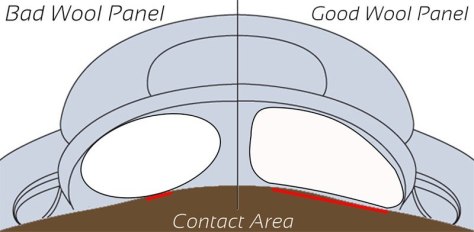
Finally, the saddle itself can have a positive or negative impact on a horse’s comfort level.  Each saddle is unique in terms of its load-bearing area, fit and suitability for a given horse, rider and job.   Soft tissues compress when pressure is applied.  The larger the area the force is spread over, the less overall pressure there will be.  This is one of the reasons why more modern saddles have long, broad panels.

Saddle-Panel-Diagram1-1024x501
Image from http://www.totalsaddlefit.com

Pressure is calculated via force divided by area.  Therefore, the pressure increases if the force is larger or if the contact area is smaller.  Areas of deep pressure can be very harmful, causing ulcers or necrosis of the tissue due to increased capillary pressure.  On a less extreme level, pressure can cause discomfort through abrasions.  Clayton says that it is the magnitude and duration of pressure which are most important.  Muscles in particular are easily damaged by pressure.

If you see dry spots under your saddle after work, these are areas of increased pressure which prevent the sweat glands from working and are cause for concern.

dryspot
In this photo, it is clear where there has been an area of increased pressure and therefore inhibition of the sweating mechanism. 

Interesting Saddle Trivia

In her research, Clayton has had cause to investigate a number of different areas in which saddles might impact the horse, and she shared some of her findings with the audience.

One of the first questions she looked at was whether a saddle is truly necessary.  Most riders prefer to use a saddle for the stability and security it provides them on the horse’s back, and as it turns out, horses seem to prefer that their riders use saddles, too.  Without a saddle, the pressure of the rider is distributed over a smaller area, and the focal points of that pressure are over the rider’s seat bones.  (Interestingly, Clayton found similar results when she looked at one brand of treeless saddle, as well).  Clayton found that in general, a saddle which fits the shape of the horse’s back and the shape of the rider’s pelvis will provide stability to the rider’s position, and as a result, the pressure is more evenly distributed.  She also mentioned that within a breed, 80-90% of animals will have a similar back shape.

Correct saddle fit is of course of paramount importance.  Correctly fitted saddles are more stable, which increases horse and rider harmony.   The rigid parts of the tree, including the gullet plate, the points and the bars, can cause increased areas of pressure on the horse’s back.   It is important to consider the width of the gullet plate and length of the tree’s points in relation to the position of the scapula and related muscles.  When the horse extends their forelimb, the scapula rotates back and down on its back side, and rotates a little bit up in front.  This causes the back edge of the scapula to actually slide underneath the saddle in this moment of the stride.  A well fitting saddle should allow for free movement of the scapula when the forelimb is protracted.

Dia-2-Saddle-Fit
From http://www.equilibriumproducts.com

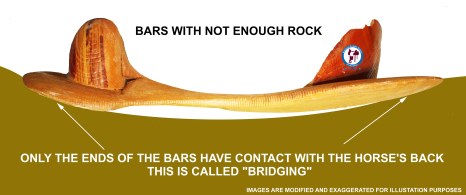
Clayton says that the width of the tree is equally important.  The correct width allows the load to be evenly distributed over a large area.  Ideally, the contact area is long and wide, with no focal points of high pressure.  A tree which is too wide may cause the gullet to put direct pressure on the withers and/or cause high pressure along the panels close to the spine.  In addition, the saddle often tips forward and down.  A tree which is too narrow is one of the most common causes of bridging; there is more pressure at the front and the back of the panels, and the saddle tips backwards.  Clayton says that bridging is the most common saddle fit problem, and it must be evaluated with the rider on board and while the horse is in motion.

bridging
Image from http://www.saddlemakers.org.  

More nuanced aspects of saddle fit include assessing the width of the gullet and slope and shape of the panels.  A wider gullet is usually better, because it allows mobility of the spine without causing it to hit the edge of the panels.  The slope of the panels must also suit the shape of the horse’s back. Panels come in a variety of widths and curvatures, and it is important that the type chosen suits the individual animal.

Finally, Clayton emphasized that saddle pads cannot compensate for the deficiencies of a poorly fitting saddle.  However, they may increase the horse’s comfort if the saddle is essentially the correct size and shape.  Clayton says that pads made with natural fibers, such as sheepskin, seem to have a better degree of resiliency and spring.

Girths and Slipping Saddles

Girth design has evolved considerably in recent years, and Clayton touched briefly on the subject at the end of her talk.  She said that the highest pressure beneath the girth occurs just behind the elbow in the moment when the forelimb contacts the ground. In her research, contoured girths seem to do the best job in terms of reducing both force and pressure.

Finally, Clayton discussed saddles which seem to constantly slip to one side.  She says that it is important to determine if the cause of the slip is the horse, the rider or the fit of the saddle.  Subtle hind limb lameness can be blamed for the cause of many slipping saddles, particularly when the slip occurs consistently to one side and with a variety of different riders on board.  In 60% of these cases, the saddle slips towards the side of the lame/more significantly lame hind limb.  The slip will go away when the lameness is eliminated through the use of nerve or joint blocks.  Clayton commented that rider crookedness is more likely to be an effect than the cause of saddle slipping.  Clearly if the cause of the saddle slip is lameness, this issue must be addressed before the problem will go away.

Final Thoughts

Clayton’s presentation covered a broad range of topics, but one theme was quite clear—riders have an obligation to their horses to ride them in as correct of a manner as possible, in the best fitting tack possible.  In this way, riders and trainers can actively contribute to the preservation of the horse’s long term soundness and promote their well-being.

Cadre_noir_-_saut_au_piquet.jpg
With good training and attention to correct tack and conditioning, horses are truly capable of amazing feats.  “Cadre-noir-saut au piquet” by Alain Laurioux