Managing your Velociraptors…Or your herd of mares

Mares aren’t everyone’s cup of tea, but I don’t mind them and without any sort of conscious decision making on my part, I find that I have now acquired a herd of three of them.  Little did I know, however, that establishing harmony in this herd would prove to be so emotionally draining for all involved.

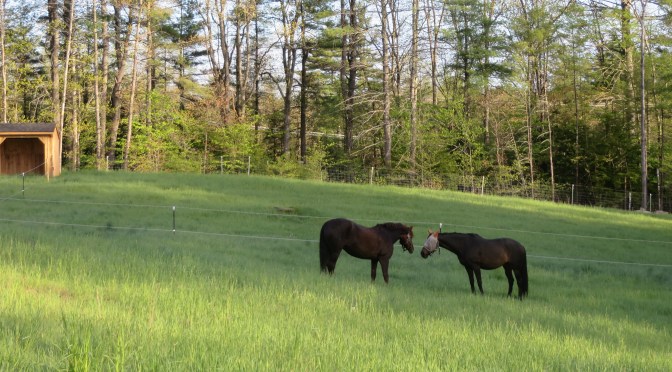
For the past nine months, the Dark Mare (Lee) has contentedly been living here alone at Cold Moon Farm.  She was pretty settled in her routine, hacked out here there and everywhere alone, and admired the goats which live next door.  This all is quite impressive given that at her core, Lee is a pretty anxious and insecure horse who draws a lot of her confidence from the animals around her.

Lee and the New Fence 003.JPG
Lee enjoying grass in the new fencing for the summer pastures.

But last week, I upended her little world.

On Wednesday, I brought home our new friend, Spring Hollow Marquesa.  Marquesa is a 20 year old purebred Morgan who has been a part of the school horse team at the U of New Hampshire for the past eighteen years.  She is still quite full of life—everyone knows that a 20 year old Morgan is merely middle aged—but as far as we can remember, she hadn’t been off the UNH property in nearly fourteen years, and that just to school cross country.  Considering all of this, the fact that I was able to quietly load her on my own and bring her home uneventfully is pretty impressive.  But even so, the move was a big lifestyle change for her, too.

Marquesa comes to Cold Moon 008.JPG
Spring Hollow Marquesa

Marquesa is a sweet mare, and in my twelve years of teaching off of her, I have never seen her so much as flick an ear back at another horse, never mind exhibit any of the other stereotypical “marish” behaviors that people dislike.   I figured Marquesa would be dominant over Lee, who would be happy once again to have an Overlord to tell her where to stand and what to do all day.

I put them in side by side paddocks to meet and greet.  There were a few quiet squeals but nothing too terribly dramatic.  I left them like this overnight, and then the next day turned them out together for one hour on grass.  They seemed to be pretty content with one another, and were clearly taking comfort in each other’s presence—while still exhibiting all of the behaviors of sorting out dominance. And I started to see a side of Marquesa that I hadn’t before; she was acting a little bit like a bully.
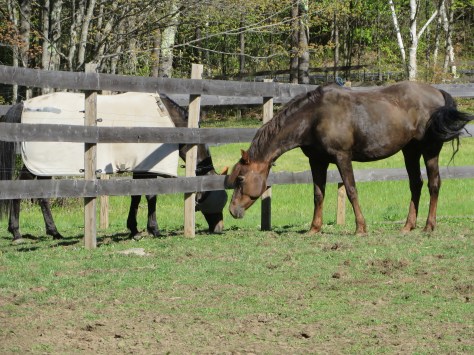
Marquesa comes to Cold Moon 014.JPG
Meeting officially.

Marquesa’s main body language cue was the snaking of her neck.  Watching her do this motion over and over made my own neck hurt.  She walked circles around Lee, arching her neck and snaking it around and around.  Lee clearly understood this meant to pay attention and smartly trotted off.  I didn’t ride her in those forty-eight hours, but I suspect she easily covered ten or twenty miles being ‘driven off’ by her alpha.
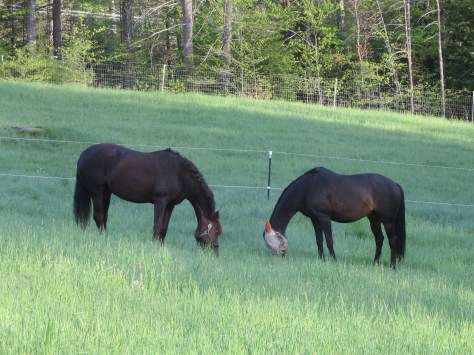
Marquesa comes to Cold Moon 019.JPG
Out together for the first time.

At feeding time, I stood guard between them.  Again, the first few meals were funny…Marquesa actually tried to get to Lee’s food, in spite of my presence.  I drove her away with voice and body movement, and she reluctantly moved off, snaking her neck the whole time.  What had happened to the sweet mare that I had known for twelve years?

This is where my ‘mare drama’ started to remind me of the movie Jurassic World.  If you haven’t seen it, the lead male character, played by Chris Pratt, is a trainer who works with a pack of the highly intelligent velociraptor species.  If you are a devotee of the franchise, you will know that the “raptors” are clever, communal hunters.  They can open doors and seem to be able to use logic to solve complex problems.  If you are going to be followed by dinosaurs, raptors are not the ideal.  Pratt’s character handles the animals by establishing himself in the ‘alpha’ role; this required a relationship with each individual but in particular the beta raptor, Blue.  This alpha role was reserved for him alone; other humans could not step into his place within the hierarchy (which is played up to great theatrical drama in the movie).

Raptors.gif

Marquesa is allowed to be dominant over Lee, but under no circumstances is she going to be allowed to be the alpha mare.

That would be me.

But I wasn’t done disrupting the peace and harmony previously enjoyed at Cold Moon Farm.  Two days after bringing Marquesa home, Annapony also joined the group.  Having previously experienced the challenges of having Anna live in the same paddock as Lee when we went to Tamarack Hill two summers ago, I had already decided that side by side living was going to be preferable this time around.
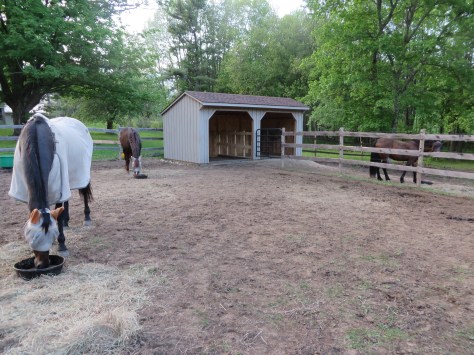
Raptors Settling In 027.JPG
A moment of peace after several days of chaos.

So now there were three raptors.  The challenge:  figure out how to manage the group so that horses can be handled and ridden safely with the minimum of risk to person, animal or property.

The first forty eight hours after Anna came home were probably the worst.   All three horses were acting like feral creatures; unhandled and rank, ill behaved, no respect.  I really wondered if it was going to work out.

Right now, the horses spend most of the day in the sacrifice area as they are gradually introduced to grass.  Three horses in two paddocks and one human means that in order to get everyone into the grass fields, someone at some point is going to be alone.  Anna was the logical choice, and she more or less was good about it—except for one day, when at the end of the lead rope she demonstrated the most amazing array of airs above the ground that I have ever seen from her.  I took to wearing my helmet for turn out and turn in.

The first time Anna saw the peaceful goats that live next door…velociraptor snorting and passaging up and down the fence line.  So Lee next to her also became concerned about the goats and starting running around to help her feel better.  The same goats that have been here THE ENTIRE NINE MONTHS SHE HAS LIVED HERE.  Lee’s behavior then irritated Marquesa, who started her neck snaking behavior again. This sort of communal drama played itself out repeatedly.

Raptors Settling In 001.JPG
Lee lays down only on rare occasions.  She seems to feel safe with this pack! Note the fence board which doesn’t fit the others.  Raptor Repair # 1.

Then came the process of separating the mares for basic care.  You know, those unusual sorts of things we like to do with them—daily grooming, riding, etc.  Oh the screaming and the calling and the nervous pooping.  The two who were left together outside weren’t happy.  The one who was inside being tacked up wasn’t happy.  The drama. The chaos.  I was left truly questioning my judgement in bringing them all together into one place.

With the mild weather, I have been sleeping with the windows open, which meant I could hear every snort or squeal, and every set of trotting hoof beats (no doubt as Marquesa snaked her neck again and set Lee off moving).  I tried only to get up when the noises sounded extreme, which took some discipline.  Still, I slept with the flashlight by my bed, ready to shine it out on their fields in the front of the house at the first sign of significant drama.

Like any good raptor pack, this group has been religiously testing the fence line.  Now, it is on the agenda for the summer to do some replacement of worn boards, run a new fenceline down one side to block off the wet area and finally install some functional electric wire to keep them off the boards.  But these edits have not yet been made.  So far, we have broken two boards and destroyed the bungee gates which were separating the two paddocks, resulting in all three raptors being out together one morning earlier this week.  That ruckus I slept straight through, and in the morning I found them all fairly peacefully existing in the same space.

Raptors Settling In 014.JPG
The new gate.  Installed courtesy of YouTube and my interns!

But day by day, the raptors seem to be settling into their new routine.  They are almost ready for full day grass turnout, which will give them plenty to do other than test boundaries—and if they do, they will receive a strong electric charge for their efforts.  Each horse can now successfully be taken away from the others for their daily care and exercise, with Lee being the last one to come around (it is as though nine months of pent up frustration over being home alone are all coming out in one week of temper tantrums).  Sweet Marquesa is back to being her cheerful self and is learning how to be an independent trail horse.  And Annapony has really set the bar high with excellent dressage schools and a solo hack two miles down the power line trail and back. Perhaps there is hope for this pack after all.

I wish I could say that I had stayed calm and cool through it all.  In reality, I was a nervous, worried mess and could barely focus for my worry.  If I had had a friend in my situation, I would have said the same things my friends said to me:  “Give it time”  “they will work it out”.  Intellectually, I knew this but emotionally I stressed.

In the meantime, we continue to adjust to our new lifestyle. The thing about mares is that you can’t force them to do what you want.  You must present the question and then give them time to choose to participate.

I think the raptors are choosing to be okay with their new arrangement.

Riding Aside

A Day with Side Saddle Expert Rhonda Watts-Hettinger

Considering the diversity of disciplines available for the modern rider, side saddle may seem like it would have become relegated to the annals of history, an antique style without merit to a contemporary equestrienne.  But a devoted community of side saddle riders keeps the technique alive, regularly competing aside in nearly every discipline, from eventing and fox hunting to dressage and even western.

Sure, Boyd Martin does it once, a photo gets posted and now all the groupies are fawning over how cool he is for trying it out.  But all of us normal folks also had a chance to get to know more about riding side saddle, thanks to a wonderful clinic with Rhonda Watts Hettinger at Fox Brook Farm in Berlin, MA, in early April.  The clinic was organized by volunteer extraordinaire Susan Goldfischer to benefit the Old North Bridge Hunt, of which both women are members.

Zones 2016 and Side Saddle 021
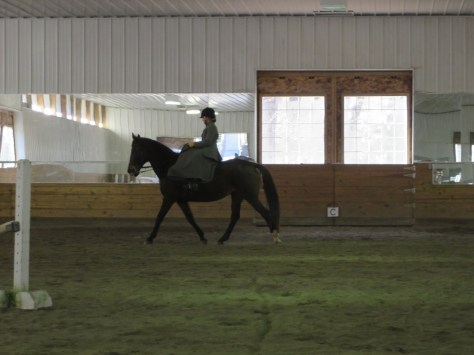
Rhonda and her homebred mare, Cricket, give a brief demonstration.

Rhonda gave us an over view of “side saddle 101” and then many in attendance gave riding aside a try, either on their own horse or one generously provided by facility owner and host, Ginny Zukatynski.

I remembered seeing Rhonda riding side saddle while competing her horse at the UNH horse trials back when I was an undergrad.  I thought eventing was hard enough without sitting side ways but she sure made it look easy, and with her formal attire she and her horse cut a sharp image.  So it was kind of cool to see her again so many years later and share her extreme passion and commitment to this traditional, feminine style of riding.

Saddle Fit

Rhonda started her presentation by informing the audience that most anything we already knew about riding astride applies to side saddle as well, and this theme certainly recurred throughout the day.

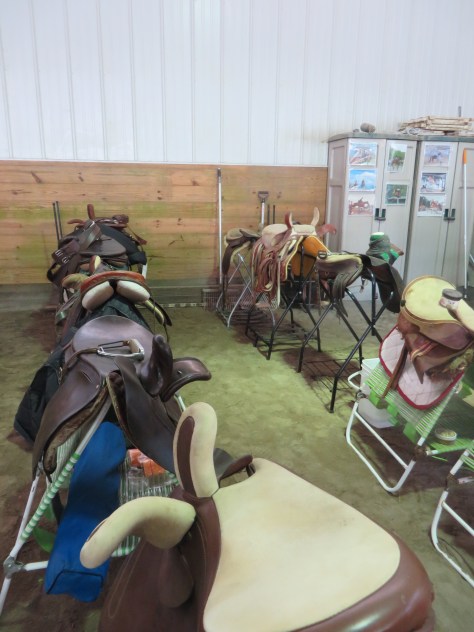
Side saddles are clearly unique from other English style saddles, with a broad, flat seat and just one stirrup, traditionally on the left, or “near” side.  The horns are also on the left; the top horn is called the ‘top pommel’ while the lower one enjoys the more colorful title of ‘leaping horn’.  Most saddles seem to fasten with whatever your chosen style is of traditional English girth, though Rhonda mentioned that the old fashioned three fold leather girths are still considered a standard appointment and are coveted by modern side saddle riders.  Unique to a side saddle is the ‘balance strap’, an additional thin strip of leather which increases the security and stability of the saddle on the right, or “off”, side. The balance strap prevents the saddle from lifting up or pitching back and forth.

Zones 2016 and Side Saddle 010.JPG
Side saddles come in many shapes and sizes.

Rhonda commented that the unfastened side saddle is particularly precarious and can easily slip due to the weight of the horns, which can be damaged should the saddle fall.  Otherwise, though, fitting a side saddle is much like fitting any other saddle.  The saddle should fit well over the withers and have clearance through the gullet; the seat should be level and bridging should be avoided.  To help support the horns on the left, side saddles usually have a longer tree point on the left side, so this area must be carefully checked to ensure it isn’t digging into the horse’s shoulder.  When padding is added to improve the fit of a side saddle, it is usually done so on the right side in order to keep the saddle centered.

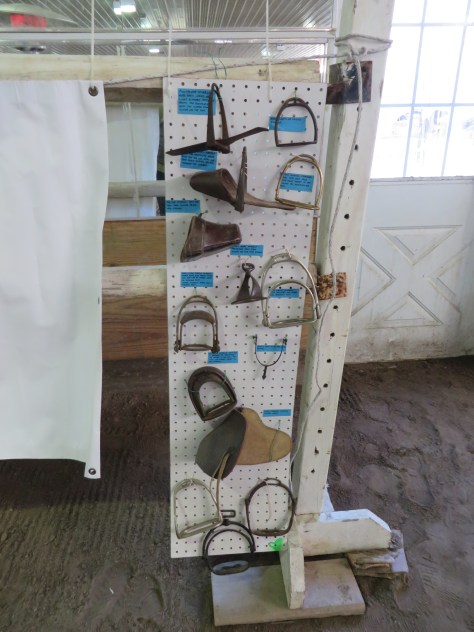
The stirrup of a side saddle is considered part of the rider, not a part of the saddle, and the rider should detach it when she dismounts.  The stirrups do not run up and feature a quick release mechanism, allowing them to snap free if caught.

Zones 2016 and Side Saddle 008.JPG
A variety of different styles of stirrup.

Rhonda commented that many of the best side saddles still available are older antique models; however, many of these were made to fit Thoroughbred types and so have narrower trees.  This can provide a fit challenge when working with a modern horse, which also is typically better fed than its more historic counterpart.

Rider Attire and Styling

Most everyone that I know who has gotten into side saddle has done so because they thought that the formal habits just looked smashing, and therefore needed an excuse to wear one.  At our clinic, Rhonda was dressed in ratcatcher style, also known as informal attire to foxhunters.   However, several versions of habit were on display and ranged from historical recreations to fancy ladies’ dress.

Zones 2016 and Side Saddle 013.JPG
Cricket models her side saddle.

Rhonda offered some practical tips on attire for the aspiring side saddle rider.  Side saddle boots are cut short, especially for the right leg, so that the rider isn’t nipped behind the knee by their boot.  Riders can get away with wearing paddock boots while they are getting started.  Rhonda suggests wearing britches that match the color of your habit; apparently wearing light pants with a dark habit can be quite suggestive!

Zones 2016 and Side Saddle 012.JPG

Side saddle riders have used a safety skirt or safety apron since the early 1900’s; this skirt is specially cut so that the rider’s outer legs are covered, but the seat of the rider and off side have only a minimal amount of fabric hanging down.  This makes it easier for the rider to come free should she start to fall, without risking getting tangled in her skirts.   Riding trousers were introduced in the 1800’s to be used underneath the skirt, and today are replaced for most women with regular riding breeches.

For a rider interested in showing side saddle, the various appointments are important and could take up a whole article in and of themselves.  It would be important to consult with the rules regarding your specific discipline to be sure that you are not in violation. For example, carrying a cane on the off side is permitted in some sports but not others.

Tips and Technique

Unlike most English disciplines, side saddle riders spend most of their time sitting.  But just like when a rider sits astride, it is important to ensure correct alignment and posture, and equal balance on both seat bones.  If anything, the evenness of the rider’s seat becomes even more critical because the weight of the rider becomes an essential component of communication with the horse.  Because of the amount of sitting work, horse should not be started in side saddles until they are four to six years old and already have a base of fitness on them.

When riders first mount, they do so in the traditional manner—on the left side, by stepping the left foot into the stirrup, swinging the right leg over, and settling onto both sit bones astride.  The rider should settle here until she has her weight centered.  From there, the rider will lift her hands on the reins and bring the right leg up and in front of her, settling it on the top horn.   It is important to not shift the seat bones when the rider makes this transition; at first, most riders will find that they have to slide back.

The rider uses the right leg to support themselves, pulling the heel towards the shin of the left leg while simultaneously pointing the toe down.  There should only be a small gap behind the rider’s right knee.  The position of the saddle causes the rider to sit a little higher and further back than in a regular saddle; the reins will also need to be kept a little longer.

Zones 2016 and Side Saddle 094.JPG
Sitting aside for the first time. Balance strap adjustment!

Clearly, the rider’s weight will have a tendency to shift to the left, since this is where her legs are positioned.  In fact, back in the day when ladies rode because it was fashionable to do so, rather than because they really wanted to, many were only taught how to walk and canter on the right lead, because turning right helped to keep the rider more centered and balanced.

Because it is easier to turn right, Rhonda started each of the clinic participants out in this direction.  Most riders have been trained to look where they want to go, and so tracking right causes the rider to shift her eye—and therefore her weight—to the right.  This also allows for a secure contact of the leg on the horns.  The rider should try to keep an equal distance from her last rib to the top of the hips on both sides of their body.

Rhonda told us that anytime you get into trouble in a side saddle, the best thing to do is to pull the right shoulder back, which will automatically snug the rider into the horn.

The First Person Experience

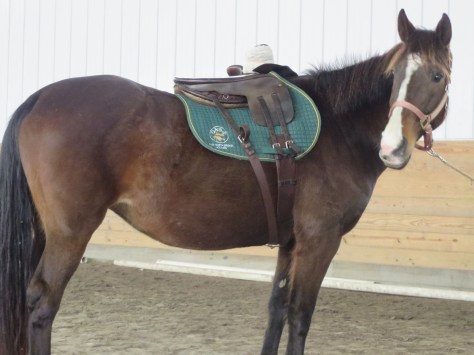
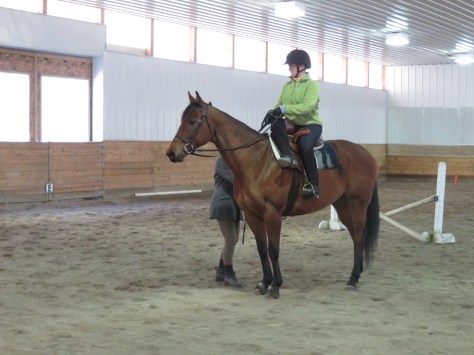
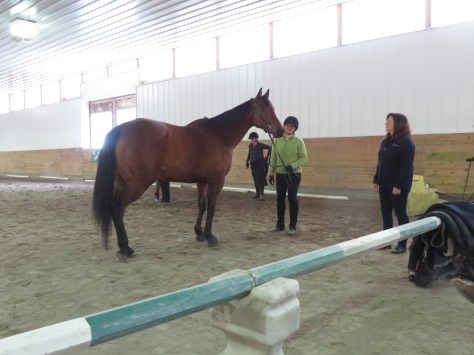
For my first side saddle experience, I had the pleasure of riding Betty Boop, an OTTB owned by Ginny’s daughter.  Boop’s first side saddle ride had been with Rhonda in preparation for the clinic, and her second ride was with yours truly.  A seasoned hunt horse, Boop was rather unconcerned with the whole affair.

Zones 2016 and Side Saddle 085.JPG
Boop waiting for her saddle.  Her owner looks on.  Thanks for sharing her!  

As with the other riders, we started tracking right, and by keeping my eyes to the right and pulling back the right shoulder, my alignment fell into place.  I quickly determined that to be a dedicated side saddle rider, one would develop a fairly good degree of body awareness.  I tried to emulate my best yoga posture, but at first this translated into a bit of rigidity.  Rhonda reminded me to relax my shoulders and arms enough to follow the horse, which seemed quite obvious— once she pointed it out.

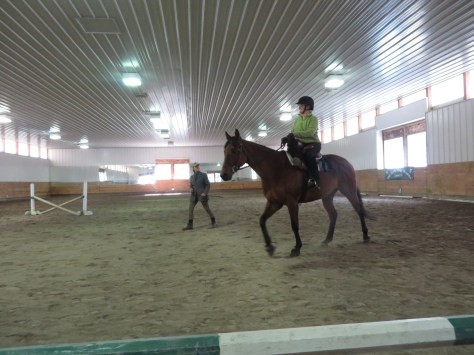
We soon progressed to a little trot.  We started in the sitting trot, which feels pretty easy and natural in this saddle.  The ‘post’ of a side saddle rider is much less distinct that when riding astride.  We practiced this too—a sort of shifting of the rider’s weight from the seat bones onto the thigh.  The rider never really comes out of the saddle, but the process does give horse and rider some of the benefits of posting.

Zones 2016 and Side Saddle 097.JPG

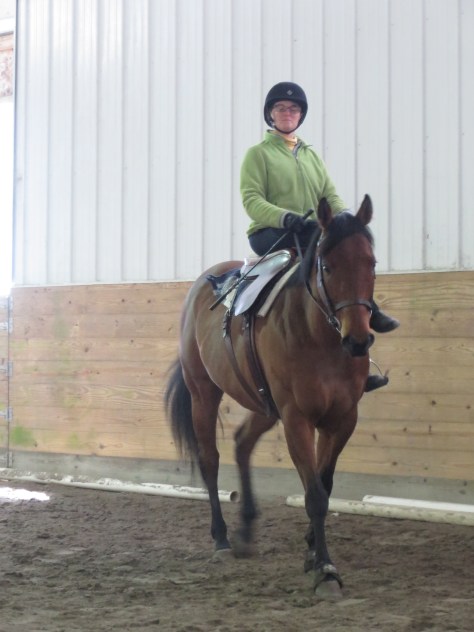
Since things seemed to be going well, Rhonda let us try a bit of canter.  Here I felt the least secure but I tried to remember what Rhonda had said about keeping the eyes and shoulder to the right.  As it turns out, after thirty plus years of riding, my body seems to know what to do on a cantering horse—even if one of my legs is hooked over funny!

Rhonda let us try a little bit of walk, trot and canter to the left as well.  She instructed me to keep focusing the eyes to the right, even though we were tracking left, in order to keep the legs secure.  Going to the left while focusing to the right may seem counterintuitive, but isn’t super different than other “counter” dressage movements, so it didn’t feel as awkward as one might imagine.  The canter to the left definitely was the most difficult of the phases, and it was here that I felt the least balanced.

Zones 2016 and Side Saddle 120.JPG

Having one’s right leg hooked over the front of the saddle does mean that the rider really has to be intuitive about how they are using their seat bones.  Rhonda said that the flying change, for example, can be achieved just by a shift in the weight and swing of the seat.  This should be true in any well trained horse, but for a side saddle horse, there is no hiding behind a leg aid.  Riders can carry a cane on the off side, and Rhonda let me carry one with Boop.  But to cue the canter, I thought more about using the inside seat bone and a little kiss sound.

Final Thoughts

Going into the day with limited knowledge of side saddle riding, I found that I have come away with quite a newfound appreciation for this unfamiliar discipline and its supporters.  Like Rhonda said, most everything you know about riding astride is also true aside, but I further feel that trying side saddle can only improve a rider’s sense of balance, feel for alignment and coordination while riding astride.

Many thanks to Rhonda, Susan, Ginny and the rest of the crew who helped put this clinic on!

Zones 2016 and Side Saddle 132.JPG