Metabolic Management of your Endurance Athlete

Notes from a lecture presented by Dr. Susan Garlinghouse at the ECTRA Winter Getaway 2017

For horses covering long distances, the management of metabolic health is of the highest priority.  For the competitive distance rider, attention paid to these specific parameters can spell the difference between a completion and a pull (or retirement, for riders used to other disciplines). Distance riding is a sport whose mantra is the phrase, “to finish is to win”.  Most distance riders want to have a fun and successful weekend, which means that they are bringing home a healthy horse; to this end, they are always working to learn how to better care for their mounts.

SGarlinghouse2014.jpg
Dr. Susan Garlinghouse (photo from AERC)

Dr. Susan Garlinghouse presented “Beating the Metabolic Pull” at the Eastern Competitive Trail Ride Association (ECTRA) Winter Getaway in Boxborough, MA in early February, offering attendees instruction and strategies based on the most current of scientific evidence.

Dr. Garlinghouse is an endurance rider and has completed the grueling Tevis Cup no less than three times.  She has ridden her Tennessee Walking Horse John Henry over 2,800 endurance miles.  Garlinghouse referenced John Henry many times during her talks throughout the weekend, as her insights into metabolic management have been influenced by the additional challenge posed by preparing a horse with a dense build for strenuous competition.  She is a well-known authority on many of the unique health and maintenance issues faced by the distance horse.

Garlinghouse emphasized that during a ride there are three primary factors which must be managed to ensure the horse’s wellbeing:  hydration, gut motility and energy balance.  They are listed here in their relative order of importance, and we will explore each one now in a little more detail.

Hydration

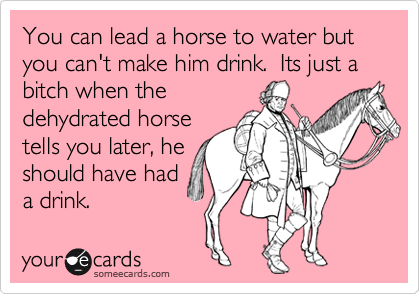
Garlinghouse says that 90% of metabolic issues come from hydration loss.  The line between “sufficient hydration” and a horse at risk is incredibly narrow.  Horses sweat at the rate of 1.5-3.75 gallons per hour, and may produce over forty gallons of sweat during a 50 mile ride.  During heavy exercise, horses may lose 5-6% of their body weight, with about 4-5 gallons of net fluid loss.

Dehydration during heavy work can affect equine athletes in all disciplines, and the effects come on quickly, beginning with 2-3% dehydration rates.   Health concerns escalate rapidly from there.  At 6% dehydration, capillary refill time and heart rate are elevated.  At 8%, capillary refill time will be 2-3 seconds (normal is under 1), with dry mucous membranes, dry or mucous covered feces, and decreased urine output.  At 10% dehydration, capillary refill time will be over three seconds, and the horse will have a high, hanging heart rate with weakness and cold extremities; this horse is in serious trouble.  At 12%, the horse is close to death.
dehydration.jpg

The difference between 4 to 8% hydration in a 1000 pound horse is only 4-5 gallons of water.

Some riders believe that the horse will naturally consume water sufficient to replace this lost fluid, but this is a myth.  According to research done on fluid balance in endurance horses conducted at UC Davis, the horse will only replace about 2/3 of fluid loss through voluntary drinking.  For example, if ten gallons of fluid have been lost, the horse will only voluntarily consume 6-7 gallons.  Equally concerning is that this same research showed that over 60% of the horses starting at the 100 mile endurance rides where the studies were being conducted were already dehydrated to some extent, prior to starting the ride.  Another 20% were at the high end of normal.  Just 10% of the starters began the ride at optimal hydration.

Therefore, it becomes incumbent to create situations in which the horse will stay at a higher rate of hydration before and during the ride.

Garlinghouse offered several strategies to help with this.  Even for the non-distance rider, some of these practices could help enhance their performance horse’s well-being, especially before intense work or competition.  First, Garlinghouse recommends feeding lots and lots of hay—horses will drink 1.5-2 gallons of water for every five pounds of hay that they consume. She also reminded the audience that the rate of passage from the mouth to the hind gut is relatively slow. What you feed your horse on Thursday becomes their source of energy on Saturday.

fall-2016-037
Roughage should always be at least 50% of your horse’s ration, and for a distance horse, more is better.

Feeding soluble fibers, like beet pulp or soybean hulls, can also increase the fluid reservoir available to the horse during a ride.  These feed stuffs help to retain fluid and electrolytes which the horse can pull from during exertion.

The manner in which we feed our horses is also important to consider.  Garlinghouse explained that there are fluid shifts in the body associated with the consumption of large (over 4.5 pounds), episodic (fed more than 2-3 hours apart) meals.  When we feed on this schedule, as much as 5-6 gallons of fluid shifts from the plasma and tissues and into the gastrointestinal tract, leading to a 15-24% reduction in plasma volume.  The effect is transient, lasting two to three hours.

If your horse is at rest, this isn’t a big deal.  But if your horse is teetering on the edge of being dehydrated, and then there is this huge fluid shift…well, that is not good.

To prevent this, riders must ensure that their horse has something going into their digestive system more frequently than every two hours.  Garlinghouse emphasized that the quantity doesn’t have to be great—grazing, some carrots or apples, a baggie of soaked beet pulp—will all do just fine.

beetpulp
Soaked beet pulp.  Photo credit:  www.equinenutritionnerd.com

On a related note, Garlinghouse cautioned riders about the common practice of syringing large doses of electrolytes into the horse’s mouth, as this draws fluids from the plasma and into the digestive tract in a similar way to large servings of food.  The effect can be minimized or eliminated by giving electrolytes in small but frequent doses, preferably after the horse has been drinking.  So eight, 2 ounce doses is preferable to two, 8 ounce doses.  Garlinghouse also recommends mixing electrolytes with a buffer like kaolin pectin to help reduce the risk of ulcers.

Another cause of excess dehydration is feeding high amounts of protein.  Garlinghouse recommends feeding distance horses at a 10% protein rate.  Protein fed at higher rates will be used for energy production, but processing protein in this manner results in waste heat, almost 3-6 times as much as what is produced through the processing of fats or carbohydrates.

Garlinghouse’s “Fast Facts” on Hydration:

  • Maximize your horse’s forage intake for 2-3 days before the big ride to increase their reservoir of fluids and electrolytes
  • Provide small, frequent meals throughout the ride rather than a few large ones
  • Minimize the amount of protein in the diet

Gut Motility

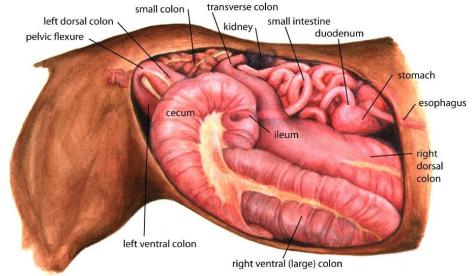
While dehydration is responsible for 90% of metabolic problems, gut motility can be one of the first accurate indicators of stress.  Gut motility slows down when blood supply is reduced, which can happen anytime the horse’s systems are under excessive demand somewhere else.  This is because the gastrointestinal system is the last in line in terms of the “pecking order” amongst the horse’s body systems; vital organs like the brain, heart and lungs come first, followed by the muscles of locomotion, then skin surfaces for heat dissipation…and then the GI tract.  This chain of command stems from the horse’s prey animal status; if you are about to be eaten, it is more important that you can effectively run away than that you can digest your breakfast.
dg-pic-1
Equine digestive system.  Photo credit: http://www.threeoaksequine.com

For the well-being of the horse, it is important to actively monitor and stimulate GI activity during a ride.  Garlinghouse recommends carrying a high quality stethoscope and have a vet teach the rider how to check all four quadrants.  Improving motility can be as simple as keeping small amounts of feed in the stomach, which triggers a hormonal release thereby increasing motility.  Another strategy is to occasionally slow down, which will reduce heat production and therefore the demand on the skin surfaces to release excess heat.   The nature of distance riding can cause a horse’s body to think is constantly being chased.  Slowing down will reverse this effect.

Garlinghouse cautions against feeding pellets or cubes at a ride, both of which require extra fluids to process.  Instead, feed soaked products, including hay.  The better the horse’s overall hydration, the more efficiently he will circulate his blood and therefore improve his gut motility.

Energy Balance

A distant third to hydration and gut motility in terms of managing the horse’s metabolism during a ride is energy balance.  There are many different strategies related to effectively managing a horse’s feed ration leading up to and during a ride.  Garlinghouse helped to dispel some common misconceptions and offered some practical tips to help ensure adequate energy reserves for the endurance horse.

There are two primary sources of energy for exercise:  fats and glucose (from carbohydrates).  Fats are more energy dense, offering 2.25 times the energy of an equivalent amount of carbohydrate, and the body can store fats in much greater quantities.  Glucose is generated from the breakdown of carbs; limited amounts are stored as glycogen in the muscle and liver, but glucose is the limiting substrate in fatigue.  Therefore, the thoughtful rider should be trying to maintain glycogen stores by balancing the diet with fat.

Garlinghouse suggests a ration with 10-12% fat in a commercial grain is acceptable, so long as horses are given time to get used to it.  Fats are calorically dense and help to maintain the horse’s body weight.  They also have a glycogen sparing effect.  Additionally, Garlinghouse recommends supplementing with a glucose source throughout the ride.  Riders should not provide extra fats during a ride, as the horse cannot process fat that quickly.  A horse in good body condition already has all the fat they need for the day’s energy requirements.  Horses should not arrive at the ride so thin that ribs are visible, as they do not have an adequate fat reserve.
proforce-fuel
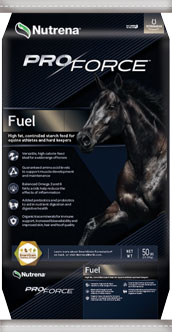
My distance horse, Lee, has been running on ProForce Fuel for the past three seasons.  It is 12% protein/13% fat.

One of Garlinghouse’s most important messages related to energy balance was that horses should not receive a large grain meal within four hours of their ride.  Feeding grain causes an increase in blood pressure, triggers insulin release and inhibits the utilization of fat.   In the distance athlete, this is particularly troublesome because the horse will experience something similar to a ‘sugar high’; the transient effects of the grain meal will cause the horse to be hyper to start the ride but then they will experience a ‘crash’.  Most grain digestion occurs in the small intestine, and the stresses of the ride will cause some of the grain to spill into the cecum undigested.  The bacteria which live in the cecum are not able to process grain, and this can cause GI stress.

Garlinghouse again emphasized that horses should be fed a meal with a high glycogen index (like a sloppy beet pulp meal) not later than midnight before a ride.  On the ride morning, horses should receive unlimited hay and then small, frequent meals throughout the ride day, which will minimize the insulin response while maintaining gut motility.

Final Thoughts

There is certainly always more to learn when it comes to managing a horse’s well being during a long distance ride.   Garlinghouse gave attendees plenty to think about and apply to their own horse’s feeding and management strategies as we move into the 2017 season.


Book Review:  Schooling and Riding the Sport Horse

Schooling and Riding the Sport Horse by Paul D. Cronin

C 2004 University of Virginia Press, Charlottesville 274 pages

ISBN 0-8139-2287-9

Schooling and Riding the Sport Horse was originally given to me to review for possible use as a text in a course I teach at the University of New Hampshire.  I had high hopes for the book, as author Paul Cronin is a well-respected protégé of the late Vladimir Littauer and also the longtime director at Sweet Briar College’s riding program.  The content of the book is geared towards the riding and training of hunter/jumpers and is well organized.  Unfortunately, it is also dry and dense, with dated images, and will simply not be read by the Millennials I am now responsible for educating.  If you tell me that you have a Millennial-aged student who will actually read this book….I frankly don’t believe you.

I started reading Schooling and Riding the Sport Horse back in 2014.  I finished it late in 2016.  I was stubborn and determined to get through it.  It is simply not a page turner.

CroninSportHorse.jpg

As a rider/trainer whose interests tend more towards dressage and eventing, I still find a great deal of helpful inspiration in understanding the training systems used by those who are more oriented towards hunters, equitation and jumpers.  In this book, I do think that Cronin clearly and progressively lays out the elements of his system, which is geared to develop the position, controls and schooling of the horse used in forward seat riding.  But starting as early as the introduction, I started to take issue with what I perceived as his derogatory tone towards the classical dressage system and his belief in the superiority of what he calls the “American hunter seat”.  I think I had a hard time letting go of this perceived slight throughout the rest of the book.

PaulCronin.jpg
Author Paul Cronin in an uncredited photo. 

With that being said, I found much to agree with in the book as well.  I appreciated his emphasis on the importance of correct and progressive work on the flat to prepare horse and rider for over fences performance.  For example, Cronin points out that “it is not accurate to refer to the short gaits with hunters as classical collected gaits. That is a concept that has a special meaning in educated classical dressage riding.  The hunters are not collected and on the bit but are connected and on soft contact” (Cronin, 2004, p. 33). This sentence is contained in his chapter on “Position and Controls”, in which he details some of the differences in theory and objective between what I would call classical dressage theory and American hunter seat theory.

littauer
Captain Vladimir Littaur was an influential early proponent of forward seat riding.  His book, “Commonsense Horsemanship” was a bible for the discipline for many years. 

Another theme in the book which I appreciated was Cronin’s direct acknowledgement that all horses and riders have their “niche”; not every horse needs to be trained to the highest levels, because not every rider aspires to ride to them.  “Not all horses and riders will be able to achieve the advanced level of control not do they need to in order to experience safe, enjoyable riding” (Cronin, 2004, p. 46).  He further expands this concept in other chapters, including “Evaluating and Selecting a Horse” and “The Philosophy for Schooling in the Modern Hunter/Jumper System”.

The last half or so of the book is the description of a systematic and progressive series of “schooling periods” which takes the horse successively through seven stages of training.  Each phase includes key concepts and exercises to be attained during the schooling period, important concepts to keep in mind and pitfalls to watch for, as well as some sample plans for workouts and training sessions. The most important theme is “systematic progression”.  Each step is to be taken in turn, not sooner, not later. A serious trainer could absolutely use this series to develop a young horse or retrain one who had inconsistencies in previous work.

joe-fargis
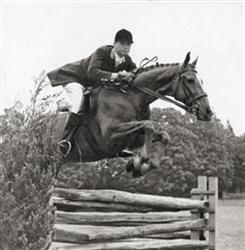
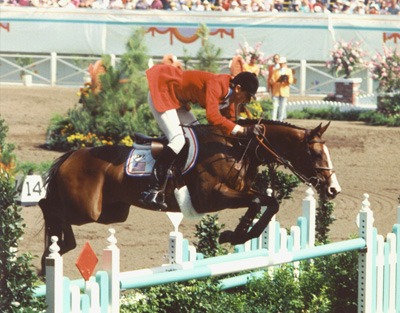
Joe Fargis, here on the elegant and athletic Thoroughbred mare Touch of Class (with whom he won the individual gold at the ’84 Olympics), wrote the forward to Schooling and Riding the Sport Horse.  He is featured in photos throughout, as well as on its cover.  Photo credit: Showjumping Nostalgia

My sentiments towards this book softened as I read through the chapters on the schooling periods.  It is clear to me that Cronin is a classical trainer in the style of American forward seat riding, and believes firmly in consistency, patience and slow, steady, horse-oriented progress.  I was able to draw more connections between his concepts and those common to the training of dressage and eventing horses in these chapters than the others (mind you, this was all in year three of reading the book).

Overall, this book really is a good source of information, even if it is written in an “old school” style which makes it a bit dense.  For a reader who is able to thoughtfully digest any of the classical texts on horsemanship written by the old masters, this book would certainly ring true and fit right into that library.  Unfortunately, for the average modern reader of horsemanship books, I am afraid the terminology used throughout the book is too uncommon, the text too dry, and the photos too dated to make it a useful reference.  I suspect that most ambitious modern riders who purchased this book have left it sitting on their shelves amongst the others which they have never quite made it around to reading.  If you are looking for an easy read on progressive horsemanship—this isn’t your book.  If you want to delve into a systematic progression for the training of hunters and jumpers, and enjoy really taking the time to understand the heritage left by Littauer (who went on to influence so many of the great American horsemen of the 20th century), then this text may be worth the time to plod through.

3/5 stars

** Bloggers note: If you like the featured image at the top, it is sold as a decal here.**


Winter Break Training Projects 2017 Edition

In the downtime between our two semesters at the University of New Hampshire, I always try to tune up a few school horses or work with some of our newer herd members to get to know them a little bit better. Increased tack time is always good for the soul (even if the cheeks end up a little chapped from the cold!) and I appreciate the opportunity to work with different horses.  There are so many lessons to be learned.

brr
Sometimes winter is not so much fun. At least getting to ride extra ponies makes up for it.  Sort of.

I think school horses are simply some of the most amazing horses on the planet.  They tolerate all manner of riders and need to decipher their aids.  The riders who sit on them are, by definition, students, which means that those aids may lack refinement, finesse and sophistication.  It is the exceptional school horse that can absorb all of this without ill effect, and it is my opinion that they deserve having one consistent person work with them for a period of time every now and then.  The horse and rider have a chance to connect more deeply, and if the rider is experienced enough, they can help to break through any blocks or defensiveness that the horse may have installed in an effort to absorb some of the confusion in the aids.

During the recent winter break, I worked with three horses which are used in our dressage-only classes: Fiona, Otto and Tino. Despite all being dressage specialists, they each require a different kind of ride to elicit their best performance.  Riding each horse helped to remind me of details which I then applied to my usual dressage ride, Anna.

Fiona

Fiona is a chestnut Thoroughbred type mare who has been with our program for several years at this point.  Of all the many horses I have tried out for the program, Fiona is by far one of my favorites.  She is “my type” of ride; slender, athletic, a little sensitive, and of course, a mare.  I always enjoy reconnecting with her during our breaks.

Fiona2017.jpg
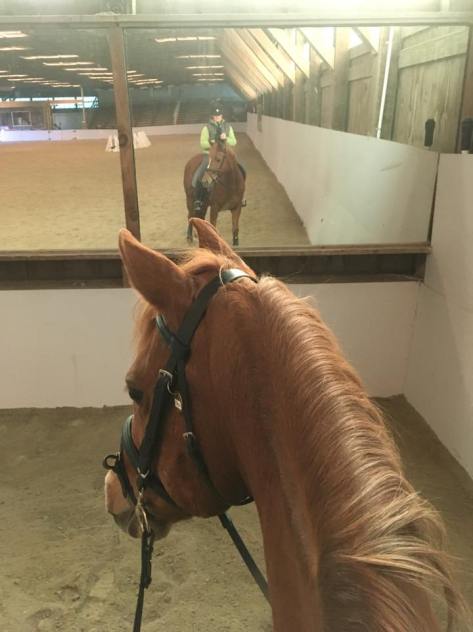
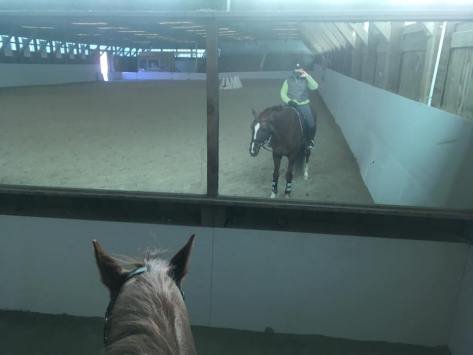
Fiona, through the ears. 

It has been almost one year since I last sat on Fiona, and I was a bit disconcerted at first by how much more defensive she felt this year than last.  By “defensive”, I mean that her initial reaction to any soft contact was to brace and become hollow, and she was also reluctant to actively reach with her hind legs.  It was my sense that Fiona was protecting herself, but the question was, from what?

I started by re-checking her tack, which by and large looked ok.  She was definitely due for a re-shoe, so we had that taken care of.  I then started a program which encouraged Fiona to begin to reach through her entire topline and stretch into the connection. While this idea is a key principle of dressage, it seemed to me as though she had a little bit lost her faith in that concept.

I very rarely warm up a horse at the trot completely off contact (although I always start with a ten minute or so free walk on a loose rein).  But with Fiona, I had to break my own rules.  First, Fiona absolutely needed the walking in phase; if I had a shorter than usual period of time to ride her, this was not an area where I could cut corners.  Once I moved on to the warm up trot, I didn’t shorten my reins at all, instead allowing Fiona to warm up while carrying her topline wherever she felt like she needed to with a completely floppy rein.  I didn’t ask her to align her shoulders and hips or even do more than the most basic of soft bend in the corners.  I kept all of the turns sweeping and wide and changed direction regularly.  After a few minutes like this, I very, very tactfully shortened the reins until I had a delicate, soft, pushing-toward-the-mouth contact, and I stepped Fiona into a canter.

Fiona
Fiona several years ago, with one of our graduates. 

For this horse, at this time, it is the canter which does the best job of loosening her up and encouraging her to let go.  The left lead seems to be more comfortable for her than the right, so I usually started there.  I never forced her to connect but instead encouraged it.  In the canter, Fiona is more willing to reach underneath herself with the hind leg while also allowing the rider to maintain a soft, steady, elastic feeling in the reins.  But the nanosecond that the rider gets greedy and holds too much in the rein or blocks with the seat, Fiona hollows again.  The rider must practice patience.

I went through this slow, gentle warm up with Fiona every single ride.  It honestly would take ten minutes of walking and twenty of trotting and cantering before she started to feel even remotely soft or fluid. If you pushed her harder before then, she would quite literally stop, or kick out at the leg—a sign that the question was ‘too much’.  It would be easy to label her as being resistant (“this horse won’t connect”) but I think it was much more an example of ‘this horse can’t’.  She had been blocking her body to such a degree for so long that every exercise session was only dedicated to unlocking her muscles again.

By the end of a ride, Fiona was loose, supple, forward and through.  She stayed soft in the jaw, chewing the bit and generating the “lipstick” that we like to see in a dressage horse.  Her responsiveness to the aids improved dramatically; Fiona at the end of a ride was like a completely different horse.

Fiona is not as young as she used to be, and she tends to be hard on herself out in turnout, so my sense is that all of these factors, plus her inherent personality, are simply starting to add up in creating this level of “block” in her body.  I think the lessons which I took away from working with Fiona this winter were 1) that the rider can always be more patient 2) sometimes you have to throw your usual “rules” out the window and experiment to figure out what works best—the horse is always right!  And of course, riding Fiona reinforced a rule that we always can be reminded of:  force will get you nowhere.

Otto

Otto is a wonderful little petite Ferrari of a horse, who joined our program late this summer.  He is trained through Third Level, and having seen him go a few times, I just knew that I would enjoy riding him.  As I work towards bringing Anna up to Third Level, I thought it would be helpful to take advantage of the chance to ride a schooled horse through some of those movements again.

Otto is half Arabian, and he has a tremendous “go” button.  I made the mistake on our first ride of carrying a dressage wand; it was so not needed!  The students had told me that he gets heavy in the hand, and I had personally observed him tending to tuck his nose in towards his chest and get stuck in the kind of power trot that is flashy to watch but not much fun to ride.  While still a connection issue, this is at least a different variety than the one I am used to dealing with!

Otto2017.jpg
Otto was never super cooperative about stopping to have his picture taken…he just wants to GO!

Otto came to us wearing a Baucher bit.  Many people mistakenly believe that this bit uses poll pressure in its action, but this is not the case. In fact, if you put your fingers under the crown piece and then have a friend apply pressure on the rein, you will feel that there is no poll action.  A Baucher does raise the bit slightly higher against the corners of the lips and holds it steadier in the horse’s mouth; it seems to appeal most to horses which dislike any kind of fussiness in the connection.  In my experience, though, most horses just lean on it, and that is what I felt in Otto. My colleague helped switch out the Baucher for a basic jointed loose ring, which gives him more to chew on and definitely helped to improve the softness of his jaw.

The biggest key with Otto, and horses like him, is that you have to take a leap of faith and give the rein when you want to take. On the days when I would get on Otto with an agenda, and maybe too much tension in my muscles, I could feel him tend to take a bit more feel on me in return.  This is the start of that inevitable cycle of pull and tug—you pull on me, I tug on you.  I remember my mentor from many years ago, Beth Adams, saying, “It takes two to pull.”  So whenever I felt that weight increasing, I pushed the rein forward towards the corners of Otto’s mouth.  Sure, he sometimes accelerated, and then I would circle or leg yield (or both!) and take advantage of the energy to help Otto become better balanced and engaged through the use of my diagonal aids.

Otto was simply so much fun to play with.  We did a million transitions within and between gaits, worked the half pass in trot and canter, and played with his flying changes.  The entire time, I kept thinking, “give”.  The softer I stayed, the softer Otto stayed, with a more correct neck and improved connection.

This lesson was especially helpful to bring forward onto Anna, who is sort of the opposite in terms of her connection issues—she tends to be above the bit and lacks thrust.  On her, finding the right blend of steadiness in the rein (to encourage her to connect) versus give (to encourage her to stretch) is tricky.  Riding Otto reminded me that I can always offer Anna the opportunity to develop better roundness by my becoming a bit more elastic and giving for a few steps.  When I apply this concept, it is nine times out of ten that Anna softens back.  Funny how that is….

Tino

Tino is by far one of our most elegant and well bred school horses, and we are lucky to have such a lovely animal in our program.  It actually hadn’t been my intention to work with him over the break, but when he is out of work, he becomes a bit sassy for the crew to handle, so back to work he went.

Like Otto, Tino has been shown through Third level, but he has much bigger gaits, and these can make him quite challenging to ride correctly.  The sheer power of his movement can throw the rider far out of the saddle and off balance in the trot, and I think it is because of this that most of his riders hesitate to send him correctly forward.  When this happens, Tino gets stuck in a “passage trot”, which is of course horribly incorrect and not good for his muscling and long term comfort levels.

Tino2017.jpg
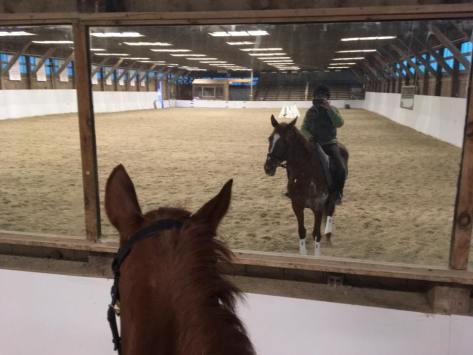
Tino, though the ears.  You might notice a theme of there not being many people around to help with photos!

Tino has had some excellent schooling in his past, and I wanted to make sure that I did right by this horse.  I took some video of him and sent it off to a trusted friend for some feedback.  She supported my initial instinct, which was that Tino needed to come more freely forward and respond to the rider’s leg aid by reaching forward and under, rather than higher and loftier.  As with all my rides, I started each session with Tino with ten minutes of a marching free walk, and then warmed him up in the trot and canter while encouraging him to stretch through his topline and reach forward into a soft contact, all without dropping his shoulder or getting too heavily onto the forehand.

Tino’s canter is pretty gosh darn amazing.  It is rhythmical and cadenced, and I found that using forward and back adjustments in the counter canter during the warm up phase really helped Tino to loosen his topline, making more correct movement in the trot easier afterwards.

Tino Canter Work Jan 21, 2017

Once he was warmed up, I did a lot—and I mean a lot—of lateral work with him, working on getting a more correct and sharper response to the leg aids.  We did shoulder in, travers, renvers and tons of half pass.  As the strength of his topline returned, we added in more work with adjustable gaits, and I encouraged him to lengthen his stride, then come back to a shorter yet still reaching step.  I also played a lot with his changes; they are easy for him, and as my “consultant” said, “I have yet to meet a horse who was hurt because of doing the flying changes.  If they are easy, they are fun for him.”

I am thrilled with the progress Tino made over the break.  He is a powerful, athletic animal, and thankfully he is generally good natured and doesn’t use any of those qualities against us!  That being said, I think he is a really challenging school horse for riders to figure out.  To get the best work from him (as it is with any horse), the rider must ride forward.  And once Tino is really going forward, you have A L O T of horse underneath you.  That is pretty intimidating– but SO much fun.

A little of Tino at the trot (Jan 21, 2017)

Riding Tino reminded me what it is like to experience the talents of an animal who is simply bred to do their job. The “movements” are easy.  What is important to remember, especially with a horse like Tino, is that when the quality of the gaits decline, we have forgotten the purpose of dressage, which is (simply put), “to enhance the natural gaits of the horse”.  There are certainly moments when the horse is learning a new movement during which they may lose quality, but we need to remember that if this becomes the norm, it is time to take a different tack in our training.

On an even more basic level, riding Tino reminded me that I have to stay back with my upper body.  I have always had a tendency to tip forward, left over from my hunter/jumper days, and on most horses I get away with it.  On Tino, if I tipped forward, I immediately felt off balance due to his big movement.  I also had to make sure to keep my eyes up and forward, for the same reason.  With great power comes great responsibility, grasshopper—in this case, the responsibility to maintain one’s own position.