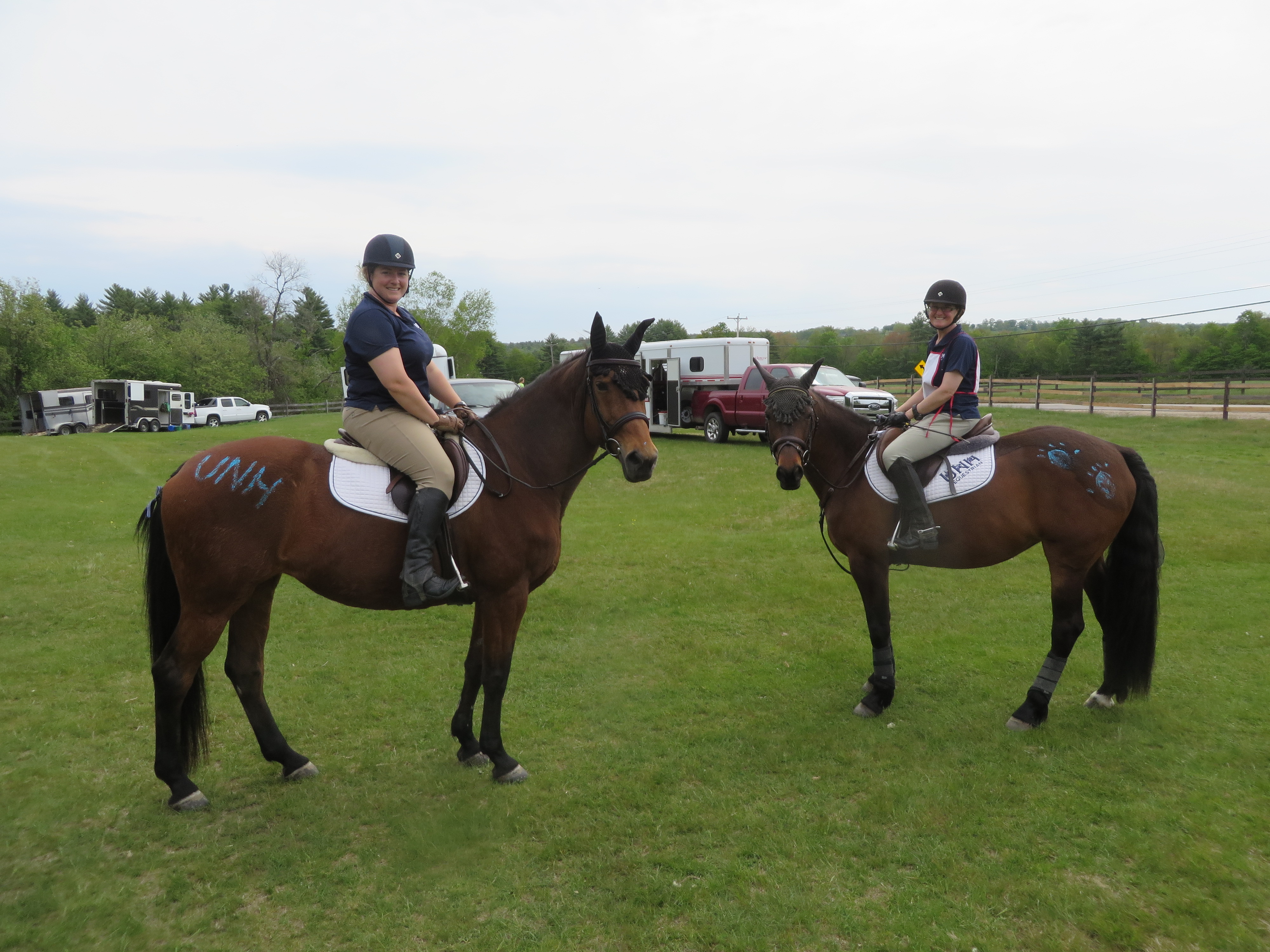
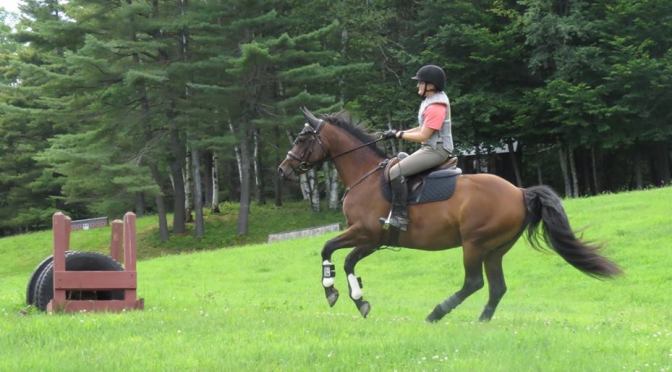
All posts by christinakeim

Motivating the Lazy Equine Athlete

Further Learnings from the Area I Scholarship

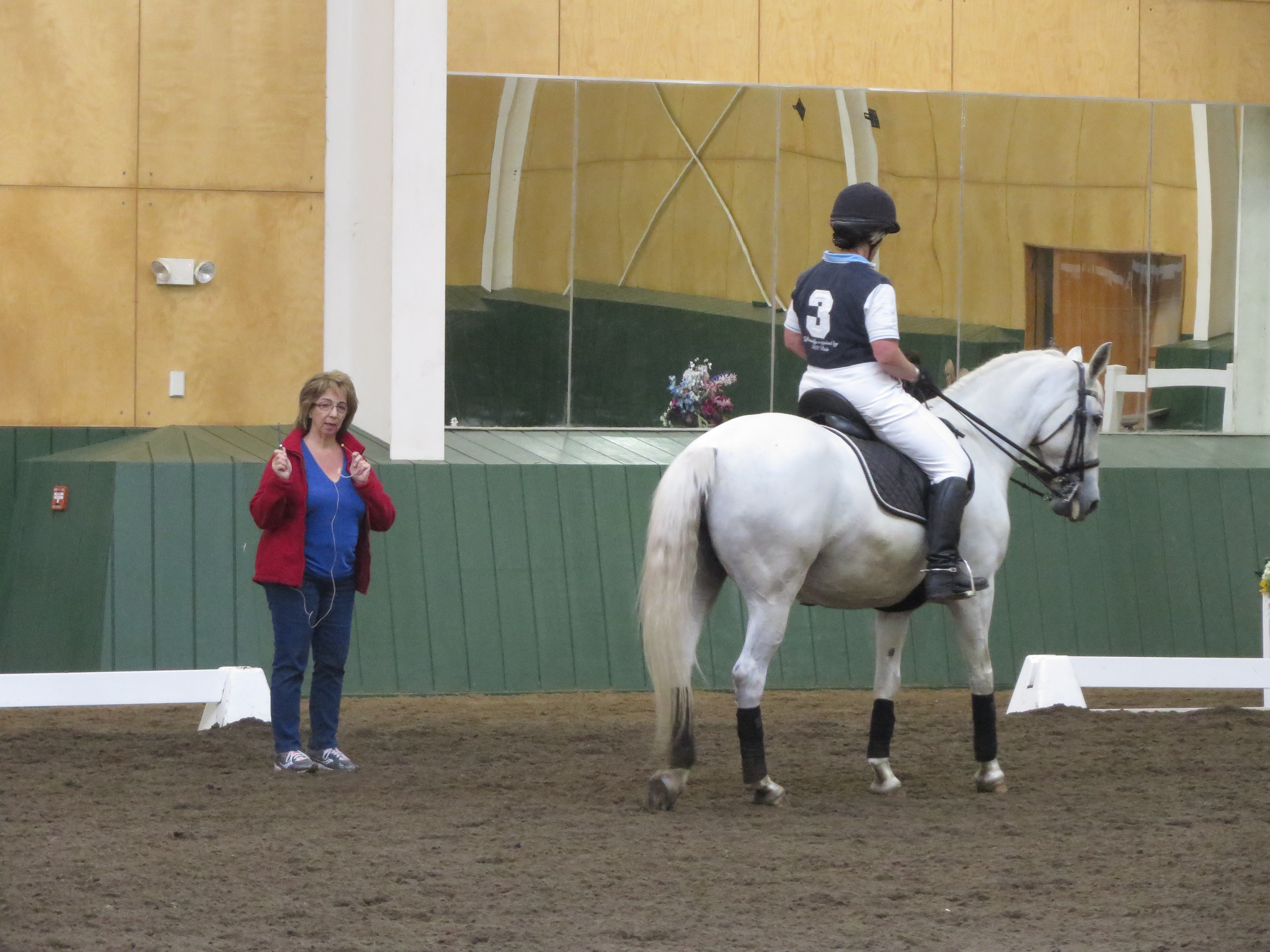
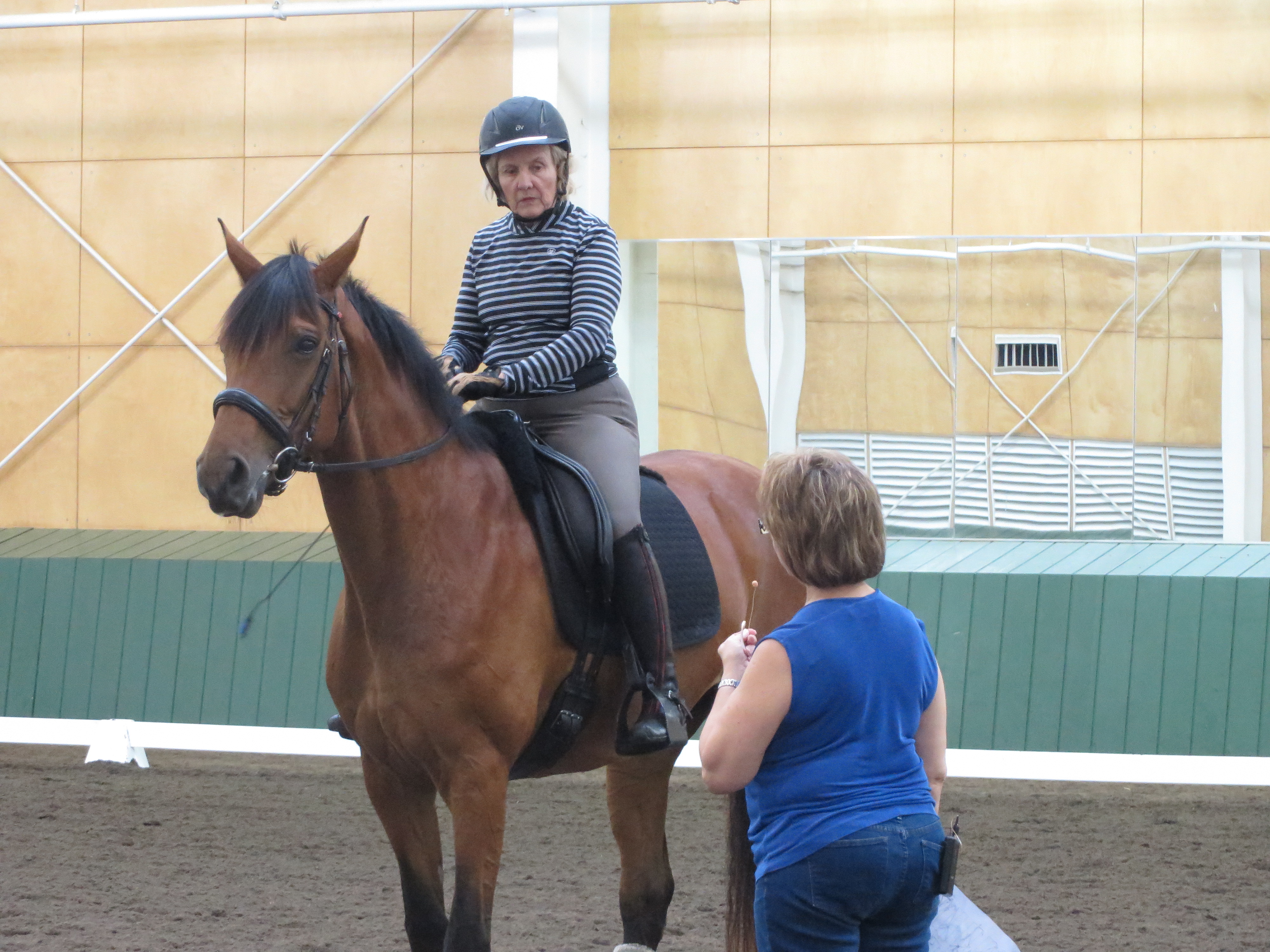
In 2015, I was lucky enough to be one of ten recipients of an Area I Eventing Scholarship.  In my application, I indicated that I planned to focus on training rather than competing Annapony this season.  I used funds from the scholarship to pay for lessons with Verne Batchelder, Denny Emerson and Nancy Guyotte (see Another Clinic with Nancy Guyotte).  Throughout each session, one theme became abundantly clear:  Anna is a capable, but somewhat lazy, athlete, and nagging her for “more” will get you nowhere. My lesson with Nancy focused mostly on show jumping, while Verne tackled dressage and Denny, cross country.  In this blog, I will discuss the main exercises and techniques learned in the sessions with Verne and Denny.

Verne Batchelder:  Using Double Longeing to Improve Suppleness and Impulsion

Verne Batchelder of River House Hanoverians in Williston, FL, gives clinics regularly in New Hampshire.  I have really enjoyed working with him over the past several years both with Anna and Lee.  One of Verne’s great strengths is his ability to find many different approaches to correcting deficiencies, all while staying within a clear training system and progression.  Verne is also an expert with work in hand, including double longeing and long lining; he regularly includes such techniques in the training programs of his own horses, which I had the opportunity to witness on a visit to his farm several years ago (see Winter Training Sessions: Mini-Pro Style).

RiverHouse

Having worked with Verne a number of times previously, he is well familiar with Anna’s tendency to be generally lacking in impulsion.  Some of this he attributes to her inherent mellow nature, but some of it is due to a lack of suppleness.    We have worked on improving her suppleness in a variety of ways, including improved neck control, the use of traditional lateral exercises such as shoulder fore, leg yield and haunches in, as well as longitudinal stretching work like long and low or lengthenings.

This spring, Verne decided for the first time to incorporate some work on the double longe into our session. His intention was to provide increased support through the outside turning aids while improving control of the curvature of her neck.    I remained mounted while Verne ran two lines; the outside line was simply attached to the bit ring and ran over my leg and around Anna’s hindquarters, while the inside line was set up as a sliding longe.  This meant that the line ran through the inside bit ring and then attached to a loop on the girth, underneath my inside foot.  With the sliding longe, the ground handler can smoothly achieve correct inside flexion.  The outside line allows for a clear and consistent support through the entire arc of the horse’s body while also providing a mechanism to apply a traditional half halt.

Here is a video which shows a little bit of basic long lining.

It is quite a strange feeling to essentially have one’s horse ridden from the ground while one remains mounted!  Anna has longed only a little bit, and I was definitely mildly (well, greatly) concerned that she might not be a model citizen when put into these boundaries.  My job was to essentially hold the reins evenly and to remain centered, adding leg to support Verne’s body position and voice.  At first, Anna was somewhat resistant to the idea of accepting the newly imposed limits.  It is important for a trainer to remember that resistance is only the horse’s way of expressing their displeasure.  If the question the trainer is asking the horse is fair given their physical condition and previous training, and the aids are appropriate, usually the rider’s best response is to simply ignore the resistance and remain consistent in using the aids to ask the appropriate question.  In fairly short order, Anna relaxed into the new parameters established by the double longe and began to more actively engage the muscles of her topline as well as increase the degree of thrust from her hindquarters.  In addition, the connection further stabilized and the quality of the bend improved.

After this session with Verne, I incorporated the use of about ten minutes of warm up on the double longe with Anna on dressage days, with the inside line set up as a sliding longe.  When the horse is unmounted, side reins set just a little bit on the longer side will help to maintain straightness; as always, they should not be adjusted in such a way that the horse’s head is forced down or in. In working with this technique independently, I noticed that Anna could find her own balance and begin to develop looseness throughout her back more rapidly than when warmed up under saddle.  When I rode her after this style of warm up, she was much more willing to stay “hotter” off my leg and therefore I could use a much quieter forward driving aid.

Here is a video of some double longeing.

One of the other huge benefits of using the sliding longe technique to warm up was that the overall work session could remain “short and sweet”.  Because she had already loosened up her muscles, it was possible to keep the actual “work” session much more focused and organized.  I think this is super important with all horses, but especially those which don’t have an unlimited reserve of energy.  If you can get in the ring, do what you need to do, and then go out for a hack, the horse’s attitude will stay fresher and more enthusiastic than when they anticipate a long session of drill work.

Denny Emerson: Jumping Fences off a Forward Stride

Anna and I spent the summer of 2014 up at Tamarack Hill Farm, where we worked hard to rebuild our confidence over fences (see The Tamarack Chronicles: Vol III).  We left in August with a renewed sense of harmony and assurance in our jumping work and completed the fall season with placings at King Oak and Stoneleigh Burnham Horse Trials.
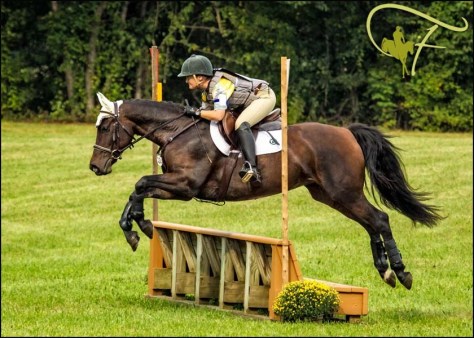
Keim-C-090714-3765
Anna at King Oak Farm, September 2014. Photo courtesy of Flatlandsfoto/Joan Davis and used with permission.

Overall, I was able to continue to apply the techniques I had learned at Denny’s to our regular schooling routine and keep Anna’s jumping skills tuned up while working on my own over the winter.  In general, I keep the fences low enough that “mistakes” are not a big deal.  I have focused a lot of energy on further refining my jumping “eye” and improving the quality and consistency of Anna’s jumping canter.

Denny always says that when under pressure, all riders will show a tendency to either “choke” or “chase” their eye.  What he means is that we all have a preference for pushing a horse to lengthen their stride, perhaps leaving a bit too long, or to overly compress the horse, causing them to jump from a deep spot.  While either option might be the best one in a given circumstance, neither is ideal as a method of riding to every fence; this is why most of us have to develop,  through practice, the ability and habit of organizing the horse’s canter to arrive at the  “ideal” take off spot.  It is my opinion that horses, too, have a tendency to prefer to leave long or to jump deep, and they also need to be conditioned to be able to jump from a variety of different reasonable points.

IMG_5190

Anna would be a “choker”.  She can be carrying a decent amount of energy and power in the canter, and then in the final few strides before the fence, drop behind the leg, compress her stride, and calmly decelerate to the base with increasingly shorter strides.  It isn’t quite the same as a “chip”, which is when the horse will squish one extra small stride right in front of the fence.  With Anna, it is a steady deceleration which allows balanced but small strides to be fit into the space where a few longer strides would have been better.  She is simply more comfortable jumping from a slightly tighter distance off a shorter stride.

For a long time, I have allowed Anna to manage her fences in this way, as it seemed to be the place from which she was most confident.  It is also incredibly difficult to prevent her from doing it, and when I try to address the issue, I feel like I am beating her with my legs and/ or crop to keep the canter going.  I have participated in clinics (most notably with Kim Severson) where the entire focus became trying to eliminate this change in the canter, to get Anna to jump more “out of stride”, but I always end up feeling like both Anna and I are frustrated.  She also will begin to shut down if you really push her on it—her response seems to be, “hey, I jumped your fence, lady, what more do you want?”

BankTHF14

The major issue is that there are some fences which simply do not ride as well when jumped from this tighter spot, including upright verticals like planks and wider oxers.  In addition, she will often quit when faced with this deep distance and a tough question.  Yet when I push her to maintain the same canter to avoid this situation, she will obstinately ignore my aids and put herself into the not ideal take off point.  It is just yet another manifestation of her tendency to not stay in front of the leg.  Story of our lives!

So if I rode like Michael Jung or Ingrid Klimke or any of the other equestrian elite, my horse would never have gotten to this point.  But as I am a mere mortal, and have made a ‘deal’ with my horse, I am now faced with trying to change the terms of our established contract.

My session with Denny started in the show jumping arena.  After a brief warm up on the flat, I began popping over a few of the smaller fences in the ring.  Anna was obedient but also performing her signature “I change my canter on the approach” maneuver.  Denny decided that the focus of our session was going to be keeping her much more forward overall, but especially in those critical last few strides before the fence.

JumpingtheCows
In this lesson at Tamarack in summer of 2014, we were racing an impending storm– the energy in the air came through into the pony and we finally found some forward intention!

Still in the show jumping ring, Denny had me kick Anna up into a cross country style canter—as much of a gallop as Anna will do under saddle (have I mentioned that she is not a very forward thinking animal?).  My job was to do whatever it took—growl, flail, kick like a D2 Pony Clubber—to keep her not just in a jumping canter but a forward, cross country canter, to each and every fence I aimed at.  I really did feel just like a 10 year old whose legs don’t clear the saddle flaps, both in technique and overall effectiveness.  For her part, Anna did stay much more forward, but it wasn’t coming from within her—it was the result of my motivation.

So in spite of seeing this glimmer of improvement, Denny decided that we needed to go out onto the cross country course to seek more energy.  Most horses show an intrinsic improvement in their forward intention when they are out in the open, and the terrain of Vermont would also provide some assistance.  Denny hoped that by adding in these variables, Anna would begin to better ‘self-motivate’ in her approach to the fences.
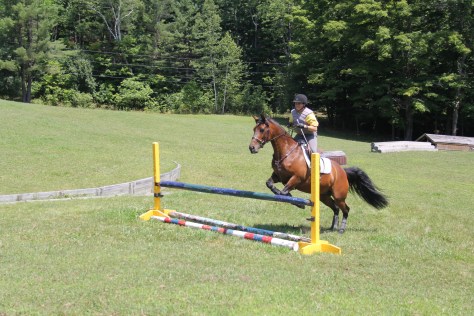
OneStrideBank
Working on a similar exercise at Tamarack in the summer of 2014, we had jumped up a bank and then were looking for a bounce to this vertical.  I must be trying to pick her up off the ground here!

The exercise seemed simple—pick up a positive canter at the bottom of a slope, kick on up the hill, then ride a gradual turn over the crest of the hill and allow the momentum of the descent to carry us forward down to a tire jump at the bottom.  The objective?  To maintain the positive, forward energy up to and across the fence, with no change in step.

It was really, really hard to not “check” Anna on the descent down the hill.  The tire fence we were tackling at the base was small, and so no matter where we came to, Anna would be more than able to cope with getting us up and over.  In spite of that, it took everything in my power to not try to come to a specific take off point.  For the first several attempts, I did pretty well at the roll down the hill but when Anna began her typical slow down at the base, I did little to prevent it.  It was truly amazing how effortlessly she could check all of that forward energy and then insert her little microstrides in before the jump.
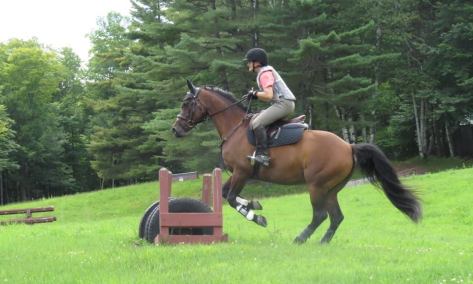
THFAug4

I ended up having to channel that inner ten year old girl again, and basically kick and flail and feel like we just galloped down the hill, before Anna FINALLY jumped the tire fence directly out of stride.

Left to my own devices, I don’t think I would ever have been brave enough to ride Anna so aggressively.  I still have hunter equitation roots, where aids such as visible kicking or moving out of harmony with the horse are certainly frowned upon.  I think I would also have worried too much about getting her out of balance and causing her to make a dangerous mistake.  But Denny made two comments regarding these thoughts:  1) The fences MUST be kept low and straightforward, so that jumping them is a given almost regardless of the horse’s balance and 2) he almost never ever coaches riders to ride like this either.  Anna is just that lazy!

THFAug5
Finally getting it right!  Photos by Denny Emerson.

My major take home from this session was that no matter what, I NEED to practice remaining assertive and positive with the forward driving aids up to and away from each and every fence.  I don’t think that I have been passive with my aids at all; it is just clear that in some circumstances with some horses, it is possible to be even bigger and louder with your aids than you might think is appropriate!

I would really to thank the members of the Area I Scholarship for choosing me as one of the 2015 recipients.  I feel that I definitely benefitted from the instruction I gained from the scholarship, and I hope that through these blogs, other riders with lazy horses might gain some additional ideas or insights into techniques which can help them, too!

Book Review: The Complete Guide to Endurance Riding and Competition


By Donna Snyder-Smith

c 1998 Howell Book House, New York, NY 244 pages

ISBN 0-87605-284-7

I picked up Snyder-Smith’s book in preparation for my successful first time attempt at completing a three day 100 mile competitive trail ride.  The author is an experienced horsewoman with a broad background and successful Tevis Cup completion on her resume; while the focus of the book was more on endurance riding than competitive trail, I found that more than anything, it was a book about good horsemanship, and there is something which riders of any discipline can take away from it.

EnduranceRidingCompetition

In this book, Snyder-Smith takes a comprehensive look at the details of how to prepare a horse and rider team for success in the sport of endurance.  Full chapters are dedicated to riding in balance, gymnastic development of the horse, conditioning and feeding the endurance horse and the merits of various types of equipment.  The book concludes with a look at the requirements for crewing at an endurance ride and then the dynamics of a ride itself.

What struck me over and over in reading this book was how so much of what the author stated applied to not just endurance horses, but to all equine athletes.  For example, she outlines the requirements for a successful endurance horse as follows: “good feet, a good respiratory system, a good mind, to be an efficient mover, the desire to do it” (Snyder-Smith, p. 8).  However, these are ideal qualities for ANY performance horse, though perhaps certain other disciplines could be more forgiving to a horse which does not have the best attributes in some of these areas.

LeeCookieHill
Lee and I on the last day of the three day 100 mile ride at GMHA (VT), fall 2015.

In her chapter on the importance of rider balance, Snyder-Smith goes into great detail on the importance of body awareness, symmetry and correct riding position and their collective effect on the horse for better or for worse.  If a rider is expecting a horse to carry them over tens of miles of terrain, it is critical that the rider is doing their part to be efficient and to maintain their own balance and coordination.   Horses can cope with rider asymmetry or weakness to a point, but adding in the cumulative stress of a long ride to the mix means that an inefficient rider can make the difference between a completion or a pull.  Lest anyone think that trail riders need not be attentive to the performance of their mount, Snyder-Smith states that “Riding that is comfortable and productive for both horse and rider is based on the rider’s ability to feel the horse and what it is doing with its body” (Snyder-Smith, p 22).  In other words, riding well, and riding correctly, matters!

LeeWent2010MysticalStretching
Lee at the Wentworth schooling show in 2010. Photo Credit to Mystical Photography, used here with permission.

In her chapter on preparing the endurance horse, Snyder-Smith addresses the difference between conditioning and training, and emphasizes that both are required for success in endurance.  Snyder-Smith explains that endurance horses need to spend time in the arena in order to develop their flexibility, suppleness and strength.  In fact, she proposes that basic dressage training is an excellent way to introduce a “systematic, gymnastic training program…to enable horses to perform to the limits of their athletic capabilities without injury,” (Snyder-Smith, p 63).  Another especially important concept for successful conditioning is that “if you are not able or willing to listen to your horse and learn from him, your success as an endurance rider will be limited” (Snyder-Smith, p. 84).  Again, the author is specifically referencing conditioning for the sport of endurance, but the reality is that this idea applies to all disciplines across the board.  Another universally applicable statement is that “commonsense is the single ingredient that, when missing, causes the greatest damage to horses” (Snyder-Smith, p 87).

Throughout the book, Snyder -Smith inserts tips and helpful hints from her own experience as a distance rider.  For example, she suggests mixing electrolytes with baby food like strained carrots or applesauce to make them more palatable. She also discusses the experience of how having a vet make a comment about your horse’s soundness at a check can cause even an experienced rider to doubt the animal’s fitness to continue.  Having personally had this experience at a few rides, I know how much it gets under your skin and infiltrates your consciousness, even when you are really fairly confident that the horse is okay and what the vet saw might be just fatigue or the result of a misstep.

25MileRideAug2014 005
Three happy distances horses at the end of a successful ride!

Overall, I found Snyder-Smith’s writing easy to follow and the concepts clearly explained and well-articulated.  This book was immensely helpful to me in my own preparation for the 100 mile ride, and to help me as a novice to become more familiar with the requirements of the sport.  But more than anything, I found the author’s perspective on horsemanship refreshing.  Simply put, if you take your time, do your homework and only ask of the horse that which you have properly prepared them for, you can expect their best effort.  For this reason, I would recommend the book to riders of any discipline who are reaching out of their comfort zones for a larger goal.

“If your horse has it in him, you’ll be able to get it out of him if you don’t ask for too much too soon and use him up,” (Snyder-Smith, p 175).

5/5 stars


Hilary Clayton:  Biomechanical Interactions Amongst the Rider, the Tack and the Horse

Dr. Clayton shares her thoughts at the University of New Hampshire Equine Program on October 27, 2015

There is no doubt that how we ride our horses, the tack we use on them and the manner in which the horses carry themselves has a cumulative effect on their well-being over time.  Whether that effect is positive or negative is one of the questions considered in the study of equine biomechanics, which combines the disciplines of physics and physiology to study how forces and work affect the body of the horse.  Dr. Hilary Clayton is well known for the work she has done in this field, and she visited the University of New Hampshire in October of 2015 to share her thoughts on some of the more common interactions which occur amongst the horse, the rider and the tack.

HilaryClaytonPortrait
Dr. Hilary Clayton (Photo taken from her promotional poster.)

Equine Topline Mechanics 101

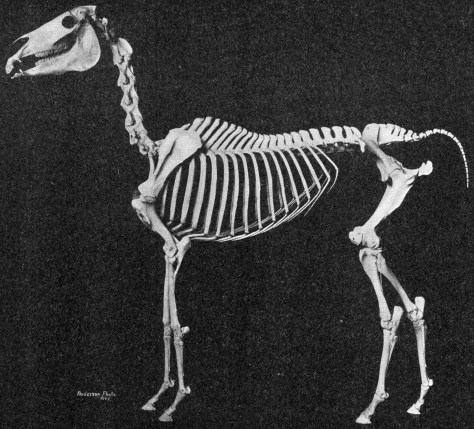
Clayton started her presentation with an overview of the structure of a horse’s vertebral column and how it works.  Just like in humans, the horse’s spine is made up of bone, ligaments, muscles and discs; equine discs are relatively thin compared to a human’s, and therefore horses don’t suffer from slipped discs and disc pain like humans can.  Even though the horse’s spine is horizontal, it loads similarly to a human’s in that it compresses together when force is applied.

Arabian_horse_skeleton
In this skeleton of an Arabian, it is easy to see the difference in the bones of the cervical and thoracic spine.  Note also the proximity of the spinous processes.

Each intervertebral joint has a small degree of mobility; when taken in totality, this allows for considerable movement along the entire length of the horse’s spine.  The degree and type of movement which the topline displays varies with each gait. In the walk, there is some bending and rotation in the topline, but little flexion or extension.  At the trot, there is more flexion and extension and the back is stabilized.  At the canter and the gallop, there is a great deal of flexion and extension, particularly in the lumbosacral joint, and the back is stabilized.

The Horse in Motion by Eadweard Muybridge

Instructors and trainers will often tell their clients that their horses need to move with a swinging back.  Clayton explained that this statement is not wholly accurate.  When in locomotion, the horse’s back must actually remain stable in order to support the horse’s weight and to transmit propulsive forces from the limbs. Clayton says that when the horse moves at liberty, they are not actively moving their back.  The back movement we see is due to gravity, inertia and the propulsive forces of the hind leg. In fact, excessive mobility of the bones in the spine during motion is never the goal—it is the muscles which need to be supple into order to control the movement of the spine.

Charlotte_DUJARDIN_JEM2014
Charlotte Dujardin and the incomparable Valegro.  Photo by Florence Skowron, via Wikimedai Commons.

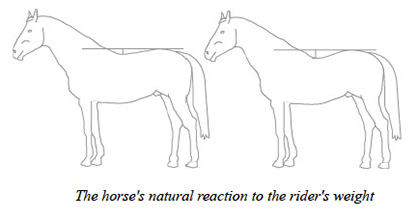
Clayton compared the structure of the articulated vertebrae of the horse’s spine to a beam which has a support at each end.  In the horse’s case, the “beam” tends to sag a bit in the middle, due to the weight of the internal organs and other viscera.  When we add the weight of a saddle and rider to this region, we increase the hollowing of the spine and the “dip” in the middle of the beam.  Clayton explains that with a rider, the range of flexion and extension is the same but the entire cycle of the motion is more extended.

Through the above description, it should be immediately apparent that the weight of the rider is inherently causing stress on the horse’s topline.  More troubling, though, is that when the horse’s back is hollowed as result of this weight, the dorsal spinous processes are approximated, which can lead to the development of the degenerative condition known as kissing spines.  Clayton’s research has shown that far more horses are affected with kissing spines than just those which show overt symptoms; however, even at a subclinical level, the syndrome can cause the horse discomfort and reduce the quality of their performance.  The good news is that when the back is rounded, the opposite effect occurs—the spinous processes are spread out. Therefore, regardless of your discipline, you horse should learn to work with a round topline.

kissingspines
In this image borrowed from a fellow wordpress user, the kissing spines can be clearly seen.

Round Backs and Development of the Horse’s Core

Clayton compared the mechanism which causes the horse’s back to be round to a “bow and string”.  The “string” is comprised of the muscles on the underside of the bones of the back, in this case the abdominal and sublumbar muscles.  The “bow” is therefore made up of the muscles located above the vertebrae.  Rounding their back requires the coordinated action of the horse’s core muscles.

Athletes of all species can achieve more optimal performance with a strong core.  These muscles are important both for balanced movement and coordinated stabilization.  Clayton divided the muscles of the horse’s core into three groups:  the back muscles, the sublumbar muscles and the abdominal muscles, and the groups work in concert to achieve the maximum mobility of the horse’s spine.

horsereactiontoweight
Image from http://www.equinechronicle.com

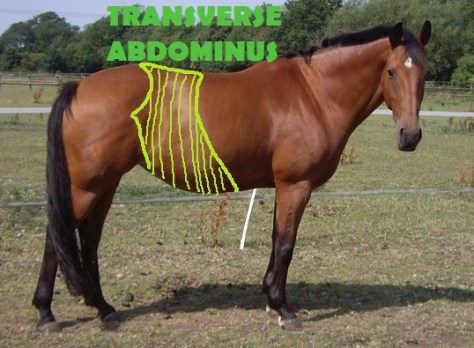
The back muscles make the topline hollow, round or bend right and left.  The sublumbar muscles flex the lumbosacral joint and the pelvis, which helps to bring the hind legs forward and underneath the body.  Finally, the abdominal muscles wrap all around the horse’s belly, running many different directions.  This group of muscles includes the transverse abdominal, the obliques and the rectus abdominus.  Collectively, they literally help hold the horse’s ‘guts’ in place, as well as stabilize the spine and assist with lateral bending.

Clayton explained the function of the back muscles in more specific detail. First, she discussed the longissimus and iliocostalis muscles, which are the long mobilizing muscles of the back.  They are made up of long fibers and cross many joints. These muscles are able to move the entire back of the horse.

The multifadi muscles serve the function of stabilizing the horse’s back.  These muscles are located right against the spinous processes and are comprised of short fibers which cross only a few joints; therefore, they work on only a limited area of the horse’s spine.  However, the condition of these muscles can have a profound effect on the shape of the back in a specific area.  More will be said on this later.

horse_anatomy_the_muscles_by_wiggle_chicken
Image from jenpenjen.deviantart.com

Clayton pointed out that most muscles work in pairs or layers; therefore, the deep stabilizing muscles are as important as the long mobilizing muscles, as they help to prevent vibration in the horse’s bones.  They also have a low activation threshold, which means that they will contract (along with the transverse abdominal muscle) simply in anticipation of locomotor activity.  They then serve to stabilize the horse’s spine as the limbs move.

Limited research has been done on the many effects of the horse’s stabilizing muscles on the spine.  However, research done on humans has shown that chronic back pain is often associated with atrophy of the deep stabilizing muscles, as joints then become too mobile.  Impaired spinal stabilization is an important risk factor and a predictor of recurrent back pain in humans.  Based on her research, Clayton extrapolates that a similar connection exists in horses.

core.stability.muscles
Notice how the same muscles provide stability to the human spine.  Image found on http://www.appliedpostureriding.com.au

Human research has also shown that even when back pain is resolved, the deep stabilizing muscles do not resume normal activity on their own.  Physiotherapy exercises are necessary to re-train the pre-activation of the stabilizing muscles.  In human patients who underwent this therapy, the one year recurrence rate of pain reduced from 80% to 30%.

When it comes to back pain, Clayton says that horses go through a similar cycle to humans.  When the back hurts, the deep stabilizing muscles become inactive, resulting in atrophy.  This causes the long mobilizing muscles to compensate, but since they are not equipped to stabilize the spine, these muscles spasm and cause further pain.  Therapeutic exercises are needed to reactivate the deep stabilizing muscles and to break the cycle of compensation and pain.

Developing Your Horse’s Core with Dynamic Mobilization Exercises

Clayton has developed a series of core strengthening exercises and sequences through her research, and she goes into illustrated depth about these in her book, Activate Your Horse’s Core (Sport Horse Publications, 2008). She gave a brief synopsis during her presentation.

Dynamic Mobilization Exercises are those in which the horse follows a controlled movement pattern which strengthens the muscles that move and stabilize the back.  They are comprised of rounding exercises and bending exercises.  In the rounding exercises, most of the flexion comes from the poll (high position) or the base of the neck (low position).  In the bending exercises, most of the movement comes at the base of the neck.

pilatesmobile1
Image from http://www.horseyard.com.au, from an article related to Dr. Clayton’s work.  

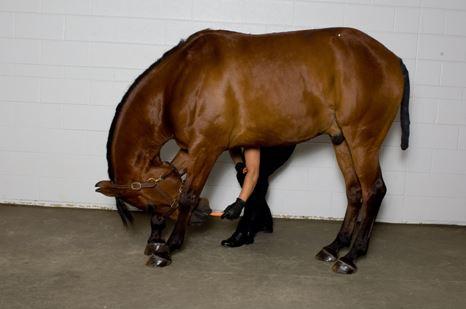
Clayton described a protocol which provided positive results in several “couch potato” school horses.  Using small bits of carrot to motivate the horse, they did three rounding exercises (chin to chest, chin between the carpi (knees) and chin between the fetlocks) and three lateral bending exercises (chin to girth, chin to hip, chin to hind fetlock).  For the lateral bending exercises, the human stood next to the horse, making them bend their neck around the human.  Horses did five repetitions/day and on left and right sides, if appropriate.  The exercises were repeated five days/week for three months.  Even with these stretches as the only form of exercise, the horses showed a positive development in their deep stabilizing muscles.

One of the benefits of these exercises is that the horse will only stretch as far as they are comfortable.  Ideally, the handler should encourage the horse to hold the stretch for as long as possible, but even stretching for a short period will help improve the strength of the multifidus muscle.   The best benefits are seen when these exercises are performed before the horse works each day; regular inclusion of them in a training program will help equine athletes throughout their career.  In addition, these exercises can be used in youngsters to help develop the deep stabilizing muscles before they begin under saddle training and are also especially beneficial for horses recovering from colic surgery, with appropriate approval from the attending veterinarian.

Transverse-Abdominus
Image from http://www.classicphysiotherapy.co.uk

The Role of Equipment and Rider in Equine Back Pain

When it comes to saddle selection and fit, it is clear that both the horse and the rider must be comfortable.  While the rider can simply vocalize their discomfort, the horse must express it in other ways, and it is important for riders and trainers to remain sensitive to this communication.  Unfortunately, the manner in which horses display the existence of back pain is as variable as the causes.  However, both the saddle and the rider can contribute to discomfort in the horse’s topline, and certain issues are almost sure predictors of pain in the horse.

horse-and-rider

Clayton has made extensive use of an electronic pressure mat which sits on the horse’s back in her research on saddles.  This specialized mat has 256 sensors (128 on each side of the spine) which measure force distribution on the horse’s back.  Her research has shown that the total force placed on the horse’s back varies with the size and weight of the rider and saddle as well as the gait of travel.

For example, in the trot, the suspension phase has minimal pressure, while the stance phase of each stride has the maximum force.  This is when the horse’s body is starting to rise up, but the weight of the rider is still down.  The mean force placed on the horse is at least equal to the rider’s weight in the walk; in the trot, it is two times the rider’s weight and in the canter it is three times.

equetrian-market-01
This image, taken from http://www.sensorprod.com, shows the pressure profile of a rider’s buttocks and thighs on the saddle.  Clayton’s tools offer her similar insight into the intensity, duration and location of pressure when a horse is in motion. 

Clayton says that she is frequently asked to quantify how much weight a given horse can fairly be asked to carry, but she says that this is a complex question to answer.  Variables such as the height, weight, conformation, fitness and soundness of the horse all play a role.  For example, a horse with a short and broad loin coupling can likely carry more weight than a horse of similar size with a long or narrow loin.  As far as the rider goes, variables such as weight, fitness, symmetry, balance, postural control and health issues all influence the impact they have on a given horse. Also important is the activity the horse is being asked to do—what type of work and on what kind of footing or terrain.

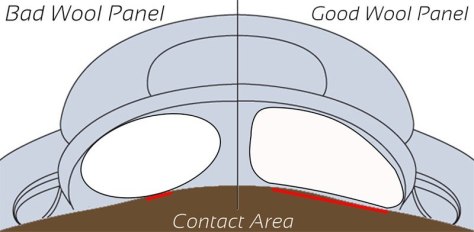
Finally, the saddle itself can have a positive or negative impact on a horse’s comfort level.  Each saddle is unique in terms of its load-bearing area, fit and suitability for a given horse, rider and job.   Soft tissues compress when pressure is applied.  The larger the area the force is spread over, the less overall pressure there will be.  This is one of the reasons why more modern saddles have long, broad panels.

Saddle-Panel-Diagram1-1024x501
Image from http://www.totalsaddlefit.com

Pressure is calculated via force divided by area.  Therefore, the pressure increases if the force is larger or if the contact area is smaller.  Areas of deep pressure can be very harmful, causing ulcers or necrosis of the tissue due to increased capillary pressure.  On a less extreme level, pressure can cause discomfort through abrasions.  Clayton says that it is the magnitude and duration of pressure which are most important.  Muscles in particular are easily damaged by pressure.

If you see dry spots under your saddle after work, these are areas of increased pressure which prevent the sweat glands from working and are cause for concern.

dryspot
In this photo, it is clear where there has been an area of increased pressure and therefore inhibition of the sweating mechanism. 

Interesting Saddle Trivia

In her research, Clayton has had cause to investigate a number of different areas in which saddles might impact the horse, and she shared some of her findings with the audience.

One of the first questions she looked at was whether a saddle is truly necessary.  Most riders prefer to use a saddle for the stability and security it provides them on the horse’s back, and as it turns out, horses seem to prefer that their riders use saddles, too.  Without a saddle, the pressure of the rider is distributed over a smaller area, and the focal points of that pressure are over the rider’s seat bones.  (Interestingly, Clayton found similar results when she looked at one brand of treeless saddle, as well).  Clayton found that in general, a saddle which fits the shape of the horse’s back and the shape of the rider’s pelvis will provide stability to the rider’s position, and as a result, the pressure is more evenly distributed.  She also mentioned that within a breed, 80-90% of animals will have a similar back shape.

Correct saddle fit is of course of paramount importance.  Correctly fitted saddles are more stable, which increases horse and rider harmony.   The rigid parts of the tree, including the gullet plate, the points and the bars, can cause increased areas of pressure on the horse’s back.   It is important to consider the width of the gullet plate and length of the tree’s points in relation to the position of the scapula and related muscles.  When the horse extends their forelimb, the scapula rotates back and down on its back side, and rotates a little bit up in front.  This causes the back edge of the scapula to actually slide underneath the saddle in this moment of the stride.  A well fitting saddle should allow for free movement of the scapula when the forelimb is protracted.

Dia-2-Saddle-Fit
From http://www.equilibriumproducts.com

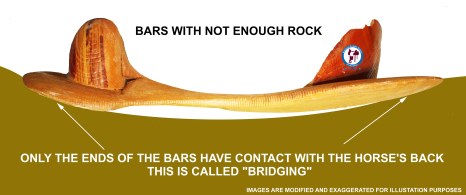
Clayton says that the width of the tree is equally important.  The correct width allows the load to be evenly distributed over a large area.  Ideally, the contact area is long and wide, with no focal points of high pressure.  A tree which is too wide may cause the gullet to put direct pressure on the withers and/or cause high pressure along the panels close to the spine.  In addition, the saddle often tips forward and down.  A tree which is too narrow is one of the most common causes of bridging; there is more pressure at the front and the back of the panels, and the saddle tips backwards.  Clayton says that bridging is the most common saddle fit problem, and it must be evaluated with the rider on board and while the horse is in motion.

bridging
Image from http://www.saddlemakers.org.  

More nuanced aspects of saddle fit include assessing the width of the gullet and slope and shape of the panels.  A wider gullet is usually better, because it allows mobility of the spine without causing it to hit the edge of the panels.  The slope of the panels must also suit the shape of the horse’s back. Panels come in a variety of widths and curvatures, and it is important that the type chosen suits the individual animal.

Finally, Clayton emphasized that saddle pads cannot compensate for the deficiencies of a poorly fitting saddle.  However, they may increase the horse’s comfort if the saddle is essentially the correct size and shape.  Clayton says that pads made with natural fibers, such as sheepskin, seem to have a better degree of resiliency and spring.

Girths and Slipping Saddles

Girth design has evolved considerably in recent years, and Clayton touched briefly on the subject at the end of her talk.  She said that the highest pressure beneath the girth occurs just behind the elbow in the moment when the forelimb contacts the ground. In her research, contoured girths seem to do the best job in terms of reducing both force and pressure.

Finally, Clayton discussed saddles which seem to constantly slip to one side.  She says that it is important to determine if the cause of the slip is the horse, the rider or the fit of the saddle.  Subtle hind limb lameness can be blamed for the cause of many slipping saddles, particularly when the slip occurs consistently to one side and with a variety of different riders on board.  In 60% of these cases, the saddle slips towards the side of the lame/more significantly lame hind limb.  The slip will go away when the lameness is eliminated through the use of nerve or joint blocks.  Clayton commented that rider crookedness is more likely to be an effect than the cause of saddle slipping.  Clearly if the cause of the saddle slip is lameness, this issue must be addressed before the problem will go away.

Final Thoughts

Clayton’s presentation covered a broad range of topics, but one theme was quite clear—riders have an obligation to their horses to ride them in as correct of a manner as possible, in the best fitting tack possible.  In this way, riders and trainers can actively contribute to the preservation of the horse’s long term soundness and promote their well-being.

Cadre_noir_-_saut_au_piquet.jpg
With good training and attention to correct tack and conditioning, horses are truly capable of amazing feats.  “Cadre-noir-saut au piquet” by Alain Laurioux


A Journey of a Thousand Miles…or One Hundred


“Until one is committed, there is hesitancy, the chance to draw back. Concerning all acts of initiative (and creation), there is one elementary truth, the ignorance of which kills countless ideas and splendid plans: that the moment one definitely commits oneself, then Providence moves too. All sorts of things occur to help one that would never otherwise have occurred. A whole stream of events issues from the decision, raising in one’s favor all manner of unforeseen incidents and meetings and material assistance, which no man could have dreamed would have come his way. Whatever you can do, or dream you can do, begin it. Boldness has genius, power, and magic in it. Begin it now.”  W.H.Murray

Murray was a Scottish mountaineer and writer, who spent three years imprisoned during World War II in an enemy camp.  While there, he wrote a draft for a book later called Mountaineering in Scotland on the only paper available to him—toilet paper.  So he knows a thing or two about being resilient, I should think.

Denny Emerson recited this quote to me after the Dark Mare (Lee) and I completed the seemingly impossible— the rigorous three day long, one hundred mile ride at the Green Mountain Horse Association Distance Days, held annually in South Woodstock, Vermont each fall.   What made the completion so sweet, and somewhat amazing, is that previous to that weekend, the longest ride that my horse and I had ever done was a two-day fifty mile route, just one month before. 2015 was only our second season riding in competitive trail, and in 2014 we had ended our first year by finishing the 25 mile ride at this same event, feeling pretty proud of that accomplishment.  To say that we were rookies is an understatement of the term.

GMHA 50 Mile Finish 2015
Lee completes her first two day 50 mile ride at GMHA, with her friends Roxie (middle, ridden by Denny Emerson) and Camille (ridden by Robin Malkasian). Photo: M. Emerson.

Denny had first planted the seed in my mind that aiming for the 100 mile ride was a possible goal when I spent the summer of 2014 up at his Tamarack Hill Farm.   At that point, Lee and I had done exactly one 10 mile “intro” conditioning distance ride.  While up in Vermont for the summer, we finished two fifteen and one twenty five mile CTR, and completed one additional twenty five mile ride after we returned home.  Even while I was letting the seed incubate in my mind, there was a more dominant, rational part of my brain which was saying—trying for the 100 would be ridiculous!  You have never done more than a 25 mile ride.  There is no WAY you will be ready, and you have no idea what you are doing.

But still the idea ruminated….

Planning and Prep

Being fairly new to the sport meant that I had no idea how one would go about conditioning a horse to do a 100 mile ride, never mind whether or not it was a good idea to even try to do so.  I gain confidence from feeling well informed and making plans, and so I figured that the New England winter presented a good opportunity to do a little research.

I started with a cover to cover read of several books, especially Hilary Clayton’s bible, Conditioning the Sport Horse, which gave me an outstanding overview of all aspects of conditioning, from physiological changes to the various forms of conditioning (interval, long slow distance, skill drills, etc) to proposed conditioning schedules for various activities.  I also read several books more focused on endurance than competitive trail, but still helpful gave many helpful insights and ideas: Go the Distance by Loving, Endurance Riding by Wilde and The Complete Guide to Endurance Riding and Competition, by Snyder-Smith.  Two of the major takeaways from my research were that 1) just like marathoners don’t go out and run 26.2 miles every day to get ready for their marathons, 100 mile horses don’t go out and ride tens of miles every day to get ready either and 2) a horse who has remained in consistent, steady, 60 minutes/day/6 days/week of work for many years, like Lee, likely has a fairly good base to start with.  Maybe this wasn’t such a crazy idea after all.

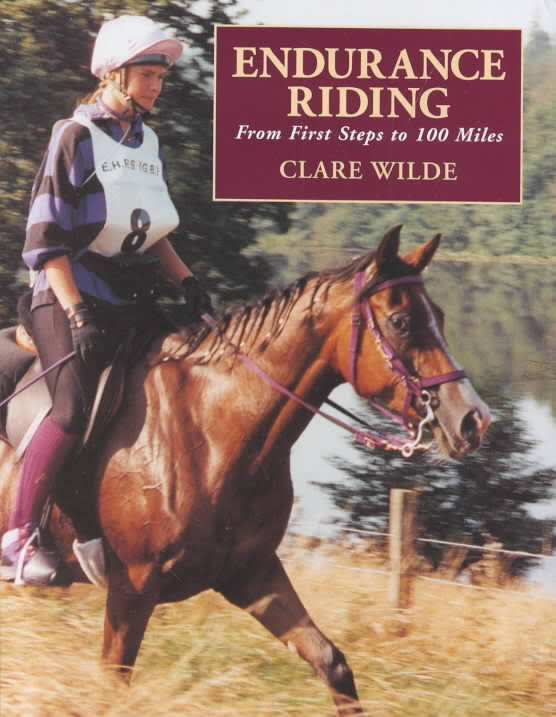
Wilde Cover


Next, I ordered a heart rate monitor and a GPS watch which measured distance and time.  It arrived shortly after one of several February blizzards, and it took me until June to be able to figure out how to use it properly (when all else fails, but only as a last resort, read ALL of the directions).  The watch was immensely helpful in teaching me a sense of speed over miles—CTR is based on maintaining a fairly steady 6-7 minute mile, and developing an awareness of what this speed feels like over varied terrain is important to ensure that you finish within the allotted window.

Finally, I planned a schedule for the season.  As in any discipline, you can’t push for peak performance year round.  I needed to develop a program which would allow Lee to steadily build her endurance and strength over time, without pushing so hard that she became sore or sour.  I decided up front that if at any point she indicated that she wasn’t feeling up to the task, I would pull back and regroup.  I live in seacoast, NH, where the terrain is rather…coastal.  In order to get ready for the hills and rocks of Vermont, I needed to carefully balance speed work to improve cardiovascular capacity with maintaining soundness in the musculoskeletal system.

Finally, I knew that the CTRs themselves would serve as an important component to her conditioning.  I decided that we would do the 15 mile ride sponsored by VERDA in mid May, followed by a one day 30 mile ride on flatter terrain a few weeks later in Maine (Lee actually was the high point champion that day!).  Based on how she felt after the 30 mile, next I aimed for the 25 mile ride at GMHA in June, and entered the “intro to endurance” 15 mile ride the next day, to have our first experience of a “back to back” weekend.  Considering that she was running away with me at times on the 15 mile, I figured she was coping ok! Our final CTR before the 100 was the two day fifty at GMHA in early August.

LeeMaine30CTRMay 2015 009
Lee went on to win the Maine 30 CTR with a perfect score of 100.

Before I began our conditioning, I had our vet, Dr. Monika Calitri of Seacoast Equine, out in March.  Lee is 16, and I wanted to make sure that there were no signs of any trouble brewing which would preclude the commencement of her conditioning plan.  With Dr. Calitri’s blessing, we got the green light to move forward with our schedule, and made a plan to recheck her in mid-June, after the back to back 40 mile weekend, to see how she was doing at that point.

As we progressed through each event, Lee felt better and better.  There were a few bumps in the road—she had some minor girth galls after the back to back 40 mile ride, prompting me to ask the trail community for advice (mohair/string girths), and we had some soundness concerns raised by the vet judge at the 50 mile ride, which really gave me pause, though I could personally feel and see nothing wrong.  However, she came out of the recovery phase of her 50 mile feeling better than ever, and after consulting again with Dr. Calitri, we received the green light to enter the 100.

Yet in spite of the successful completion of my preparation, and the encouragement of several mentors in the trail community, I hesitated to enter the 100 mile ride.  I worried that I wasn’t qualified, that I was in over my head, and maybe rerouting to the 60 mile ride, being held the same weekend, was a better plan.

But then I realized that the major reason that I was vacillating about entering the 100 mile ride was because I didn’t want to not finish it.  And as it turns out, if you don’t try, you certainly will not finish.  The only way to finish a 100 mile ride is to start one.

So on closing day, I dropped my entry in the mail.  And so began one of the most exciting and emotional weekends I have ever experienced with my horse.

Team Peanut Butter and Jelly

TeamPBandJatstart
Waiting to start on Day One:  Lee, Flower and Robin, Quinn and Kat.  Dr. Joan Hiltz offers us her well wishes!  Photo by H. Reynolds.

I can still count on just a few fingers the total number of people I have ever completed rides with, and not one of them was entering the 100 mile.  I knew that in order to be successful, I would need the guidance and companionship of someone who had done this before.  Through a mutual friend, I was introduced to Kat Waters, who was entered to ride Lee Alexander’s palomino Morgan gelding, Quinn.  Kat kindly agreed to let me join her and her friend, Robin McGrath, who was ironically also riding a palomino Morgan, Flower.  While it was Quinn’s first 100 mile ride, all other participants were veterans from previous years.  As a group, we looked like two pieces of bread and the “stuff” in the middle—Team Peanut Butter and Jelly.

Distance Days 2015 Lee's 100 012
Flower, in the foreground, and Quinn rest after completing 40 miles on day one.

I must pause here to pay respect to both Kat and Robin, without whom I am sure I would not have completed this ride.  From start to finish, we all functioned as a team, and enjoyed every minute on trail and off.  Kat became the team statistician, keeping track of our pace and the remaining time allowed.  We jokingly referred to Quinn as the “overlord”, as he typically led the group, comprised of his own personal harem.  Robin and Flower helped to set the pace, with their infectious energy and enthusiasm pushing us forward through fatigue and the seemingly never ending Vermont hills.

Our group rode the entire 100 miles from start to finish together, and I don’t think there was a happier or more excited group at any phase of the way.

Day 1—The White Loop (40 Miles)

The day prior to the ride, each competitor was required to ‘weigh in’ on the GMHA Member’s Room porch, carrying tack, helmet, boots and any other equipment they would be carrying with them.  Riders were divided then into “lightweight”, “middleweight” or “heavyweight” divisions.  We also had the standard “vet in”, where we presented our mounts to the judges, Dr. Ann Chaffee and Eva Norris.  Lee decided that she needed to liven things up by bucking vigorously during most of her trot out.  Clearly my strategy to “taper down” before the ride had left her with plenty of energy— but unfortunately, you want to try to match your trot out at the end of the ride with your initial presentation, which meant we had a lot to live up to!
The first day of the ride was the longest on trail, and I was a little nervous knowing that it would be the longest distance I had ever ridden Lee in one go.  To add to my nerves, the route was to take us over the trails in Reading, which are known for being exceptionally rocky and rugged, and therefore difficult to make time on.

Day1100miles
Lee and I about to start the 100 mile ride.  Photo courtesy Robin Malkasian.

Our day started early.  There were just nine horses entered in the 100 mile ride, and so our group of three represented fully one third of the ride’s entry.  We were certainly distinct—two Morgans of color and one decidedly Thoroughbred mare.  No traditional Arabians here!

Once we got on trail, we quickly realized that our three mounts really were going to stick together just like peanut butter and jelly.  The time passed quickly and Lee readily pulsed down at the half way hold.  I was especially pleased because with such a long distance, the hold was at about mile 25—which meant that Lee had gone nearly as far as she had ever gone before without the benefit of a mid-point break.  Other than being hungry, she seemed quite good to continue.

TheHarem
Quinn and his “ladies”– tackling the Reading trails on day one.  Photo courtesy of Kat Waters.

One of the funniest moments happened at a water stop.  We had caught up with another small group of 100 mile riders, and so about five or six of us were standing in a running stream, allowing our horses to drink.  Lee likes the moving water best, and had finally settled down to take a good drink in, when she decided that actually she was more concerned with scratching her face on her leg.  Somehow, she slipped the crownpiece of her bridle right off over her ears!  We were literally in midstream, and I was NOT interested in dismounting to fix the problem.  I managed to keep enough pressure on the S curve hackamore noseband that I prevented the rest of the bridle from slipping off, and then somehow manipulated the rest of the pieces back into their rightful places, all with one hand.

Upon returning to GMHA grounds, Flower and Lee pulsed down quickly, but Quinn, who is a bit thicker in his muscling, struggled to recover in his pulse parameters, despite a reduced respiration rate.  Kat needed to use every minute of extra time she was granted to continue to sponge and cool Quinn.  Within the rules of CTR, the most we could do was hold him or refill her water buckets—no one but the rider is allowed to apply the water, except in an emergency.  After an anxious wait on all our parts, Quinn was approved by the judges and Team Peanut Butter and Jelly remained intact.

We took the horses out for several walks and periods of hand grazing.  Lee seemed pretty content, and I was incredibly pleased with her for handling the rocky, rugged terrain in the Reading area with such “fight”. I looked forward to the ride the next day.

Distance Days 2015 Lee's 100 005
Lee looking fairly bright and perky for a horse who just went 40 miles.

The overnight temperature was expected to be in the low 40’s, but the early evening still felt fairly pleasant.  It is not a temperature that I would normally choose to blanket at, so I was surprised to see many other riders bringing out coolers and sheets as the sun dipped down.  Kat and Robin explained to me that after such a big exertion, the horse’s muscles need to be kept warmer than usual to prevent stiffness or cramping as they stood in the stalls overnight.  Fortunately, I had a supply of appropriate horse clothing in the trailer, so I put a sheet on Lee too.  This was just one of many tips this rookie picked up from the other riders.

Day 2—The Red Loop (35 miles)

Day two sent us on the thirty five mile red loop.  Today, we were joined by a medium sized group of horses and riders who were entered in the two day sixty mile ride and a small group who were doing the thirty five exclusively.  The 100 milers were sent out first, though, and it was as we were getting ready to leave that I began to realize what a celebrity status the 100 mile group had at the ride.  People I don’t know, or have only met once, were there to see us off, and many of them knew who we were and who we were riding.

As we started out over some of the fields at GMHA, I could feel tightness in Lee’s back, and I had a moment of panic that she was not right after her long ride the day before.  After a bit of warm up, though, I could feel her muscles begin to loosen, and her stride began to lengthen and swing as it usually does.

Day two was an exciting day on so many levels.  First, the route took us on trails in the town of Brownsville which I had never seen before, including one road which allowed us a fairly stunning view of Mt. Ascutney.  Second, once we passed through the safety check/hold at the half way point, each mile we covered was one mile further than Lee had ever gone before.  I knew that even if we didn’t finish, at that point we still had accomplished a great deal.

I noticed at the halfway hold that some of the galling which I had experienced on the June ride was starting again, in spite of using the mohair girth. I ride Lee in an all purpose saddle that I fished out of a dumpster (I am not making this up), and I had it flocked with wool over the winter. Comparing where Lee’s girth sits in relation to her elbow to the same setting on the trail saddles my friends used, I could see that it really wouldn’t matter what style of girth I chose—the placement of the billets dictate that Lee’s sensitive skin behind the elbow is destined to become pinched over longer distances.  Small issues with tack which are only minor irritations on a daily basis can become major issues or even deal breakers as the miles add up.  I reset the saddle, stretched her legs, and hoped for the best.

Leegettingherfacewashed
“Oh, the things I must endure…” says Lee. Photo courtesy of Robin Malkasian.

When we got back to the GMHA grounds, it was clear that the galls had grown, even though Lee didn’t seem to compromise her movement because of them.  However, her always-tending-towards-tight back was now incredibly sore, to the point where even a light brush of the fingers elicited a strong reaction, and she had two “hot spots” forming in the saddle area where she was exceptionally sensitive.

The judging team was not thrilled with these developments either, and they asked me to re-present Lee to them in the morning.  The rules of CTR are quite clear that no lotions, salves, medications or other “product” can be used on the horses while the competition is underway; however, soaked towels, massage and hand walking are all completely legal.  I spent hours over the afternoon and into the evening applying cool towels to Lee’s hot spots and galls, alternating with periods of hand walking and grazing or massaging the long muscles of her neck, topline and hindquarter.

Gradually, there was some reduction in the swelling, and Lee’s saddle area seemed to be less sensitive.  Kat returned from afternoon chores on her own local farm with several different versions of saddle pad and girth to try for the third day, as it was clear that several of the galls correlated with the positions of the string on the mohair girth.

I spent an anxious night in my trailer, hoping that Lee’s sore spots would resolve enough overnight to allow us to start.  We were so close to our goal, but I didn’t want to ride her if doing so was going to compromise her well-being.

Day 3—The Blue Loop (25 miles)

It was still night out when I arose to get ready for my AM pre-check on day three.  Hoping that the coyote pack which seemed to visit the grounds each morning around 4 AM had finished its rounds, I headed to the barns.  No one else seemed to be up and about yet, but the horses were alert to my activity.   More horses had arrived the night before as riders settled in for the twenty five and fifteen mile rides happening on day three, and the barns were fairly full.

As Lee ate her AM feed, I cautiously checked the galls from the day before.  Nearly all were flat or close to it, and her sensitivity level was much reduced.  I spent a little more time massaging the big muscles of her topline, while trying to keep as much of her body covered with the blanket as possible.  I had done nothing towards getting ready for the day—I hadn’t prepared my hold bucket or organized feed, I hadn’t tried on any of the borrowed pads or girths—as it felt too much like tempting fate to set up for something which I might not be permitted to do.  Once Lee was done eating, I took her out for a graze and a long, loosening walk.  I practiced a few trot ups to get her muscles supple and warm.  She seemed willing to move and to trot, and maybe a little bit rolling her eyes at me as if to say, “Really?  Again?”

At 5:45 AM, we presented to our judge team at the pavilion.  They noted her improved topline and asked me to jog her.  I am not sure I breathed the entire time we presented ourselves in hand, but I let out a long exhale when they gave me the thumbs up to start.  Team Peanut Butter and Jelly was still holding together.

I had to hustle back in the stabling area to finish preparations for the day’s ride.  I scooted right out of the pre-ride briefing in order to experiment with the tack options.  I ended up using a quilted and padding enforced dressage pad I found in my trailer, with my usual half pad and Kat’s fuzzy double elastic girth.  This combination seemed to provide good distribution of padding over the saddle area and also elicited only a minimal response from Lee as I tacked her up.

LeeCookieHill
Lee takes a break on Cookie Hill during day 3. Photo courtesy Kat Waters.

The last day of the ride was glorious.  To be quite honest, after riding forty and thirty five miles, back to back, twenty five felt like an absolute piece of cake.  We enjoyed gorgeous fall weather, stunning views, and the traditional chocolate chip cookies at the top of Cookie Hill.  After we passed through the final half way hold of the ride, I realized I was smiling like a crazy person and getting a little giddy.  We had less than thirteen miles to go.  We just might finish this thing!

Returningonday3
Team Peanut Butter and Jelly returning to the White Ring after completing 100 miles. Photo courtesy H. Reynolds.

I am not sure I can fully put into words the feeling of returning to the White Ring for the third time, and hearing our names announced once more, this time proclaiming us one hundred mile finishers.  People on the rail cheered.  I just kept stroking Lee’s neck, silently thanking her for giving me her best over the entire process—not just these three days, but the weeks and months leading up to it.  As we dismounted after crossing the finish line, I gave Lee a big hug around her neck.  She sighed.  She isn’t much for demonstration of affection but I think after 100 miles, she was willing to put up with me just a little longer.

Thanks and Gratitude

The entire experience of my first three day 100 mile ride was amazing and humbling. The people I have met in the competitive trail community have been truly helpful and have often gone out of their way to help my rookie self out—I am greatly indebted to the wisdom and guidance of them all, but especially Robin Malkasian and Kate Burr, Denny Emerson, Sarah MacDonald and of course Kat Waters and Robin McGrath.

Distance Days 2015 Lee's 100 036
Robin and Flower won all kinds of honors, including High Point Morgan and the Reserve Champion High Point Horse of the whole ride!


Distance Days 2015 Lee's 100 040
Kat and Quinn received honors for being the best Morgan trail horse, high point rookie horse and the horsemanship award.

These rides are a ton of work to put on, and I have found both the organizers and volunteers to be gracious and helpful, frequently answering my questions and giving me guidance.  And of course, all riders must acknowledge the willingness of land owners to allow us access to their properties—such an amazing privilege.

Distance Days 2015 Lee's 100 025
Team Peanut Butter and Jelly still sticking together at the awards ceremony.

To my friends at home who also have shown me so much support and love, helped train with me and take care of me and the critters—Dr. Amanda Rizner, Pam, Molly and Kaeli McPhee, Heidi Chase, Dr. Monika Calitri and our wonderful farrier, Nancy Slombo, who often will come on a day’s notice when I change my mind and decide that no, that shoe WON’T stay on through the weekend after all– my deepest gratitude and appreciation.

But my biggest acknowledgement of all must go to the Dark Mare herself.  Anyone who knows Lee and I also knows what a tremendously long road we have been on together, literally and figuratively.  I am so appreciative for all that she has taught me and for finally finding a niche in which this wonderful athlete can truly excel.


LeeatAwardsCeremony2015DistanceDays
Photo credit to Denny Emerson.

Green Mountain Horse Association’s 79th Annual 100 Mile Ride

Christina Keim and Liatris:  1st place Middleweight Division, Champion Rookie Rider, Perkion Trophy for Best Scoring Thoroughbred

Whatever you can do or dream you can, begin it.– Goethe


Book Review:  Endurance Riding: From First Steps to 100 Miles

Endurance Riding: From First Steps to 100 Miles by Clare Wilde

c 1996 Kenilworth Press, Buckingham (Great Britain) 170 pages

ISBN 1-872082-83-1

This past winter, I dedicated my equine reading to a selection of titles related to endurance and distance riding.  I knew that for 2015, I wanted to try to bring my horse up to a level of condition which might make it possible for her to tackle a 50 or even 100 mile ride, but I really didn’t know how to go about doing that.  It was with this mindset that I picked up Wilde’s book.  Wilde is an experienced endurance competitor whose love for the sport, and for riding and horses in general, is apparent throughout the book.

Wilde Cover

This book covers many aspects of the sport of endurance for the novice, tackling everything from horse selection to tack to schooling to what it takes to crew at a ride.  One of the sections that I enjoyed the most was called “Basic Schooling and Education,” and I liked it because it reviewed critical basics of training for any horse.  For example,  Wilde discusses the fact that in order for a horse to stay sound and sane over a long distance ride, they must move in an “economical, balanced yet dynamic motion” (Wilde, 1996, p. 45).  To achieve this, the rider must be conscientious in both their own posture and position and also work to develop suppleness and strength in the horse.  Horses must be encouraged to work correctly from back to front so that on the trail they can be supple and balanced.  In endurance riding, where competitive riders move at fast speeds much of the time, this preparation is essential.  “The versatile, supple horse will be able to move away from your leg to enable you to open gates quickly, avoid hazards and move off rough ground.  He will also be able to corner efficiently, particularly at speed” (Wilde, 1996, p. 46).   This information is so critical; a successful distance horse must be a true athlete, which requires paying attention to all forms of physical conditioning.

Wilde also points out that the endurance horse is the marathoner of the horse world, and the end goal of conditioning should be “to produce a supremely fit, laid-back equine athlete in the peak of physical condition” (Wilde, 1996, p. 49).  To do this requires not just attention to their workload, but also their overall stable management.  There is a big difference between the casual trail/pleasure horse that goes for a leisurely walk every now and then and a horse that is in preparation for a serious distance undertaking.  The horse’s stable management therefore must be of a higher standard than for a horse not in such intense training.  This is an important area of consideration which is sometimes overlooked.

Endurance and competitive trail riding can be enjoyed by riders of all ages and with all breeds of horse, with the proper conditioning.

Just like in other equine sports, Wilde reminds distance riders that the horse needs a warm up and cool down phase in each work set.  It is important to actively walk a horse for at least ten minutes before asking for faster gaits, and then to ease into the trot and canter.  Riders who are looking to start their race time at speed must budget in this warm up prior to the start.

The section titled “Conditioning for Competition” was especially enlightening.  Wilde says that once her horse has been built up to a base level of fitness which allows for easy completion and recovery from 20 mile rides, she rarely rides more than 15 miles in training.  One of the big challenges in distance riding is doing enough work to bring the horse to a fit level of condition but not doing so much that they become sore or unsound, or that their attitude becomes unwilling.  Learning how to “peak” your equine athlete at just the right time is both an art and a science, and certainly the ability to do this well separates the best from the also ran’s in any horse sport, not just endurance.  Wilde offers several sample conditioning and training schedules which can work to help horses develop for various distance rides, but also cautions readers to remember that each horse is an individual.

“Endurance riding Uzes 2005 front”. Licensed under Public Domain via Wikimedia Commons – https://commons.wikimedia.org/wiki/File:Endurance_riding_Uzes_2005_front.jpg#/media/File:Endurance_riding_Uzes_2005_front.jpg

The final chapter which I thought was particularly well done was titled “Personal Preparation”.  Here, Wilde discusses the care and feeding of the rider as an athlete, as well addresses the critical importance of rider fitness.  “In the most basic terms, your horse will find himself unable to perform, no matter how well he is prepared, if you are a hindrance to him rather than an asset” (Wilde, 1996, p. 95).  This last statement would seem to be true regardless of your chosen discipline, and is a concept which more riders need to take to heart if they truly want to progress in their riding.

Overall, Wilde’s book is an easy read with relevance to riders who want to improve their level of awareness on the subject of conditioning across the board.  While the author is certainly focusing on conditioning for the discipline of endurance, so very much of what she says relates to any equine endeavor that I would recommend it for anyone who wants to do a better job of preparing their equine athlete for their goals.  In this book, Wilde is essentially preaching practical, good horsemanship.  My only criticism is that at this point, the book is nearly twenty years in print, and photographs and certain references could use an update if there were to be a newer edition released.

4/5 stars

Blogger’s Note:  The featured image is from the first Tevis Cup ride.   Started in 1955 by Wendell Robie in California, the Tevis Cup 100 mile ride is regarded as one of the hardest in the world.  Wilde credits Robie with being one of the inspirations for the spread of endurance riders world wide, and especially within the United States. 

Trusting the Unstrustful Horse

We joke that the Dark Mare, Lee, is a survivor. She lives her life in a fairly constant state of alertness, and if there is a sign of trouble brewing, she is going to get out of dodge.  In her younger years, she broke cross ties and halters with frequent regularity and closely monitored objects such as dumpsters, mounting blocks and piles of jumps for the presence of trolls, chipmunks and other instigators of mayhem.   While she has mellowed somewhat, in general, if danger is afoot, Lee is leaving—with or without you.

When Lee gets upset about something, she can really revert to a primitive state of fight or flight.  On the one hand, it is easy to understand that this reaction has kept horses as a species alive for eons, and the behavior is imprinted in her genetic code.  But at the same time, it is frustrating because the reaction can be so out of proportion to the problem. And at some level, one would hope that her training and systematic exposure to all kinds of stimuli would result in at least one ounce of trust in her humans, but this has not always been the case.

Lee enjoyed the cow-free cow barn in Maine at the 30 mile CTR.  I was also impressed by her overall "coping" here, including the wind blowing hard all night, which rattled the metal roof panels to no end.
Lee enjoyed the cow-free cow barn in Maine at the 30 mile CTR. I was also impressed by her overall “coping” here, including the wind blowing hard all night, which rattled the metal roof panels to no end.

As a result of dealing with this behavior for the better part of a decade, I realize that I have come to assume the worst of Lee in many circumstances, expecting her to have mini or major meltdowns over various situations.  You might think that I am about to tell you how my preconceived ideas usually set up a self-fulfilling prophecy, and that Lee lives up to my (minimal) expectations when push comes to shove.  However, increasingly, the opposite is the case, and perhaps it is I who has the trust issue, not Lee.

This March, tired of being in the indoor and looking for a change of pace, I was riding Lee in the dirt parking lot at the University of New Hampshire during its Spring Break week.  The footing was actually quite good given the season and weather we had experienced this winter, but the lot was ringed with a decently sized plow bank creating a de facto fence line and leaving only one entrance/exit from the lot.  I had planned to do a set distance, changing direction at regular intervals, working at the trot and canter.  As I was getting close to the end of my set, I noticed a fairly dark and ominous looking cloud in the not so far distance, coming from the direction that ‘weather’ normally approaches us from.  “I am almost done,” I thought. “Two more laps and I will head in. No problem.”

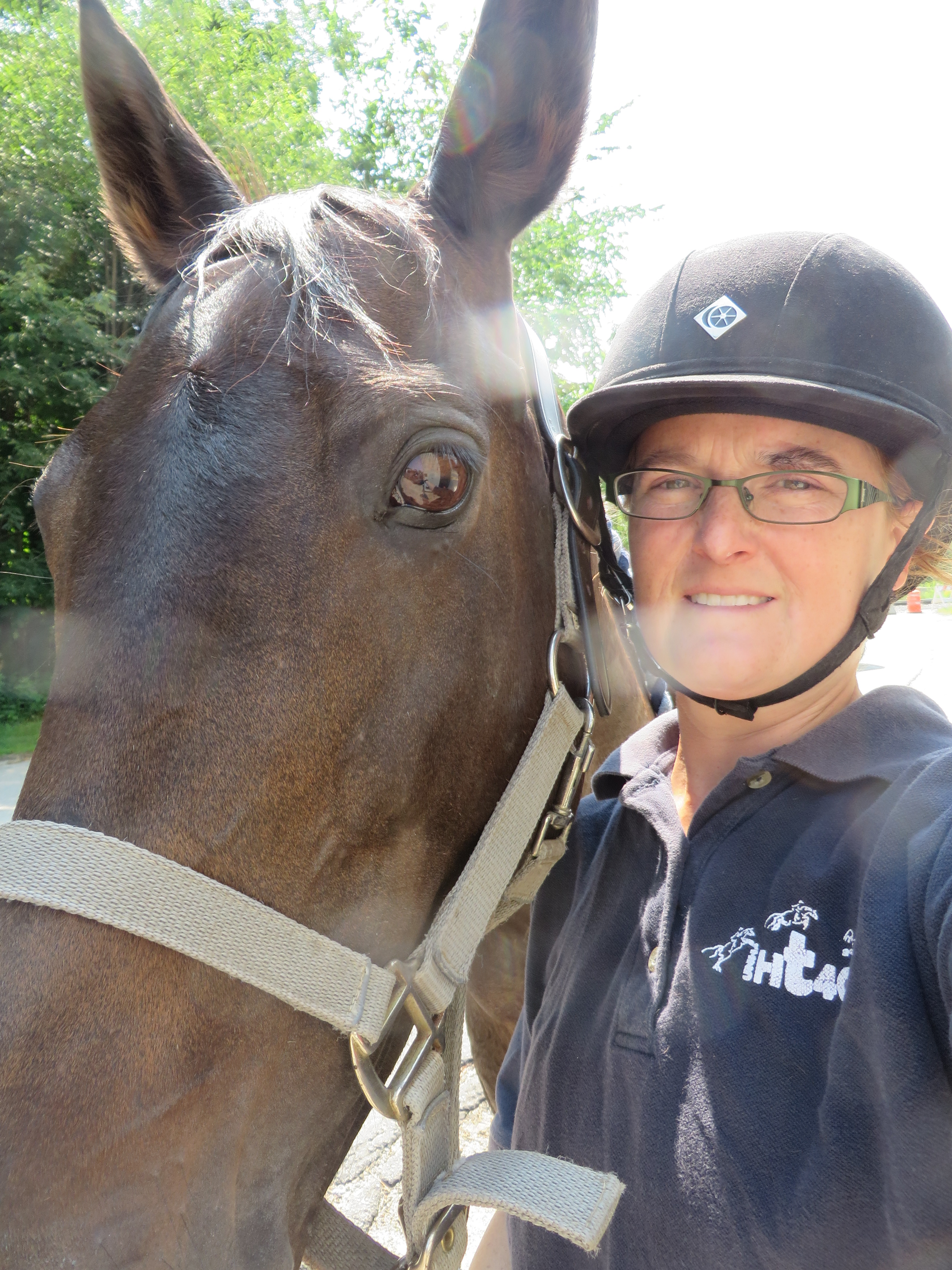
Lee and I took our first selfie ever at the Rockingham Rail Trail after a solo 14 mile conditioning ride this July.

Almost before the thought was complete, the wind picked up like I have never experienced and began to howl. Debris that I hadn’t previously noticed was flying sideways and into us.  Suddenly it began to precipitate—something.  Hail? Snow balls?  I couldn’t even tell you because the intensity of the icy precipitation combined with the incredible wind meant that I couldn’t even lift my head.  Lee instinctively swung her hindquarters into the wind, but we were still being pummeled from all sides and were instantly soaked through.  I had no idea what was going to come next—I wondered if a tornado were about to blow through, and had the thought, “so this is how it will end”.

We were not in a safe situation, and I knew we needed to get out of there, but due to the snow banks and our position in the lot, to do so required riding the length of the parking lot heading straight into the wind and snow/ice/rain to reach the exit.  I truly couldn’t even raise my head to see ahead of us due to the intensity of the weather, so I dropped down onto her neck and yelled “go on!” to Lee over the wind.  And sure enough, Lee actually went—straight into the wind, neck and head down, in spite of the power of the frenzied air.  As soon as we rounded the corner, I urged her to the trot and we made a break for the barn, wind to our backs.

Denny Emerson and High Brook Rockstar and Lee and I about to start the Hartland 15 Mile CDR in July of 2014.

I was impressed with Lee that day.  She would have been well within her rights to bolt or panic, to scoot or ignore me.  But for whatever reason, she didn’t.  I was (and still am) quite proud of her for all of it and for getting the both of us to safety.

This spring, I had to move both of my horses to new facilities.  Anna had been in the same barn for five years, but Lee had been at UNH for over ten.  I wasn’t too worried about Anna making the transition, but I honestly worried and worried about Lee.  I can worry like it is my job.  The barn she moved to is a low key private barn at my good friend’s home; it allowed Lee her own paddock with run in and access to dirt roads and trails.  Perfect.  Yet I worried.  My friend has a mule—what if Lee is scared of her funny mule noises?  The fencing is just electric wire.  What if Lee doesn’t see it or respect it? What if I can’t ride Lee alone on the roads? What if…?

The night before the move, it poured, the first rain in almost a month.  When I say it poured, I am talking about the soaking type of deluge that saturates you through to your core instantly, the kind that is like a hose from above.  I don’t think I slept more than a few fits and starts as my anxiety and worry ate away at me.  What if Lee won’t go into the shelter?  What if she works herself up into a colic?

As I hitched up the trailer in the pouring rain, I not so silently cursed the Powers That Be for the weather on this most important of days.  The schedule was to move Lee first, then go back and pick up Anna, since she was taking over Lee’s stall at UNH.

When we arrived at Namaste Farm, Lee fairly quietly unloaded, marched into her new abode, and took a tour around.  She didn’t touch the wire fence.  She didn’t respond when her new neighbors whinnied to her.  While clearly not 100% settled, she was far, far less worried that I was.  We did end up having to lock her into her run in that evening, as it continued to pour, because she wanted to stand outside near the other horses (who had sensibly gone into their own sheds) even once she was shivering under her rain sheet.  Once she figured out that the shelter was dry though, she began using it on her own when the doors were re-opened the next day.  We haven’t had to shut them since.

PinelandKurLeeNewCar 100
Lee’s new friends, Taydee the Connemara and Marybeth Applebottom, the chestnut appaloosa mule.

After a day or two to settle in, I took her for her first ride.  I decided to start in the fields first.  Lee’s new neighbors whinnied as we left, but she didn’t answer, and instead was all business.  But when we got to the fields, she became quite unsettled and agitated, and was being overly spooky and difficult.  “Here we go,” I thought to myself.  “I knew this would happen.  She is going to be unrideable here.”  I ended up having to dismount for safety and led her in hand for a bit, full of negative thoughts and wondering what I had gotten myself into.

The fields were soaked after the heavy rain and I was worried about leaving hoof prints once she started to act up, so I decided that maybe I should try taking Lee down the dirt road instead.  I had hesitated to start with this, because the traffic on the road can occasionally be unpredictable and since she can be too, I thought it might be a bad combination.   However, I knew that on the road I could more confidently ask Lee to go forward and it seemed like maybe that was just what she needed.

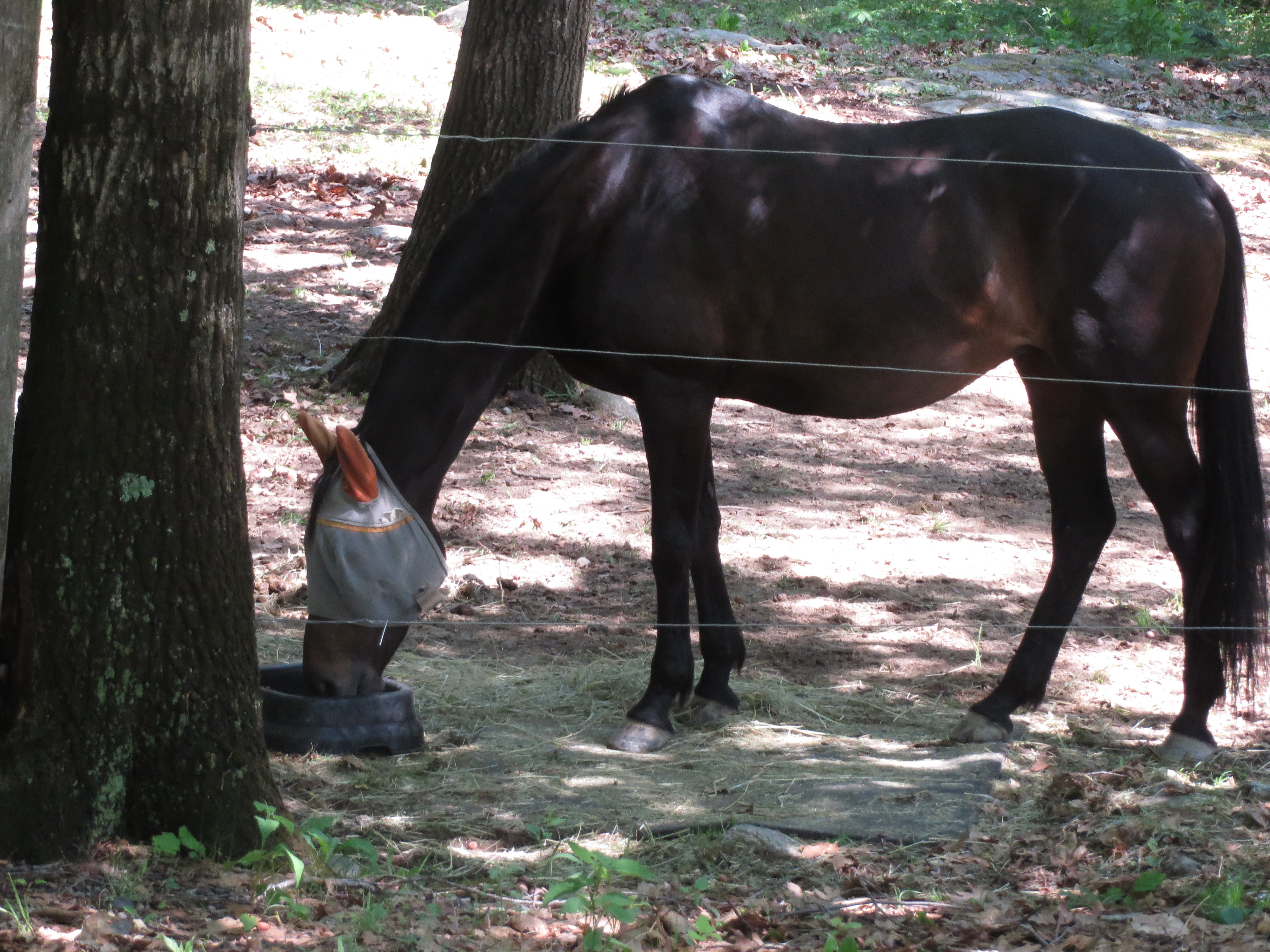
Lee having breakfast shortly after arriving at her new home.

So I gamely re-mounted and headed off down the road, away from the farm.  Almost instantly, my reliable distance horse was back.  She happily trotted off, one-two-one-two,  going all the way to where the pavement starts near the town line, and then home.  No issues.  No spooking.  No drama.  She was in her Zen place.

And so it has gone with Lee at Namaste Farm. Since that first ride, she has gone all the way into Newmarket and into a little subdivision, she has ridden alone and in company to Adams Point and seen her first cormorants and sailboats, and she has even come to tolerate the fields (though the bugs which live on them, not so much).  She has done nearly two hundred miles of trail since her arrival, and is just one of the herd.

I don’t think I will ever stop worrying about things which haven’t happened and might not ever happen.  I can at least recognize that the worry and anxiety I feel is, for me, an inevitable part of change, but I also am trying to learn to be more accepting of the fact that some variables are just out of my control.  I think worry starts with some kernel of truth, but then it can grow and mutate and take on a life of its own.

Lee completes her first two day 50 mile ride at GMHA, with her friends Roxie (middle, ridden by Denny Emerson) and Camille (ridden by Robin Malkasian).

I need to start to give Lee more credit for the animal she has become.  On August 1-2, she completed her first two day 50 mile competitive trail ride (CTR), and I never felt one ounce of quit in her the whole weekend.  In a week, she has more than recovered and was joyfully jigging all over the place on our AM ride today.  While I am sure there will be situations in the future where the “survivalist” Lee comes back, I also think that I know the horse well enough to start to trust that she will cope more often than she won’t.

As we all know, trust in any relationship is a two way street.  Perhaps Lee and I are more alike than we are different in our tendency to worry.  Sometimes I take care of her, and sometimes she takes care of me.

Early AM grazing in Vermont, August 2015.

Book Review:  Conditioning Sport Horses

Conditioning Sport Horses by Hilary M. Clayton

c 1991 Sport Horse Publications, Mason, MI, 256 pages

ISBN 0-9695720-0-X

Still referred to by many as the “Bible” of equine conditioning principles, I picked up Clayton’s 1991 work, Conditioning Sport Horses, this past winter as I was beginning to think seriously about the demands of conditioning for long distance riding.  I was worried at first that the book might be a bit dry or too technical for me, a non-scientist, to understand.  However, Clayton is skilled at breaking down complex concepts into manageable pieces and I found it a fairly pleasurable read.

Dr. Hilary Clayton   Photo taken from her promotional poster.
Dr. Hilary Clayton Photo taken from her promotional poster.

Conditioning Sport Horses is divided into three chunks.  Part One looks at the major systems involved in the process of preparing a horse for athletic work and devotes full chapters to the cardiovascular and respiratory systems, energy production, muscles, thermoregulation and fluid and electrolyte balance.  Part Two delves into the “practical aspects of conditioning” and covers concepts such as general conditioning principles, cardiovascular conditioning, strength training, increasing suppleness, and managing these elements in a horse’s overall training program (including using a heart rate monitor and providing adequate nutrition).  Finally, Part Three shows how to use these concepts to prepare a horse for the specific demands of various disciplines; Clayton addresses the traditional sport horse disciplines but also several western sports as well as polo, endurance and chuck wagon racing (!).

These polo ponies show how much a horse will naturally lean onto the inside forelimb and shoulder when turning. Polo is a fast moving sport, requiring speed and agility (Clayton, 1991, p 229).  "Polo3-1-" by Ems (Emanuel Sanchez de la Cerda) - de.wikipedia.org: 18:50, 16. Mär. 2006 .. Ems .. 800×520 (292.111 Bytes) (* Bildbeschreibung: Sal. Oppenheim Cup Finale 2005 * Fotograf/Zeichner: Emanuel Sanchez de la Cerda (~~~) * Datum: 26.06.2005 18:00). Licensed under CC BY-SA 2.0de via Wikimedia Commons - http://commons.wikimedia.org/wiki/File:Polo3-1-.jpeg#mediaviewer/File:Polo3-1-.jpeg
These polo ponies show how much a horse will naturally lean onto the inside forelimb and shoulder when turning. Polo is a fast moving sport, requiring speed and agility (Clayton, 1991, p 229).
“Polo3-1-” by Ems (Emanuel Sanchez de la Cerda) – de.wikipedia.org: 18:50, 16. Mär. 2006 .. Ems .. 800×520 (292.111 Bytes) (* Bildbeschreibung: Sal. Oppenheim Cup Finale 2005 * Fotograf/Zeichner: Emanuel Sanchez de la Cerda (~~~) * Datum: 26.06.2005 18:00). Licensed under CC BY-SA 2.0de via Wikimedia Commons – http://commons.wikimedia.org/wiki/File:Polo3-1-.jpeg#mediaviewer/File:Polo3-1-.jpeg

I read this book much like I would a text book, underlining key concepts and passages and pasting sticky notes on others.  Doing so really helped me to dig into the material. While I have studied conditioning concepts in the past, I have never done so with the intensity or scrutiny that I have brought to my work this season, and Clayton’s writing included many important concepts and principles that I am not sure I have truly ever heard before, as well as reminded me of old favorites.

Conditioning Sport Horses, by Hilary M. Clayton (cover).

For example, we have all been told that we shouldn’t feed our horses immediately following a hard work because the blood supply has been shifted away from the digestive organs.  Clayton includes a graph which shows that during exercise, just over 75% of the cardiac output and distribution of blood flow is shifted to the horse’s muscles, and less than one quarter is dedicated to all of the other organs in the body.  A horse at rest is nearly opposite of these values.  Seeing the ratio so clearly visually depicted really drove the point home (see Clayton, 1991, page 14).

Another relevant question was answered in the chapter on thermoregulation.  Here in New Hampshire, winters can get downright frigid, and the question “when is it too cold to ride” is often raised, in particular in reference to whether or not conditions are safe for the horse.  Clayton settles the point clearly: “Compared with horses exercising at normal temperatures, horses undergoing strenuous exercise at -25* C(-13* F) have no significant changes in heart rate, lactate production, blood gas tensions, gait or lung tissue morphology” (Clayton, 1991, p 70).  So next winter when I choose to not ride when the temps are in the single digits, I will know that it is for me that I am staying in the warmth, not for my horse!

My horse, Carmel, after the New England Blizzard of 2015.

Perhaps one of the most interesting segments of Conditioning the Sport Horse is the section on general conditioning principles.  When most riders think of conditioning, it seems that their minds immediately go to the concept of “sets”; going out and riding at a certain speed or pace for a specific period of time, then allowing the horse to partially recover before completing another round.  I am not sure that riders in non-aerobic disciplines (dressage comes to mind) often think hard about their horse’s “conditioning plan”.  Clayton explains in great detail that the term conditioning encompasses far more than just improving the horse’s cardiovascular capacity; in fact, this system is the fastest one to improve with exercise, while other equally critical systems (such as the musculoskeletal system) lag behind.  If a rider fails to address each of the critical areas of conditioning, their equine athlete’s performance will be compromised (at best) or they will risk injury or breakdown (at worst).

There are three components to the volume of exercise which a horse is in:  intensity, duration and frequency.  Smart riders are able to gradually increase the horse’s capacity in each of these areas, though not in all three at once (Clayton, 1991, 80-81).  Strategically incorporating the various forms of conditioning with these principles will allow for the most consistent and safe increase in athletic capacity.

This book is full of practical and useful tips, everything from  how to make your own electrolytes (3 parts sodium chloride to one part potassium chloride—see page 72) to how to introduce fitness concepts to a green horse in any discipline to feeding strategies for animals in endurance sports which will maximize performance.  In the chapters on specific disciplines, Clayton provides clear and do-able formats for conditioning in each sport, attending to each of the major categories of conditioning.   I learned a lot from reading each chapter, even for those disciplines which are not my specialty.

If you are going to consider yourself a serious student of the correct and conscientious development of the equine athlete, you simply MUST have this book on your shelves.  Read it, underline it, dog ear it, and refer to it regularly as you create a conditioning plan for your athlete— and whether they are a dressage specialist, a reiner, a show jumper, or something else,  your horse will thank you.

5/5 stars

Creating a Musical Freestyle that WORKS: Tips from the Top

This past May, I had the opportunity to attend a two day musical freestyle symposium at The Equestrian Center at Pineland Farms in New Gloucester, ME. Day one focused primarily on the judge’s perspective (see my previous blog on this subject), while day two allowed participants to dissect the ingredients of a freestyle which will guarantee to impress the judges.  The weekend was facilitated by FEI judge Lois Yukins and Klassic Kur founder Terry Ciotti Gallo, who has designed for some of the best riders and horses in the world.

Lois Yukins
Lois Yukins
Terry Ciotti Gallo
Terry Ciotti Gallo

“Riding a freestyle is not just for the judge’s entertainment,” says Yukins.  “It is for you—the rider—and the audience.” Putting together a freestyle requires a great deal of time, creativity and patience, and it is important to enjoy the process as much as the performance.

Choosing Your Music

Perhaps the single most important aspect of making a freestyle that works is to choose the perfect music.  According to Gallo, the right music will match the footfalls of the trot and canter, is suitable for the horse and appeals to the taste of the rider. It is equally important that the selections for each gait are cohesive in genre, theme or instrumentation.  Once the perfect music is chosen, it will further enhance the quality of the freestyle by using seamless editing (either done professionally or on a home computer) so that the entire program sounds like it all goes together.

Gallo explained that in order to choose the correct music, it is important to know what the average tempo is for the horse for each gait, expressed as beats per minute (bpm).   This can be done by having someone take video of the horse performing the required movements at the level for later review or it can be done in live time.  Count the number of steps taken in sixty seconds; for the trot and walk, count the steps of each front leg, but for the canter, count only the leading leg of each stride.  Using a metronome can be a huge help, as the listener can set its pulse to the beat of the movement.  Many smart phones have free or inexpensive metronomes to download.  It is then easy to play the metronome set to the horse’s beats per minute against a prospective musical selection to determine its appropriateness.  In this way, the rider can easily test many more samples of music at once than by playing them with the live horse riding around the arena.

Doris Carlson worked with her Third Level mare on ascertaining tempo and creating choreography.

The basic gaits of most horses fall within a similar range.

Gait Range (in BPM) Average BPM
Trot 132-168 145
Walk 98-112 106
Canter 92-105 96
Passage 105-116 110

The horse’s tempo in each gait will change as they progress through their training, and may even vary through those movements which are still harder for the horse to execute correctly.  Therefore, Gallo recommends that riders set their horse’s tempo only when the horse is going the way they will in the competition arena.  If the horse seems to be between two tempos, use the lateral movements to help figure out which tempo is more appropriate.

Sometimes, the music’s tempo can act as a training tool, encouraging riders to ride their horses more steadily all the time.  As the horse gets stronger and the moment of suspension becomes more enhanced, the horse’s tempo will slow down, and music may need to be modified.  This is one of several reasons why the right music for a horse’s First Level freestyle may not be the right music for them at the FEI levels.

Notice also that there is some overlap in the average beats per minute for the walk, canter and even passage.  This means that it may be possible to use the same piece of music for both the walk and the canter, but something in the musical phrasing must express a change of gait.

Michelle Hirshberg worked with her Lusitano stallion on creating a consistent tempo which matched the music.  Gallo discussed how the type of music used could help to create greater consistency and more jump in the canter, elevating its quality.
Michelle Hirshberg worked with her Lusitano stallion on creating a consistent tempo which matched the music. Gallo discussed how the type of music used could help to create greater consistency and more jump in the canter, elevating its quality.

How do I find this “perfect music”?

For someone who truly enjoys music, mulling through various selections could provide hours upon hours of entertainment.  But it can be hard to know where to start, as the number of options seems limitless, and the best music might truly come from any genre.

Gallo says that it is important to keep an open mind—the best music for the horse might be a surprise. Your own personal music library is of course a great place to start, but don’t forget to ask friends for some of their favorites as well.  Gallo recommends checking the selections at college and public libraries, online stores such as iTunes or Amazon and also radio stations, especially those like satellite, Pandora, etc.  As you listen to a selection, try to feel the beat, or keep a metronome handy.  iTunes can be useful to pull up nearly every available version of a song, which can make it easier to find arrangements of favorite tunes recorded in a certain instrumentation or without words.  Pandora’s grouping feature will make it easy to search all of the music which sounds like a particular artist.

Music that is within ten beats of the horse’s usual beats per minute may be usable with the help of a good sound artist.  As you listen to selections, set up a catalogue to organize them by their beats per minute.  Notebooks, recipe cards or computer databases all work well for this.

Gallo mentioned that some music is recorded using a “click track”, which is a metronome that plays when musicians are recording.  These songs tend to have a consistent beat; music recorded without a click track can have a range in the beats per minute that makes it harder to follow.

Gallo helped Cyndy West and her Lippizan mare create Intermediare choreography which would suit previously edited music from a lower level freestyle.

Lower level horses generally are better suited to lighter music; many dance styles work well.  It requires the big and powerful movement of an upper level horse to carry off stronger musical selections or music played by a full orchestra.  Gallo mentioned that it is totally acceptable for younger riders to choose more modern musical selections.

Lyrics (words, voice) are permitted, but it is conventional wisdom that they are to be avoided when possible as they can distract from the performance.  Some music features vocals that sound more like instruments (ooh’s and aah’s), which may actually enhance the performance and should not be considered to be in the same category as full lyrics.  Gallo has chosen to carefully use vocals in select freestyles, but says it is like “sprinkling your latte with caramel as opposed to creating a crème brulee.”  Songs which heavily feature vocals may have versions available that are wholly or significantly instrumented, which might work better for freestyle design.

Gallo further cautions that heavily syncopated music is not always good, as it can be hard for riders to follow the beat.  “When the beat is very clean, it is an aid to the rider,” says Gallo.

Suitability and Cohesiveness

Just because a piece of music matches your horse’s tempo doesn’t make it the right or best choice to use in your freestyle.  Riders must consider suitability and cohesiveness as well.

Suitability means that the music enhances the horse’s way of going, and makes their movements appear to be light and effortless.  Big, powerful horses performing upper level movements can carry big, powerful music; lower level horses which lack some of that suspension and power will be better with lighter music that makes their movement appear to be lofty.  To check whether a piece of music is suitable, play it while you ride, and either video it or ask a friend to tell you how your horse looks.  Does the horse seem to be light or heavy?  Are their movements sluggish or frantic, or do they seem to be relaxed?  Does the horse seem happy, or burdened?  Each piece should suggest the gait that it is used for.

Paula Pierce's elegant and powerful Intermediate horse was able to carry off nearly any musical genre.
Paula Pierce’s elegant and powerful Intermediate horse was able to carry off nearly any musical genre.

Cohesiveness means that the music is all from the same genre—the selections have an obvious theme.  The instrumentation might match, or the sound between the pieces is similar.  Sometimes a single instrument is highlighted in each selection.  While you would never design a freestyle to one complete piece of music, you want your edited music to sound as if it could come from one piece.  The music used in a freestyle should overall be pleasing to the ear.

Of the three gaits, the walk is the most relaxed, and it is not critical that the beat of the music matches the footfalls—unless your horse has an 8 or 9 walk, in which case you should try to match them after all!  The walk is a section of the freestyle in which the rider can catch up to their music if needed.  While the music choice may be more relaxed, it should still have energy.

Riders can choose to have entry music or not.  The freestyle judging doesn’t officially begin until the first halt and salute, which must be performed somewhere on center line.  If the rider chooses to have entry music, it should come from within the program, be a fanfare related to the program or introduce the theme of the program.  Entry music must start within 45 seconds of the bell being rung, and the rider must enter the arena within 20 seconds of it starting to play.

Exit music is not allowed in competition freestyles.  The music must cease with the final salute.

Planning your Choreography

Choosing the right music is just one part of creating a winning freestyle.  Riders must also design a pattern for the ride which highlights the horse’s best qualities and showcases each of the required movements.  The results of this planning are scored by the judge under the artistic impression scores for choreography (for USDF tests, a coefficient of 4) and degree of difficulty (for USDF tests, a coefficient of 2, but x4 for FEI levels).  Gallo recommends designing the choreography first, in most cases, and then editing the music to suit the choreography.

Before the rider can begin to plan the choreography, they must know which movements are required for the level.  Note also those movements which must be performed on both reins.  Omitting a movement is just giving away a score.  Included on the lower left corner of each test sheet is a list of those movements which are considered “above the level”, which are not allowed.  While some riders might think that showing their horse’s talent for half pass in a Second Level freestyle would be an opportunity to increase the degree of difficulty, it is in fact a significant point penalty because the movement is above the level.  Riders must also consider that certain movements could be hard to interpret, depending on their placement; for example, shoulder in is virtually invisible to the judge at “C” when ridden on the short side of the arena.

Dinah Rojek listens intently to Gallo, who worked on helping her really feel the beat of various musical selections.

Degree of difficulty is certainly a consideration when planning the choreography for a freestyle, but both Gallo and Yukins cautioned that riders must only do what they know they can really execute well—or else both the artistic and technical scores will suffer.  “Simple and correct always beats complicated and messy,” says Yukins.  “Don’t compromise the basics of the horse to add difficulty.”

Gallo says that the overall degree of difficulty is one of the first things she considers when designing choreography for a client; this mostly applies to the configuration of movements at the trot and canter, unless walk is being included in a transition.  With only a coefficient of 2 at the USDF levels, degree of difficulty is not as critical a factor as it is at the FEI levels.  Another important factor is the horse’s experience at the level.  The design and difficulty should not exceed what the horse can manage at that stage of their training.

Degree of difficulty is shown by doing things like performing a movement at a steeper angle than is required at a standard test of the same level, placing movements off the rail or on center line, doing demanding transitions (such as a canter lengthening to walk on the same line), challenging combinations of movements, reins in one hand, or tempi changes on a broken or curved line.

Another decision which must be made related to choreography is what order the gaits should be featured in.  The choice made here will ultimately affect the amount of editing required for the music.

Riders must consider the point of view when placing their movements in the competition arena.  Here is the chance to really highlight something your horse does well—a pirouette right on center line, close to the judge, for example.  The rider can also de-emphasize movements or transitions which are harder for the horse.  In most cases, movements can be completed moving towards or away from the judge; always consider, though, what the view looks like from “C”.  Half pass is usually most elegant when seen from the front.   Design cohesiveness is important; the judge should never be left wondering what a particular movement was meant to be.

Gallo helped Bryn Wash experiment with different musical selections for her Third Level mare, as well as tinker with some choreography ideas.

Well-designed choreography uses the entire arena well; movements are spread out within the ring, and there is a sense of balance in terms of both time spent on each rein and where movements are placed.  One way to check this is to physically draw the movements out on paper; if the lines look all clumped together, then they will also appear that way in the ring.   These drawings can also be a helpful tool to ensure that all compulsory elements are included and that no “above level” movements are present.

dressage arena

Good choreography is creative and shows design cohesiveness.  Many riders get caught up in the idea that movements should not be “too test like”.  At the lower levels, however, it is challenging to come up with wholly new or unique ways of combining movements together.  Choreography should not closely replicate anything contained within a current USEF test, but it is acceptable to use combinations of movements that may have been included in previous editions of tests at that level.

Gallo suggests using direct and indirect combinations of movements to increase the creativity in the choreography.  A direct combination is when the pattern goes straight from one movement to the next, for example, from a lengthening to a 10 meter circle.  An indirect combination is when the choreography accommodates a few steps of rebalancing, straightening or regrouping to prepare for the next movement, such as when riding a lengthening to straightening to a shoulder in.

Try to shake off “riding a test rigor” and explore less common lines, such as riding from the rail to the center line, shorter diagonals and using the quarter line.  Asymmetry in freestyle design is acceptable; you don’t have to do exactly the movements on each rein, so long as you are keeping the patterns logical and clear.

Reading the regular tests from First Level through Grand Prix can help to familiarize with existing common patterns.  It can also help to watch other freestyles at shows or on video to get ideas.  Being “creative” doesn’t mean that you are the first person to ever think of the combination or pattern of movements; it means that you are putting the movements together in a unique way that highlights your own mount.

The only way to know if an idea on paper will work for your horse is to get into the ring and experiment with it.  Olympian Michael Poulin, who demonstrated a Grand Prix freestyle on day one of the symposium, commented that it is critical to take your time and not over do the horse during the creation of the choreography.  “Do part of your regular training, then play with a part of the choreography,” says Poulin.  “Do this a few times.  Don’t try to do it all in one day.”

Abby Hardy rode the impressive Geoffrey through intermediare movements to modern dance/pop music.

Considering Musical Interpretation

The concept of “interpretation” as it relates to freestyles is that the choreography expresses the phrasing and dynamics (loudness vs softness) of the music.  When the rider is able to coordinate transitions and movements with these musical elements, the performance becomes more like a dance performance, as the movements “go” with the music.

In the early stages of learning to design and ride freestyles, it can be an additional challenge to consider interpretation in the performance.  However, working towards improvement in this area is a sure way to improve the overall artistic score, and it is a “must have” when riders enter the upper levels.

Judges are trained to reward riders who are able to coordinate the following moments specifically with their music:

  • Initial halt/salute
  • First change of phrase
  • Trot lengthening/mediums/extensions (depending on level)
  • Canter lengthening/mediums/extensions (depending on level)
  • Gait transitions
  • Final halt/salute

Part of scoring well in the area of interpretation (which is worth a coefficient of 3 at the national levels) comes from having chosen appropriate music which suggests the horse’s gaits.  When the music plays, the beat should suggest the energy of a walk, trot or canter.  The next step is learning to ride with those beats.  During the practical portion of the clinic, when Gallo and Yukins worked directly with horses and riders, a common theme was how strongly the tempo of the music playing would influence the rider.  Riders can unwittingly speed up or slow down their horse’s tempo to match the music.

Gallo provides her own "musical interpretation".
Gallo provides her own “musical interpretation”.

Know Your Rules—the official and the unwritten

It is easy to review the rules and general guidelines for the musical freestyle available through the USEF or USDF website.  Failure to adhere to the rules when planning the freestyle at the outset can create more work or lower scores in the long run.  Here is a short list of official rules that competitors should be mindful of:

  • The minimum and maximum time allowed (FEI: 4:30 minimum, 5:00 Maximum (except for Grand Prix and para); USDF: no minimum but 5:00 maximum)
  • The halt/salute can be performed anywhere on center line, but must be done facing judge at “C”
  • It is required that the rider demonstrates straight strides into and out of the pirouettes
  • Movements that are at or below the level are allowed
  • Movements “above the level” are forbidden

In addition to the stated rules above, there are some “unwritten rules” which will help to improve the quality of the freestyle.

  • Extended trot must be performed on a straight line. It will be considered a medium trot if performed on a curve or circle.  Medium trot may be performed on a straight or curved line.
  • Transitions do not have to be at letters (best if they are with musical phrases)
  • Lateral movements must cover twelve meters minimum (but eighteen meters is better)
  • Show a minimum of twenty continuous meters of walk
  • Avoid “embellished” entrances
  • Don’t include long lines of trot or canter with no purpose
  • Asymmetry is acceptable

G Clef

Final Thoughts

Musical freestyles are amongst the most popular rides at a show, and inspire riders and non-riders alike.  They provide the ideal means to highlight the artistry that goes into the performance and execution of dressage.  But like any artistic endeavor, having a strong understanding of the technical aspects of the craft will enhance the quality of the final product, and can result in a freestyle that appears harmonious and effortless.

On Being an “Ivory Tower Equestrian”

An online dictionary defines the term “ivory tower” as “a state of privileged seclusion or separation from the facts and practicalities of the real world”.  It is frequently used in a derisive way, especially in regards to academia, to imply that someone’s ideas or actions are not as relevant as they might be otherwise because they are so far out of step with reality.

The day to day life of a full time, self-employed equine professional can certainly be grueling.  These people often refer to the fact that being seriously involved with horses is a way of life, and they don’t mind the challenging aspects, including the long hours and few days off.  The up side—being able to spend so much time with horses and to watch horses and riders under their direction or care grow and develop, outweighs the challenges.  However, few would say that the self-employed route is easy, and there are certainly at least moments during which most reasonable people would consider whether the stress and adversity are really worth it.

Before joining the faculty at UNH, I too was “in the trenches” and cobbled my living together through an assortment of jobs.  In the mornings, I was an assistant barn manager at a dressage facility, completing the usual daily chores but also getting horses ready for the trainer/manager.  In the afternoons, I ran a small lesson business on borrowed school horses, teaching mostly children the basics of horsemanship.  I taught Pony Club.  I worked part time at UNH for a few semesters.  I worked in the banquet department at the Sheraton, where I learned that the best shifts were for weddings, because most everyone was in a good mood and there was a DJ and cake.   I lived from contract to contract. I paid through the nose for a health insurance policy which would still have required me to drain all savings before it would have paid a cent.

My horse Lee and two UNH IHSA team members, each of whom won a flat class on her at the home show.

When I first started at UNH, it was positively decadent.  I couldn’t BELIEVE that they sent me a paycheck every two weeks just for showing up.  UNH has excellent benefits, both insurance wise and investment wise, and you can also take classes.  I was able to complete my Master’s degree mostly for free.  The hours are still long, and there have been plenty of nights and weekends dedicated to the cause.  But by and large, it has provided me with a great deal of security and stability, values which I have determined are essential for my mental health.  And most of the time, I get to do what I like to do: work with horses and humans.

Participants in UNH's therapeutic riding program.  Shazaam, Marcy and Quill are all now retired, while Snowy (second from right) is a boarder who still works part time in the therapeutic program.
Participants in UNH’s therapeutic riding program. Shazaam, Marcy and Quill are all now retired, while Snowy (second from right) is a boarder who still works part time in the therapeutic program.

Recently, I had the opportunity to spend four days in Michigan teaching a Pony Club camp—it was great fun, and a nice chance to get back to my roots.  The schedule was full, as was camp enrollment—something like 32 campers and a few Horsemasters, four mounted instructors and assorted local experts helping out with unmounted topics.

The three other instructors who I worked with all run their own riding/training/lesson businesses.  One owns a thriving eventing and dressage barn, and had during one day in the previous week taught 18 lessons and ridden something like five horses.  Another maintains foxhunters for owners who come to ride on weekends, providing full service care including daily conditioning rides and then shipping to and turning out for hunts.  The third has a combination of training horses and lesson clients, straddling the disciplines of dressage and eventing.

With members of the UNH IHSA team at a Vermont show.
With members of the UNH IHSA team at an Vermont show.

Listening to their discussions about the ups and downs of their businesses was enlightening.  One trainer travels from farm to farm in the afternoons to teach private clients.   A few clients are chronic last minute cancellers, which leaves her on the road with an hour or more of down time.  When you freelance, time is money, and when such cancellations become common it can significantly impact the bottom line. She is struggling to come up with a cancellation policy which won’t alienate her clients but can protect her interests.

The trainers all have a few “difficult” clients; we know the archetype.  They have more money than horse sense; they want to do cool and fun movements or jump big jumps with their horses, but do none of the actual work that gets you to that level; and they demand constant attention and validation.  They talked about the strategies they use to keep these clients on track, working towards attaining goals without pushing too hard, placating their concerns and worries via text and phone.  I was exhausted just listening to them.

Then there was the discussion on insurance, all aspects of it—liability/professional, but also health and disability. It is a cripplingly expensive essential. The cost can make it hard for them to save money for future plans or retirement.

It was then that I realized that I may have, quite inadvertently, become an “Ivory Tower Equestrian”, and I listened to the conversation with a bit of detachment. I used to deal with all of these concerns in my previous life, but my current reality is somewhat different.  When a student chooses to repeatedly not come to class or doesn’t want to work super hard at it, their grade is reduced.  Liability insurance is not a major concern as our activities fall under the university’s umbrella policy.  If the weather is bad for a few days, or I am out sick or need to take a day off for personal reasons, I will still get paid the same amount.

Retired UNH horse Flash models the equine digestive system for students participating in the 2013 Equine Education Day.

From the outside looking in, it might seem like we Ivory Tower Equestrians have it made.  And in many ways, we do.  But it is not all sunshine and roses, and in some ways the challenges we face are not all that dissimilar to those of our self-employed brethren.  They are similar, but different.

Sometimes Lee lets riders from other schools win prizes too-- here a rider from Colby Sawyer celebrates after winning reserve high point honors.
Sometimes Lee lets riders from other schools win prizes too– here a rider from Colby Sawyer celebrates after winning reserve high point honors.

At colleges/universities, programs live and die by their overall enrollments.  If your classes are full, and there are students in your degree program, then odds are good that there will be some kind of continued support for you, though rarely in the amount or frequency which is actually needed.  But the reverse of the equation is true, and the reality is that an equine program is an expensive one to run.  The “lab equipment” used in all of the hands on classes, including horsemanship but others as well, requires daily care, food, and veterinary/farrier attention.  These aren’t microscopes that sit quietly on a shelf until they are next needed.  All of the usual issues with facility maintenance apply to us, too; fencing needs to be replaced, footing wears out, tack gets worn.  In some ways, it is worse for us than at a private facility, because of the high volume of use during the academic year.  School horse saddles can be ridden in for as many as ten hours per day; when you multiply that times five days per week per a fifteen week semester, that is a lot of seat time for one saddle to see.  These costs are partially covered by the lab fees paid by students; if our classes aren’t full, or the lab fees exceed what the students are willing or able to pay, then the house of cards begins to quickly topple.

Two UNH riders with leased horse Wiggle and UNH's Whisper celebrate after their first ever two phase competition.
Two UNH riders with leased horse Wiggle and UNH’s Whisper celebrate after their first ever two phase competition.

Some people, both from within and from outside of the university setting, criticize the existence of collegiate equine programs, and they are derisive towards the validity of an equine studies degree.  Some think that all we do is ride, or that we are part of the athletics department. At one staff meeting last semester, a tenured faculty member asked if our students’ final capstone course was whether or not they could sit eight seconds on a bucking bronco.  As a program, we are constantly evaluating our curriculum both for efficacy and rigor, but still there are those who publicly and privately question what we do.  At the end of the day, the University of New Hampshire Equine Program graduate is receiving a Bachelor of Science degree, with a heavy emphasis on biological science and including courses in general biology, anatomy and physiology, genetics and nutrition, with specialty courses in equine disease and sports medicine, amongst others.  These subjects and the skills students gain in studying them are applicable to a wide range of career paths, both in and out of the equine industry. Regardless of choice of college major, it is up to the student to figure out what to do with it.  A college major, and the degree it elicits, is only a starting point; the student must then seek out opportunities to continue to grow and expand their careers.

A senior equine studies major gets Coco (leased to UNH by Camp Runoia and a valued horse in the therapeutic riding program) ready for a presentation at the Equine Education Day, spring of 2015.

Some of the same external critics who deride the validity of an equine degree also publicly criticize anyone who would even CONSIDER donating their horse to a collegiate program.  At least 90% of our horses come as donations from private individuals.  They come for a variety of reasons—age, manageable conditions which reduce resale value, owner financial issues, or a horse that is not up to the continued challenge of a competitive show career, for examples.  Many donors want to know that their horse will not continue to be sold on and on.  Some of our horses have been in our program for most of their lives.  They are well cared for, loved, carefully supervised, and have allowed hundreds if not thousands of horsemen to grow and develop during the animals’ careers with us.  When our horses tell us that they are no longer happy doing what we need them to do, we seek to place them in carefully screened adoptive homes, sometimes with former students.  If they are in pain, suffering or otherwise unwell in a manner which will cause a diminishing quality of life, we allow them a humane and dignified end when their time comes.  However they leave us, we cry to lose them and smile with their memories.

Longtime UNH school horse Cooper passed away this spring at the age of 23 after a period of failing health.  He was in the program for thirteen years.
Longtime UNH school horse Cooper passed away this spring at the age of 23 after a period of failing health. He was in the program for thirteen years.

People criticize equine programs because they cannot keep horses forever.  The reality is that all horses get to an age or physical condition in which their workload must be modified or ceased.  After all, this is often the reason that their original owners passed the horse on to us in the first place.  If the former owner has asked to be notified when this time comes, we always do so (and sometimes even when they have not asked, just to make them aware).  Very few are interested in taking their horses back but are grateful for the call.

UNH students riding school owned horses Clementine, Whisper and Morocco participated in a clinic with UNH graduate Nancy Guyotte.

The critics claim that equestrian programs at universities overwork horses, quickly sell them on, or ship them off to auction when they don’t work out.  Perhaps that happens at other places, but it does not happen here.  And frankly, it really frosts me to read those kinds of ignorant comments.  We are quite transparent with our policies and the use of our horses; in fact, every single activity we do with our horses—from riding them to practicing bandaging to therapeutic riding— must be reviewed and approved by the Institutional Animal Care and Use Committee, and their work hours are carefully documented.  I somehow doubt that most privately owned lesson strings receive such comprehensive and regulated monitoring.

UNH equine residents check out the view.

We Ivory Tower Equestrians may not be working to run our own business, but many of us are working to run the business that is our program.  We must recruit new “clients” (students) and ensure that the “product” that we are selling them (a B.S. degree) is of high quality and a good value for the money.  We must balance the needs of our program with the values of a constantly changing and somewhat underfunded state university.  And just like our comrades in the field, if our clients aren’t satisfied with our output, they will take their business elsewhere.  A true Ivory Tower Equestrian who does not consider these realities will likely find themselves out of a job. Perhaps we are more alike than we are different.

UNH Equine Program co-hosted a course design clinic with internationally acclaimed designer Richard Jefferey with USEA Area I.  Here students pose with Jefferey after building the show jumping course for the UNH Horse Trials 40th Anniversary.
UNH Equine Program co-hosted a course design clinic with internationally acclaimed designer Richard Jefferey with USEA Area I. Here students pose with Jefferey after building the show jumping course for the UNH Horse Trials 40th Anniversary.

For me, this experience was an important one in terms of remembering what the daily concerns of the self-employed instruction business is like, but also to appreciate the unique benefits and challenges of the university setting.

Riding Your Own Ride

When we were kids in school, most of us were told to keep our eyes on our own papers.  Ostensibly, this was a punitive measure for not studying, designed to prevent us from getting a leg up from the students around us who we perceived to be smarter than ourselves or more likely to have the correct answer.  However, it is quite often the case that we in fact do know the right answer, and keeping our eyes on our own papers is a means to demonstrate our own skills, knowledge and strengths.

I have long struggled with feeling insecure about my riding, probably because it is the one thing above almost anything else which is tied to my self-identity.  Riding is a humbling sport, in so many ways.  How many times have we equestrians said that horses are our best teachers?  Every single day, we can learn new things about ourselves, our own horses, and about horses in general, if only we are willing and able to listen.  But sometimes our eyes stray, and we take in the movement of another horse, the skills of another rider, the amenities of a different facility, and we begin to doubt the value of what we have in front of us.

Annapony and Dark Mare (Lee)
Annapony and Dark Mare (Lee) at Tamarack Hill Farm last summer.

This happens to me all the time.  But I am slowly learning the value and technique of riding your own ride.

This spring has been a time of real growth for the dark mare, Lee.  As we progress towards our season’s goal of completing the three day 100 mile ride at GMHA in early September, I have been gradually stepping up her competitive distances.  This May, we rode our first one day thirty mile ride.  It was full of new adventures—we had to camp the night before, with Lee spending the night in a three sided cow stall at a fairground in rural Maine, while I slept in my horse trailer (the part the horse rides in, not a tack room or LQ).  We didn’t know anyone there, but the other riders and organizer went out of their way to be helpful and friendly to the rookie rider and horse.  The morning of the ride was cold, in the thirties, and as I hand grazed Lee before the ride started she was leaping about at the end of the line.  I am sure that some who witnessed her behavior wondered how the rookies were going to fare that day.

Lee enjoyed the cow-free cow barn in Maine.

We rode out with another rider, a gentleman on a lovely Dutch Harness Horse who was doing day one of the three day eighty mile ride.   Lee has overall gotten much better about going out on her own, but has a hard time leaving other horses if they are around.  So for the first several miles, we stuck with the gray gelding and his veteran rider.

As both horses began to loosen up and get moving forward, they seemed to be staying at a steady pace consistent with the training rides I had been doing with Lee.  The terrain on this ride was mostly flat, which meant that it was easy to sort of just motor along.  This rider told me that he had more recently been doing endurance competitions (which is essentially a race) and so was needing to readjust his sense of pace to suit competitive trail, which requires riders to finish within a set window, neither too slow or too fast.  He used a combination of trot and canter, and for a while I kept pace with him.

But then I looked at my watch, and I realized we were averaging five minute miles.  I knew that this was not a pace that Lee could sustain, nor was it necessary to do so to finish the ride on time. So I gradually held Lee back, allowing the gray horse to push further and further ahead, eventually leaving our field of vision altogether.  For the first time in her competitive trail career, Lee and I were riding alone.

Looking forward.
Between the ears– riding Lee in Vermont summer of 2014.

Without a friend to lead her, Lee was a little less confident, spooking or shying more than usual, but she gradually settled into her own rhythm and continued steadily forward.  We continued like this for nearly ten miles, and as we traveled along, I reflected on the truth of needing to do what is right for your own horse.  In endurance riding, the tag line is, “to finish is to win”, and experienced riders talk about the importance of building a horse up for years before they get to the level of strength and experience that they can actually race and attempt to win at rides.  Competitive trail is assessed by more subjective criteria than endurance, but the overarching theme is that your horse must be well taken care of before, during and after the ride if you are going to achieve a good result.  That means that you, the rider, must make good choices for your horse in terms of when and how hard you push them onwards, which requires that you have an excellent awareness of both their fitness level and condition as well as how they are handling the ride that day.

Lee and I caught up to other riders at the half way hold, including our friend on the gray.  She quickly pulsed down to recovery criteria and continued on in good form.  But I don’t think this would have been the case if I had tried to keep up with the other horse.  It wasn’t a question of his horse being ‘better’ than mine, or he being a savvier rider.  She simply wasn’t as fit as he was, because the two horses are currently on different training paths. The gray horse’s pace was inappropriate for Lee.  It was important for me to stick to what I knew was right for my own horse, and to ride my own ride.

Lee went on to win the Maine 30 CTR with a perfect score of 100.

This June, I had the amazing opportunity to officiate in the Connemara division at the Upperville Colt and Pony Show, held in the heart of Virginia horse country.  This year was the 162nd anniversary of the show, and my first time officiating as a licensed USEF judge.  No big deal—just one of the most prestigious “AA” shows in the country, and the largest sanctioned Connemara division.   I admit I was nervous to be a part of such a cultured history in horse showing.

The show grounds are incredible, and overall the quality of the horses there matches the atmosphere.  One doesn’t bring the average workaday hunter to compete at Upperville. This is a land of quality breeding, high end care and all the accoutrements that go along with it.  There are classes running on both sides of the street, countless vendors, spectators everywhere and golf carts galore.  The evenings each feature some sort of marquee class, one night a grand prix, the next a $25,000 Hunter Derby.  Ringside parties are attended by richly dressed members of the social elite; the old money just oozes off of them, in the most non ostentatious way possible.   I am confident that the amount that most competitors spent on their week of showing would send a family of four on a decent vacation.

http://www.upperville.com/

It would be so easy to become jealous of the riders there, to long for a pair of their custom field boots (made by someone whose name I can’t pronounce), to covet their high end tack, their amazing, highly trained jumper (the one who TOTALLY ignored their cues to leave a stride out at the combination and who instead smartly touched their feet down just so and carried that rider straight into the jump off).

But instead, I am learning to ride my own ride.

Instead of getting overwhelmed by the sheer affluence of the horse show, I found myself able to look at it with new perspective. We can spend our time bemoaning the “things” or the assets which we haven’t got, or we can spend that same life energy focused on using our resources to their best advantage.  My pocket book may not be anywhere near as deep as that of the average Upperville competitor, but that doesn’t mean that I am not making steady progress towards my own goals.  Being a successful rider means different things to different people, and for me, my own success is not dictated by the caliber of the competition which I am able to afford to attend.  We each have to set those goals which make the most sense given our unique set of variables.  We need to know which goals are most important to us, and by identifying the destinations which matter the most, we can better prioritize whatever resources we have at our disposal towards reaching that goal.

Anna and her friend Izzy show U of New Hampshire Wildcat pride at the Wentworth Hunt Hnter Pace in May.

Finally, I have a sneaking feeling that there are people who I know, who I am friends with on Facebook, who I see out and about, who are looking at me and saying, “gee, I wish I had what Chris has…she is really living the dream”.  I have two horses, a truck and trailer, a great job which allows me the freedom to pursue some of my own equestrian goals as well as the opportunity to be doing “horse things” for my paid work.  I appreciate how truly fortunate I have been to get to where I have gotten to, with the support of so many friends and family members that I couldn’t even begin to name names.  Sometimes I wasn’t as grateful to them as I should have been, for which I am sorry but I am trying to be better. And I am trying to be better about keeping in perspective the fact that there are aspiring riders who would love to be standing in my shoes.

So the next time you find yourself saying, “if only…” stop and ask yourself instead why you think that what the other person has or is doing is better than you.  Consider if the answers you have put down on your own paper are, in fact, valid and correct for you.

Ride your own ride.