All posts by christinakeim

Judging Musical Freestyles with Terry Ciotti Gallo and Lois Yukins: Understanding Artistic Impression

The musical freestyle is by far the most accessible display of the sport of dressage; even non riders can appreciate the harmony, joy and majesty of the horse and rider partnership when it is set to music.  A well-designed freestyle is truly a work of art, melding athletic performance with creativity in ways limited only by the rules of the USEF or FEI.

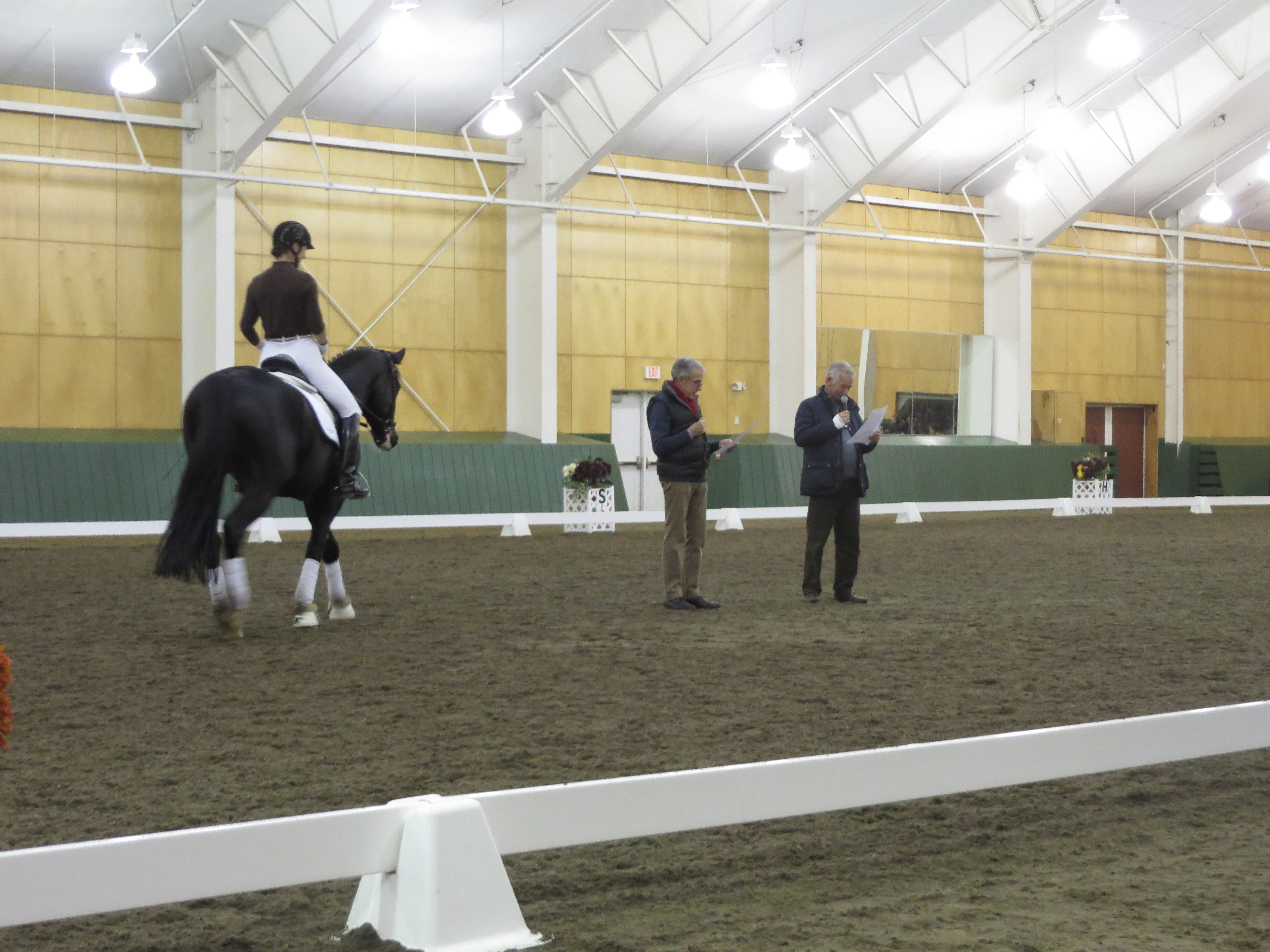
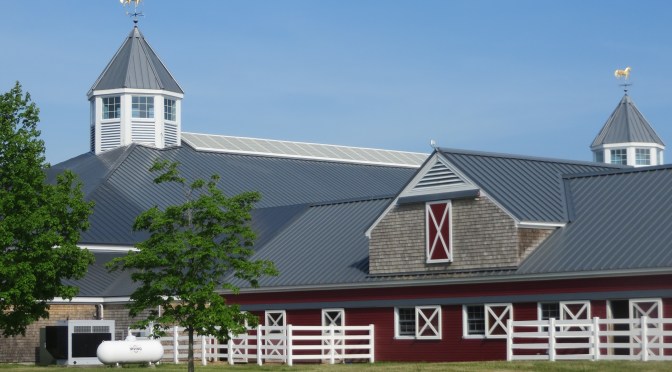
The Equestrian Center at Pineland Farms (the facility itself is a thing of beauty) in New Gloucester, ME, hosted a continuing education weekend for judges focused on the musical freestyle on May 30-31, 2015.  Led by longtime USDF Freestyle Committee member and Klassic Kur founder Terry Ciotti Gallo and supported by USEF “S” judge Lois Yukins, day one of the clinic covered in comprehensive detail a system by which judges can objectively assess the elements on the artistic side of the scoresheet.
Terry Ciotti Gallo
Terry Ciotti Gallo
Lois Yukins
Lois Yukins

This program is just one of several being offered across the country; the goal is to help to create a more consistent standard of evaluation for the freestyle by giving judges an objective method of evaluating a subjective performance.  In addition, it is hoped that riders will be inspired to work towards the creation of better, more effective freestyles—or perhaps even to try it out for the first time!

In this blog, I will review the elements of the artistic impression score, as considered by the judge.  Information about creating a freestyle, the focus of clinic day two, will be handled separately. There was so much content shared over this weekend that it is simply too much for one article!

Five Categories of Assessment

For the USEF levels, there are five categories of assessment on the artistic impression side of the musical freestyle scoresheet.  They are (in order on the scoresheet):

  • Harmony between horse and rider
  • Choreography (design cohesiveness, use of arena, balance and creativity)
  • Degree of Difficulty
  • Music (suitability, seamlessness, cohesiveness)
  • Interpretation (music expresses gaits, use of phrasing and dynamics)

For FEI freestyles, each category has a coefficient of 4 (and they combine music and interpretation into one mark, and add a category for rhythm, energy and elasticity), but for the national test levels, the coefficients vary.  Understanding that the biggest coefficient score will come from choreography can help riders to prioritize this score over degree of difficulty.  While “harmony between horse and rider” might sound like something which should be on the technical side of the scoresheet, it is scored artistically in USEF tests because harmony reflects the “artistry of the rider”.
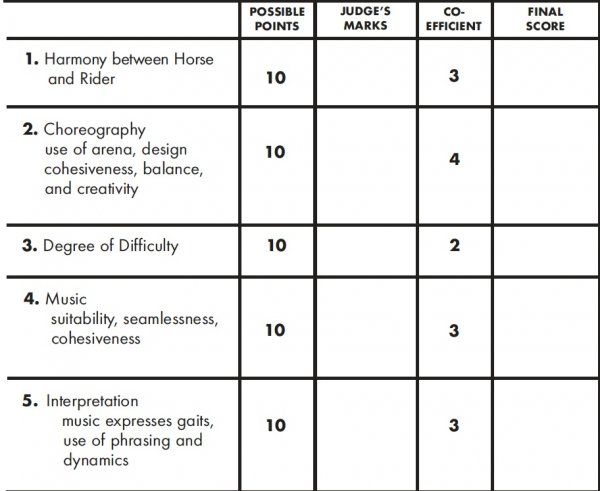
Artistic Impression

Understanding the score for “Music”

In presenting the analysis for each category, Gallo chose to begin with music, as this has to do with selection and preparation, factors which are taken care of before the show.  This score is the only artistic impression mark which should not be affected by the technical execution of the freestyle, unless a horse is feeling so naughty that they don’t demonstrate their basic gaits. The score for choice of music should not be influenced by the personal likes or dislikes of the judge, but rather by evaluating the suitability, cohesiveness and seamlessness of the music chosen.

Suitability is the most important aspect of the evaluation, and in judging methodology it represents the basic element for the score; the other qualities can modify the score higher or lower.  Suitability means that the music enhances the horse’s way of moving, and should fit the character of the horse.  Gallo says that a wide range of genres of music can be suitable -dance music, not surprisingly, can work well for many horses- but it must be level appropriate.  Lower level horses are going to be overwhelmed by big, powerful music better suited for pirouettes, half pass or tempi changes.  Yukins used the analogy of a supermodel that could look good wearing anything, including a burlap sack, but the average woman must more carefully consider cut and fit.   Some horses are so expressive, so beautiful, that nearly any music will work.  However, for a more average horse or one that is a flatter mover, well-chosen music can elevate the performance.  If the musical selection is suitable, the score for the mark should start at a 7.

Cohesiveness is a modifier to the base score for music, and it means that the pieces of music chosen for each gait have a unified feel.  This may be due to genre (all one style, like jazz, classical, rock and roll, etc.), theme (an underlying quality or idea, like all Elvis, all children’s music, and so on) or instrumentation (all pieces are played on piano, or with full symphony, etc).  Yukins and Gallo both emphasized the importance of not making the theme too hard to understand—judges have too much to analyze during the five minute performance of the freestyle to make more obscure associations.  As Gallo put it, when the theme is so obvious that the judge doesn’t have to think about it, the score goes up; she encouraged judges to give the rider the benefit of the doubt if the music seems sort of cohesive but the judge isn’t sure why.

Seamlessness is the final music score modifier, and this has to do with the editing of the music.  The music must flow together, with no jarring shifts which disturb the ear.  Editing can be done within a song, or between songs, and is needed in order to have appropriate music for each gait.  Basic editing can be done with the use of downloadable software or riders can work with professional editors.  Abrupt cuts and overly long fades should be avoided, but short fades can be helpful to create smooth transitions between pieces for each gait.  Gallo advises against using a fade out on the final center line, preferring instead to end the freestyle with a closing note or chord in the music.

If all three aspects of the music score are done well, the final mark should be above an 8. The mark for music carries a coefficient of 3.

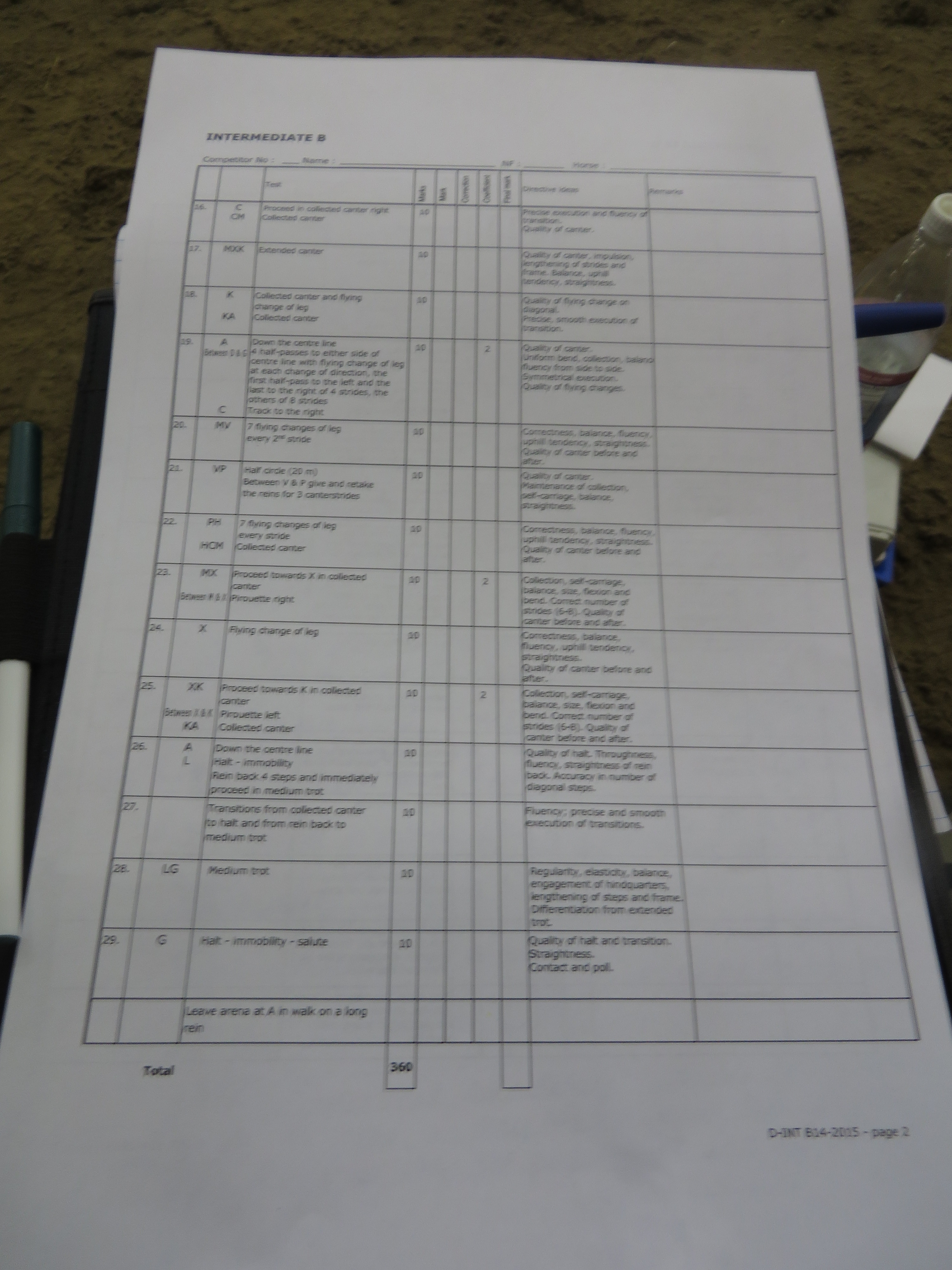
freestylescoresheet

Understanding the score for “Interpretation”

The score for interpretation of the music is largely determined by what happens during the performance itself.  Considered in this mark is how well the music expresses the horse’s gaits, as well as if the rider has coordinated movements with the phrasing and dynamics within the music.  Getting a good mark for interpretation requires both advance planning and on pointe execution.  It also requires the understanding of some basic musical terminology.

The term beat is used to describe the underlying pulse of the music; it is what your foot wants to tap to as you listen, if you are so inclined.  In a horse’s gait, the beat is a footfall.  Most riders understand that the walk has four beats, the trot two and the canter three (though for freestyle planning it only has one, which I will discuss in my next blog).   Rhythm in musical terms is a repeated pattern of sounds, while for the horse rhythm is the timing and sequence of the footfalls.  Tempo is the rate or speed of the beat in music or the rate of the repetition of the rhythm for the horse.

In my second blog related to this weekend, I will discuss how knowing the tempo of your horse’s gaits is related to choosing appropriate music.

When you hear each piece of music, its rhythm and tempo should suggest the gait which it is being used for.  While neither the FEI nor the USDF require that riders match the beats of the music to their horse’s footfalls, Gallo says that the smart rider will try hard to do so.  That being said, it can be hard to stay right with the beat of the music, especially at the lower levels, as the horses here lack the strength to stay off the ground in the new movements introduced at each level (the leg yield at First Level or the shoulder in at Second Level, for examples).  Gallo says that music must at least suggest the gait which it is being used for to get a good mark for interpretation.

If the music is well chosen, it will have clear phrasing and dynamics.  Phrasing is a musical unit; at the end of a phrase, the music changes in some way.  Dynamics relates to the loudness or the softness of the music; Gallo explained that a forte or crescendo of louder music would indicate a bigger movement (like a lengthening or extension) while softer music suggests circles or pirouettes.

To help judges, Gallo presented the minimum requirement of “Six Point Phrasing”.  Basically, a rider who demonstrates their initial halt or salute, their first movement change, their trot and canter lengthenings or extensions, their gait changes and their final halt or salute with musical phrase changes should get at least a 7 for interpretation.  Judges should try to note each time the rider goes beyond these six basic points and can add to the score accordingly. If the rider executes the six point phrasing and also matches the footfalls to the beat of the music, the score should be at least an 8.  If the rider can also take advantage of the dynamics, then the judge should add a few more tenths of a point.  The score for interpretation carries a coefficient of 3.
G Clef

Understanding the score for “Degree of Difficulty”

The degree of difficulty mark is only worth a coefficient of 2 for the USEF tests First-Fourth, and a coefficient of 1 for Training level, for a reason:  attempting to add difficulty that results in poor technical execution makes for bad freestyles.  Gallo and Yukins both emphasized how important it is to be totally confident that your choreography will work well for your own horse.  “Consider carefully,” says Yukins.  “Only do what you can do reliably and well.”

Gallo reminded judges that in a freestyle for a specific level, they should expect to see transitions and movements which correlate to the requirements for the highest test of that level; she even suggested reviewing this test before watching the freestyle.  It then is easier to evaluate whether the freestyle performance reflected what the judge was expecting to see (“met” expectations for the level) or exceeded them.

One thing which riders need to be aware of is that they cannot use movements “above the level” to increase degree of difficulty. Judges must be mindful of this and deduct 4 points for any above level movements which are intentionally executed.  However, there may be movements which are not traditionally included in standard tests that are permissible for that level of freestyle.  On the lower left of each scoresheet, there is a list of movements which are allowed for that level; note that some of these lists changed for 2015.

Examples of ways to increase the difficulty include:  a movement at a steeper angle than for a standard test at that level; unusual placement of movements (like a shoulder in off the rail or movements on the center line); demanding transitions (like a canter lengthening to the walk on the same line); challenging combinations (such as a leg yield zig zag); reins in one hand; tempis on a broken or curvilinear line; doing greater than the required number of flying changes.

In terms of scoring, a freestyle that matches the basis for the level should receive a 6 for degree of difficulty.  If the freestyle matches the highest standard for the level (such as the movements in the highest test), the score should be a 7.  The judge can then add to the score for each element which exceeds their expectations.

Remember that the score for degree of difficulty is linked to the quality of the execution.  If a rider tries to do something ambitious and does it well, then they will receive both a high technical mark and a high mark for degree of difficulty.  Passable execution will result in no deduction but also no credit.  However, if the rider tries for something complex and the quality of the performance falls apart, they will receive penalties in several areas.
Borrowed from "The Chronicle of the Horse" Image uncredited.
Borrowed from “The Chronicle of the Horse” Image uncredited.

Understanding the score for “Choreography”

The choreography relates to the “construction of the patterns”, according to Gallo.  There are four criteria which fall under this score:  design cohesiveness, use of arena, balance and creativity.  Of these four, design cohesiveness is the most important and is the basic score.

Design cohesiveness relates to the clarity and logic of the movements used in the freestyle.  It does not need to be symmetrical, but the design should never leave the judge wondering, “what was that?”.  If there is clarity in design, the score for choreography should start at 7.

Use of the arena is a modifier to the score.  The choreography should use the arena in its entirety, distributing movements around the ring.  Freestyles which have all the elements at the far end, for example, are not using the arena well.

Balance in this case refers to the relative equality of movements on the left versus right rein.

Creativity is a modifier which many judges and riders think is the main criteria. Creativity is important, and it refers to combining the elements in interesting ways, or using uncommon lines.  Creative choreography is imaginative and not test-like.  This does not mean, though, that the choreography is brand new/one of a kind/totally unique.  “Not test-like” means that the choreography is not like the movement configurations of any tests currently being used at that level.  It does NOT mean that a configuration that was part of a test at that level in years past is off the table.  Let’s face it—at the lower levels, there are just not that many movements required and there are only so many ways to put them together.

Choreography really is one of the areas in which both judges and riders need to release their usual concerns regarding test riding and learn to think creatively.  Transitions should be made with musical phrases, not at letters.  The halt and salute can be done anywhere on the center line so long as they are facing the judge at C.  Gallo likes doing diagonal lines that end on centerline, which then allow riders to turn in either direction.

Gallo says that the relationship between the execution of the movements and the score for choreography is indirect.  Riders must show lateral movements over a minimum of 12 continuous meters (18 is better); trot extensions must be done on a straight line (mediums may be done on a 20 meter circle) and canter pirouettes must have straight strides into and out of the movement.  The only time where execution can really detract from choreography is when a horse has a strong reaction and the judge cannot tell what they did. It is also important to make sure than in an attempt to show creativity, a movement does not appear to be ‘above the level’ (haunches in on a diagonal line looks much like half pass, for example).
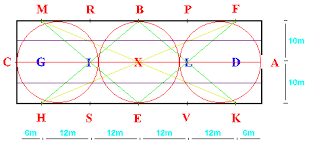
dressage arena

Understanding the score for “Harmony between Horse and Rider”

Harmony is something which every dressage rider should aspire to, and watching a well-made freestyle in which horse and rider appear to seamlessly dance to the music can give you chills.  The score for harmony reflects the trust between the horse and rider, and the horse’s confidence in both the rider and his own ability to execute the demands of the test.

Getting a high mark for harmony requires that the horse stays calm and attentive and that the performance shows ease and fluidity.  This is actually another area in which the FEI and USEF differ—the FEI considers harmony to be about the submission to the aids but the USEF considers it an artistic criterion because it goes into the relationship between the horse and rider.

Harmony takes into consideration the challenges of a good freestyle: staying to the beat of the music, aiming for musical interpretation, the extra demands of increased difficulty and the great number of adjustments that riders must make relative to a standard test.   To quote Gallo, “judges should truly appreciate and reward a harmonious freestyle”.

Click on the link above for a visual representation of “harmony between horse and rider”.

Tips for Judges

Gallo and Yukins both emphasized that evaluating the artistic impression of a freestyle is not a matter of simply taking a percentage of the technical mark and calling it good.  Judges must use the same kind of system by which to fairly evaluate a ride and arrive at consistent scores that they do to judge regular tests. The “L” program teaches learner judges that to arrive at a score, one must use a formula:

Basics + criteria +/- modifiers= score

By using this same methodology, even something seemingly subjective like artistic impression can be evaluated in a more objective manner.

The artistic impression scores are interrelated with each other, but not all of them relate to the technical performance.  Harmony and degree of difficulty are directly linked to the quality of the technical execution.  Choreography and interpretation of the music are independent of but modified by execution.  Only the music score is not affected at all by the execution of the test.

Judges must be mindful of a few critical rules that pertain to freestyles.  For Training through Fourth levels, rides have no minimum time but cannot exceed five minutes.  Any movements performed after the time ends are not judged, and a one point penalty is taken from the artistic impression score.

Gallo has a few words of advice for judges.  First, in regards to “creativity”, it is important to remember that even if a combination of movements has been done before, or is done the same way by a number of riders, it can still receive positive marks for creativity.  The idea is to compare each rider’s performance to what is seen in regular tests, not to what is seen in other freestyles.    Secondly, Gallo hopes that judges will continue to learn more about using a standardized system to assess the freestyle.  She points out that most judges are experts in dressage first, and have had to learn about freestyle after the fact, and so are going to need time to adjust to a new system.

Yukins cautioned that the judge’s comments on artistic impression are really important, as they will help to shape the future of freestyle.  She reminded participants that the role of the judge is extremely difficult, as they have so much to consider.  “Judges have six minutes to evaluate a product which riders could have been working on for years,” says Yukins.

Gallo suggests that judges practice their freestyle judging skills by utilizing videos on You Tube.    Judges should work to develop a note taking system which allows them to keep track of phrasing and other artistic elements without losing track of the technical score.   Another technique is to create a personal “cheat sheet” which can help the judge to keep track of the various elements.

Next up:  Creating a Musical Freestyle: Tips from the Top
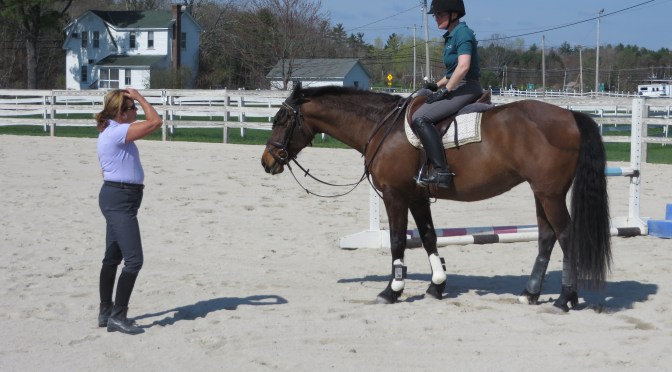
(Another) Clinic with Nancy Guyotte: Keeping your horse in front of the leg

Blogger’s Note: I am grateful to be a recipient of a 2015 Area I USEA eventing scholarship.  In my application, I indicated that this year may be one in which I focus more on training than on competing in the sport, and I asked for funds to help cover the expenses of training sessions with both eventing and dressage experts.  My recent ride with Nancy Guyotte was included as one of these training sessions.  I would like to thank the scholarship committee for awarding me with this funding and I hope that this blog will help to share some of my experience with others who are interested.

I recently had the opportunity to ride once again with Nancy Guyotte, an alumna of the University of New Hampshire Animal Science program, who returned to give a clinic for the UNH Equine Program at the end of the spring semester, 2015.  After working on my own for most of the winter, I welcomed the opportunity for some feedback and fine tuning from such an experienced coach.

Nancy discussing her ideas.

One of Anna’s qualities, which can be simultaneously both helpful and frustrating, is that she is by and large “ho-hum” about most things.  New events and activities are not necessarily worthy of great energy or reaction.  This is a wonderful attribute in that you can be confident that most of the time she will remain sane and sensible.  However, she has never been one who has had a strong response to any of the forward aids, meaning that it can be incredibly difficult to get and to keep her in front of the leg.

None of us want to be “that rider”, the one who goes around kicking and thumping ineffectively on their horse’s sides, nor do we want to have to use the whip constantly.  We all know that, theoretically at least, we are supposed to use “light” and “invisible” aids.  But doing this is only possible when the horse has been properly conditioned to respond to these cues, which means that we as riders must be able to administer our aids precisely and accurately and then release them immediately, without nagging or holding too long.  Here is where riding well is simultaneously a skill and an art.

I think Nancy might be "helping" us off the ground here!
I think Nancy might be “helping” us off the ground here!

I asked to ride privately with Nancy this time because I have found that in clinic settings I am often riding with people whose horses have the opposite problem of mine—they need to be slowed or steadied, as opposed to moved forward.  The clinician then spends most of the session working on exercises which bring the horse back to the rider.  With Anna, the response to “whoa” is pretty good, especially when she is already behind the leg.  So when you do exercises such as, for example, halting in between two fences in a line, Anna only becomes more and more sucked back, and usually she begins to stop.  What I needed in this session were exercises that asked my horse to go forward and which improved the timing and accuracy of my “go” aids. I know that I am not alone in this, so if you ride a sometimes lazy and unmotivated horse, perhaps some of Nancy’s exercises will help you, too!

In watching Anna warm up, Nancy immediately noticed that she lacked suppleness and was reluctant to stretch through her topline and to let those muscles swing.  These issues can be difficult to improve on when the horse is reluctant to move forward.  Nancy suggested that there are two ways to help motivate a lazy horse during the warm up:  first, go into a canter in two point sooner rather than later and do many forward and back transitions within the gait; second, do lots of transitions between slower gaits (like walk and trot), asking once and if the response is lackluster, using the aids really strongly and then immediately letting them go. It is important to remember in either of these exercises that the response to the downward aids must also be immediate.  The goal is that the horse responds quickly to either the “go” or to the “whoa” aids. Further, one’s application of these aids ideally becomes less and less yet creates a greater response.

Nancy Guyotte 515 and Team Banquet 006

We tried each of these approaches with Anna, and the improvement was excellent.  One of the most critical pieces of guidance Nancy offered was to not worry so much about the position of the horse’s neck during the transitions.  At this point, being above the bit is acceptable.  As the horse becomes more forward thinking and their suppleness increases, they will also become softer in the topline and more willing to seek the contact.  This then creates the roundness in the transitions.  In general, I needed to keep Anna’s neck straighter and to use more outside leg on the turns in order to keep the connection correct.

I admit that I was a bit skeptical of the’ transitions between slower gaits’ exercise.  It has always been counterintuitive to me to come all the way to the walk and then to ask the horse to go forward, since the walk by definition lacks impulsion.  The other thing with Anna which has been challenging is her utter lack of concern regarding the whip.  Most young horses that I have worked with are aware of the whip and most respond to its presence alone by increasing their speed; it is only over time and use that they become desensitized to it, hopefully in a positive way, one which results in their appropriate response to its use.  To say that Anna is unimpressed by a whip is an understatement; even the very first session that I carried one with her resulted in a minimal response.  It takes a significant amount of application before its use elicits any response at all;  to “tickle” her with the whip is not a useful technique.   So when you decide to use the whip to back up your leg aid, the timing of its use is critical, and you have to commit to getting a response.  Years ago, when I was a working student for Lendon Gray, she said it was far more humane to make your point once and be done than to nag a horse with your aids.  This is certainly the case with Anna and the dressage whip.

So what Nancy really had me work on improving through the use of the transitions exercise is the timing of my aids in the transitions.  No sooner had the transition been made than we were working on the next one.  For the first several transitions, Nancy had me take both reins into one hand and use the whip strongly behind the leg, but then immediately let go. It is the letting go that is the hardest part of the transition, I think.  I find that I want to keep supporting or squeezing with the leg aids, even if the response was good, instead of expecting Anna to carry me forward.  But the other place in which it is possible to hold for too long, and therefore dull the horse’s response, is in the downward transition.  This might be in the use of the rein aids, which would seem fairly obvious, but also in the use of the seat.  If you want your horse to maintain their energy through the downward transition, be sure that you aren’t inadvertently holding too much with the seat.  Check to see that your hips and lower back still flow and that you aren’t gripping with any muscles that need to stay soft.  I know all of these things, and I thought I was doing a pretty good job in executing them, but Nancy reminded me that we are always working to be even better and even faster.  The trick for me was figuring out how to be faster at releasing without releasing so much that I was dropping the aids all together.

Anna took great offense to these fake flowers at first!

We also worked on a variation within the warm up, taking advantage of Anna’s ability to do clean flying changes.  After doing some forward and backs in the canter, we then started riding a half circle back to the track with a flying change at the end, followed by a transition forward and back within the canter to another half circle to the rail and flying change in the other direction.  The half circles were smallish, between 12 and 15 meters.  The purpose of this exercise was twofold:  first, to get Anna thinking faster by making a series of changes in gait, direction and balance and second, to improve the turning from the outside aids.

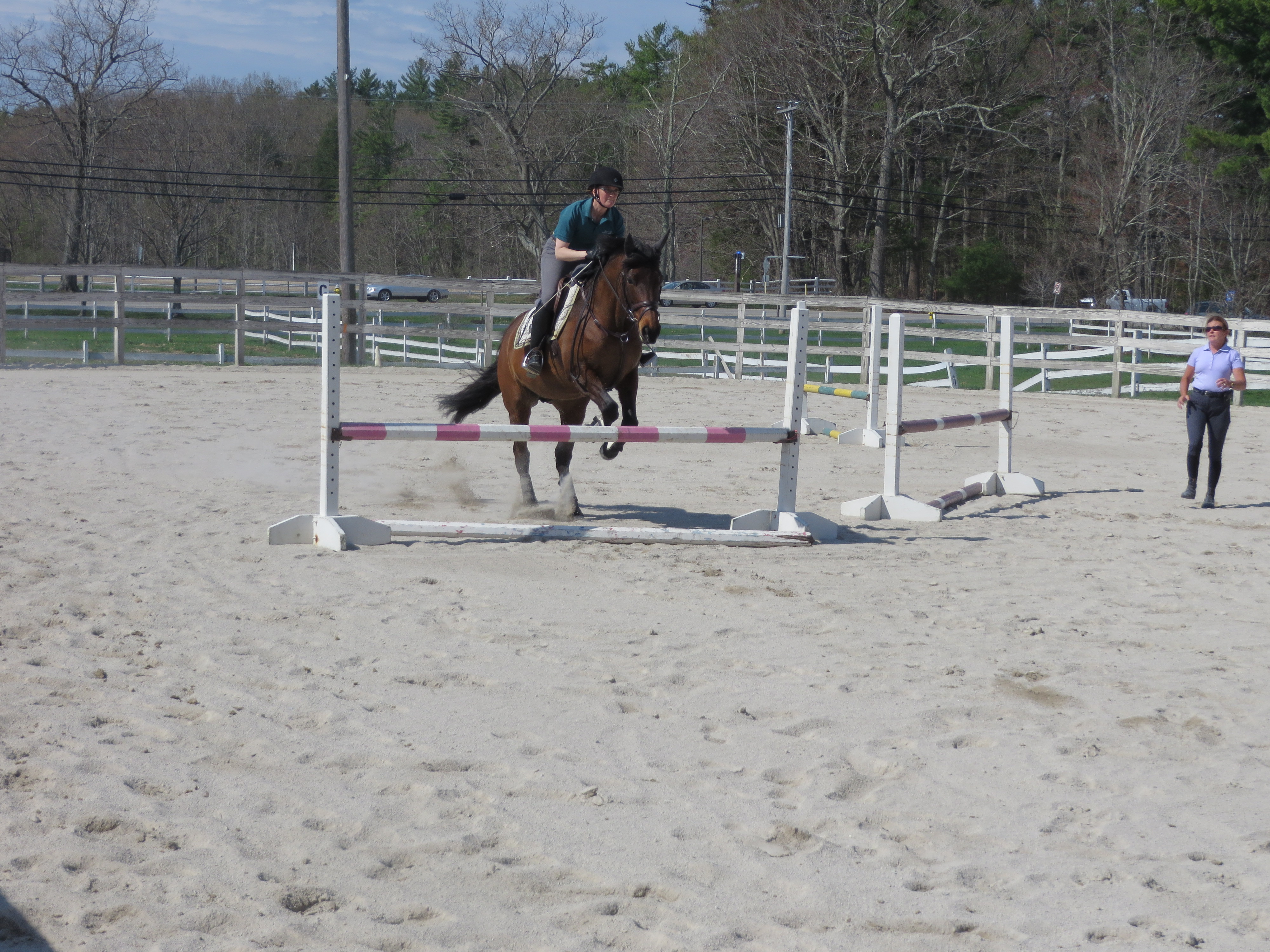
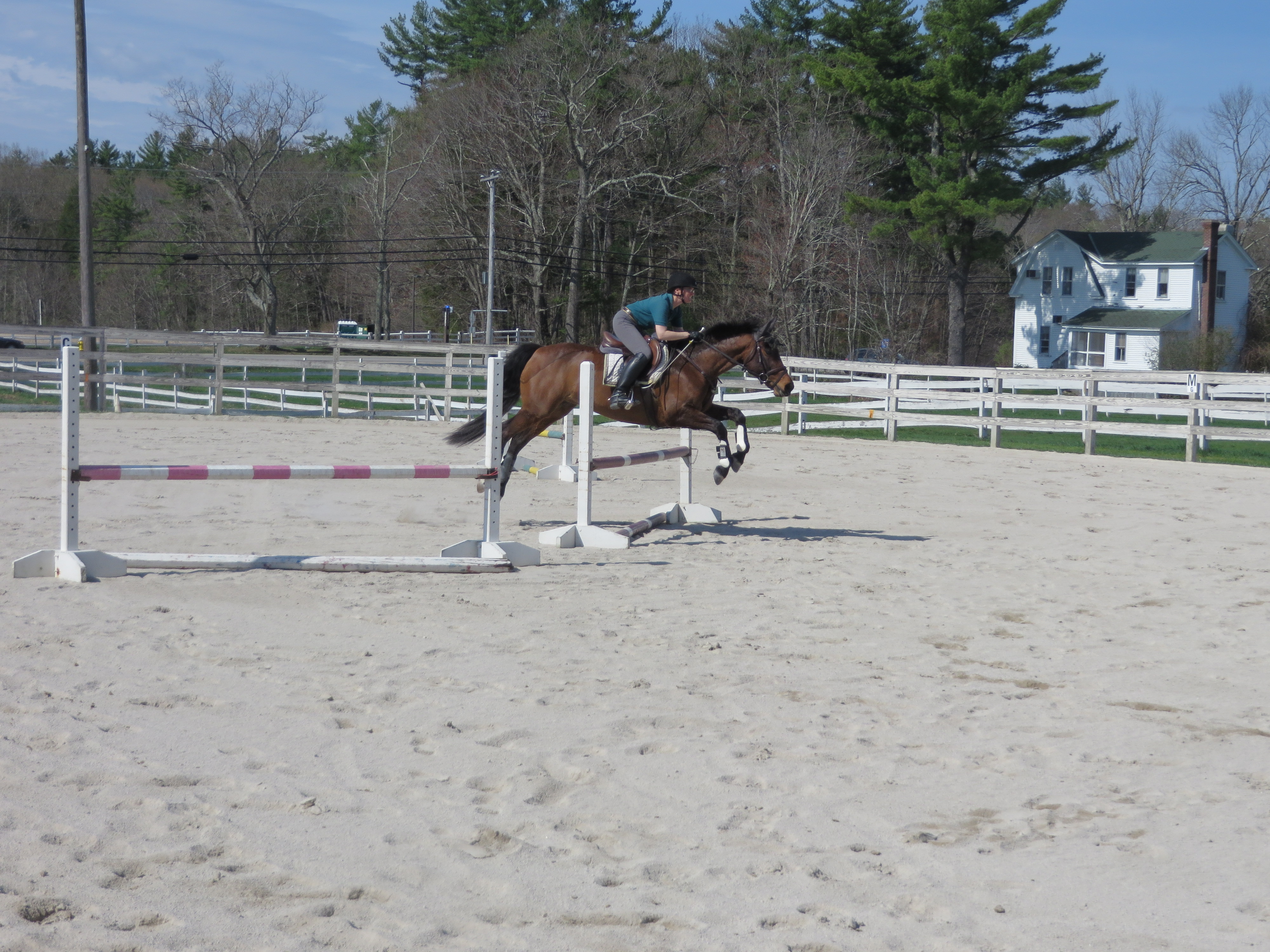
Once we began the actual jumping work, Anna was staying reliably in front of my leg and therefore the exercises felt easy and do-able.  As always, it is impossible to adjust a canter that is not forward thinking, so any attempts to manage timing at the fences are futile without a forward thinking canter.  I think this session was a good reminder of the fact that horses don’t usually have jumping problems so much as they have canter problems.  When you improve the quality of the canter, you then improve the quality of your performance over fences.

At one point, Anna had become so forward that she was starting to motorcycle a bit around corners and turns.  To address this, Nancy had me work on another exercise which combined turning, transitions and improving the responsiveness to the aids.  Starting on the long side in the canter, I rode a transition to the walk and then immediately rode a turn on the haunches followed by a canter transition in the new direction.  Again, the purpose at this time was not to execute a flawless, round, dressage test worthy turn on the haunches but rather to improve the responsiveness to the outside aids as well as increase the suppleness through the inside rib cage.  We progressed to riding the whole exercise in the canter, so the half turn on the haunches became a small circle around the inside leg with a flying change at the rail.

This exercise clearly showed me that Anna is stronger on her left hind than her right, as the turns flowed more easily with the left hind as the strike off phase of the canter stride.  I would never have thought of using this kind of exercise to improve her jumping work, even though I am familiar with it.  I would have assumed that because she isn’t reliably in front of the leg and that the quality of her gaits and connection while doing this exercise would not be good, that it wouldn’t be an appropriate exercise for her at this time.

I was reminded, yet again, that sometimes you have to use the exercises and movements themselves to help to teach the horse how to do them.  Even if the execution is not perfect, or the horse isn’t “round enough”, sometimes it is helpful to use the exercise as a tool and then you can improve the details later.  I remember working with another clinician, Verne Batchelder, with Lee some time ago.  Lee has always struggled with connection issues, and he said that there were many trainers who would just keep her on a 20 meter circle until the connection improved.  His philosophy was to use movements, and to allow the connection to develop as it would through the use of those movements.  Verne said that otherwise what you end up with is a fifteen year old training level dressage horse who can only do twenty meter circles.  His point was that sometimes to get to where you want to go, you have to take another way around.

This particular session left me with new ideas and new inspiration to take back to the laboratory to experiment with.  I will definitely be working to discipline myself to do less with the leg and to be quicker in the timing with my aids.

Caring for the Older Horse

As the caregiver for a 33.5 year old equine (who has been in my life since he was a mere lad of 16 years), I am frequently asked for insight or advice in terms of the care of the older horse.  I have to admit that in Carmel’s case, I think I have had the advantage of some good genetics—his dam was a maiden mare in her upper twenties, who was bred by a recently gelded youngster who jumped the fence.  Clearly there is something in these lines which is determined to survive!

That being said, I feel that Carmel’s longevity and good health can also be attributed to several critical care and management decisions along the way.  I have the unique advantage of basically knowing his whole life’s history, and I know that he has always been well taken care of.  With the ever improving quality in veterinary care and an increase in owner education, it stands to reason that more people will be finding themselves caring for aged horses who are still sound, happy and healthy members of the equine community.

Carmel at one of his last events at UNH, ca 2000.

For me, caring for an older horse has been a gift, but it has not been without its hard times too.  Once horses reach a certain age, it is a tough truth that as the steward of that animal’s well-being, you will be asked to make some hard decisions.  Horses are expensive to maintain, and it isn’t everyone’s reality that they can afford to keep a horse who doesn’t suit their personal needs anymore.  I feel quite strongly that if you make the commitment to keep a horse into their retirement years, you have an obligation to do right by that animal—which usually means that you will be doing more than just meeting the horse’s basic needs for shelter, feed and water.  It is important to know, going into it, just where your personal “bottom” is—knowing this will hopefully help ease the difficulty of making judgement calls when they come before you.

So with all that being said, here are five tips from my own personal experience caring for older horses.

Tip # 1:  Give them a job.  In my opinion, a horse which is used to competing, regular riding or even just weekly pleasure outings doesn’t do well in complete retirement.  Horses are creatures of habit and routine, and when they are used to a consistent program, it can actually increase mental stress and contribute to physical issues when their work is ceased, particularly when such a change is made abruptly.  Certainly as horses age, their job will change.  But this doesn’t mean that they don’t still have a niche to fill.  The term “schoolmaster” is frequently used to describe the experienced horse which teaches the novice.  While it is perhaps most appropriately used to describe horses trained to elite levels, I believe that the term is relative.  Carmel never competed above novice level in eventing but went on to give lessons to many beginners who learned to walk, trot, canter, and jump small fences on him, and he took several Pony Clubbers up to the D3 level, all after he “retired” at 20.  Even today at 33.5 years old, I take Carmel for twenty minute hacks a few times per week in order to provide him with some sort of structure and routine.

Tip # 2: Quit while you are ahead. A corollary note to tip # 1 is that in order for your older horse to have a job, they must retire mostly sound.  This means that it is imperative for you to be highly in tune with your horse and to fully consider the consequences of pushing them “just one more season” at a level which is becoming a physical challenge.  While we certainly can prolong the performance career of our horses through the judicious use of all means of sports medicine therapies, it is my opinion that the conscientious horse owner must always consider at what point enough is enough.  Horses which need extreme maintenance to perform at a given level should probably step it down a notch to where their job can be done without taking such lengths.  In my case, that time came when Carmel was twenty.  While he was still handling the height and width of novice fences at that point, I could tell that the effort was becoming greater and his recovery times longer. Instead of risking an injury which might result in permanent lameness, I opted to change his job.

Carmel at the age of 27, competing at the elementary level with his friend Olivia.

Tip # 3:  Allow for plenty of turnout. We all know that horses are herd animals which are meant to travel up to one hundred miles per day or more, foraging along the way.  It is a reality in our increasingly developed and suburbanized world that our horses frequently must be kept stalled due to lack of appropriate turnout areas.  This is truly unfortunate and contributes to all manner of health and behavioral disorders.  I have been very fortunate that since owning Carmel, he has almost always been able to live in an in/out situation where he can come and go from a shelter at his own desire.  Barring that, he has lived at a facility that allowed him to be out about twelve hours per day and kept in only at night.  I really do believe that this living situation has allowed him to remain sounder in the long run, both in mind and body.  Arthritis never had a chance to really establish itself in his joints in a debilitating manner, and his lungs remain clear due to good air circulation.  My horses go out every day for at least a little bit, even in extreme weather –and what is funny is they almost always choose to go outside in spite of it.  I do not think that we do them any favors by locking them in for our benefit.  So long as they have an accessible shelter if they need it—let them be out!

Carmel enjoying some time outside after the Blizzard of 2015.

Tip # 3:  Provide routine veterinary care. Older horses require the same regular veterinary care that any other horse receives—but having a good relationship with your veterinarian can help you to customize their care to suit your individual needs and situation.  For example, your older horse still needs to be vaccinated each year, but some of the risk based vaccines may no longer be a priority.  This is important if your horse is one who has had a history of mild or moderate reactions to vaccination.  Annual monitoring of your older horse’s bloodwork can give you a baseline from which to compare results if your horse begins to seem a bit “off”; it can also allow your vet to notice changes in the function of the body’s systems early.  Many older horses end up developing pituitary pars intermedia dysfunction, or PPID (usually called Equine Cushing’s Disease), which often causes symptoms such as an extremely heavy hair coat that is slow to shed, a cresty neck, abnormal fat deposits and sometimes hoof abscesses and laminitis.  Confirmation of this disorder is done via blood test completed in winter, spring or summer.  For most horses, Cushing’s can be regulated through the use of diet modification, exercise and medication (pergolide)—but you will need to work closely with your vet.  Older horses also need routine dental care, but as they age and the available tooth decreases, they may not need regular floating—your vet or other qualified dental professional can advise you on your horse’s specific needs.

1998 or 1999.  I wish I could get his tail that long again!
1998 or 1999. I wish I could get his tail that long again!

Tip #4:   Give them a little attention every day. Just because you may not be riding your older horse as regularly doesn’t mean that daily attention isn’t important.  At a minimum, I always pick out feet every day and do a once over of Carmel’s entire body. In the winter, blankets come off at least every other day, but preferably daily, to check on body condition. (Blogger’s Note:  To blanket your older horse or not is a topic for another blog—I have chosen to blanket Carmel due to his tendency towards being a hard keeper and also because his PPID can cause thermoregulatory challenges.)   Even as Carmel’s activity level has decreased over the years, I have still religiously groomed him every day.  I think this is important for so many reasons—it is a way for me to keep my bond with him, and because I am in close contact with him, I notice the tiniest changes in his attitude or way of being.  Grooming promotes circulation and stimulates the oils of the skin to come to the surface, and for horses who are struggling to shed, regular grooming can help ease the process.

Tip # 5: Feed the right amount of a quality feed.  Older horses can be challenging to keep at an appropriate body condition.  Some are easy keepers and they need little to no grain to maintain a healthy weight.  Others, like Carmel, tend more towards being too thin and therefore careful feed management is necessary in order to keep them in good physical shape.   There are numerous senior feeds on the market which are formulated to meet the needs of an older equine.  They tend to be palatable, fortified, extruded and complete—meaning that if your horse struggles to chew forages, the senior feed can be used as a sole source of nutrition.  Most also dissolve easily in water to make a mash for those horses whose teeth are not up to the task of chewing.  Something I learned along the way is that senior feeds are meant to be fed at a much larger quantity than regular feeds.  We are so conditioned to feed “little and often” that it can be hard to understand that as much as five pounds of senior feed can be fed at one meal, with as much as fifteen pounds per day being totally reasonable and safe to feed.

Carmel snacking in 2012.

Final Thoughts

The truth is that taking care of older horses is mostly about continuing to practice good horsemanship and to attend to their basic needs with the same level of attention to detail as for a competition horse.  Certainly the onset of age related conditions will require some modifications to their riding schedule and maintenance plan, but with quality care the older horse can remain a productive and happy equine citizen well into their golden years and beyond.

Preparing for the Worst: Planning for Animal Care in Disasters

First, a Little Story….

When I was a recent Pony Club graduate, I had the opportunity to travel to Kansas and Oklahoma to teach a few weeks of summer camp for some local clubs.  One club in particular had a robust program for its members; few of the riders owned their own horses but instead were dropped off at the DC’s facility, where an appropriate mount was provided.  When I asked how many horses were actually on site, the answer was “something on the order of seventy five before we stopped keeping count”.  Horses were stashed here, there and everywhere, with a large number living in a herd on the hill.  Mind you, this was Kansas, so “hill” is a relative term.  But each morning, the members would head up to the hill, halter and lead slung over one shoulder, horse treats in hand, and they rode whichever horse they could catch.

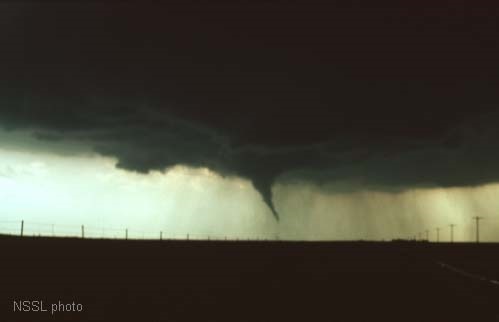
If you live in the Midwest, apparently tornado sirens become a sound synonymous with summer.  During the first several days of camp, the sirens went off at least daily, causing this New Englander’s hair to stand on end.  “Shouldn’t we take shelter or something?” I asked nervously the first time they went off, while simultaneously noting that no one else, human or equine, looked remotely concerned.  “Oh no,” came the reply.  “There is nothing going on right now.  Those just go off every time there is the remotest chance there might possibly be a tornado.  If we went inside every time they went off, we’d never get anything done.”

Waurika_Oklahoma_Tornado

The sirens continued to intermittently howl, and as the days went by, I began to adopt the “casual and carefree” attitude of the locals.  I will admit that a part of me wondered what the point was of having a warning sound which no one seemed to listen to.  Nevertheless, they lived here, I didn’t, and they weren’t worried.  So why should I be?

Then there was The One Morning.

I will never forget it.  The air was thick—humid, oppressive, heavy–the kind of air that only a strong thunderstorm can get moving again, the harbinger of a front and a change of tide.  While the air felt still on the ground, the clouds above were agitated and rolled along quickly; not in a leisurely, lazy summer afternoon sort of way, but in a hectic, hurried and disturbed manner.  And the sky was green.  Everything felt positively unsettled.  Then the sirens went off.  Again.

I went to the covered arena, where the first group of riders was already mounted and waiting to start their lesson.  I looked to read their faces, to see if any level of concern was creeping into their visages.  I certainly felt on edge.  Most were busying themselves in adjusting tack and joking with each other.  No one looked worried.  “Ok,” I thought. “This must be just another day.”

But not one beat later, the only other Real Adult on the farm (my co-instructor) came running over.  “I am going up on the hill to get the kids back down,” she yelled.  “Tell these guys to pull off the bridles and get in the shelter.”

“WHAT?!” I couldn’t help but exclaim.  Her instructions seemed irrational.

She grabbed my arm and pointed to the roiling clouds.  “Do you see how that cloud is curling that one way, but that one is doing it the opposite?” she asked.  I did.  “That is how they start.  Tornados.  This is a siren we listen to.”

http://soundbible.com/1937-Tornado-Siren-II.html

So we pulled the bridles, grabbed the attention of all the kids on the hill and ran for the storm shelter.  The older children reassured the younger ones, while I tried to remind myself that I was also supposed to be a Real Adult and needed to be calm and in charge of the situation.  Fortunately for us, the area we were in only experienced a strong thunderstorm with large and damaging hail; a neighboring town was less fortunate, as a tornado did in fact touch down, though leaving minimal damage.

The experience for me was a powerful one on a number of levels.  As someone who has lived in the northeastern US for her entire life, tornados were an unfamiliar threat; I had to rely on the wisdom and experience of the locals for guidance as to how to act.  Their reaction showed a level of composure that only comes from having done something before; even the younger children knew what to do and got themselves to a safe place efficiently and calmly.  Yet it got me thinking about how easy it is to become nonchalant about those threats that we face on a regular basis, perhaps leaving us unprepared to quickly react when true danger is imminent.

New Englanders don’t usually face threats from sudden and hard to predict events like tornados and earthquakes.  Our natural disaster risks are most often weather related—the classic “nor-easter” winter storms and blizzards, ice storms, and in milder weather, hurricanes.  These are events which have the capacity to paralyze a region figuratively and literally; however, they also usually come with plenty of warning.  In spite of this, local residents are usually found scrambling at the last minute to refill pantries, replace batteries and to check generators.

My horse, Carmel, after the New England Blizzard of 2015.

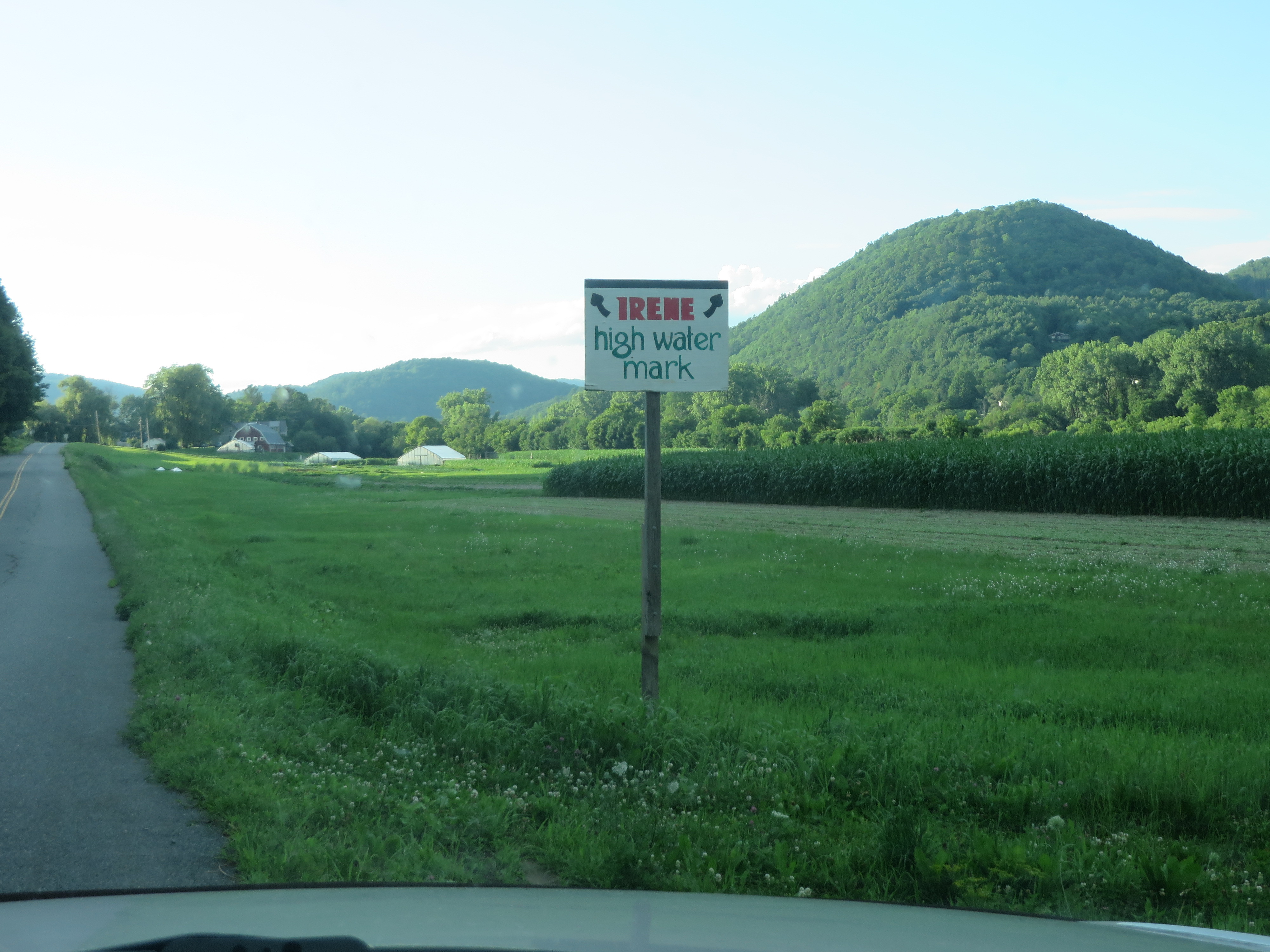
In 2011, Hurricane Irene left a devastating wake of destruction in its path, especially impacting Vermont, a state which normally escapes hurricanes relatively unscathed.  When I lived in Vermont during the summer of 2014, many of the areas which I travelled through each day to get to and from work had been under water after Irene came through.  What was chilling is the fact that the rivers in this area for the most part are shallow enough for fly fishing or even just wading; tubing is a popular past time as well, but the waters are so tame that it is possible to devote one tube to one’s beverage of choice.  It is nearly impossible to imagine that these seemingly placid rivers could ever reach a flood stage that would cause so much damage and destruction. Yet even now, three and a half years later, there are numerous locations in Vermont and New York which still have piles of debris now weathered by the sun , pushed high up on banks and into fields.  These piles serve as silent reminders that disasters can affect us in even the most unlikely of locations.

For perspective, this photo was taken from the cab of a GMC 2500 Heavy Duty pick up.  Hood is visible at bottom of image.
For perspective, this photo was taken from the cab of a GMC 2500 Heavy Duty pick up. Hood is visible at bottom of image.

Defining Disaster

Pearce (2000) defines a disaster as a non-routine event that exceeds the capacity of the affected area to respond to it in such a way as to save lives, to preserve property and to maintain the social, ecological, economic and political stability of an affected region. Disasters are usually large scale, cross geographic, political and academic boundaries and require response and recovery efforts greater than what a local community’s resources are equipped to provide.  According to the Federal Emergency Management Agency (FEMA), most common disasters are weather related or geological in origin; some are predictable (like a hurricane or blizzard) and some are not (earthquakes).  Clearly there are also disasters that are manmade in origin; this could include a toxic spill, a nuclear reactor failure, or acts of terrorism.

200px-FEMA_logo.svg

For individuals who are responsible for managing animals, ignoring the threat of disaster is simply unacceptable.  In fact, FEMA emphasizes that owners are individually responsible for the animals under their care during a disaster threat.  If you as an animal caregiver are not prepared, then it is more likely that you will potentially experience a devastating loss.   Ultimately, animal caregivers will need less outside assistance and will experience fewer losses if they face the possibility of disaster with proper preparation.

FEMA defines five areas of emergency management:

  • Prevention
  • Protection
  • Mitigation
  • Response
  • Recovery

The first three areas are all geared towards “preparedness”, which is better defined as the prevention of or decreasing the cause, impact and consequence of disasters.  Taken cumulatively, the goal is to create “a continuous cycle of planning, organizing, training, equipping, exercising, evaluating and taking corrective action in an effort to ensure effective coordination during an incident and response”  (FEMA).  Preparedness activities include planning, training and educational actions.  Response defines those efforts which occur in the immediate aftermath of a disaster; during this phase businesses and other services might not be normal.  The term recovery addresses those restoration efforts which occur concurrently with regular operations and activities; this phase can be prolonged in the case of a severe disaster.

Considering for the care and safety of animals (livestock as well as companion) during a disaster is a critical component to a community’s Emergency Operations Plan, because experience has shown that by planning for the care of animals, a community ultimately is planning for the care of its citizens.

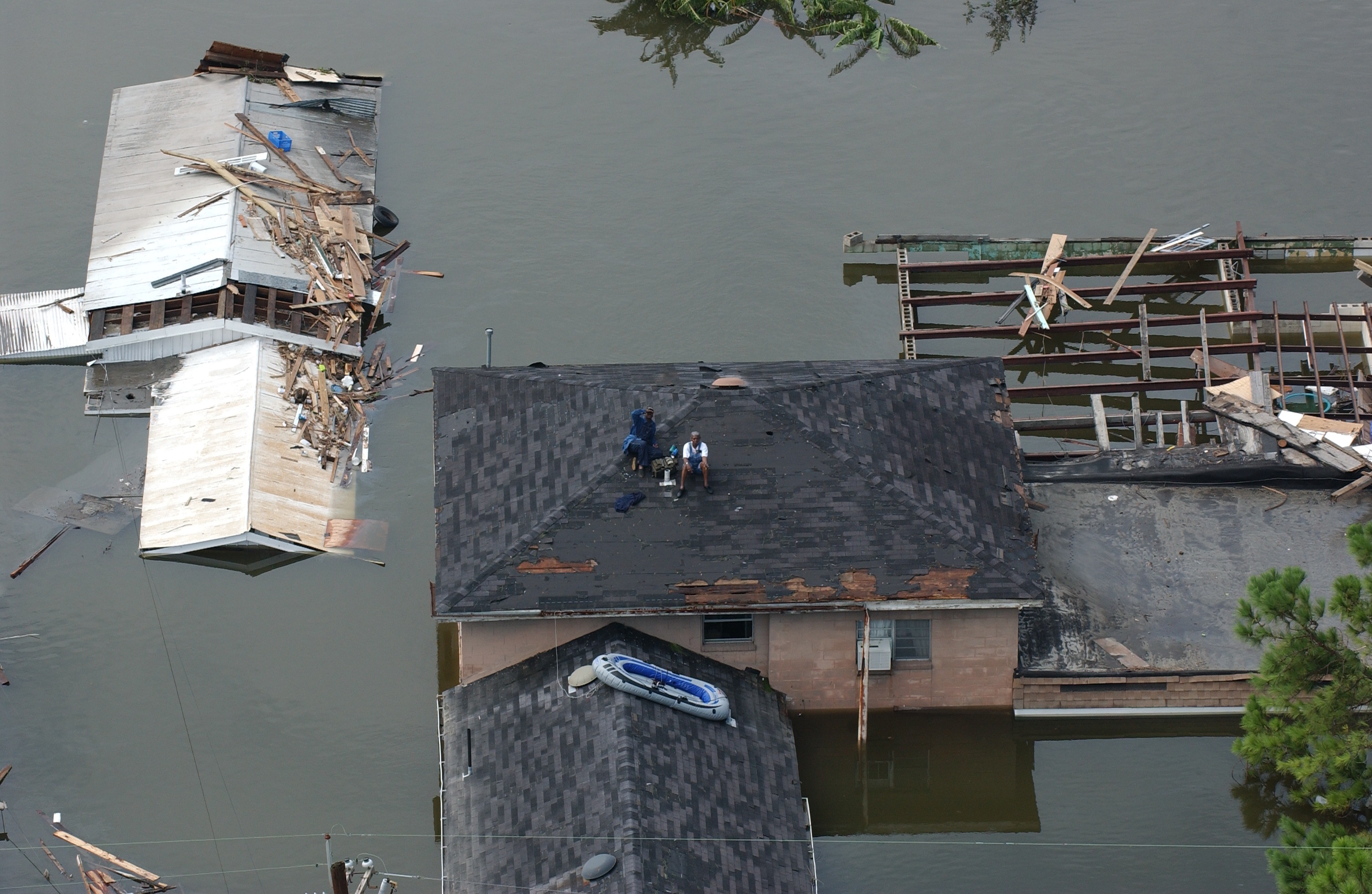
Hurricane Katrina slammed into the Gulf Coast in 2005, leaving over 1800 people dead and causing nearly $89 billion in property damage (FEMA).  In addition to the loss of human life, thousands of chickens, cows and hogs were lost, as well as hundreds of horses and companion animals.  The negative effects on agriculture in the region were felt for years.  A portion of these losses were the result of individuals who failed to evacuate in a timely manner due to concerns for their animals.  It has been proven time and again that when it comes to their animals, people will put themselves at risk by going back into damaged areas to rescue animals or failing to evacuate when told to do so.

New Orleans, LA--Aerial views of damage caused from Hurricane Katrina the day after the  hurricane hit August 30, 2005.
New Orleans, LA–Aerial views of damage caused from Hurricane Katrina the day after the hurricane hit August 30, 2005.

And while major disasters like Hurricanes Katrina, Rita and Irene, and the tornado which devastated Moore, Oklahoma in 2013, grab the national media headlines, livestock producers (which includes horse farms under FEMA guidelines), suffer the most losses from small scale disasters and local events, such as localized flooding, hazardous waste spills and fire.

It is easy to become overwhelmed or to feel hopeless or helpless in the face of some of these disasters.  Where should a concerned animal caregiver start when it comes to planning for disaster?

Lessons from Irene, Rita and Katrina and Moore: How to Protect Your Animals

Preparedness (prevention, protection and mitigation) are the three areas in which animal care givers have the most control of the outcome of a disaster event.  Below are some specific areas in which to focus your energy.

Know your area

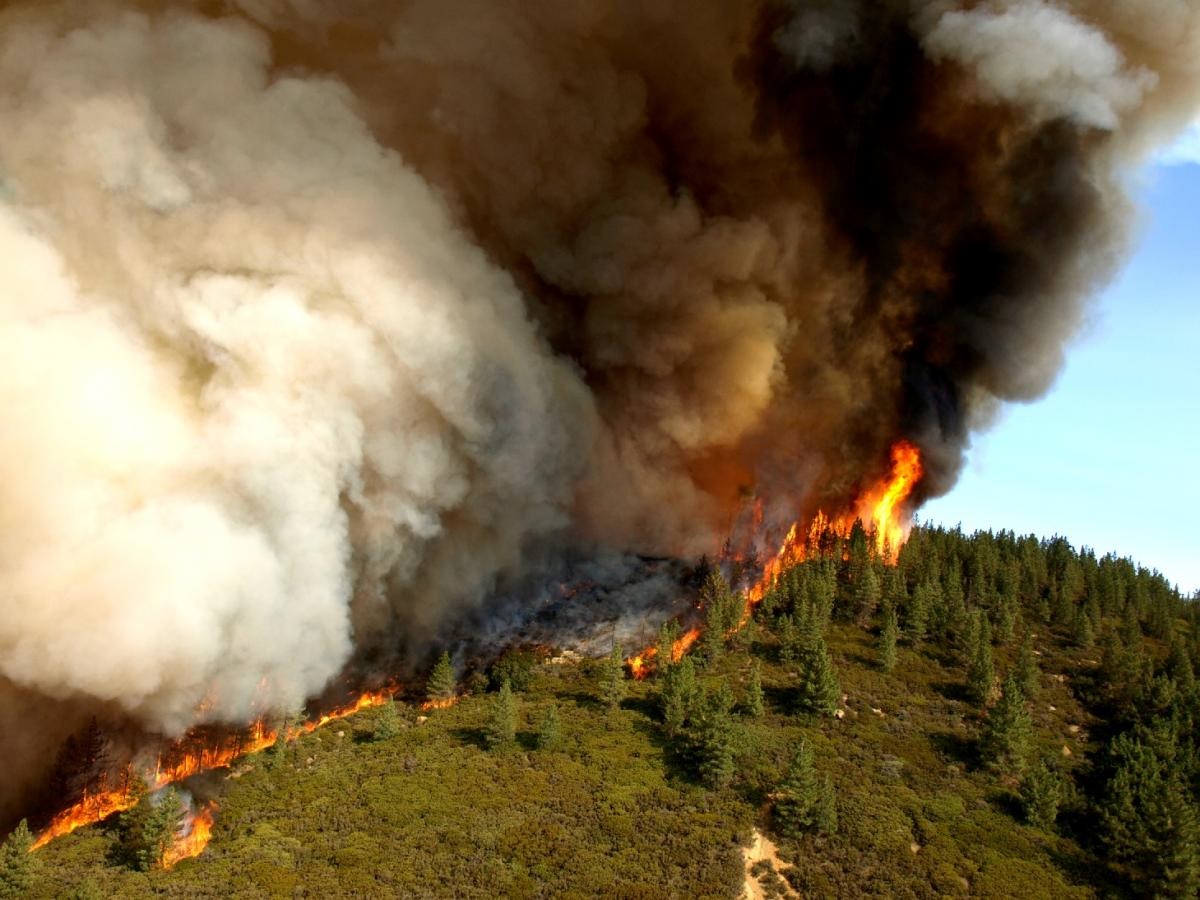
Certain weather or geological events are more common in some parts of the country than others.  Here in New England, we are more likely to face severe snow or ice storms or hurricanes than fires, tsunamis or earthquakes.  However, I remember flying into Boise, ID, a few years back to the sight of smoke out the plane window, rising from uncontained wildfires in the region.  My friends from Kansas were accustomed to the threat of tornados.   Knowing which kinds of threats are most likely to affect you will help you choose the best types of protection and mitigation strategies.  This might mean relocating a barn out of a flood plain along a river, building fire stops into the landscape on a western farm or installing an automatic generator to power a well in New England.

A 2007 wildfire near Santa Barbara, CA.

Disaster Kit

Every animal care provider should have an emergency disaster kit which is kept stocked and accessible; it is important to periodically check the kit and update its contents.  The exact content will vary depending on the species which you are taking care of.  For companion animals like cats and dogs, the kit might contain spare harnesses/leashes, carriers/crates, bowls, litter/litter boxes, dry or canned food, spare medications, toys, beds, and copies of health paperwork; essentially, everything you would need to take care of your pet, all stored together in one place for easy collection if the need for a quick evacuation arose.

For larger animals like horses it is more complicated; however, a modified version of this kit might be kept in your trailer.  Similar to above, the kit should contain items that would allow you to care for your horse in the event that you needed to evacuate; it is ideal to be able to bring grain/hay, but in a true emergency this might not be possible.  Spare halters/leads, health paperwork, first aid kit and proof of ownership/identification are good to keep in one easy to access location.

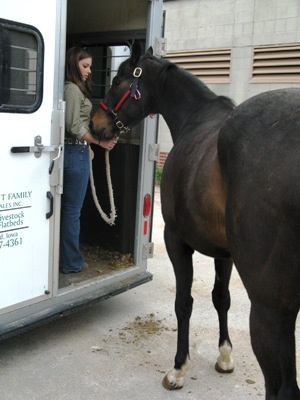
Planning for the removal of horses and having a pre-packed disaster kit can lead to a more efficient evacuation. Photo:  Kathy Anderson, University of Nebraska
Planning for the removal of horses and having a pre-packed disaster kit can lead to a more efficient evacuation. Photo: Kathy Anderson, University of Nebraska

Identification

Having clear identification on your animals can make it possible to be reunited with them post-disaster as well as clarify ownership in situations where large numbers of animals may be gathered for shelter.  Owners of companion animals should consider implanting permanent microchip identification, but can also use tags on collars and harnesses.  Livestock such as horses can also be microchipped but identification is more likely to rely on markings, coloring, permanent ID like tattoos and brands, as well as photos.  Owners who have had to evacuate without livestock sometimes resort to labelling taped phone numbers on halters or even painting the owner’s phone number on the animal themselves.

Several horses were brought in to the Animal Disaster Response Facility staged in the Ford Arena outside Beaumont following Hurricane Rita's landfall. Bob McMillan/ FEMA Photo
Several horses were brought in to the Animal Disaster Response Facility staged in the Ford Arena outside Beaumont following Hurricane Rita’s landfall. Bob McMillan/ FEMA Photo

Plan Escape Routes/Alternative Housing

In its Emergency Management Institute training, FEMA encourages animal owners to take their pets with them when told to evacuate, if it doesn’t jeopardize human safety, even if you have no place to go. However, planning in advance for your animals will alleviate stress and worry during a chaotic time.

Consider looking into staying with friends or relatives from out of town as well as pet friendly hotels; knowing several areas to which you could go will provide alternatives if some routes are impassable.  Note that many Red Cross and public shelters are unable to allow animals in due to public health concerns.   Contact local shelters and animal welfare groups in your area in advance to locate potential shelters which will allow animals during disaster.

Large animals are obviously a bit more complicated and require advance planning. Fairgrounds, large horse farms, racetracks, show facilities and veterinary referral hospitals all have taken in livestock during evacuation orders.  Many states have an emergency DART (disaster animal rescue team) which might be able to refer owners to evacuation centers within the region.

The unfortunate reality is that when it comes to large animals like horses, it may simply be impossible to save all the animals, especially in the case of a “sudden impact” event like fire, tornado or flash flood.  In these situations, saving some is preferable to saving none, so managers should know in advance which animals are the priorities to get to safety.

If a potential disaster is aiming for your area, it is best to respond to the threat at the earliest sign of danger.  Using the tornado example from the beginning of the blog, the other adult went to get the children from the hill and so began to enact their emergency drill as soon as it became clear that a tornado threat was imminent.  This meant that all of the Pony Clubbers were able to take shelter before the storm’s force hit the area, and if a tornado had actually come through, that they had the best chance of emerging unscathed.  If the actions prove unnecessary due to the threat moving away, the practice gives managers the opportunity to assess and modify the emergency plan so that it will work effectively when it counts.

Two horses in a flooded Missouri pasture.  FEMA photo.
Two horses in a flooded Missouri pasture. FEMA photo.

Get Involved in Your Community

When it comes to disaster preparedness, no one is better equipped to plan for the safety and well-being of a community’s animal residents than their caretakers.  This is particularly true when it comes to large animals like horses.  It is the responsibility of local government to create an emergency plan to serve as the roadmap for an effective and coordinated response in the event of disaster.  These plans are typically reviewed on a regular basis, and these reviews can present the perfect opportunity for the input of knowledgeable and skilled livestock and animal caretakers.  Local resources and expertise usually are the best source of ideas, and can identify those resources which already exist or are needed within a specific community.  Developing a cohesive plan with the input of all critical stakeholders is the only way to ensure that citizens, animals and property will be protected during an emergency.

In its Emergency Management Institute training, experts from FEMA recommend that animal caretakers take the initiative to see if their community’s plan addresses the needs of livestock and companion animals.  If the existing plan does not address these concerns, then the impetus to improve or revise the plan moving forward will likely need to come from the caretakers themselves.

Further Education

FEMA offers a variety of free online courses through its Emergency Management Institute which can help provide a more complete picture of disaster planning.  These programs take participants through the disaster preparedness process and help them to consider how disaster planning can benefit their farm and community.  After passing a final exam, participants may download a certificate of completion and/or receive continuing education credits.

The whole list of offerings is found at http://training.fema.gov/is/crslist.aspx.

I have personally completed four courses relevant to planning for animals in disaster, and would highly recommend them to anyone who might find themselves in charge of the wellbeing of animals in an emergency situation.

IS-10 Animals in Disaster: Module A, Awareness and Preparedness

IS-11 Animals in Disaster: Module B, Community Planning

IS-111 Livestock in Disasters

IS-100.b Basic Incident Command System

Book Review: Cavaletti for Dressage and Jumping

Cavaletti for Dressage and Jumping by Ingrid and Reiner Klimke

c 2014 J.A. Allen London, UK, 151 pages

ISBN 978-1-908809-19-3

Cavalletti.indd

The name “Klimke” is, I am pretty sure, the German word for “amazing horseman”.  The late Reiner Klimke is regarded as a legend, and the written work he left behind after his untimely passing in 1999 remains as relevant today as it did when first published.  Daughter Ingrid has carried on in the family tradition and today successfully trains horses to the highest international levels in both eventing and dressage.

https://www.youtube.com/watch?feature=em-upload_owner&v=5x6Y_PbATfw

The 2014 English translation of Cavaletti for Dressage and Jumping is an updated version of the 1969 publication of the same name written by R. Klimke. Ingrid has modernized the illustrations as well as the phrasing of the original text.  I believe she has also inserted her own perspective here and there, though it is clear that her father’s work serves as the main inspiration.

As I planned to be stuck in the indoor for the foreseeable future (as I write this we are experiencing yet another round of 8”-10” of snow), I picked up Cavaletti in order to better understand how these exercises could be used to improve my horses’ strength, spring and suppleness as well as to break up the monotony of the indoor.  Klimke’s book takes the reader through how cavaletti work is incorporated into her training regime from start to finish, to the point where the text could be used as a template for any training program.

Klimke’s training philosophy is based on classical principles, and what I really appreciated in this book was how often the importance of slow, gradual and incremental increases in the horse’s training program was emphasized.  I have read in other articles by Klimke that she always begins and ends each training session with at least ten minutes of walk on the buckle; I have been trying to be religious about giving my horses a solid ten minute free walk prior to beginning work, which I think has been beneficial.  This practice allows the rider time to become focused and present, and allows the horse to limber and loosen their body prior to being asked to complete any real work.  I notice that it is at about the seven or eight minute point in the walk that my horses begin to, of their own initiative, swing more freely through their topline and reach with a longer stride.  For each stage of the training program, Klimke reminds the reader that the horse must also have a period of “working in” before being expected to tackle new tasks.

Ingrid with her now retired Olympic eventing horse, FRH Butts Abraxxas.  Her love of horses is evident here, I think.  Photo has been taken from her website, www.klimke.org
Ingrid with her now retired Olympic eventing horse, FRH Butts Abraxxas. Her love of horses is evident here, I think. Photo has been taken from her website, http://www.klimke.org

Another aspect of this book that appealed to me was the emphasis on the importance of having a methodical, organized, planned progression to training, which includes consideration for the mental health of your horse.  “Many training problems can be solved far more easily if you do not rely solely on riding experience, but have a plan for how to go about the training before you start it…In addition, you must take responsibility for the wellbeing of your horse.  Only a healthy horse, whose condition and musculature have been carefully developed, can reach his full potential,” (Klimke, 2014, p. 11).

No matter what the intended discipline, Klimke says that cavaletti work can benefit all horses as part of their basic training.  Through modifications in the exercises, training challenges unique to specific disciplines can be addressed.

In Cavaletti, detailed discussion is included regarding free longeing in general as well as the use of cavaletti work during free longeing.  Klimke also discusses cavaletti exercises which are appropriate for the horse on the longe line.  The illustrated diagrams which are provided for basic to advanced cavaletti set ups are such that anyone with a tape measure and the basic required equipment can assemble the exercises.  Included are ridden exercises both on straight lines and circles.

The examples of ridden cavaletti exercise ideas show how a horse can be taught to move with a longer or a loftier stride, as well as how they can be taught to think about where to place their feet by removing a rail from a sequence.  As Klimke reminds us, “the aim of dressage is that the horse, through systematic gymnastic training, is made more beautiful and powerful and his natural movement is improved” (Klimke, 2014, p. 58).  That is the purpose of utilizing many of these exercises, as far as the horse is concerned.

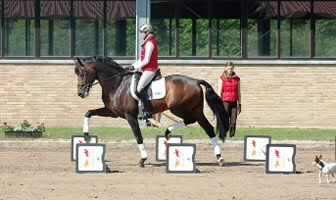
This photo shows one of the exercises which has had a cavaletti removed.  It is designed to help improve the horse's concentration. Photo by Julia Rau/Hindernisbau Rumann
This photo shows one of the exercises which has had a cavaletti removed. It is designed to help improve the horse’s concentration. Photo by Julia Rau/Hindernisbau Rumann

Finally, Klimke provides an excellent overview of the introduction and progression through basic gymnastic jumping exercises, something which should only be presented to the horse once a basic foundation has been firmly established.  Klimke states that gymnastic jumping is not just for the jumping horse, “Gymnastic jumping is excellent for improving the relationship between rider and horse. It covers a wide variety of schooling areas that are relevant to all the disciplines—dressage, show jumping and eventing—and for both horses and riders” (Klimke, 2014, p. 71).   Klimke also emphasizes the importance of tailoring the jump exercises to the individual horse and rider, which is true of the cavaletti work as well.  The distances included throughout the book are meant to be guidelines but of course should be edited to suit the stride length of the specific animal you are working with.

I must say that Klimke is a far more creative grid setter than I have ever been, and I look forward to introducing some of her layouts in my classes and personal schooling sets.

The book concludes with three model outlines for four to six week training schedules for three types of horse: for a horse in basic training, for a dressage horse and for a jumping horse.  These schedules provide a glimpse into how these exercises can be incorporated into a more comprehensive training plan.

Overall, I think this book is destined to become a true classic text and is a worthy addition to any sport horse trainer or rider’s library.  You can read it cover to cover then leave it handy to serve as reference for specific exercises or phases in training.

5/5 Stars

For more information about Ingrid, her schedule and her training program, you can visit her website at http://www.klimke.org/

David O’Connor at the Area I (USEA) Annual Meeting: Minutes of Mr. O’Connor’s Remarks

On January 11, 2015, my colleague and I had occasion to travel to Mt. Holyoke College in South Hadley, MA, to attend the Area I Annual Meeting.  While our true purpose was to attend the annual organizer’s meeting, held just before the business meeting, an added bonus was to listen to keynote speaker and current eventing chef d’equipe David O’Connor.

As most of the sport’s enthusiasts know, O’Connor has had a long, successful career in the eventing world.  An Olympic gold medalist and Badminton winner, he also spent nearly ten years as the president of the US Equestrian Federation before stepping down in 2012.  A 3*/4* course designer, O’Connor served as the International Technical Advisor to the Canadian eventing team before “assuming the reins” as the US team coach in 2013.

O'Connor's individual gold medal winning mount, Custom Made.  Photo taken from O'Connor Eventing's website (http://oconnorequestrian.us/)
O’Connor’s individual gold medal winning mount, Custom Made. Photo taken from O’Connor Eventing’s website (http://oconnorequestrian.us/)

O’Connor’s remarks ran the gamut, from his predictions for future US team development to remembering his time training in New England with LeGoff to his hope for the creation of more “destination events” to promote the sport.  Here, I will provide a summary of some of his key points.

Thoughts on Coaching, Training, and Getting an Education

O’Connor began his speech with an anecdote regarding a cross country trip from Maryland to Oregon which he, his older brother Brian and his mother Sally all took by horseback when O’Connor was eleven.  He said that it was on this trip that he really learned how to ride, because it was when he began to understand how horses think.  O’Connor says that he feels it is critical for riders to learn about horses before they begin to compete and get specialized.  “Riders specialize too early,” said O’Connor.  “It is not a good thing.  I believe that riders benefit from a multi-discipline base.”

O’Connor says that being open to diversity in training can only enhance your skills as a rider.  “You will learn something on a reining horse that will improve your turn on the haunches,” said O’Connor. “Too many riders want to learn to compete before they learn to ride.”

O’Connor says that to be a good event rider, one has to have a balance of education and experience.  He encouraged instructors to think innovatively, and to get their riders out of the ring.  He also spoke to the fact that he believes that the educational system in the US needs to be stronger.  To this end, O’Connor promoted the US Eventing Association’s Instructor Certification Program (ICP). O’Connor feels that it is better for the industry to set its own parameters regarding what makes a good instructor, rather than having those guidelines dictated to them by an outside entity.

http://useventing.com/education/icp

“I predict that at some point everyone will need to be licensed, and that this will be driven by the insurance companies,” said O’Connor.

O’Connor made some general remarks regarding the current status of the US High Performance team, who collectively had a disappointing 2014 season.  He acknowledged that ideally, the team should be riding American-bred horses, but right now we are in a gap between buying everyone else’s horses and developing our own.  He says that within the next few years, there are several exciting younger American-bred horses which should be arriving on the international stage, ready to be competitive.

In addition, O’Connor emphasized the importance of the developing rider programs to help spot and support young talent within the sport.  He specifically referenced Ariel Grald, a native Vermonter, as being a rising star.

O’Connor emphasized that in order to become competitive, the high performance squad members must continue to push out of their comfort zone, and ride and compete in new places which many not be comfortable or familiar to them.  In a related vein, he remarked that the riders must arrive thinking of themselves as real players, not just as someone who is there simply to compete.  It would seem that such advice is relevant to all riders who wish to expand their horizons, not just those interested in high performance!

Eventing, “One Sport”:  We are All Under the Same Blanket

New England, and Massachusetts in particular, was once upon a time the epicenter of American eventing.  O’Connor called the era of LeGoff, in the 1970’s and 1980’s, a time when the northeast was the “intellectual center of eventing”.  Competitions at Ledyard and nearby Groton House, Flying Horse, and others where “the” places to go in this emerging sport.

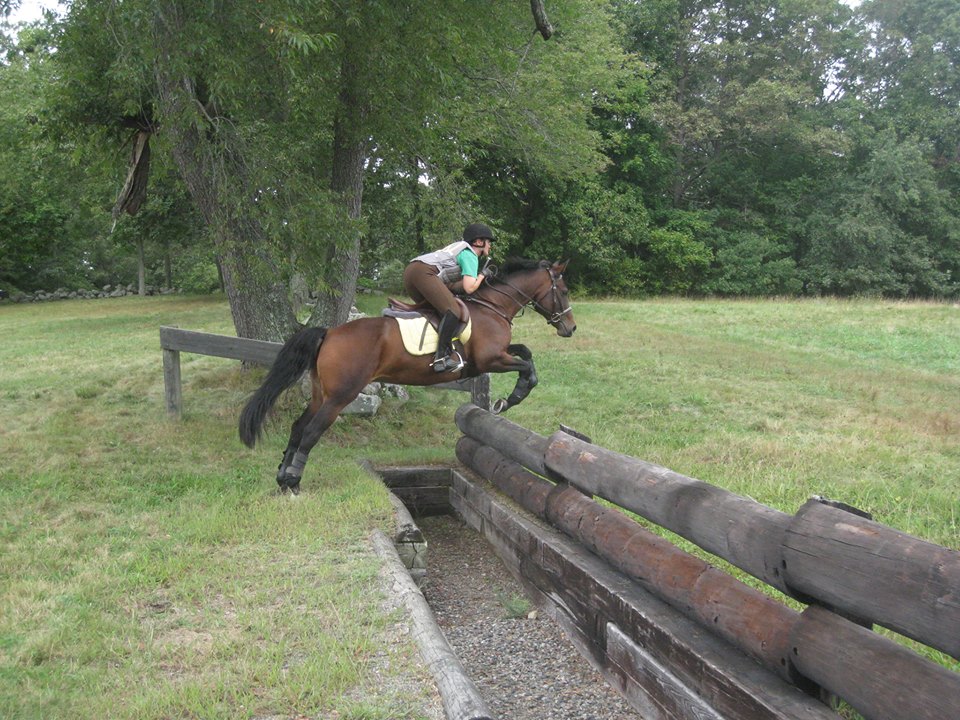
Anna jumping the ditch and wall at Ledyard.

O’Connor referred to that era as the “philanthropic” era of eventing, because the sport was essentially bankrolled by several wealthy families who were able to turn these competitions into destinations.  Today, however, eventing has become a business; O’Connor points out that other horse sports, such as show jumping, have grown even further, from being a business to being an industry.  Such growth, while not necessarily inevitable, does contribute towards the long term viability of a particular sport.

O’Connor acknowledged that eventing has been a sport with an image problem, with those outsiders perceiving event riders to be just crazed, adrenaline seeking junkies.  The reality is that in our highly interconnected world, bad news travels fast, and global issues can suddenly hit close to home.  These remarks were made specifically in reference to several high profile catastrophic accidents which were widely broadcast in the mainstream media.  “We are all under the same blanket,” said O’Connor.  “Global issues affect us locally and vice versa.”

While he agrees that eventing is not without danger, to train/compete in the sport is to take a “calculated risk”, not dissimilar to that assumed in the sports of skiing or cycling.  “Our risk management is strong,” said O’Connor.  “And our safety record, especially at beginner novice and novice, is good.  This sport is not dangerous but it has a calculated risk that you must respect.”

The more the “business” side of the sport of eventing grows, the greater the angst related towards it, with a rift being perceived between the upper level and lower level riders.  O’Connor commented that while we all were sitting in that meeting on a chilly New England winter day, over five hundred horses were competing at an event in Florida.  Such an occurrence would have been nearly inconceivable even twenty years ago.  O’Connor went on to say that from mid-January until early April, there will be in an event in Florida or Georgia every weekend with four hundred entries each.

Area1logosmall

In spite of this growth, eventing is still a niche sport.  The USEA currently has about 14,000 members, only 9,000 of whom compete.  O’Connor says that he looks at the sport as having three levels:  high performance, who are the ambitious, almost manic riders who want to compete internationally; the professionals, who are usually under-recognized and under-utilized, but who provide coaching, training and other services to the third category, the enthusiast.  The enthusiast is the grassroots, bottom of the pyramid rider/competitor who simply enjoys the sport as a means of recreation; this is not to say that they are not serious about it, but they are not deriving their income from the sport.  Often, the professionals are grouped with the high performance riders, instead of being recognized independently for the important niche which they fill.

O’Connor says that due to the overall small size of the sport, we do not have the luxury of being divided between upper and lower level niches.  “We are passionate,” said O’Connor.  “This [passion] encourages but also consumes.”

O’Connor emphasized that those who care about eventing are entering a critical cross roads.  “We are custodians of the sport but we also need critical thinkers,” says O’Connor.  “We are hitting the ceiling of a bubble economically.  We have to allow all of the levels to flourish.”

Goals for the Future and Olympic Fever

O’Connor closed his remarks with some of his ideas regarding the next steps which eventing must take in order to continue to thrive as a sport.  He described events as falling into one of three categories:  the local event, which primarily draws off the resident eventing community and makes up the largest percentage of events held; the ‘goal-oriented’ event, which is usually a more prestigious, demanding or upscale event that is being used as preparation for something else; and finally the ‘destination event’.  The main crux of his discussion centered on his vision for these “destination events” and what they could mean to the sport.

Essentially, a destination event as defined by O’Connor is one which is meant to be an “entertainment product” and is geared heavily towards the enjoyment of the spectators.  Ideally this event should be FEI-sanctioned so that it will draw the major players of the sport.  It should be so enticing that it can attract an audience from far away, and induce them to pay for tickets; therefore, its location must be accessible.  This revenue can then be turned into prize money for the “players”.  “A destination event has the ability to change and support the sport outside of ourselves,” said O’Connor.

In O’Connor’s vision, each area of the country would have its own destination event, enough so that they are available but not so many that they become run of the mill.  Currently, events such as Rolex, Carolina Horse Park, the fall Plantation Fields and Great Meadows (VA) all are at or are working towards ‘destination event’ status.

O’Connor challenged the audience to consider where such an event could be held in New England.  He emphasized the significance of such an event in that it would draw riders back to New England, the former center of eventing.  “It would return New England [eventing] to its roots, the destination events at Ledyard,” said O’Connor.

To make such remarks to an audience who have just heard that their local big city, Boston, has been selected for consideration for the 2024 Olympics, was well calculated, in my opinion.   The room was quickly filled with chatter about where the equestrian events could be held in conjunction with these Games, and whether such a site could be tested first by becoming a New England destination event.

Earlier in his speech, O’Connor had reflected upon his own experience as an Olympian, saying that although he won his gold in Sydney (Australia), it was really the 1996 Atlanta (GA) Games which were his “Olympic experience”, because they were held on US soil.  “The Olympic Games are the only moment that everyone believes in, when religion, beliefs, etcetera, don’t matter,” said O’Connor.  “At the end of the day, only one person gets to stand on the podium, but being part of the process stays with you forever.”

In regards to continued discussion by the International Olympic Committee concerning the long term viability of horse sports in the Olympic Games, O’Connor had this to say.  “With horses at [the Olympic level] costing over one million dollars, equestrian is not remaining as a sport which anyone can do,” said O’Connor.  “That is a real risk for continued inclusion in the Olympics.  At least the sport has historical inclusion on its side.”

For the 2012 London Games, the cross country phase of eventing was held right in Greenwich Park; O’Connor said that within two days of the competition’s conclusion, over 90% of the fences were cleaned up and the park was re-opened.  “In this way, we have shown that cross country can be portable,” said O’Connor.  “We could hold cross country in Central Park, which would be a great thing for the sport.”

Summary

Overall, O’Connor is an engaging speaker, equal parts politician and story teller.  It was clear that his passion for the sport of eventing is as strong as ever, and that he is committed to a long term vision for the sport which will allow it to have a more secure niche within the horse industry for the long term.

Blogger’s Note:  I hope to not offend the excellent photographer whose work appears in the Area I website’s banner (www.area1usea.org), which I have borrowed here for my featured image.  All of the work in the banner belongs to Joan Davis/Flatlandsfoto,  an artist who generously compiles and sells an Area I eventing calendar each year to benefit the activities of the region.  I include the images here only to promote Area I eventing and encourage all riders to support the official show photographers who dedicate so much time and passion to our sport. 

A Clinic with Nancy Guyotte

On December 15, 2014, the U of New Hampshire Equine Program hosted a jumping clinic with eventing veteran Nancy Guyotte.  Nancy, of Hill, NH, is a graduate of the UNH Animal Science program and was involved with the early years of its now well established horse trials.  Of course, Nancy also went on to great personal success of her own as an eventing rider, coach and breeder.  Our students very much enjoyed having the opportunity to work with her; I was also able to squeeze myself into one of the groups, which was great fun and a positive experience!

Getting Started: Connection and Suppleness

In my personal experience, taking a clinic with someone new can be a nerve wracking undertaking, particularly when the focus is work over fences.  I have absolutely had the experience of riding with a clinician who simply raised the fences higher and higher, assuming I guess that it is everyone’s goal to jump large obstacles, even if they do so poorly.  I like to be challenged and to learn new exercises, but I don’t want to find my horse overfaced with the questions in front of us.

I think it is hard for clinicians as well, especially when they are coming in cold and don’t totally know for sure what the expertise level will be of the riders they are working with or the caliber and training of the horses.

Therefore, I wholly appreciated that after a brief round of introductions and review of equipment, our session with Nancy began working with cavaletti and flatwork.  Nancy wanted our group to focus on suppleness, responsiveness, adjustability and connection in our flat work, which are also important qualities to bring forward into the work over fences.  In my own instruction, I try to help my students to make this association as well—because for many riders who like to jump, flatwork is just what you do to warm up, not the main focus of a ride.

Anna warming up.
Anna warming up.

After a working in phase of work in walk, trot and canter, Nancy began to focus more directly on each horse’s lateral and longitudinal suppleness as well as the overall connection from hindquarters to the bridle.  Two exercises were particularly helpful for me.  The first was using a bit of counter-flexion with a leg yield of just a few steps to the inside to get Anna more even between both reins, as opposed to overflexed in the neck without bend through the ribcage (a favorite evasion).  This mini-exercise is used as a microadjustment, a rebalancing of the aids, and it is super effective.  Another exercise that Nancy had the group work on was turn on the forehand.  I don’t school this movement frequently, though I do use other forms of leg yield and turn on the haunches.  Turn on the forehand can help improve the connection to the outside rein as well as the engagement of the inside hind.  If your horse gets stuck, you should step forward for a few strides and then return to the turn.  You can also think about riding a small circle with the hind legs, and a smaller circle with the front ones, rather than making the turn be completely “on the spot”.

As our group rode the turn on the forehand, most of us would do 180 degrees and then leave the movement.  Nancy reminded us that you can go 360 degrees around, or even just keep your horse in the movement until you are satisfied with the result.

An Eye for Detail

Once the horses had worked in, we began working over a straight row of four cavaletti poles.  If you do not have traditional cavaletti (the kind with an “x” at the end), it is important to try to use square poles which cannot roll or to brace round rails with plastic blocks or other similar tools.

Nancy set up a row of cavaletti at a distance of 4’6” on centerline; we walked through the rails first and then proceeded to the trot. At this distance, the horse should put one trot step in between each of the rails.  The advantage of using centerline is that you can reverse directions after each approach and therefore work the horse equally on both sides.  The challenge is that it then becomes harder to keep the horse straight.

Working through the cavaletti.

I have usually allowed my horses to stretch and reach a bit over cavaletti rails, but Nancy pointed out that when Anna did this, she was taking advantage of the rails as an opportunity to become disconnected.  Nancy encouraged me to take a bit more time prior to coming through the rails to really get Anna through and over the back, and then reminded me to keep my lower leg on as we came over the rails.   With successive repetitions through the rails, Anna began to more consistently remain connected and increased her activity.

Next we moved on to work over a fan of three rails.  In a “fan” pattern, the rider approaches the rails with bend through the horse’s ribcage, as opposed to the straighter line taken through rails on the center line.  The inside rails of the fan are closer together, while the outside rails are spread further apart.  In this case, Nancy placed the rails such that the center to center approach was at 9 feet.  This meant that the horses could trot through the rails, taking two steps in between each, or canter through in a bounce stride.  Depending on the horse’s natural length of stride, fading to the inside of the fan or pushing towards the outside might make the exercise easier.  However, Nancy emphasized the importance of being able to create the middle canter, and to be able to maintain the bend, balance, connection and energy through the center of the rails.

Coming through the fan.

Though this sort of exercise sounds as though it should be rather easy, the reality is that to keep each component of the horse’s gait and body position wholly under control of the rider is actually quite difficult.  The horses in our group tended to start over the first rail straight (so, perpendicular to the center of the rail) but then veered off on a tangent, rather than remaining connected, bent and engaged through the inside hind leg.  With successive repetitions, each of the horses became more consistent through the exercise.  Nancy remarked that she actually keeps an exercise like this set up in her arena most of the time, so that it can remain a regular component of her schooling.

Eventually, the center element of the fan became slightly elevated, and we began to approach the first rail in trot but then ask for the canter as we crossed the third rail.  Finding the timing for this aid was most possible when the approach into the exercise was correctly executed.

What I most appreciated during this segment of our session was Nancy’s impressive eye for detail.  It was always the most subtle things which made the biggest difference— for example, lowering the hands slightly or supporting with the lower leg more consistently. As always, the constant focus and attention on basics is essential for success.

Moving on to Jumps

These preparatory cavaletti exercises were actually quite demanding on the horses.  On the one hand, work over cavaletti can be less arduous than actual jumping and therefore represents an excellent method to work on jumping related skills without adding wear and tear on the horse.  On the flip side, these kinds of exercises require the horse to consistently and deliberately flex and then engage the hind limbs, as well as add greater elevation to the forehand and shoulder.  The stress of the exercise is cumulative.  Muscles become fatigued and then mistakes can be made, which is when injury might occur.  So it is important to find the balance.

After our preparatory cavaletti work during this session, we moved on to working over a few fences.  Essentially, we began over the fan, and then maintained the bouncy canter which the exercise had created to a modified oxer.  From there, it was an immediate bending line, then a related distance on the diagonal.

On course!
On course!

Again, few repetitions were necessary but details were important.  Nancy pointed out that though Anna has a lovely flying change, sometimes she uses it as an excuse to not remain connected, and has a tendency to try to swing the haunches.  I have a bad habit of raising my hands on the approach to a fence, which of course just ruins the canter, and Nancy reminded me to keep the hand low and allow Anna to come forward at the fences.

Take Home Thoughts

At this time of the year, when we are stuck indoors and usually are sharing our ring space with other users, it can be a real challenge to keep jumping skills tuned up or set a full course.  The use of exercises such as those which Nancy used in this clinic can be a great way to provide some relief to the monotony of the arena while also helping to polish jumping skills.  In fact, most of the exercises we practiced would be quite appropriate for any horse and rider, whether they jump or not, to help maintain fitness, improve the development of a correct connection and build strength.  I have already begun incorporating one day per week of cavaletti work into my routine and hope that through its use I can further improve Anna’s connection and swing.

My Equine Bucket List 

Happy New Year!  Tis the season for resolutions large and small, for those promises to ourselves and others that this year we will finally take those steps towards positive change.  Here in New England, it is also the beginning of the most challenging riding season of the year, with bitterly cold temps alternating with ice or snow storms—these are real impediments when you have to ship your horse to an indoor to ride, as I do with Anna.  Therefore, it is a great time to pause to reflect upon your goals for the upcoming season—short, medium and long term.

After my summer in Vermont working with Denny Emerson (see the Tamarack Chronicles, Volumes I- VI), I came back inspired and full of new energy and ideas regarding what I want to do with my riding and within the equine industry in general.  In preparing my goals for the 2015 season, I realized that it would be a huge help to step back and really evaluate the Big Picture—to think about those goals which seem so outlandish and so far out there as to be almost unattainable.  Because the reality is, if you don’t think about those kinds of goals in a Big Picture way, you almost certainly won’t backtrack and make the changes or seek the opportunities necessary to try to take them from being a dream to a certainty.  And then someday you are likely to reflect upon your career and say, gee I had always wanted to [fill in the blank]…but it is too late now.

Lee at the awards ceremony for the 25 mile ride at GMHA Distance Days, 2014.

Therefore, this year I have formally created Chris’s Equine Bucket List, a short collection of goals, dreams and experiences that I wish to have with horses.  I maintain that this list is subject to revision and editing as I see fit, and I reserve the right to add, remove, alter and/or otherwise modify these Big Picture destinations.  However, as of right now, these are some actual goals that I want to achieve before I hang up my spurs, in no particular order.

Chris’s Equine Bucket List

  • Drive a big hitch. At Equine Affaire in Springfield, MA, this year, I was treated to a performance of the Fantasia show.  This spectacle features performances from riders and horses representing an array of breeds and disciplines.  This year, by far my favorite exhibitor was the six horse Belgian hitch from the Morrisville College Foundation.   The quiet power of each of these amazing animals combined into one suddenly small arena was just awe-inspiring.  The metal fittings on the harnesses gleamed, and the air hung heavy with the sound of their powerful feet rhythmically striking the soft footing.  I probably should start with a refresher on how to drive just one horse.  But boy, it would really be amazing to be directing that much power.
    The lead pair of a six horse hitch of black Clydesdales.  By Blodyn (Own work) [CC BY-SA 3.0 (http://creativecommons.org/licenses/by-sa/3.0)], via Wikimedia Commons
    The lead pair of a six horse hitch of black Clydesdales. By Blodyn (Own work) [CC BY-SA 3.0 (http://creativecommons.org/licenses/by-sa/3.0)%5D, via Wikimedia Commons
  • Raise a foal. There is a true problem in our country with there being more horses than appropriate homes for them.  In spite of this, I have not so secretly had the desire to breed one of my mares, a desire which to date I have been able to keep reasonably in check.  That said, I still would like to have the experience at least one time of raising a foal from the very beginning, whether I am the breeder or not, and bringing them through the training process.  I have had the pleasure of working with my current horses from a very green place in their lives, but someone else had done all of the early work. I want to have the experience of raising, developing and nurturing the horse from their first days through to their time under saddle.   I also believe that this route might be my only option when it comes to getting to the FEI levels in either dressage or endurance.
  • Train my own horses. In general, I am more interested in training my own horses than I am in buying or leasing a schoolmaster to get me to a certain goal.  I think that schoolmasters are AMAZING and I am so grateful for the ones that I have had the opportunity to learn from in the past.  I also fully believe that I will seek their wisdom in short doses as I move forward in my career.  However, I take a great deal of pride (and humility) in knowing that the horses I ride and work with are the product of my own effort and time.  It is more meaningful to me to develop the relationship with each individual horse along the way. See entry # 2 for more info on this point.

    Anna and I schooling July 2011.  To date, I am the only rider to ever school her over fences.
    Anna and I schooling July 2011. To date, I am the only rider to ever school her over fences.
  • Earn my USDF Gold Medal. This one kind of relates to #5; before I can compete at a CDI, I need to actually get a horse to the FEI levels. If I am riding at the FEI levels, maybe even on a Connemara or a half bred (how cool would that be?), my goal would be to attain the scores for the silver and gold medal rider awards—two scores of 60% or higher at Fourth and Prix St. Georges for the silver, and two each at Intermediate and Grand Prix for the gold.  One of my favorite classes to compete in with my former mount Worldly (show name: Weltinus) was the musical freestyle, and I already have bronze bar scores for First and Second Level from my time with him.  The “bar” award is for freestyle performance, and is only awarded after the regular rider award for that level has been attained.  So let’s add earning the bronze, silver and gold bars, too, to this item.  What the heck.

    Worldly (Weltinus, on the left) after winning the 2006 Region 8 Second Level Freestyle championships.
    Worldly (Weltinus, on the left) after winning the 2006 Region 8 Second Level Freestyle championships.
  • Compete in a CDI. So this is definitely a huge end goal. I don’t care if I even place.  I just want to have the chance to compete in an FEI competition, and I think that dressage is the most likely niche for me to do it, maybe on my fictional Connemara, who I have also raised and trained myself.  It’s a wish list, don’t judge.
  • “Do the Florida thing”. I would really love to have the chance to see what winter in Florida is all about.  I have heard so much about it—and it seems like it would be like going to equine Disneyland.  So many talented horses, riders, instructors and clinics are available in a condensed place.  Whether riding, competing or auditing, I can’t imagine that one wouldn’t return from the experience a new horseman (and with a much lighter checkbook, I understand).  And I never object to getting out of the cold.

    (Kristen M. Clark / The Palm Beach Post)
    (Kristen M. Clark / The Palm Beach Post)
  • Keep my horses at home.  This has been a lifelong dream of mine—to have my own farm, with my horses wholly in my care.  I have been very fortunate to board at wonderful facilities but there is just nothing quite the same as being able to do everything the way you want to.  Related to this, I have a strong interest in sustainable living and sustainable agriculture, and how we can apply those concepts to horse facility management.  Having my own place would allow me to begin to experiment with these principles first hand.

    On this day, I had forgotten something at home and stopped in en route home after a clinic.  Not quite what I mean when I say that "I want to bring my horse home" but it is the closest I have gotten so far....
    On this day, I had forgotten something at home and stopped in en route home after a clinic. Not quite what I mean when I say that “I want to bring my horse home” but it is the closest I have gotten so far….
  • Trail ride in Acadia National Park. I am told it is amazing—a breathtaking area, with trails specifically designed for horses. Parts of Acadia used to be owned by the Rockefellers, who have had equine enthusiasts in their family for years and who were critically involved in building the miles of carriage roads in the 1930’s.  With my newfound interest in competitive trail and my wonderful and now reliable mount Lee, I hope that a visit can be arranged in the near future.
  • Train in Europe I am not talking anything on the level of taking my own horses over and training like I am going to make a team or something like that. However, the tradition of horsemanship in countries like England, Germany or even Portugal and Spain is rich, and I think it would be greatly informative to have the chance to see how horses are managed and trained and riders are coached.
  • Complete a classic three day event. This one has been on the list for a long time, pretty much since I first learned about the novice and training level educational three day event options being held at Green Mountain Horse Association (GMHA) in Vermont. When the lower level classic format events began, I didn’t have an event horse and was mostly riding dressage, but I thought, “Perhaps someday”.  What I didn’t count on was the fact that after taking a few years off from jumping and then returning to the eventing scene, I am not quite as brave as I once was.  So I am not sure if the reality of actually doing this is going to happen.  But for the time being, it remains on the list.  See the clause above regarding editing of the list at the owner’s whim.

    Anna at King Oak Farm, September 2014.  Photo courtesy of Flatlandsfoto/Joan Davis and used with permission.
    Anna at King Oak Farm, September 2014. Photo courtesy of Flatlandsfoto/Joan Davis and used with permission.
  • Complete a 100 mile ride. This one is a fairly recent addition to the list. I am secretly hoping that Lee might be able to complete the three day hundred at GMHA before her career is done, but if not, at some point this is something I wish to have accomplished.  As they say in the sport, “to finish is to win” and the opportunity to connect with your horse on the level which is required to prepare them and help them to get you through such an effort is a true testament to a rider’s horsemanship skills. I would be so bold as to say that someone who completes a one hundred mile ride on a horse which they have prepared themselves is not just a rider; they are a true horseman, which I consider to be the highest compliment.

    Crossing the finish line at GMHA Distance Days 2014, completing the 25 mile ride.
    Crossing the finish line at GMHA Distance Days 2014, completing the 25 mile ride.
  • Save a horse. This is not a goal which is wholly defined in my mind; it is more that I think it is of the highest importance that those who love horses remain advocates for the promotion of humane education and training. So whether attaining this objective might be quite direct, in terms of getting a horse out of a situation that is dangerous or inhumane, or indirect, in terms of providing continued education to horse lovers and support for rescues, I think it is absolutely critical that we as a community remain ever vigilant.

    It is imperative that anyone who loves and cares about horses be an advocate for their protection and well being.
    It is imperative that anyone who loves and cares about horses be an advocate for their protection and well being.
  • Ride a reiner. In the vein of stepping out of my usual comfort zone to have new experiences with horses, I have secretly had the desire to learn a little bit about—and try my hand at—riding a reiner. Mind you, my experience in riding in western saddles is limited almost exclusively to my horse packing trip out west.  I have some friends in the Intercollegiate Horse Shows Association (IHSA) who are western specialists, and just the other day I asked if it was reasonable to ask someone to teach a rider like myself some basics of reining on an experienced horse. She gave me some northern contacts, and then explained to me the basic aids for beginning a spin to the left.  The cues are subtle and, of course, totally not what I would do to initiate a pirouette left.  It sounds like it could be fun, and totally out of my comfort zone.  I am not looking to change disciplines, just to try it out.

    The sliding stop.
    The sliding stop.

This version of Chris’s Bucket List represents some of my thoughts as of today, early January, 2015.  I think I will see what the year brings in terms of progress towards knocking a few of these off the list, and perhaps I will check back in a year’s time to see where I have come to.

So what is on your Equine Bucket List?

Where are you going with your equestrian pursuits?


Gary Rockwell and Stephen Clarke: The FEI 5* Judges’ Symposium

Gary Rockwell and Stephen Clarke:  The FEI 5* Judges’ Symposium

At The Equestrian Center at Pineland Farms, New Gloucester, ME

12/10/14

The state of Maine may not be thought of as an epicenter of dressage, but the staff at the Equestrian Center at Pineland Farms are working to change that.  With all-star trainers like Olympian Michael Poulin and former Young Rider champion Gwyneth McPherson heading the coaching team, and assistant trainer/organizer Jennifer Dillon pulling together equestrian A-list clinics, this facility is sure to make a positive influence on the education of dressage enthusiasts from across the northeast.

An early season Nor’easter didn’t keep attendees away from what was billed as the Five Star Symposium on Dec 9-10, 2014.  FEI 5* judges Gary Rockwell of the US and Stephen Clarke of the UK were invited to Pineland to help educate participants’ eyes towards the quality of performance.  Several talented riders, including Poulin and McPherson but also Jutta Lee, David Collins, Laura Noyes and Heather Blitz, demonstrated movements and performed complete tests ranging from Training level to Grand Prix, while Rockwell and Clarke provided scores and commentary.  This format meant that auditors could gain perspective as riders, trainers and judges, depending on their area of personal focus.  In addition, several USEF rated judges sat ring side and offered further comment/question to round out the experience.  As a representative of the University of New Hampshire (UNH) Equine Program, I was able to attend on day two, bringing along fourteen of our program’s students.  We are most grateful to the Equestrian Center at Pineland Farm for this amazing opportunity.

Students from the University of New Hampshire (UNH) Equine Program thoroughly enjoyed their visit to The Equestrian Center at Pineland Farms.

Rockwell and Clarke banter like old friends do and were remarkably “in sync” with their judging and remarks, rarely deviating more than one point from one another.  Throughout the day, their feedback combined training tips with judging perspective, as well as insight into the theory behind why correct riding is the best kind of riding.

Transitions, Tension and Test Riding

As the day began, auditors were treated to the performances of a pair of talented four year olds, ridden by Collins and Lee. One horse demonstrated the 2015 Training Level Test 3, while the other rode the FEI Four Year Old test.  The USEF tests are scored in a traditional manner, with a comment/score given for each movement, while the FEI Young Horse tests are scored with overall marks given for each of the gaits, submissiveness and overall impression.

Let me start by commenting that any one of us would likely have traded the outfit we were wearing that day and offered to sit in our undies on the bleachers in exchange for a ride on either of these lovely youngsters.  The tests that they performed were scored in the 70’s and low 80’s by Rockwell and Clarke, giving those present an excellent picture of what a high standard of performance  and correct training looks like.

At these introductory levels, much emphasis is placed on the correctness of the basic paces. No matter how good a mover the horse is, Clarke and Rockwell emphasized that in order to show a horse’s paces to their best advantage, riders must perfect the transitions.  The quality of the transition will determine how well and how clearly the horse begins the next gait.  Even horses with “average” gaits can improve in quality with correct transitions.

On a related note, tension (mental or physical) will block a horse’s throughness and ultimately impede the quality of their gaits.  The judges remarked that tension in the canter is especially common in developing horses, and it is important that horses come into the gait with suppleness and swing.

One of the most challenging movements in the lower level tests is the infamous “stretchy circle”.  Judges are usually quite critical of the performance of this movement, with common mistakes including loss of rhythm/regularity, loss of balance, and failure to reach through the topline and down to the bit.  Clarke and Rockwell emphasized that it is important for riders to remember that the stretchy circle is not meant to be just a test movement; it is a test of the horse’s balance and throughness and must be incorporated into the regular work.

David Collins riding Bojing (unattributed but taken from his website, www.centerlinestables.org).
David Collins riding Bojing (unattributed but taken from his website, http://www.centerlinestables.org).

An interesting point came up as Clarke and Rockwell discussed the performance of Collins’ mount, Bojing.  This talented youngster already moves with the confidence and poise of an experienced campaigner, but occasionally showed his youth in certain moments of the test, particularly in terms of showcasing his full power.  Clarke and Rockwell remarked that in training a horse from day to day, riders can get in the habit of doing things the same way they always have.  However, the result of good training should be a horse that changes and develops, and it is important for riders to remember that with this growth may come a need to moderate an aid—perhaps to change how it is given, or the intensity of it.

We would be treated to several additional examples of this axiom as the day progressed.

Although the demonstration horses performed fairly good halts during their test rides, Clarke and Rockwell remarked that at the lower levels, the squareness of the halt is less critical than the overall obedience, submission, steadiness and straightness as seen from “C”.  Once these qualities are maintained, it will become easier for the rider to ride the horse from back to front to achieve a square halt.

One additional discussion which emerged after watching the first few horses perform was related to the choice of bit for individual horses.  Clarke and Rockwell emphasized that horses who demonstrate “mouth” issues are usually also holding internal tension; this cause must be sought and addressed before the mouth issues will resolve.  According to the judges, riders who constantly change bits to look for a solution to mouth issues are sometimes overlooking the most common one—the rider themselves.  Asymmetry, weakness, lack of balance and lack of coordination in the rider can all manifest as mouth issues in the horse.  Therefore, if the horse has an issue in the mouth—look to the rider first.

Gait Distinctions, Soft Rein Backs and Head Tilts

2015 Third Level Test 3, 2015 Fourth Level Test 3 (and boy, is that test ramped up!) and the FEI Prix St. Georges tests were demonstrated by Poulin on a client’s horse, Blitz on the young stallion Ripline and McPherson on an older campaigner, Flair.  Again, all three horses demonstrated quality tests and allowed auditors a clear picture of what is expected at the given level.  Clarke and Rockwell began asking riders to stay a moment longer in the ring with these older horses, in order to repeat certain movements or to demonstrate particular points.  What became clear through the feedback provided by the judges is that, for these medium level horses, continued attention to the finer points allows for an increase in the quality of performance.

Rein back is a movement that appears in tests starting at the Second Level.  Horses should halt quietly, and then step backwards without visibly losing balance, dropping or raising the poll, or stepping sideways.  It is actually quite an unnatural movement for the horse and requires a great deal of submission.  Clarke and Rockwell said that if there is restriction in the reins during the rein back, the horse will brace against this and drag their feet.  Instead, the rider must learn to execute the rein back with a soft hand.

Turn on the haunches and walk pirouettes also appear at these levels, which led to a bit of friendly US-UK terminology debate. Clarke explained that the term “turn on the haunches” is an old military movement that has nothing to do with maintaining the rhythm or regularity of the gait, two qualities which are “must have’s” when performing this movement in the modern arena.  Therefore, Clarke insists that a more correct description for a “turn on the haunches” is really “large walk pirouette”, which is actually a classical dressage movement.  Rockwell simply shrugged his shoulders and sipped his coffee at this. No matter what you call them, the horse must maintain a clear four beat rhythm and the rider must be especially careful to not allow the horse to “stick” behind.

https://www.youtube.com/watch?v=LfskPZHrdRQ

The three talented horses which demonstrated the middle level tests were also able to present auditors with three different levels of proficiency with the medium and extended gaits.  Often, riders “push” for so much in their medium gaits that there is not a clear difference between it and the extended gait.  However, Clarke and Rockwell admitted that judges must also partially take the blame for this, because they sometimes too harshly score a “normal” medium trot.  So of course, this led to a discussion of what exactly is being expected in each of these paces.

Clarke and Rockwell explained that in the medium gaits, there is a soft, quiet opening of the steps with no loss of roundness or throughness.  Extended gaits, by contrast, are the “utmost”, and need to be more than the medium.  For those of us who ride horses with limited natural gaits, it is best to really go for it in the medium gaits, and to accept the comment of “not much difference” in the extended movements.

Blitz and Ripline had to execute a challenging movement in the new USEF Fourth Level Test 3—the shoulder in on the center line.  From “C”, the judge commented that the horse was not correctly bent and the movement was not clear.  From where we sat on the side, the movement had seemed okay.  This was a great example of how a judge can only assess what they can actually see (review the “Judge’s Notebook” section below).  Rockwell had Blitz repeat the movement, this time being certain to keep Ripline’s hind legs on the center line, with the forehand only to the side of the line.  Once the letter “A” could clearly be seen between the horse’s hind legs, the angle and bend of the movement became more correct and the score was adjusted accordingly.

Occasionally during their tests, each of these horses had demonstrated a slight head tilt which negatively impacted the score for that movement.  This led to an interesting discussion of where in the horse’s body submission to the bend begins.  In a horse that is accepting the aids correctly, the ribcage gives to the rider’s inside leg and the horse steps to the connection of the outside rein, allowing the rider to then be “free and easy” with the inside rein.  When the horse doesn’t move off the leg appropriately (and therefore lacks true submission to the bend), the rider will use the inside rein more than they ought to, which begins the head tilt.

The Elite Levels:  “It’s from another planet”

Auditors were in for a real treat after the lunch break, when Lee returned with Glorious Feeling to demonstrate Intermediate A, and Laura Noyes rode her own Galveston in the Intermediate B.  However, the finale was not to be missed, and 2012 London Olympics alternate team members Blitz and her own Paragon elicited multiple “10’s” from the judges and the now infamous comment, “It’s from another planet” (in reference to Paragon’s extended trot).  I must admit that my note-taking fell off the page a bit during these last few rides as I was so mesmerized by the horses’ performances.

Clarke and Rockwell discussed the meaning of a horse “being on the outside rein” as the effect of how much control and influence a rider has with the outside rein, versus the amount of weight the rider feels in the outside rein.  This sense of connection to the outside rein is a must have requirement in order to execute the rapid changes of bend, balance and pace required in these elite level tests.

Jutta Lee and Glorious Feeling listen to the comments from Rockwell and Clarke.

Less experienced riders tend to focus on the head and neck of the horse, and as riders gain experience, they learn to look through the whole body to see the lift through the topline and engagement of the supporting muscles, which then allows the poll to come to be the highest point with the nose just in front of vertical.  These confirmed FEI horses demonstrated this correct balance clearly and showed how this much power can still be soft.

Earlier, Clarke and Rockwell had emphasized the importance of constantly checking in with how the rider is using her aids as the horse grows and develops.  With Galveston, Noyes delivered an accurate and fluid test that had many good (“8”) and very good (“9”) movements.  However, the judges felt that the horse still had more to offer and that Noyes was not quite asking enough.  By changing the balance between her forward leg aid and restraining seat and rein aids, as well as modifying the timing of the two, Galveston began to produce an extended trot which elicited a collective gasp from the audience.  Surely Noyes knew this trot was in there, but now she has new tools to play with in order to develop it further.

In these tests, Clarke and Rockwell discussed the critical importance of preparation for movements and the use of transitions and corners to aid in building up the required power and correct balance.  For example, in the sequence changes (the four, three, two and one tempi’s), the rider must come onto the diagonal and create an uphill balance in the horse and then release into the first change, as opposed to trying to push into them.  The medium and extended trots are also a release of stored energy that has been built up in advance; if the rider has failed to build the energy, she cannot magically create the power required for these paces at the letter itself.

Blitz and Paragon were truly inspirational to watch.  At 18 hands, the chestnut gelding would command attention no matter what, but the incredible sitting in his piaffe/passage, the ease of his tempi changes and of course the unbelievable power and control demonstrated in his extended trot were simply magical.  I think everyone there knew we were watching a special partnership.

Clarke and Rockwell of course have seen (and judged) this team before, and both remarked on the tremendous growth in the horse’s confidence.  “Whatever you are doing in your training program—keep doing it,” commented Clarke.  The judges said that for so many horses, no matter what, the muscular growth acquired through consistent training will help them develop the confidence to do the movements.  For a Grand Prix horse, learning the movements themselves is only a beginning.  Clarke and Rockwell said that if you are lucky, it takes five years to develop a horse to Grand Prix, and then another two years to put it all together in the arena. So much of this development comes down to the strength of the horse in being able to correctly do the movements.

Judge’s Notebook

As a (2007) graduate of the United States Dressage Federation’s “L” judge’s training program, I can assure you that the view from C is one that comes only after years of dedication, effort and growth in terms of developing one’s eye, skill, vocabulary and clarity.  While I am lucky to be invited to judge at local schooling horse trials and dressage shows, I am not sure that I will ever feel fully qualified or up to the commitment of pursuing the dressage judge’s license.  Completing the “L” program has helped me to interpret judge’s comments on my own tests with better clarity and also to know that most judges truly want to help the competitors to be better. I have an immense amount of respect for the challenge that judges face in their role.

Clarke and Rockwell represent the pinnacle of judging, and I was completely impressed with how they came within one point of each other on nearly every movement, with similar comments.  As adhering to the training pyramid will lead to a horse with correct basics, these gentlemen show that the progress judges make through their own training helps to refine the eye and to create cohesion and consistency in a subjective discipline.

Throughout the day, Clarke and Rockwell offered insight into the role and mind of a judge, both by actually scoring/commenting on the tests being performed and also through their discussion of each performance.  In addition, they fielded questions from the audience.

Here are a few of the “judging notes” I picked up throughout the day.

  • Judges must actually use the entire scale to reflect what they are really seeing. During the course of the day’s rides, we heard Clarke and Rockwell say everything from 3 to 10.  I must admit, I find it hard to get out of “six-ville” when judging, so it was exciting to see the quality of performance which elicits higher marks, as well as the fact that these elite judges will forgive minor mistakes (like a small stumble).
  • One of the main purposes of the Young Horse classes is to educate the public; this is especially true in Europe, where such classes will draw a large crowd. In the YH tests, judges want to see a relaxed, confident horse which is being shown in a natural balance.  Horses may have three super gaits naturally but the training must still be correct, and the young horse must not move artificially.  The Four Year Old test is roughly equivalent to the USEF Training/First Level; the Five Year Old test is roughly equivalent to the USEF Second/Third Level and the 6 Year Old test is roughly equivalent to USEF Third/Fourth Level.
  • When a horse is actively teeth grinding or tail swishing during their work, it is important to look at the overall picture and to not immediately interpret this as a symptom of resistance; judges should not automatically deduct points. Frequently if there is tension in the horse there will be additional cues.  Not every horse that grinds their teeth or swings their tail is being resistant.
  • The collective marks are meant to be a summary of the overall test. Therefore, a test whose movements are full of 5’s and 6’s should not have collective marks that are 7’s and 8’s.  Errors in the test should not affect the rider scores in the collective marks.
  • You can only judge what you can really see, not what you think or assume is happening. This was especially clear when the judge at “C” and the judge at the side had different marks or conflicting comments.
  • To arrive at a score, the judge must consider all of the qualities that they like (positive) versus those things that were negative. The judge must ask, “where is your eye drawn to?” and start there.  Beware the generic comment (“needs more impulsion”).  If it needs to be said, try to be specific (“needs more impulsion at ‘K’”).
  • The rider is responsible for the submission score and the overall performance of the horse that day; therefore, a rider may receive a different mark for “rider” from the same judge on the same day for different performances or different horses.
  • If someone comes into the ring, takes a risk and pulls it off (for example, they really went for a big medium trot), give them the points. Otherwise, why would riders ever bother to take risks, and the result is boring dressage.

    A dressage judge's job is never easy....
    A dressage judge’s job is never easy….