Tag Archives: horsemanship

A Clinic with Jan Ebeling:  Keep the Details Clear

In mid April, 2017, Linden Woods Farm in Durham, NH hosted a two day clinic with Olympian Jan Ebeling.  A serious rider and competitor, Ebeling brought his attention to detail and clear training system to the east coast, to the benefit of horses and riders ranging from First Level through FEI.

IMG_0671
Jan Ebeling

I was only able to attend day two of the clinic due to work commitments, but felt fortunate to be able to audit several sessions before taking my own lesson on Annapony at the end of the day.  As I watched Ebeling work with a series of different types of horse, several themes emerged.  In particular, Ebeling emphasized POSITIVE ENERGY, CLEAR EXPECTATOINS, MINIMAL BEND and CLARITY IN THE AIDS, regardless of the level of training of the horse or movement being executed. Calm and systematic riding was the order of the day.
IMG_0694
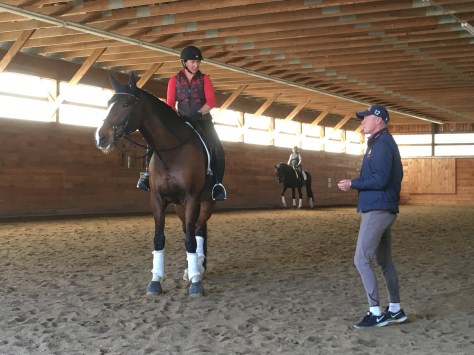
Ebeling “debriefs” with clinic rider Kara Riley-King, who rode Zamiro.

Ebeling told the audience that he always starts his training sessions the same way, with a progressive warm up.  “I start by establishing a steady tempo and use larger circles and changes on the diagonals,” said Ebeling.  “Nothing too tight.”

Ebeling reminded riders that all horses have an easier side, which is usually tracking to the left.  This is the best direction to start both the warm up phase of a ride as well as to introduce new figures and movements.  He recommends spending three to four minutes on each side, then adding in some work at the canter, before offering the horse a short break.

IMG_0679
Emily Staley on Gatsby work on their free walk.

“Once the horse has had a warm up, they are ready for a more collected tempo and sitting work,” says Ebeling.  For all horses save the most green, Ebeling believes in the rider working out of the sitting trot post warm up.  For a greener horse, Ebeling says that he might stay in the posting trot a bit longer, especially if the contact and connection become less consistent in the sitting work.

For the greener horses, Ebeling emphasized the critical importance of riding with positive energy, which he says prevents the horse from thinking that a slower tempo is acceptable. At the same time, the rider must be careful to not ask for more tempo than the horse is able to keep balanced.   “Most horses are pretty happy to go forward if you make it their habit,” says Ebeling.  “If you have inconsistency in the frame, add a little bit of tempo, keep riding forward, and keep the hand the same.”

IMG_0699
Jan Ebeling raved about Leslie Ann Guilbault’s young mount, Belfast (owned by a sponsor), saying, “He is a great horse.  A talented horse.  I am looking for weaknesses.  Mostly he needs to be stronger still.”

Establishing consistency in the expectations and performance was a theme which Ebeling returned to frequently.  The free walk is another area in which Ebeling emphasized this idea.  “The free walk should always go to the buckle and the rider must make the habit of always expecting a brisk, energetic walk,” says Ebeling.  “When there is a transition from free walk to medium walk, the steps and frame become shorter but the rhythm and energy stay the same.”

Jan Ebeling April 2017 034.JPG
Anna and I during our set.

The use of transitions between and within gaits was another theme which ran amongst the sessions.  When riders do transitions on green horses, the exercises serve to tune up the horse’s understanding of the aids.  It is important that the rider keep their aids consistent and clear.  One example Ebeling brought forward was the position of the rider’s outside leg in the canter.  “You must be super clear with your leg aid in the transitions, bending your knee and bringing the leg back,” says Ebeling.  “Keep the outer leg back in the canter, not just for the transition, but also to support the gait.  It must stay in place—no exceptions.”

Ebeling used transitions in many ways with riders throughout the day.  Some horses did trot-walk-trot transitions in fairly quick succession, sometimes with only three strides in between each.  With others, he shortened the timing so that the transition became more of an “almost walk” transition, or instead asked the horse to go into a short lengthening.  Ebeling asked one rider to send her horse forward on the short side and then collect them through the shoulder in into an “almost walk” transition, and then ride forward into a ten meter volte.   These frequent transitions challenged the horse’s balance and encouraged them to respond promptly to rider’s aids. For greener horses, Ebeling likes to use a little voice in the transitions.  If the horse makes mistakes, such as coming above the bit or choosing the wrong lead, Ebeling reminded riders to not get into a battle with their horse; instead, just make them do the transition again.
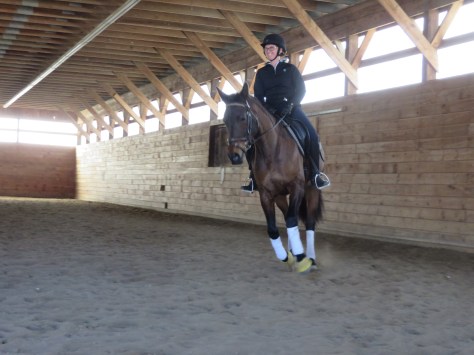
Jan Ebeling April 2017 007.JPG
I must have liked something about this transition with that smile on my face!

Throughout the day, horses and riders both made mistakes.  Ebeling reminded all that this is a necessary part of learning, but emphasized that it is important to not give the horse a break on a poor transition or movement.  Ebeling says that when the horse repeatedly makes the same mistake on a figure, it is up to the rider to figure out how to change the cycle.  This may mean making the exercise easier for the horse, overexaggerating an aid, or appreciating that at the moment, the exercise may require more strength than the horse has developed.  “Even when the mistake is repeated, remind yourself that it is just a phase,” says Ebeling.  “It can be frustrating, but don’t panic.  It is just a matter of practicing.”

Ebeling also spoke of the importance of doing movements and transitions at different places within the arena.   This can also be helpful when a horse starts to anticipate an exercise.   “The same exercise, done at a different place in the arena, isn’t really the same exercise,” says Ebeling.  “The goal is to get the horse to do the things you want so that you are able to praise them…you are always looking for the moment where you can praise them for doing the right thing.”
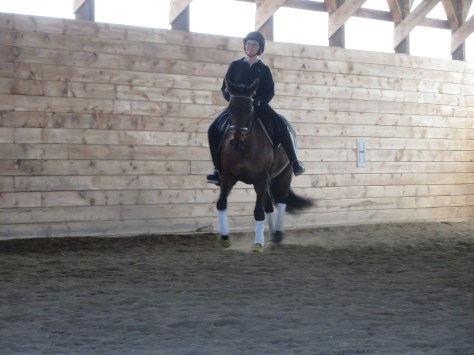
Jan Ebeling April 2017 025.JPG
Practicing.

Being effectively able to apply the aids requires that the rider understand what the correct aids should be, and then to experiment with the intensity of each aid to determine the optimal application.  One rider struggled with her half pass.  Ebeling reminded her that it was important to keep the shoulder fore position as she turned her horse onto the line of the half pass, then to ride sideways through the use of the inner leg and outside rein; he said the half pass is basically two movements in one.  But too much outside leg causes the haunches to lead, and too little will prevent the forward and sideways movement from developing.  The rider must find the balance in the aids for success.

Ebeling reminded riders that keeping their position consistent is one of the quickest and most efficient ways to get the horse to understand the aids.  “You must be very disciplined,” says Ebeling.

Ebeling told several riders (me included!) to be careful with their bending aids.  It is easy to get the horses over bent to the inside, but the aid which needs to be emphasized is the outside rein.  “Bend only a little and then get light,” says Ebeling.  “Backing off on the rein aids doesn’t mean dropping them, it is like a softening.  When you think to give, it is not necessary to move the arm, just relax the muscles.  Finish every half halt with a release.”

Jan Ebeling April 2017 030.JPG

In my ride with Ebeling on Anna, these themes came forward yet again.  I was a bit nervous going into the ride, as I was dealing with a knee injury which prevented me from effectively closing my right leg aids.  And though she sported a trace clip, Anna definitely felt that this early spring afternoon was warmer than she liked given the amount of winter coat she was still wearing. In spite of these variables, we tried our best to step up to Ebeling’s program.

Here is some video of Anna early in our set with Jan Ebeling.

In our ride, Ebeling worked to help me keep Anna more positively forward (yes, the entire Story of Our Lives).  He reminded me to watch the balance between the inside and the outside rein, particularly when tracking right, and that I need to be more steadfast in the consistency in the outside rein.  One easy tip he offered was to increase the tension of my ring finger on the reins.  Most riders will grip more tightly with their index and middle fingers, but increasing the tension of the ring finger will allow the rein contact and connection to remain steady yet not become restrictive.  Ebeling had me ride Anna virtually straight into each corner, and then ask for only about two to three strides of bend in the corner itself.

A little further along…contact is getting more consistent.

Ebeling also had me ride many trot canter transitions to sharpen her response to the leg aid.  In the upward transition, I had to make sure to not allow my shoulders to tip forward and to remain soft in the rein contact without letting go.  For the downward transition, Ebeling wanted me to use virtually no rein pressure at all but instead use seat and voice aids…then immediately ride steady and forward.

Some transitions.

While I felt that the quality of our connection improved through the set, I was a little disappointed in Anna’s overall lackluster response to the forward aids.  In my opinion, she got a bit hot and tired and would have done better with a few shorter/intense sets rather than longer ones.  I found it really difficult to keep her stepping up into the bridle, and in reviewing the photos and videos after the ride, she looks like she is barely round.  Ebeling as well seemed a little flummoxed by her lackadaisical nature, and suggested that it might be helpful to treat her like an event horse again by taking her out for some gallop sets (not an option till my knee heals, I am afraid!).   He also suggested looking at her feeding regimen to see if there is a way to feed increased energy without increasing her weight.

Serpentine work.

While I was a bit disappointed by the quality of my own performance, overall I really enjoyed watching Ebeling teach the other clinic participants and appreciated the consistency in his message.  I would definitely come audit again, and perhaps ride once I am healed up!

Some nice walk work and then some tired trot!

MikaelaAnnaLinden
I would like to thank my friend Mikaela for coming along with us!  She was the best coffee getter, pony holder, photo taker and all around cheer leader ever!


Improving Balance in the Non Traditional Dressage Horse: a ride with Jen Verharen

I might be the world’s slowest blogger but I suppose better late than never!  This blog is the summary of my notes from a lesson I took with my dear friend Jen Verheran, who visited us here in NH in early March on what turned out to be the most frigid weekend of our entire winter. Jen is an accomplished rider and trainer, as well as the founder and principal at Cadence Coaching, Inc.  Jen is also a fellow Connemara lover, and I was really interested to hear her thoughts on Anna.  We were able to squeeze one ride in together around the sessions she did for the UNH Equestrian Team.

If you follow my blog, you will no doubt recognize that Anna is not known for being the most forward thinking of mounts.  While she is pretty willing to do whatever is asked, she does not naturally possess a high degree of “forward intention”.  I showed her lightly at Second Level last season with decent scores, and she currently schools most of the Third Level movements.  But impulsion is always the variable which seems to be lacking, and coming up with new ways to inspire and motivate her is a real challenge.  I don’t frequently get the opportunity for feedback from ‘eyes on the ground’, either, and I was interested in Jen’s honest opinion in regards to where Anna stood against the expectations for Third Level.

JenV1
It was too cold for anyone to get photos of Anna and I, but here is a bundled up Jen coaching members of the UNH Equestrian team the same weekend!

Jen has a lot of experience with Connemaras and Connemara crosses, having owned several during her career.  While the breed is known for being quite versatile and athletic, they are not typically big movers.  Despite being half Trakehner, Anna seems to primarily display the traits of her Irish ancestors. Most principles of dressage training come from the German school, which favors warmblood type horses; the German training philosophy emphasizes riding the horse actively forward into the hand.  This is an excellent approach, and it works really well on horses which either naturally go forward or who are easily able to be motivated forward.  It does not work so well when you have a horse whose response to nearly any driving aid is…meh.

I will sidebar here to note that Anna has been this way since the get-go.  She isn’t desensitized.  She was never sensitized to begin with.  The very first time I carried a dressage whip with her, she didn’t respond in any way.  Not negative, not positive…just non responsive. You can really wallop her to no effect.  So louder or harder leg or whip aids just do not work.  I have never met a horse like her in that regard.

Jen told me that in working with her Connemaras, she took a lot of inspiration from the techniques of the French school.  This training philosophy favors Baroque and Thoroughbred type horses.  While these two varieties of horse might not seem similar at first, they both are types which seem to develop more correct forward activity when they are ridden first into a steady balance.  Baroque type horses tend to be better at collected movement than they are at moving with ground covering strides, whereas Thoroughbreds can cover ground but tend to be heavily downhill.  Asking either of these types of horse to go more forward, without first establishing better balance, is usually an exercise in frustration for all involved.  Specifically, the rider needs to do exercises which encourage the horse to better use the loin area just behind the saddle until the horse feels that they are moving within their own balance.  Only then can the rider expect greater forward energy.

Jen V 2

Jen introduced me to a series of exercises geared towards loosening Anna’s body, as well as lateral movements specifically to improve the softness of her loin area.  After a basic walk/trot/canter warm up, I returned to an active medium walk and put Anna into a shoulder in, then shortened stride and rode a turn on the forehand.  We then did a variation on this, where I put Anna into renvers (haunches out), and then rode turn on the forehand again from this position.  While it felt a bit ‘backwards’ at first, this exercise helped increase Anna’s suppleness pretty quickly.

From there, we moved onto the trot and began working on a series of transitions between trot and walk on a twenty meter circle.  During the trot strides, the focus was on keeping the trot bouncy; rather than just moving more forward, it was about creating more spring.  Once Anna’s trot started to develop a more consistent degree of spring and energy, I began to go large.  We then rode a sequence of movements, starting with a ten meter circle at the top of the long side, into shoulder fore going straight ahead, then establishing counter flexion and leg yielding in from the rail, finishing in shoulder fore.  This exercise was completed all down one long side, and it was super at keeping Anna focused. The frequent transitions helped to keep the trot lively and the connection clear.

anna-at-verne-2016-050
Anna performing lateral work with Verne Batchelder in December 2016.

Jen suggested that I ride Anna with minimal to no bend, especially in the canter, because of her tendency to bend more in the neck than in the body.  Anna is super compact, and like most horses, her neck is her most flexible area.  But when the neck overbends to the inside, the opposite shoulder pops out.  By riding her in a straighter alignment from poll to tail, it is easier to narrow the space between the inside hind and outside fore.  This further allowed me to adjust the position of her head at the poll.  I noticed the benefit of riding this way most clearly at the canter, which is the gait at which we have had the greatest degree of challenge in terms of keeping steady connection.  As I practiced this over the next few months, I have seen a huge improvement in the quality of the canter in general.  It also was a theme which came up during a clinic I took with Jan Ebeling in April (more on this in a future blog, I promise!).

JenV3
Jen definitely received the “hardy solider” award for coaching through an absolutely FRIGID weekend!

Jen told me that she wanted to throw as many exercises at me as possible so that I would have several new tools to use to improve the quality of Anna’s movement and connection.  I was impressed by how much softer, rounder and steadier Anna became through the course of our ride (did I mention that it was maybe 18 degrees??), and she developed both lipstick and soft eyes and ears.  Without ever doing a single “forward” transition, Anna had become much more willing and supple off the leg, and had developed a much increased ‘hot’ response to the forward aids.

Jen recommended that I continue to play with the exercises which she offered for the next month or so, and if they seemed solid at that point, it would be time to add greater adjustability within the movements and gaits.   The goal of the work is to continue to improve her balance, so that she is able to engage the hind leg better and develop connection with a soft lower back.

JenV4

Jen is such a positive and enthusiastic coach, and she really helped me with some fresh eyes on Anna’s training program.  Of course she lives on the West Coast, as all my favorite teachers seem to be as far from NH as you can get and still be in the US! I asked Jen if she thought that introducing the double bridle would be appropriate, and she encouraged me to go ahead and try it; some horses do simply go better in the double, even with a light curb contact (as it turns out, Anna seems to be one of those horses, too…more on this later as well!).  Finally, she encouraged me to change my mind set about Anna; instead of thinking, “she will go Third level”, Jen told me to start saying to myself and others that Anna is “working at Third Level”.  By thinking of her as a Third Level horse, I will come to each training session with a different attitude and set of expectations, which will more than likely help Anna to continue to step into the role.

AnnaDouble.jpg
Anna after her first ride in her double bridle.  “Ho Hum” she says.  We have since fixed the cheekpiece conundrum seen here….

Jen’s lesson was a perfect bridge between some of the concepts and techniques which we have worked on with Verne Batchelder in the past and those used by Jan Ebeling at our session in April.  It is always nice to see the pieces connect together!

Book Review: Suffering in Silence

Suffering in Silence by Jochen Schleese

c 2012 Trafalgar Square North Pomfret, VT, 187 pages

ISBN 978-1570766534

I first read an excerpt of Jochen Schleese’s book, Suffering in Silence: the Saddle-Fit Link to Physical and Psychological Trauma in Horses, in an old issue of Dressage Today magazine.  The segment provided there included information regarding the natural asymmetry of the horse, detailing how this condition develops, and how this asymmetry impacts saddle fit.  I was struck by the technical precision in the writing and the clear passion which Schleese had for the subject.  I immediately ordered a copy of the book to review in more depth.

SufferinginSilence

Schleese is a Certified Master Saddler and Saddle Ergonomist, and Schleese Saddles are known as being “ergonomically correct” for female riders.  In this book, Schleese goes into a great deal of detailed explanation regarding the how’s and why’s of his theory of saddle fitting.  In particular, he highlights the personal research he has done into the differences between male and female pelvic anatomy, and how this can impact each gender’s relative position in the saddle. What was even more interesting to me, though, were his thoughts on the ideal fit of the saddle to the horse.

Jochen Schleese discusses the importance of saddle fit

I have struggled to find the ideal saddle fit for two of my own horses; one is a distance horse who has completed two 100 mile competitive trail rides, and the other is a Connemara cross who does mostly dressage (each has their own tack).  In the past, I have had certified saddle fitters adding pads, shims and all manner of other manipulations to make saddles fit.  After experiencing years of frustration, I began working with someone new, who identified some basic issues, such as an inappropriate tree width, as being part of my problem.  Still, the process of finding a correctly fitting saddle can make someone feel like the princess and the pea.

Schleese emphasizes that a well fitting saddle for the horse must be a priority, as this variable, more than many others, can influence a horse’s long term soundness.  In this book, he describes the horse’s saddle support area, with detailed discussion of the muscles, ligaments and tendons involved.  Schleese uses clear descriptions as well as outstanding illustrations and diagrams to help the reader to see and understand where the saddle should be placed, the interaction of the saddle, girth and the biomechanics of the horse, and the importance of clearing the equine scapula.  I can’t say enough about the quality of this discussion, and I think it is something which every horseman should read and absorb.  I simply haven’t seen it done better, anywhere.

Drawing-Important-Areas-on-Horse.jpg
Schleese draws areas important for saddle fit consideration on this horse; this image is used both in their text and on Saddlefit 4 Life’s website.  Unable to find an official credit but go to Saddlefit 4 Life for more!

I have since learned that Schleese is somewhat of a controversial figure in the saddle fitting/making community.  There are some who feel that his “saddles for women” theme is just a gimmick to sell saddles; one saddler I spoke with said that if you want to sell saddles in the modern market, they “all better fit women”.  Schleese also is a proponent of rear-facing gullet plates, a design which is counter to the principles espoused by the Society of Master Saddlers, a large certifying organization based in the U.K.  However, there are many other saddlers who consider Schleese’s work to be inspirational; one local saddler says that his work is in fact what inspired her to become a certified saddle fitter.

Lee Saddle Fit 009.JPG
My mare Lee demonstrates how poorly her old saddle really fit her…and she did a 100 mile ride in this!

With all that being said, I don’t consider this book to be a sales pitch, but rather the outcome of one man’s passion for promoting greater awareness of the critical importance of saddle fit for horse and rider.  The text is clear and accessible to any conscientious horseman, the book is incredibly well illustrated through diagram and photograph, and many additional resources are provided where readers can learn more.

I was so inspired by reading this book that I have actually reached out to Schleese’s company, Saddlefit 4 Life, and we will be hosting a seminar with him at the University of New Hampshire Equine Program on September 20, 2017. Visit www.equine.unh.edu fore more information.

5/5 stars

Book Review: Teaching Tips for Horseback Riding Instructors

Teaching Tips for Horseback Riding Instructors by Jo Struby

c 2013 Rose Dog Books Pittsburgh, PA, 94 pages

ISBN 978-1-4809-0034-9

As a professional riding instructor, I always keep my eye out for new resources and reference materials which can help me to improve the quality of my work.  Teaching Tips for Horseback Riding Instructors, by Jo Struby, was reviewed in a recent issue of Eventing USA, the publication of the US Eventing Association, and it caught my eye.  Ms. Struby used to teach at Wetherbee Farm in Boxborough, MA, and while I am sure she doesn’t remember it we had several conversations while I was in high school.  Struby is a former vice president of the former US Combined Training Association and also holds an M.A. in Education, which both have clearly influenced her perspective as an instructor.

StrubyTips

This book is not intended to be read from cover to cover, though certainly one could do so.  Instead, Struby envisions readers to use the book as a reference.  She is specifically targeting instructors and teachers of horsemanship, stating in her forward that she hoped her book would fill a gap in the available literature by addressing the art of teaching horsemanship, rather than the specifics of riding and horsemanship itself.   In this book, Struby has compiled over sixty “teaching tips”, which she originally wrote monthly and sold by subscription from 1996-2000.

Struby’s tips are arranged by category, ranging from philosophy of instruction to curriculum and lesson organization to teaching tools and techniques to student needs and desires.  Instructors looking for insight or inspiration in a specific category can easily utilize the table of contents and locate short, succinct blocks of reference material on a given subject.  Struby is clear that she is not intending to create a text book, and the format of the book feels very much like a collection of shorter articles than one longer, cohesive reference book.  I believe that she was successful in achieving her aim.

Struby
Jo Struby riding Senova (found on Pinterest)

The content in each of the segments is of decent quality and shows Struby’s background in the field of education.  Her material addresses students’ unique learning styles and motivations, as well as how these can influence their progress as horsemen.  For me, though, the delivery was sometimes tedious to process for several reasons.  There are pervasive grammar and typographical errors throughout the text which impeded comprehension and lend an air of poor quality execution to the book.  It is also completely text—visual learners always benefit from quality graphics and I feel there is no reason to not include them in any book.

I don’t have a sense that this book went into a widespread printing, and I had to contact the publisher directly to get a copy.  For the motivated instructor, I think it is worth taking the effort to pick up a copy to use as a reference in order to better apply educational concepts to riding instruction.  It is too bad that readers must be prepared to wade through some of the editing issues and somewhat low quality of production in order to access what is in reality quality content.

3.5/5 stars

Metabolic Management of your Endurance Athlete

Notes from a lecture presented by Dr. Susan Garlinghouse at the ECTRA Winter Getaway 2017

For horses covering long distances, the management of metabolic health is of the highest priority.  For the competitive distance rider, attention paid to these specific parameters can spell the difference between a completion and a pull (or retirement, for riders used to other disciplines). Distance riding is a sport whose mantra is the phrase, “to finish is to win”.  Most distance riders want to have a fun and successful weekend, which means that they are bringing home a healthy horse; to this end, they are always working to learn how to better care for their mounts.

SGarlinghouse2014.jpg
Dr. Susan Garlinghouse (photo from AERC)

Dr. Susan Garlinghouse presented “Beating the Metabolic Pull” at the Eastern Competitive Trail Ride Association (ECTRA) Winter Getaway in Boxborough, MA in early February, offering attendees instruction and strategies based on the most current of scientific evidence.

Dr. Garlinghouse is an endurance rider and has completed the grueling Tevis Cup no less than three times.  She has ridden her Tennessee Walking Horse John Henry over 2,800 endurance miles.  Garlinghouse referenced John Henry many times during her talks throughout the weekend, as her insights into metabolic management have been influenced by the additional challenge posed by preparing a horse with a dense build for strenuous competition.  She is a well-known authority on many of the unique health and maintenance issues faced by the distance horse.

Garlinghouse emphasized that during a ride there are three primary factors which must be managed to ensure the horse’s wellbeing:  hydration, gut motility and energy balance.  They are listed here in their relative order of importance, and we will explore each one now in a little more detail.

Hydration

Garlinghouse says that 90% of metabolic issues come from hydration loss.  The line between “sufficient hydration” and a horse at risk is incredibly narrow.  Horses sweat at the rate of 1.5-3.75 gallons per hour, and may produce over forty gallons of sweat during a 50 mile ride.  During heavy exercise, horses may lose 5-6% of their body weight, with about 4-5 gallons of net fluid loss.

Dehydration during heavy work can affect equine athletes in all disciplines, and the effects come on quickly, beginning with 2-3% dehydration rates.   Health concerns escalate rapidly from there.  At 6% dehydration, capillary refill time and heart rate are elevated.  At 8%, capillary refill time will be 2-3 seconds (normal is under 1), with dry mucous membranes, dry or mucous covered feces, and decreased urine output.  At 10% dehydration, capillary refill time will be over three seconds, and the horse will have a high, hanging heart rate with weakness and cold extremities; this horse is in serious trouble.  At 12%, the horse is close to death.

dehydration.jpg

The difference between 4 to 8% hydration in a 1000 pound horse is only 4-5 gallons of water.

Some riders believe that the horse will naturally consume water sufficient to replace this lost fluid, but this is a myth.  According to research done on fluid balance in endurance horses conducted at UC Davis, the horse will only replace about 2/3 of fluid loss through voluntary drinking.  For example, if ten gallons of fluid have been lost, the horse will only voluntarily consume 6-7 gallons.  Equally concerning is that this same research showed that over 60% of the horses starting at the 100 mile endurance rides where the studies were being conducted were already dehydrated to some extent, prior to starting the ride.  Another 20% were at the high end of normal.  Just 10% of the starters began the ride at optimal hydration.

Therefore, it becomes incumbent to create situations in which the horse will stay at a higher rate of hydration before and during the ride.

Garlinghouse offered several strategies to help with this.  Even for the non-distance rider, some of these practices could help enhance their performance horse’s well-being, especially before intense work or competition.  First, Garlinghouse recommends feeding lots and lots of hay—horses will drink 1.5-2 gallons of water for every five pounds of hay that they consume. She also reminded the audience that the rate of passage from the mouth to the hind gut is relatively slow. What you feed your horse on Thursday becomes their source of energy on Saturday.

fall-2016-037
Roughage should always be at least 50% of your horse’s ration, and for a distance horse, more is better.

Feeding soluble fibers, like beet pulp or soybean hulls, can also increase the fluid reservoir available to the horse during a ride.  These feed stuffs help to retain fluid and electrolytes which the horse can pull from during exertion.

The manner in which we feed our horses is also important to consider.  Garlinghouse explained that there are fluid shifts in the body associated with the consumption of large (over 4.5 pounds), episodic (fed more than 2-3 hours apart) meals.  When we feed on this schedule, as much as 5-6 gallons of fluid shifts from the plasma and tissues and into the gastrointestinal tract, leading to a 15-24% reduction in plasma volume.  The effect is transient, lasting two to three hours.

If your horse is at rest, this isn’t a big deal.  But if your horse is teetering on the edge of being dehydrated, and then there is this huge fluid shift…well, that is not good.

To prevent this, riders must ensure that their horse has something going into their digestive system more frequently than every two hours.  Garlinghouse emphasized that the quantity doesn’t have to be great—grazing, some carrots or apples, a baggie of soaked beet pulp—will all do just fine.

beetpulp
Soaked beet pulp.  Photo credit:  www.equinenutritionnerd.com

On a related note, Garlinghouse cautioned riders about the common practice of syringing large doses of electrolytes into the horse’s mouth, as this draws fluids from the plasma and into the digestive tract in a similar way to large servings of food.  The effect can be minimized or eliminated by giving electrolytes in small but frequent doses, preferably after the horse has been drinking.  So eight, 2 ounce doses is preferable to two, 8 ounce doses.  Garlinghouse also recommends mixing electrolytes with a buffer like kaolin pectin to help reduce the risk of ulcers.

Another cause of excess dehydration is feeding high amounts of protein.  Garlinghouse recommends feeding distance horses at a 10% protein rate.  Protein fed at higher rates will be used for energy production, but processing protein in this manner results in waste heat, almost 3-6 times as much as what is produced through the processing of fats or carbohydrates.

Garlinghouse’s “Fast Facts” on Hydration:

  • Maximize your horse’s forage intake for 2-3 days before the big ride to increase their reservoir of fluids and electrolytes
  • Provide small, frequent meals throughout the ride rather than a few large ones
  • Minimize the amount of protein in the diet

Gut Motility

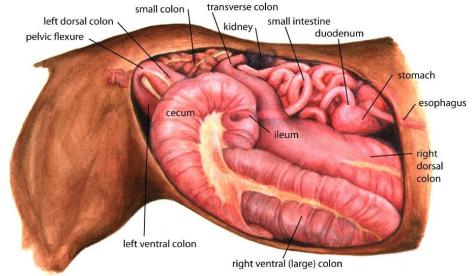
While dehydration is responsible for 90% of metabolic problems, gut motility can be one of the first accurate indicators of stress.  Gut motility slows down when blood supply is reduced, which can happen anytime the horse’s systems are under excessive demand somewhere else.  This is because the gastrointestinal system is the last in line in terms of the “pecking order” amongst the horse’s body systems; vital organs like the brain, heart and lungs come first, followed by the muscles of locomotion, then skin surfaces for heat dissipation…and then the GI tract.  This chain of command stems from the horse’s prey animal status; if you are about to be eaten, it is more important that you can effectively run away than that you can digest your breakfast.

dg-pic-1
Equine digestive system.  Photo credit: http://www.threeoaksequine.com

For the well-being of the horse, it is important to actively monitor and stimulate GI activity during a ride.  Garlinghouse recommends carrying a high quality stethoscope and have a vet teach the rider how to check all four quadrants.  Improving motility can be as simple as keeping small amounts of feed in the stomach, which triggers a hormonal release thereby increasing motility.  Another strategy is to occasionally slow down, which will reduce heat production and therefore the demand on the skin surfaces to release excess heat.   The nature of distance riding can cause a horse’s body to think is constantly being chased.  Slowing down will reverse this effect.

Garlinghouse cautions against feeding pellets or cubes at a ride, both of which require extra fluids to process.  Instead, feed soaked products, including hay.  The better the horse’s overall hydration, the more efficiently he will circulate his blood and therefore improve his gut motility.

Energy Balance

A distant third to hydration and gut motility in terms of managing the horse’s metabolism during a ride is energy balance.  There are many different strategies related to effectively managing a horse’s feed ration leading up to and during a ride.  Garlinghouse helped to dispel some common misconceptions and offered some practical tips to help ensure adequate energy reserves for the endurance horse.

There are two primary sources of energy for exercise:  fats and glucose (from carbohydrates).  Fats are more energy dense, offering 2.25 times the energy of an equivalent amount of carbohydrate, and the body can store fats in much greater quantities.  Glucose is generated from the breakdown of carbs; limited amounts are stored as glycogen in the muscle and liver, but glucose is the limiting substrate in fatigue.  Therefore, the thoughtful rider should be trying to maintain glycogen stores by balancing the diet with fat.

Garlinghouse suggests a ration with 10-12% fat in a commercial grain is acceptable, so long as horses are given time to get used to it.  Fats are calorically dense and help to maintain the horse’s body weight.  They also have a glycogen sparing effect.  Additionally, Garlinghouse recommends supplementing with a glucose source throughout the ride.  Riders should not provide extra fats during a ride, as the horse cannot process fat that quickly.  A horse in good body condition already has all the fat they need for the day’s energy requirements.  Horses should not arrive at the ride so thin that ribs are visible, as they do not have an adequate fat reserve.

proforce-fuel
My distance horse, Lee, has been running on ProForce Fuel for the past three seasons.  It is 12% protein/13% fat.

One of Garlinghouse’s most important messages related to energy balance was that horses should not receive a large grain meal within four hours of their ride.  Feeding grain causes an increase in blood pressure, triggers insulin release and inhibits the utilization of fat.   In the distance athlete, this is particularly troublesome because the horse will experience something similar to a ‘sugar high’; the transient effects of the grain meal will cause the horse to be hyper to start the ride but then they will experience a ‘crash’.  Most grain digestion occurs in the small intestine, and the stresses of the ride will cause some of the grain to spill into the cecum undigested.  The bacteria which live in the cecum are not able to process grain, and this can cause GI stress.

Garlinghouse again emphasized that horses should be fed a meal with a high glycogen index (like a sloppy beet pulp meal) not later than midnight before a ride.  On the ride morning, horses should receive unlimited hay and then small, frequent meals throughout the ride day, which will minimize the insulin response while maintaining gut motility.

Final Thoughts

There is certainly always more to learn when it comes to managing a horse’s well being during a long distance ride.   Garlinghouse gave attendees plenty to think about and apply to their own horse’s feeding and management strategies as we move into the 2017 season.


Book Review:  Schooling and Riding the Sport Horse

Schooling and Riding the Sport Horse by Paul D. Cronin

C 2004 University of Virginia Press, Charlottesville 274 pages

ISBN 0-8139-2287-9

Schooling and Riding the Sport Horse was originally given to me to review for possible use as a text in a course I teach at the University of New Hampshire.  I had high hopes for the book, as author Paul Cronin is a well-respected protégé of the late Vladimir Littauer and also the longtime director at Sweet Briar College’s riding program.  The content of the book is geared towards the riding and training of hunter/jumpers and is well organized.  Unfortunately, it is also dry and dense, with dated images, and will simply not be read by the Millennials I am now responsible for educating.  If you tell me that you have a Millennial-aged student who will actually read this book….I frankly don’t believe you.

I started reading Schooling and Riding the Sport Horse back in 2014.  I finished it late in 2016.  I was stubborn and determined to get through it.  It is simply not a page turner.

CroninSportHorse.jpg

As a rider/trainer whose interests tend more towards dressage and eventing, I still find a great deal of helpful inspiration in understanding the training systems used by those who are more oriented towards hunters, equitation and jumpers.  In this book, I do think that Cronin clearly and progressively lays out the elements of his system, which is geared to develop the position, controls and schooling of the horse used in forward seat riding.  But starting as early as the introduction, I started to take issue with what I perceived as his derogatory tone towards the classical dressage system and his belief in the superiority of what he calls the “American hunter seat”.  I think I had a hard time letting go of this perceived slight throughout the rest of the book.

PaulCronin.jpg
Author Paul Cronin in an uncredited photo. 

With that being said, I found much to agree with in the book as well.  I appreciated his emphasis on the importance of correct and progressive work on the flat to prepare horse and rider for over fences performance.  For example, Cronin points out that “it is not accurate to refer to the short gaits with hunters as classical collected gaits. That is a concept that has a special meaning in educated classical dressage riding.  The hunters are not collected and on the bit but are connected and on soft contact” (Cronin, 2004, p. 33). This sentence is contained in his chapter on “Position and Controls”, in which he details some of the differences in theory and objective between what I would call classical dressage theory and American hunter seat theory.

littauer
Captain Vladimir Littaur was an influential early proponent of forward seat riding.  His book, “Commonsense Horsemanship” was a bible for the discipline for many years. 

Another theme in the book which I appreciated was Cronin’s direct acknowledgement that all horses and riders have their “niche”; not every horse needs to be trained to the highest levels, because not every rider aspires to ride to them.  “Not all horses and riders will be able to achieve the advanced level of control not do they need to in order to experience safe, enjoyable riding” (Cronin, 2004, p. 46).  He further expands this concept in other chapters, including “Evaluating and Selecting a Horse” and “The Philosophy for Schooling in the Modern Hunter/Jumper System”.

The last half or so of the book is the description of a systematic and progressive series of “schooling periods” which takes the horse successively through seven stages of training.  Each phase includes key concepts and exercises to be attained during the schooling period, important concepts to keep in mind and pitfalls to watch for, as well as some sample plans for workouts and training sessions. The most important theme is “systematic progression”.  Each step is to be taken in turn, not sooner, not later. A serious trainer could absolutely use this series to develop a young horse or retrain one who had inconsistencies in previous work.

joe-fargis
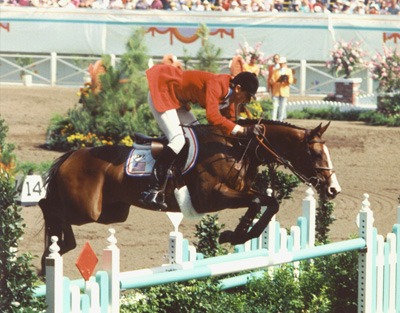
Joe Fargis, here on the elegant and athletic Thoroughbred mare Touch of Class (with whom he won the individual gold at the ’84 Olympics), wrote the forward to Schooling and Riding the Sport Horse.  He is featured in photos throughout, as well as on its cover.  Photo credit: Showjumping Nostalgia

My sentiments towards this book softened as I read through the chapters on the schooling periods.  It is clear to me that Cronin is a classical trainer in the style of American forward seat riding, and believes firmly in consistency, patience and slow, steady, horse-oriented progress.  I was able to draw more connections between his concepts and those common to the training of dressage and eventing horses in these chapters than the others (mind you, this was all in year three of reading the book).

Overall, this book really is a good source of information, even if it is written in an “old school” style which makes it a bit dense.  For a reader who is able to thoughtfully digest any of the classical texts on horsemanship written by the old masters, this book would certainly ring true and fit right into that library.  Unfortunately, for the average modern reader of horsemanship books, I am afraid the terminology used throughout the book is too uncommon, the text too dry, and the photos too dated to make it a useful reference.  I suspect that most ambitious modern riders who purchased this book have left it sitting on their shelves amongst the others which they have never quite made it around to reading.  If you are looking for an easy read on progressive horsemanship—this isn’t your book.  If you want to delve into a systematic progression for the training of hunters and jumpers, and enjoy really taking the time to understand the heritage left by Littauer (who went on to influence so many of the great American horsemen of the 20th century), then this text may be worth the time to plod through.

3/5 stars

** Bloggers note: If you like the featured image at the top, it is sold as a decal here.**


Winter Break Training Projects 2017 Edition

In the downtime between our two semesters at the University of New Hampshire, I always try to tune up a few school horses or work with some of our newer herd members to get to know them a little bit better. Increased tack time is always good for the soul (even if the cheeks end up a little chapped from the cold!) and I appreciate the opportunity to work with different horses.  There are so many lessons to be learned.

brr
Sometimes winter is not so much fun. At least getting to ride extra ponies makes up for it.  Sort of.

I think school horses are simply some of the most amazing horses on the planet.  They tolerate all manner of riders and need to decipher their aids.  The riders who sit on them are, by definition, students, which means that those aids may lack refinement, finesse and sophistication.  It is the exceptional school horse that can absorb all of this without ill effect, and it is my opinion that they deserve having one consistent person work with them for a period of time every now and then.  The horse and rider have a chance to connect more deeply, and if the rider is experienced enough, they can help to break through any blocks or defensiveness that the horse may have installed in an effort to absorb some of the confusion in the aids.

During the recent winter break, I worked with three horses which are used in our dressage-only classes: Fiona, Otto and Tino. Despite all being dressage specialists, they each require a different kind of ride to elicit their best performance.  Riding each horse helped to remind me of details which I then applied to my usual dressage ride, Anna.

Fiona

Fiona is a chestnut Thoroughbred type mare who has been with our program for several years at this point.  Of all the many horses I have tried out for the program, Fiona is by far one of my favorites.  She is “my type” of ride; slender, athletic, a little sensitive, and of course, a mare.  I always enjoy reconnecting with her during our breaks.

Fiona2017.jpg
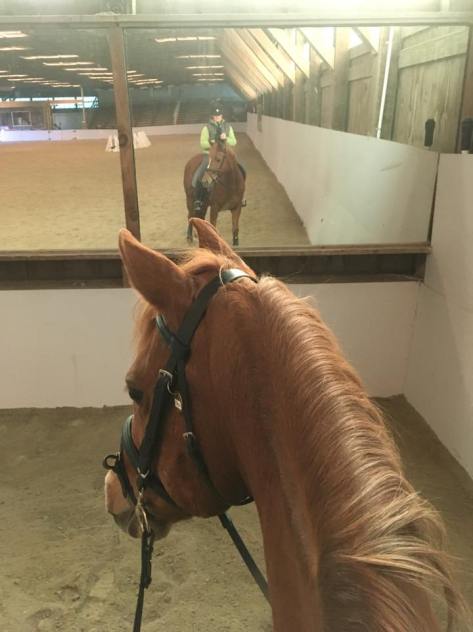
Fiona, through the ears. 

It has been almost one year since I last sat on Fiona, and I was a bit disconcerted at first by how much more defensive she felt this year than last.  By “defensive”, I mean that her initial reaction to any soft contact was to brace and become hollow, and she was also reluctant to actively reach with her hind legs.  It was my sense that Fiona was protecting herself, but the question was, from what?

I started by re-checking her tack, which by and large looked ok.  She was definitely due for a re-shoe, so we had that taken care of.  I then started a program which encouraged Fiona to begin to reach through her entire topline and stretch into the connection. While this idea is a key principle of dressage, it seemed to me as though she had a little bit lost her faith in that concept.

I very rarely warm up a horse at the trot completely off contact (although I always start with a ten minute or so free walk on a loose rein).  But with Fiona, I had to break my own rules.  First, Fiona absolutely needed the walking in phase; if I had a shorter than usual period of time to ride her, this was not an area where I could cut corners.  Once I moved on to the warm up trot, I didn’t shorten my reins at all, instead allowing Fiona to warm up while carrying her topline wherever she felt like she needed to with a completely floppy rein.  I didn’t ask her to align her shoulders and hips or even do more than the most basic of soft bend in the corners.  I kept all of the turns sweeping and wide and changed direction regularly.  After a few minutes like this, I very, very tactfully shortened the reins until I had a delicate, soft, pushing-toward-the-mouth contact, and I stepped Fiona into a canter.

Fiona
Fiona several years ago, with one of our graduates. 

For this horse, at this time, it is the canter which does the best job of loosening her up and encouraging her to let go.  The left lead seems to be more comfortable for her than the right, so I usually started there.  I never forced her to connect but instead encouraged it.  In the canter, Fiona is more willing to reach underneath herself with the hind leg while also allowing the rider to maintain a soft, steady, elastic feeling in the reins.  But the nanosecond that the rider gets greedy and holds too much in the rein or blocks with the seat, Fiona hollows again.  The rider must practice patience.

I went through this slow, gentle warm up with Fiona every single ride.  It honestly would take ten minutes of walking and twenty of trotting and cantering before she started to feel even remotely soft or fluid. If you pushed her harder before then, she would quite literally stop, or kick out at the leg—a sign that the question was ‘too much’.  It would be easy to label her as being resistant (“this horse won’t connect”) but I think it was much more an example of ‘this horse can’t’.  She had been blocking her body to such a degree for so long that every exercise session was only dedicated to unlocking her muscles again.

By the end of a ride, Fiona was loose, supple, forward and through.  She stayed soft in the jaw, chewing the bit and generating the “lipstick” that we like to see in a dressage horse.  Her responsiveness to the aids improved dramatically; Fiona at the end of a ride was like a completely different horse.

Fiona is not as young as she used to be, and she tends to be hard on herself out in turnout, so my sense is that all of these factors, plus her inherent personality, are simply starting to add up in creating this level of “block” in her body.  I think the lessons which I took away from working with Fiona this winter were 1) that the rider can always be more patient 2) sometimes you have to throw your usual “rules” out the window and experiment to figure out what works best—the horse is always right!  And of course, riding Fiona reinforced a rule that we always can be reminded of:  force will get you nowhere.

Otto

Otto is a wonderful little petite Ferrari of a horse, who joined our program late this summer.  He is trained through Third Level, and having seen him go a few times, I just knew that I would enjoy riding him.  As I work towards bringing Anna up to Third Level, I thought it would be helpful to take advantage of the chance to ride a schooled horse through some of those movements again.

Otto is half Arabian, and he has a tremendous “go” button.  I made the mistake on our first ride of carrying a dressage wand; it was so not needed!  The students had told me that he gets heavy in the hand, and I had personally observed him tending to tuck his nose in towards his chest and get stuck in the kind of power trot that is flashy to watch but not much fun to ride.  While still a connection issue, this is at least a different variety than the one I am used to dealing with!

Otto2017.jpg
Otto was never super cooperative about stopping to have his picture taken…he just wants to GO!

Otto came to us wearing a Baucher bit.  Many people mistakenly believe that this bit uses poll pressure in its action, but this is not the case. In fact, if you put your fingers under the crown piece and then have a friend apply pressure on the rein, you will feel that there is no poll action.  A Baucher does raise the bit slightly higher against the corners of the lips and holds it steadier in the horse’s mouth; it seems to appeal most to horses which dislike any kind of fussiness in the connection.  In my experience, though, most horses just lean on it, and that is what I felt in Otto. My colleague helped switch out the Baucher for a basic jointed loose ring, which gives him more to chew on and definitely helped to improve the softness of his jaw.

The biggest key with Otto, and horses like him, is that you have to take a leap of faith and give the rein when you want to take. On the days when I would get on Otto with an agenda, and maybe too much tension in my muscles, I could feel him tend to take a bit more feel on me in return.  This is the start of that inevitable cycle of pull and tug—you pull on me, I tug on you.  I remember my mentor from many years ago, Beth Adams, saying, “It takes two to pull.”  So whenever I felt that weight increasing, I pushed the rein forward towards the corners of Otto’s mouth.  Sure, he sometimes accelerated, and then I would circle or leg yield (or both!) and take advantage of the energy to help Otto become better balanced and engaged through the use of my diagonal aids.

Otto was simply so much fun to play with.  We did a million transitions within and between gaits, worked the half pass in trot and canter, and played with his flying changes.  The entire time, I kept thinking, “give”.  The softer I stayed, the softer Otto stayed, with a more correct neck and improved connection.

This lesson was especially helpful to bring forward onto Anna, who is sort of the opposite in terms of her connection issues—she tends to be above the bit and lacks thrust.  On her, finding the right blend of steadiness in the rein (to encourage her to connect) versus give (to encourage her to stretch) is tricky.  Riding Otto reminded me that I can always offer Anna the opportunity to develop better roundness by my becoming a bit more elastic and giving for a few steps.  When I apply this concept, it is nine times out of ten that Anna softens back.  Funny how that is….

Tino

Tino is by far one of our most elegant and well bred school horses, and we are lucky to have such a lovely animal in our program.  It actually hadn’t been my intention to work with him over the break, but when he is out of work, he becomes a bit sassy for the crew to handle, so back to work he went.

Like Otto, Tino has been shown through Third level, but he has much bigger gaits, and these can make him quite challenging to ride correctly.  The sheer power of his movement can throw the rider far out of the saddle and off balance in the trot, and I think it is because of this that most of his riders hesitate to send him correctly forward.  When this happens, Tino gets stuck in a “passage trot”, which is of course horribly incorrect and not good for his muscling and long term comfort levels.

Tino2017.jpg
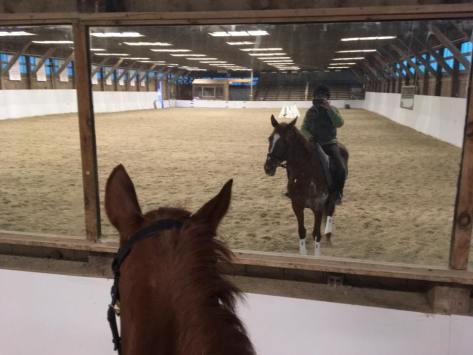
Tino, though the ears.  You might notice a theme of there not being many people around to help with photos!

Tino has had some excellent schooling in his past, and I wanted to make sure that I did right by this horse.  I took some video of him and sent it off to a trusted friend for some feedback.  She supported my initial instinct, which was that Tino needed to come more freely forward and respond to the rider’s leg aid by reaching forward and under, rather than higher and loftier.  As with all my rides, I started each session with Tino with ten minutes of a marching free walk, and then warmed him up in the trot and canter while encouraging him to stretch through his topline and reach forward into a soft contact, all without dropping his shoulder or getting too heavily onto the forehand.

Tino’s canter is pretty gosh darn amazing.  It is rhythmical and cadenced, and I found that using forward and back adjustments in the counter canter during the warm up phase really helped Tino to loosen his topline, making more correct movement in the trot easier afterwards.

Tino Canter Work Jan 21, 2017

Once he was warmed up, I did a lot—and I mean a lot—of lateral work with him, working on getting a more correct and sharper response to the leg aids.  We did shoulder in, travers, renvers and tons of half pass.  As the strength of his topline returned, we added in more work with adjustable gaits, and I encouraged him to lengthen his stride, then come back to a shorter yet still reaching step.  I also played a lot with his changes; they are easy for him, and as my “consultant” said, “I have yet to meet a horse who was hurt because of doing the flying changes.  If they are easy, they are fun for him.”

I am thrilled with the progress Tino made over the break.  He is a powerful, athletic animal, and thankfully he is generally good natured and doesn’t use any of those qualities against us!  That being said, I think he is a really challenging school horse for riders to figure out.  To get the best work from him (as it is with any horse), the rider must ride forward.  And once Tino is really going forward, you have A L O T of horse underneath you.  That is pretty intimidating– but SO much fun.

A little of Tino at the trot (Jan 21, 2017)

Riding Tino reminded me what it is like to experience the talents of an animal who is simply bred to do their job. The “movements” are easy.  What is important to remember, especially with a horse like Tino, is that when the quality of the gaits decline, we have forgotten the purpose of dressage, which is (simply put), “to enhance the natural gaits of the horse”.  There are certainly moments when the horse is learning a new movement during which they may lose quality, but we need to remember that if this becomes the norm, it is time to take a different tack in our training.

On an even more basic level, riding Tino reminded me that I have to stay back with my upper body.  I have always had a tendency to tip forward, left over from my hunter/jumper days, and on most horses I get away with it.  On Tino, if I tipped forward, I immediately felt off balance due to his big movement.  I also had to make sure to keep my eyes up and forward, for the same reason.  With great power comes great responsibility, grasshopper—in this case, the responsibility to maintain one’s own position.

In a New Year, Horse Sports Look Forward

I started 2017 by attending two big meetings, one which celebrated the 50th Anniversary of the Intercollegiate Horse Shows Association (IHSA), and one which heralded the start of a new era for the United States Equestrian Federation (USEF), including a re-branding effort which will have us calling the group US Equestrian.  I was struck by some common themes—and common company—between the two meetings, and it has caused me to ponder the long term future of equestrian sport as we begin this New Year.

IHSA50th.jpg

In general, equestrian sports are considered “elitist” by those outside of the industry and their continued existence in the Olympics Games remains questionable. Even within the business, there appears to be a dramatic divide between what I will call the “grassroots riders” and the “upper echelon” in terms of needs, motivations for being involved with horses and the ability to reach their personal and performance goals.  At the same time there are those who would argue that there is no gap, that the upper echelon depends upon the grassroots, and that the whole community is structured sort of like a pyramid, only as strong as its base.

LeeLeftyBeach
Lee and her friend Lefty at the beach, 2008

I was born with a horse bug.  My earliest memories of wanting to ride come from nursery school.  My parents aren’t “horsey”, and neither were my closest friends growing up.  How often have we heard this kind of story?  That this obsession should come from seemingly nowhere is unexplainable, yet it happens, over and over, these people who have a seemingly insatiable desire, or need, to be connected to horses.  Where that drive takes them is a journey unique to each individual.  Some may stand atop a medal podium.  Some may be fulfilled with a quiet walk down the trail.  Yet wherever we fall on this spectrum, we are all part of the same greater community.

I believe that whether we like it or not, the events which affect the “upper echelons” of equestrian sport affect the rest of us, too, sometimes as a trickle down and sometimes as a mad rushing current.  It is a good thing when we are inspired by a gifted rider’s performance on a talented horse; it is bad when we are left explaining to friends and family why a horse dropped dead at a show, or a big name rider/trainer is suspended for positive drug tests.  But the reverse is true, as well.  If an intrinsically horse loving young person grows up to recognize that there are no longer open spaces to ride, affordable boarding stables, quality instruction and opportunities to reach personal goals,  and they put their horse dreams on a shelf, then we all lose.

MollyandMel
My old horse Mel taught hundreds of children and young adults how to ride.  Here he is with his friend Molly, who enjoyed a special relationship with him. 

The USEF is the umbrella organization which oversees much “sanctioned” equestrian sport in the US.  US Equestrian sets rules, approves licensed officials, offers year end awards programs and more. Yet most people are members only because they compete and membership is required to show.  When they stop competing or take time off, they allow their membership to lapse.  Some of the controversies which have come to the fore front in sanctioned competition, most recently including covert abuse of drug rules, turning a blind eye to questionable training practices, and ever increasing fees, have caused some horse lovers to choose to leave the organization—and competition—behind.  I say horse lovers, because some of these are driven individuals who have put their love for the animal ahead of their love of competition.

us-equestrian
The new US Equestrian logo, similar to the old but without the shield.

For me, this is what it comes down to– love of the horse.  At the end of the day, it doesn’t matter whether someone shows or not, what discipline they ride, or even how often they ride.  What matters is that they love the horse, and they are committed to giving the horse a humane life, a safe life, one free from pain, suffering or misery, and that they love having that experience.  There is a woman at one barn I go to who doesn’t seem to ever ride.  She grooms, longes, and plays games with her horse on the ground.  It wouldn’t be for me, but that doesn’t matter.  SHE is happy, her HORSE is happy, and everyone wins. We are both horse lovers; we are equestrians.

LeeatAwardsCeremony2015DistanceDays
Lee and I after completing the GMHA three day 100 mile competitive trail ride. 

New US Equestrian president Murray Kessler sent a letter to all USEF members (of which I am one), which he basically opens with, “I love horses.”  He has been involved at all levels of equestrian sport, from local shows to watching his daughter ride at an Olympic Games.  People who only know him as the father of Reed might dismiss him as another one of those “upper echelon” people; he has been successful in business and clearly has become financially secure to the point where exceptional horses are now a reality.  Despite this, my sense from the US Equestrian meeting is that Mr. Kessler still remembers what it was like to struggle to find the funds to attend a local show, and that he holds a bigger, broader vision of what US Equestrian could be for our industry.  Instead of a pyramid, I think he sees a circle, where the grassroots supports the top but then the top turns around and gives back to the grassroots.  I think that is something quite exciting.

Mr. Kessler has promised that he will serve as an “advocate for our membership at all levels in all breeds and in all disciplines. Every member of the Federation is important and plays a role in our future.”  He has promised to help the organization take a stronger stance on fairness and safety in equestrian sport, going so far as to state that the “purposeful doping of horses cannot and will not be tolerated”.  He vows to increase access and participation in the world of horse showing.  “Competing in equestrian sports has become so expensive that it is prohibitive,” says Kessler in his letter.  It is beyond time for someone in this level of leadership to formally act on these points, for the good of everyone in the industry, not just the competitors.

Equine Education Day 2015 055
A senior equine studies major at the University of New Hampshire gets Coco (leased to UNH by Camp Runoia and a valued horse in the therapeutic riding program) ready for a presentation at the Equine Education Day, spring of 2015.

Because here’s the thing…on some level, the backyard owners need the horse show people.  Horses are a luxury item.  A robust industry means that resources are being produced and consumed, keeping tack retailers, grain suppliers, hay producers, instructors, trainers, boarding stables, veterinarians and farriers in business.  When the number of people consuming these resources dwindles, they become scarcer as suppliers go out of business.  Then the cost goes up, and all horse owners are forced to make difficult choices.

Kessler commented that his research shows that participation at the smaller USEF shows has declined by 40% over the past ten years, while entries at large scale, more costly events have gone up. In my role as the organizer for the University of New Hampshire Horse Trials, I have noticed a similar trend in eventing.  Our competition draws from a more local/regional audience, and we used to be full with close to 200 entries just a few days after opening; now, we are lucky to run 150 and are forced to accept entries post-close.  I hear other organizers of similar competitions say the same thing.  Our sanctioned summer dressage show used to run four rings with a waiting list; now we can barely fill three.

This slow and steady decline in participation is the result of so many different factors, but it is a concerning trend.  Undersubscribed competitions can’t sustain themselves forever, and sooner rather than later they stop running.  This takes the bridge between schooling competition and more prestigious ones away, leaving a gap in our circle that is hard to overcome.

Nevada and Eastern California 2012 582
Riding Thunder in the White Mountains of California.

US Equestrian states as its new vision, “to bring the joy of horse sports to as many people as possible”.  It has created a new “fan” membership; for just $25, fan members can have access to many of the benefits which the organization offers, including access to the new learning center (which has educational videos featuring well known riders and trainers), access to the USEF network, the youth high school lettering program, and more.  The new website lists “start riding” and “learning center” as the first two tabs in their banner, ahead of “compete” and even “join USEF”.  As part of their new membership recruitment efforts, US Equestrian has given a free fan membership to every member of the IHSA and Intercollegiate Dressage Association, and perhaps some other youth organizations as well (I just happen to know those two for sure).  The website has pictures of young people on horses and recreational riders as well as the usual competition photos.  It is, frankly, refreshing.

At the IHSA’s 50th Anniversary Banquet in early January, I was struck by how many generations of equestrians were in attendance. Everyone in the room was connected through just this one organization, and those present were but a small sliver of the total number who could call themselves a current rider, alumni, coach or former coach of the IHSA.  There are close to 10,000 undergraduate members today; over fifty years, that is an enormous community.

UNHIHSAFall2016.jpg
Many members of the University of New Hampshire IHSA team at their final show of the fall 2016 season.

Each and every equestrian needs to be mindful that we as a collective group are completely connected to one another.  Threats to open space access, to collegiate riding programs, to agriculture as a whole, all affect us.   It is crucial that equestrians seek the synergy amongst our different groups. We must work to cultivate a supportive, not competitive, atmosphere within our ranks. Our tack, goals and preferred riding speed may be diverse, but we should all be united by one thing: our love for the horse.

I challenge each of you, no matter how you define yourself as an equestrian, to work to always remember the love of the horse.  Share your love with others.  Because they are out there—those young people with the intrinsic, insatiable need to be with horses.  They are looking for you, for me, for all of us, to help them to fulfill those dreams.


December Clinic Weekend

Notes on Sessions with Verne Batchelder and Cindy Canace

Annapony and I enjoyed an educational weekend in mid-December, riding twice with Verne Batchelder and once with Cindy Canace, within four days.  I have had the opportunity to work with both of these talented clinicians before, so I was excited to get some new exercises and feedback as we head into the indoor schooling season.

Verne Batchelder and the “Circle of Submission”

My two sessions with Verne came first, and were held at the lovely Fresh Creek facility in Dover, NH, home to Chesley Brook Stables.  Their insulated indoor was a welcome haven from the unseasonably cold temperature and omnipresent wind, and the GGT footing made Anna feel positively springy.

I hadn’t had the chance to connect with Verne for almost a year, and he was super positive about the progress which Anna has made in that time.  She tends to always be more forward thinking at a new venue, which is helpful, but Verne noticed that she was also moving with a greater degree of acceptance and throughness since the last time he had seen her go.  After I had done a little warm up at the basic gaits, we started to work Anna on what Verne calls “the circle of submission”.

Anna at Verne 2016 009.JPG
One of our many “circles of submission”.

The “circle of submission” is a tool which Verne frequently uses to help horses to unlock, to improve connection and to get better acceptance of the outside rein.  Usually, it is done either at the walk or trot, on a smallish (in our case ten meter) circle.  With Anna, I asked for an exaggerated flexion in her neck to the inside, and then asked her to turn her chest towards the middle of the circle, while keeping my outside elbow bent but giving.  I continued to ride her forward and encouraged her to engage the inside hind leg so it reached further over and under.  Once she started to soften her jaw, I increased the straightness by taking more bend into my outside elbow and following with the inside hand.

Anna at Verne 2016 013.JPG

When riding the “circle of submission”, one of the important end goals is being able to swivel the horse’s head at the poll, with a response of willing acceptance from the horse. In Anna’s case, the circle allowed her to connect more consistently to the outside rein.  I rode a 10 meter circle, then rode out of the circle in a lovely uphill shoulder in for several strides down the long side, then straightened her and rode forward in the rising trot.  After moving through this sequence, Anna was better able to carry her weight over the topline and actively push into the consistent connection.

The “circle of submission” can be returned to at any point the rider feels they have lost the requisite degree of connection, and/or the ability to swivel the horse at the poll.

Anna at Verne 2016 026.JPG

We then moved on to some work with haunches in and half pass. After riding a ten meter circle, I rode down the long side in haunches in.  In both the shoulder in and haunches in work, Verne cautioned against developing too much angle.  Because my goal with Anna next season is to show Third Level, Verne also reminded me that the haunches in is a preparation for the half pass. “Don’t work to perfect the haunches in,” he said, as this movement is not required above Second Level.  “Use it to develop your half pass.”

Anna at Verne 2016 028.JPG

We did several sequences of ten meter circle to haunches in on a diagonal line (which is essentially half pass).  I was thrilled to feel Anna fluidly move forward and sideways with a consistent connection and lifted shoulder.  She felt like a “big” horse!

In the canter work, we touched on the flying changes.  On my own, I have been working quite a bit with the counter canter to develop greater strength and straightness.  Anna learned clean changes through her jumping work and tends to throw them in, unasked, during the counter canter.  Verne said that in terms of laying the groundwork for Third Level, it would be appropriate to begin asking for the flying change more frequently. Using the ten meter circle again as preparation, I then rode the short diagonal and asked for a change on the line.  Verne emphasized that the short diagonals were better than long at this point, so that there are fewer strides for the horse to begin to anticipate the change.

Despite the short distance, Anna still anticipated her change, and gave one fairly exuberant effort from right to left, during which she actually kicked the bottom of my left boot!  I think we have some homework to do in terms of “calm acceptance” of this movement.

Anna at Verne 2016 106.JPG
I love that this exact moment is caught on film.

We ended the first day’s session by playing with adjustability within the gaits.  Within the trot or the canter, Anna needed to get bigger or get smaller, but always while keeping her nose in—if I allowed the reins to slip, she would slightly poke her nose forward, causing me to lose a degree of the connection and the ability to swivel the poll.

We covered a lot of ground during this session, and I left feeling thrilled by Anna’s performance.  I had felt a degree of connection, thrust and throughness which I have not experienced with her before. Verne was highly complementary of both the progress since last year and the work during our session, and I very much looked forward to day two.

Anna at Verne 2016 050.JPG

The next morning was one of the coldest so far of the season, which only meant that Anna was even more energetic, despite her hard work the day before.  We started again working with the “circle of submission”.  Verne added to his description from day one that depending on the horse, the rider can think of riding shoulder in on the circle, or ride it more like a moving turn on the forehand, or even a leg yield out of the haunches.  He emphasized, again, that no matter how you approach the “circle of submission”, its purpose is to get the hind end of the horse active and free, to get the inside hind leg under the horse’s body, and to take the horse’s neck out of the cycle of resistance.

From here, we moved onto work with haunches in and half pass in the trot.  Verne cautioned again against creating too much angle in the haunches in, which causes the horse to lose their forward intention.  In the half pass, Verne reminded me to keep a bent elbow on the outside, and to allow Anna’s shoulders to move ahead of the diagonal line first, and then to put the haunches in on the diagonal.

Anna at Verne 2016 031.JPG
Schooling haunches in.

Allowing the shoulders to come out ahead of the line was a new idea for me, and I found that it helped Anna to say more up into the outside rein during the half pass.  By focusing first on the shoulders and then adding the haunches in, the half pass became even more fluid and effortless. We have a lot of work to do to strengthen and improve her reach and carrying power, but we definitely have some new tools to use to develop the movement this winter.

In the canter work, we worked on a twenty meter circle and played with the idea of increasing pressure, then backing off. Because horses naturally tend to carry their haunches to the inside of the circle, we allowed Anna to start this way, while simultaneously increasing the activity in her hind end and increasing the weight in my outside elbow.  I then straightened Anna’s body for a few strides, allowing her to increase the collection, then softened and let the haunches slide back in.  The idea here is to just touch on the increased collection without asking for it for too many strides in a row.

Anna at Verne 2016 124.JPG
I just love this moment in the canter!
Overall, I was so excited and encouraged by the work Anna offered during our time working with Verne.  I came away with new tools to play with this winter, and Anna has shown me how much more she is capable of doing in this work.  On to Third Level we go!

anna-at-verne-2016-042
Thanks to Cayden for coming with us on Day 1 and taking all of these great photos!

Cindy Canace:  “Be a Better Backpack”

After our two days with Verne, Anna had a much needed Sunday off, giving me the opportunity to audit several sessions with USEF “S” judge and USDF Gold Medalist Cindy Canace.  Cindy came up from New Jersey to spend two days working with riders at the University of New Hampshire Equine Program.  Anna and I had worked with Cindy back in June, and we had a session scheduled again for Monday.

Watching Cindy work with our riders allowed me to observe certain themes to her teaching.  She is incredibly detail oriented, and works hard to help riders to both understand important concepts and to feel the horse underneath them.  Cindy expects the rider to keep their hands together and in front of their body, allowing the horse to reach to the bit to seek contact.  She also works to correct posture and alignment issues in the rider which impact the horse.  One of my favorite quotes of the day was that the riders needs to “be a better back pack”, in reference to the fact that our horses must essentially relearn to balance under our weight.  It is incumbent upon us to try to make that burden as easy to bear as possible.

CindyCanaceFall16.jpg
Cindy works with two of my students, riding UNH’s horses Morocco and Ticco.  Photo from the UNH Equine Program Facebook Page

Cindy has judged me on Anna several times in competition, in addition to working with us this summer, so she has a decent idea of her strengths and weaknesses.  In our Monday session, Cindy wanted to work on helping Anna to lift more in her shoulders and truly elevate her poll.  The exercises we did were perhaps not the most interesting for the auditors, but Cindy’s laser beam focus on excellence in the basics helped Anna to show some good progress.

Cindy first had me dramatically slow down Anna’s walk, making each step extremely deliberate, by slowing down my seat while keeping a following, elastic elbow.  She then had me execute a series of walk to halt transitions.  In each downward transition I made sure to keep my leg on, and then I released Anna from the halt by pressing with the seat bones and softening the leg and hand.  Cindy only allowed us to take two walk steps before I asked Anna to halt again.  We remained in the halt, with my leg on, until Anna began to soften in the jaw and raised her shoulders.  Cindy encouraged me to give Anna a gentle tap on the shoulder with my dressage wand to get a better response to my request for elevation or if she was inattentive.

From this work, we moved into a turn on the forehand.  Just as in the earlier exercise, Anna was allowed to take two walk steps and then I asked her to halt, holding it as before.  Cindy was particular that to initiate the turn, I needed to press with the calf muscle, not my spur, and once Anna began moving, I needed to keep the march of my seat in a walking rhythm to follow.  Cindy reminded me that even though we are emphasizing the responsiveness of the horse to the inside leg in this exercise, my outside leg and seat bone are also important and must remain active.  Ideally, in the turn on the forehand, it should take four steps to get the horse facing the opposite direction.

lizandcindy
Cindy worked this summer with my colleague Liz Johnson, here riding Santa Fe ISF.  Liz coordinated Cindy’s whirlwind visit to the frigid north for all of us.  Thank you Liz!

After working on the turn on the forehand, we did a few turns on the haunches, which Anna executed with a more elevated shoulder than before. I also noticed that she had developed a degree of “lipstick”, one of the visual indicators that the horse has begun to soften the jaw.  I hope the auditors saw that Anna had become softer in the jaw as the result of the work we had done to improve responsiveness in the hind end and lift in the shoulder, and not because we had done anything at all to manipulate or pull her into a position.

We then moved on to work in the trot and canter, and Cindy helped me work with the position of my left leg.  Due to now chronic knee pain, I have a great deal of trouble keeping my left leg fully internally rotated, with the knee and toe pointing forward.  Instead, my toe tends to angle out, and I have a difficult time keeping my left spur off Anna’s side without hurting my knee.  After so many months of knee pain, I have really developed some compensatory behaviors with the left leg, especially when I am tracking left and need to use the inside leg to position Anna correctly.  Cindy had me try bringing my left heel down and forward, allowing my left knee to rotate off the saddle slightly.  She then had me rotate my shoulders slightly toward the right in order to engage my outside hip.  This positioning of course felt somewhat unnatural but it did allow me to keep Anna correctly bent without my spur ending up stuck on her side.

Cindy had me do many transitions, especially walk-trot-walk and trot-halt-trot.  In each transition, Anna needed to stay up in the shoulder.  Cindy had me ride a slight step of leg yield out in each transition to help engage the inside hind and keep Anna into the outside rein (a little bit of a similar concept to the “circle of submission” discussed above).

Back to the Laboratory

After our super educational weekend, I have plenty of new material to work with for the next several months in the indoor.  I appreciate having fresh eyes on our progress and to come away with ever increasing clarity as to next steps.  Now we go “back to the lab” to experiment with our new exercises and tools.  Stay tuned for further developments….

Relationship

Over the recent Thanksgiving holiday, I spent some time catching up on a ton of fellow blogger’s posts.  I am now the new owner of an iPad, and with shorter, colder days, curling up on the couch to catch up on other’s thoughts and activities is a welcome pasttime. One blog I follow is called “Green to 100” and it chronicles a newish rider on the quest to complete a 100 mile endurance ride.   As a rookie to the sport of distance riding myself, I find I can often relate to her stories.  But another theme which is present throughout her blogs is that of relationship, specifically with her horse.  She seeks to be a leader that her horse wants to follow, rather than to dictate to her horse about what is going to happen.  Approaching her relationship with her horse in this manner means that certain things take longer.  But it is clear that the reward of arriving where she wants to go, united as a team with her horse, is more important than getting there fast.  Quality is more important than quantity.

Reading a whole series of her blogs in a row gave me the opportunity to reflect on the nature of the horse/human relationship on a number of levels, but especially in regards to the bond I share with each of my own horses.

AnnaUNH2015
Annapony, June 2015

In preparation for the winter season, Annapony has relocated to the university, which has an indoor, so that she can remain in consistent work.  I have big goals for her next season, which will require us to use the winter to train and to build strength and suppleness. She is happy enough there, and well cared for.  But I was really quite reluctant to bring her back, and kept delaying her departure from Cold Moon Farm.  It wasn’t hard for me to realize that I simply wanted her to be at home with me and with my other horses.  I genuinely enjoy being the main caretaker for my horses.  I know them so intimately that it is easy to notice when something is off.  By bringing Anna to another facility and putting her day to day care in someone else’s hands, it feels almost like a wedge is driven into our relationship.  That isn’t entirely true but I still resent the intrusion.

Raptors Settling In 018.JPG
Supervising Anna eating breakfast this spring.

Anna is a calm horse, most of the time. She seems to enjoy human attention (especially if there is food involved) but also likes other horses.  Her rank in the herd is towards the top but her style of leadership seems to be more threat than attack.  Anna is pretty tolerant; nervous horses on trail have run right into her hindquarters and she has never so much as flicked an ear.  That being said, I find the best approach with Anna when tackling a new skill or question is to ask, then wait a moment.  If I am too hasty, and try to force her…she resists, sometimes with great vigor.  If I give her a chance to look and understand, then she usually will comply.

The other night, I took Anna for a hack onto the cross country course right as the sun was setting.  We have already had some snow here in New Hampshire, with some mild melting, leaving the ground a hodge podge of bare spots mixed with snow covered rocks, footprints and other hard to discern anomalies.  The air was cooling off and a fairly steady breeze had picked up.  Overall, conditions were not ideal for a relaxed hack, but I was determined to get out of the ring after several days of solid arena work.  In the woods, the light was dim and features unclear, yet Anna remained mostly calm and confident.  We completed a meandering loop around the course and returned to the main facility along the edge of the reservoir, past the observatory and down a trail which was now nearly completely obscured in the fading light of day.  When there is no artificial light, it is pretty amazing how much you can still see, once your eyes adjust.  A Canada goose broke the stillness with a series of loud honks, but even this didn’t cause Anna to tense or become unsettled.  It was so calming and soothing to be riding in the near darkness, and to have nearly complete trust that my horse would keep me safe.

Fall 2016 023.JPG
A different hack. But those are Anna’s ears. From Fall 2016 at Cold Moon.

While Anna is back at school, Lee and Marquesa have remained behind at Cold Moon Farm, now living side by side instead of sharing a paddock.  Lee is so submissive to Marquesa that it can make feeding complicated, so having them separated makes management much easier.

Marquesa comes to Cold Moon 020
Marquesa and Lee, out together for the first time this May.

I wasn’t entirely sure how the transition was going to go, and overall, it was far less eventful than it was bringing everyone home this spring.

Lee and I have had a long history together—twelve years, to be exact.  I think she likes me as well as she likes any human, but she has never been a cuddly horse; she isn’t going to nicker to you (unless you are carrying her grain), and during her long residence at UNH she was known to intimidate many an inexperienced crew member with her grumpy expressions.  Lee is aloof.  But she is also an absolute bottom dweller on the equine hierarchy, and I think a lot of her behavior is only posturing to try to convince you to just go away and leave her be. Lee isn’t going to come over to you in the field; but she is unlikely to run away from you, either.  If you so much as raise your voice at her, she will recoil in horror.  Lee is insecure.

LeeatWT.jpg
Snack break at the Warren Tessier 20 mile ride, October, 2016.  Photo credit to Robin!

When Lee and I moved to Cold Moon Farm last September, she spent nine months with no other companion save me and the goats which live next door.  During that time, she really impressed me with her steadiness and composure.  This year, Lee overwhelmed me with her grit and attitude on the GMHA three day 100 mile ride.  But if I think back, there are SO many occasions on which Lee has stepped up to a challenge, and most of the time I think our relationship with each other has been one of mutual respect.

leeday32016100
Lee heading home after 90 miles; GMHA Three Day 100 mile CTR, Fall 2016 (photo courtesy of Spectrum Photography)

One of the best examples of this happened two winters ago, during Lee’s last season at UNH.  I had taken to including at least one day of longeing per week into her routine, often incorporating work over cavaletti, just to break things up and give her a new mental challenge.  At the end of a session, I usually hopped on bareback to cool her out.  One night, we were alone in the indoor working on the longe.  Each session followed a similar pattern, and Lee started to head out in the new direction without much prompting from me.  I was struck by an inspiration, and so instead of stopping her, I just unclipped her longe line.  For the next ten minutes or so, I longed Lee at the walk, trot and canter, all without the aid of a longe line.  In the indoor.  She could have gone anywhere in the ring she wanted, but instead she chose to stay with me and follow my direction on a twenty meter circle.  It was pretty amazing.

LeeDressageySalisbury2008
Lee looking dressage-y at the beach in 2008.

Our newest horse, Marquesa, is different from either Anna or Lee.  For eighteen years, she has been a horse which was used in lessons that I and others taught at UNH.  I relied on her to give confidence to new cross country riders, to assist the timid jumpers, and to teach experienced riders that they still had a thing or two to learn about how ride on the flat.  She certainly respected me as the authority figure in the ring, but like many school horses I think she had become somewhat guarded about who she chose to really interact with.

Nikki and Marquesa 026.JPG
Cold Moon Farm Fall 2016 intern Nikki with Marquesa.

Marquesa is a dominant horse. She has a highly developed sense of fairness, meaning if you try to use force to correct her, she just stubbornly refuses to comply.  She can be pushy, and I think being used too many times for “equine facilitated learning sessions” has made her fairly intolerant of humans trying to use their body language to coerce her into doing their will.   However, she appreciates clear direction and boundaries, and when you treat her with kindness and fairness, she is quite sweet.  When she starts to get pushy, if you can lower your energy instead of getting upset, and then explain what you want her to do, she will usually be willing to go along with you.  Now that she is on her own side of the fence line, I find that she is more willing to interact with me directly.  Before, she was mostly concerned with continuing to exert her dominance over Lee.  Her relationship with the other horse was most important; I was just in the way.

Raptors Settling In 011.JPG
Marquesa keeps a close eye on her herd. 

Marquesa is still figuring out her own way in terms of post lesson horse life.  She still has several different riders, but not more than three at a time, and has been doing a mix of ring work and trail riding.  This fall, my friend Linsey took Marquesa out for a ride with me and Lee.  There are several stream crossings out on the trails, which the horses are used to.  After a recent period of heavy rain, though, one of the crossings was unexpectedly quite a bit deeper than usual.  The water came right up to Marquesa’s belly, and drenched her rider’s feet.  Marquesa froze for a moment, perhaps shocked by the sudden depth of water, but then she just kept right on going.  To get home, we had to make the same crossing going the other way, and I wasn’t sure if she would be willing to do it again.  I needn’t have worried.  She plunged right in and stormed across, as if to say, “I got this”.  Not too shabby for a horse who has lived in one place for eighteen years and has mostly worked in the ring. I think perhaps that she is starting to sort out that life here is okay.

Having two horses at home is hard in terms of relationship.  Despite centuries of domestication, horses are hard wired to want to be with other horses.  Solo horses feel vulnerable and show their distress through an array of behaviors.  Since Anna’s departure for the winter, I have continued taking Lee out for solo rides, and going for duo rides whenever someone else is available to ride Marquesa.  I haven’t quite gotten brave enough to pony one off the other just yet.

Fall 2016 035.JPG
Did someone say snacks?

This puts all of our relationships to a real test.  I can tell that Lee feels a little torn about who she should be listening to—me or Marquesa.  Marquesa screams at the top of her lungs when I take Lee away; she actually starts when I am just grooming Lee, something I do in the paddock to minimize the length of the separation.  On the one hand, I want to be able to work with each horse independently.  On the other, I respect the genetics which have kept horses as a species alive for generations.  Horsemen must work with these instincts, not against them. For her part, Lee usually walks out quietly and almost never answers Marquesa’s calls.  But as soon as we turn for home, Lee starts to bounce and jig.  Once Marquesa is in sight, she settles down.  It is like she is trying really hard to be good, but can’t quite pull it off all the time.

leeinwoods
Lee trying really hard to be good while I fumble with my new iPhone for a photo.  December 2016.

Listening to Marquesa scream and dealing with Lee’s jigging can try my patience.  But we are in the winding down time of the season.  Nature in New England prescribes a period of rest or hibernation for most species, a time when aquifers refill, deciduous trees go dormant, and soils take a break from producing.  The equine community similarly slows down, with fewer activities, reduced travel and less intense work outs.  There is nothing to get ready for and nowhere to go.  It is the perfect time to focus on relationship; to reconnect with what makes each horse unique and to enjoy the feeling of mutual respect which can be developed by responding to each horse as an individual.