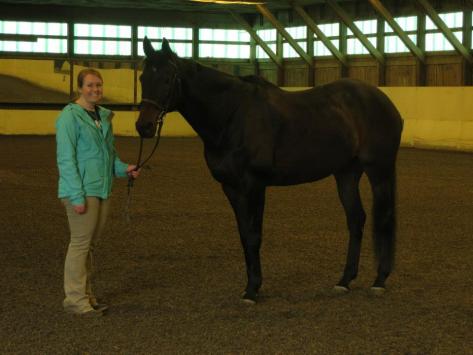
I got on the Dark Mare (better known as Lee) today for our first ride since late December. In the ten years we have been together, this is the first time I have ever let her “rough out” for the winter. With our recent move and lifestyle change, though, allowing her some time for R/R seemed not just prudent but inevitable—what little tolerance I used to have for riding outside in the snow in sub zero temperatures wore off many years ago.
But spring is just around the corner, and ride entries for CTR’s are starting to come available, so I decided the time had come to get Lee back under tack. All things considered, for a sensitive Thoroughbred mare who has had two months off…she was pretty well behaved. I had planned to just walk around our fields for about an hour or so, but at the forty-five minute mark, her entire demeanor changed. She became jiggy and more spooky, and I could tell that she was on the verge of one of her infamous meltdowns. Deciding that discretion was the better part of valor, we headed home.
Lee and I out on the trails at the farm in late fall, 2015.
I was surprised when I untacked to discover that even with just that short bit of walking around, Lee had gotten a little sweaty on her hamstrings and under the saddle area. I think her “unsettled” behavior was just her way of telling me that she was tired and it was time to stop for the day. Knowing this, I will now adjust the plan for our next few weeks, taking shorter walks, with the goal of gradually working back up to one hour.
This experience reminded me of a fellow blogger’s post that I read just the other day. Her theme was that in training animals, it is important to consider the day’s interaction from the animal’s perspective. Specifically, she discusses that if you achieve your intended outcome for the day, but neglect to consider the quality of the interaction with the animal, then overall, your training has failed. Animals which are forced to submit to training, or who are pushed beyond their capabilities or physical endurance, typically do not willingly seek out that interaction again in the future. When considering your day’s work with the animal, the author asks, “Have you left the animal better off than before you interacted with him?”
Lately, I have been reading through some long archived copies of Dressage Today, and in the January 2007 issue, a reader “asked the expert” how they could better deal with resistance from their mount. I thought to myself that I would have no idea how to answer that question without more information, but Becky Langwost-Barlow, a USDF certified trainer, did an admirable job of doing so. Langwost-Barlow provided many excellent general thoughts in regards to resistance, but there were two paragraphs which I thought were just exceptional in regards to how the rider should handle resistance in their horse:
“Every rider makes mistakes. Some are small; some are huge; some last for seconds; some can continue for years. Even misreading how the horse is feeling can be a huge mistake, taking the rider down the path of resistance….I also don’t go for a 150 percent every time I ride. I try to break up the work and look for any sign of discontent. If the horse is cranky in his stall and doesn’t want to come to me, I know he’s not happy, and I need to look for the soreness or back off in the training.”
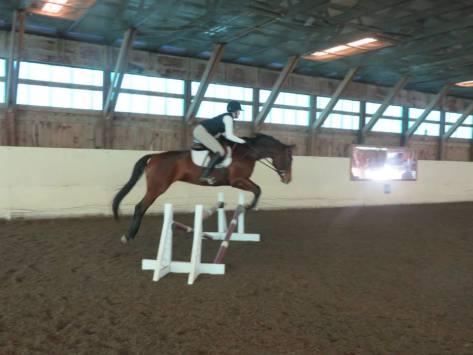
Being a true horseman requires that you be in tune with your horse and how they are feeling on a given day. During the summer I spent with Denny Emerson, he always reminded us that a rider cannot get on with an agenda, or be too earnest, because to do so usually meant that they rode without sensitivity or compassion for the horse which they were sitting on in the moment. While we were working to re-establish Anna’s confidence over fences that summer, there were many days where I would warm up and literally jump ten fences, then go off for a hack. It is far better to do too little in a work session than too much. The horse must always finish feeling like they have been successful.
Anna and I schooling at Tamarack, summer of 2014.
This is not to say that you should ride without goals, or fail to address disobedience or other issues. However, such corrections must be done with mindfulness and compassion. In the November 2006 issue of Dressage Today, author John Winnett offered a historical overview in an article titled “The Foreign Influences on American Dressage”. This article discussed the role which many of the great cavalry officers played in shaping the development of riders in the US. I had never before heard of Jean Saint-Fort Paillard, a retired cavalry officer from Saumer (France) who later relocated to California after competing at the highest levels in show jumping and dressage. Paillard authored Understanding Equitation in 1974 and according to Winnett was known for his patient, humane approach to training. In Paillard’s words:
“Let us try to remember for a moment what the atmosphere in the riding hall or around the show ring would be if the horses yelped whenever they were hurt as dogs do. Wouldn’t certain jumping competitions be punctuated by howls of pain? And wouldn’t certain dressage classes be punctuated by plaintive whimpers? What a nightmare!”
I hope that this statement would give most thinking horsemen cause for pause; we certainly have all been witness to situations in which Paillard’s words might ring true. But in my opinion, a rider who overworks their horse, or who drills, or who doesn’t learn to feel enough to quit the day’s work before the horse is too tired or exhausted to argue, is just as guilty of being inhumane as the one who overuses whips, spurs, bits or various artificial contraptions.
We are only human, and the reality is that sometimes we are going to make mistakes, misread our horse or a situation, or react inappropriately. But the thinking horseman must recognize that they have erred and actively work to avoid doing so in the future.
In the memorable words sung by Kenny Rogers (and written by the much less well known Don Schlitz): “If you’re gonna play the game, boy, you gotta learn to play it right. You’ve got to know when to hold ‘em, know when to fold ‘em, know when to walk away, and know when to run.” In horse training, the thinking horsemen must learn when to push (know when to hold ‘em), when to quit for the day (know when to fold ‘em), when to end on a good note (know when to walk away) and when to abandon a training approach which isn’t working (know when to run).
The Green Guide for Horse Owners and Riders by Heather Cook
c 2009 Storey Publishing (North Adams), 231 pages
ISBN 978-1-60342-147-8
The Green Guide for Horse Owners and Riders is a super easy to read and well organized book which represents the most comprehensive summary of the concepts of “sustainable practice for horse care, stable management, land use and riding” in one place to have crossed my desk. Depending on your previous level of knowledge on the subject of eco-friendly horse management practices, this book might alternately be too basic in some areas or too detailed in others. In either case, though, you are likely to find references to supplemental sources which can direct you to more information.
I have long maintained that the equine industry needs to get on board with more sustainable management strategies. Too many farms are overstocked, with destroyed paddocks/turnouts, unsightly and unsanitary manure piles and out of date protocols. This book helps take the reader through the steps necessary to establish a different paradigm, whether starting a farm from scratch or working with facilities and layouts already in place. Cook does an excellent job of balancing general guidelines with more specific detail. For example, each chapter concludes with guidance to be considered for various climate regions in the US and Canada.
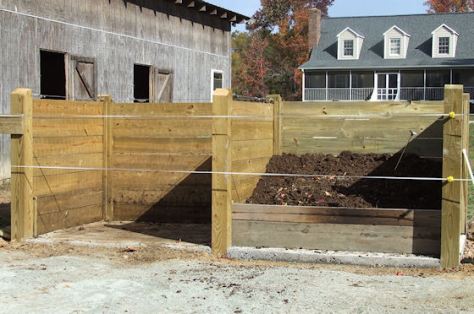
Some of the strategies covered in this book include techniques for “harvesting” water from rainspouts for use as wash water or for irrigation (which, interestingly, is illegal in Colorado); several methods of composting manure; selection of sustainable and healthy building materials; reducing the use of fossil fuels, and reclamation of muddy paddocks. In addition, there is an extensive resource list compiled in an appendix which is clearly divided into sections such as green energy, grant sources, recycling, trail riding resources, helpful government and non-government organizations, etc.
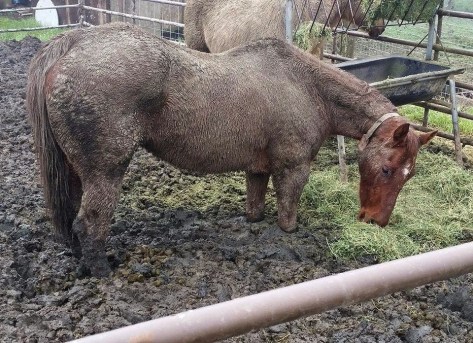
Management strategies which reduce mud will prevent your paddocks from looking like this one.
This book really is a “must read” for anyone who is interested in being a good steward of their land, or in providing guidance to someone else who is in that role. The onus is on all of us as concerned and conscientious citizens to do a better job of implementing management practices which consider the local and regional environment. A healthy farm means healthy horses.
5/5 stars
Blogger’s Note: Cover image is taken from Sustainablestables.com, another great resources for assistance and tips on better horse and farm management strategies.
In late March 2015, an invitation to ride locally in a clinic with dressage master Conrad Schumacher passed through my Facebook feed. At first, I thought it might be a mistake, but sure enough the clinic was being held right down the road at Longfellow Dressage in Nottingham, NH, and there was one space left. Almost before I knew what I was doing, I decided to sign up to ride with him on Annapony.
This forty-five minute session was PRICEY, and I was determined to get my money’s worth by spending the rest of the day auditing the other rides. As my own ride was scheduled for the first session after the lunch break, I was able to have the equivalent of nine extra lessons by watching all of the others.
Schumacher spoke to several themes throughout the day. These included neck control, good basics, correct use of the aids and taking time.
Neck Control
Even before participating in this clinic, I had read that Schumacher is known for his emphasis on ‘neck control’. In fact, I had saved a 2004 article from the June Dressage Today in which he discussed various aspects of this concept, and I reviewed said document in preparation for the clinic. So I was pleased to be able to hear more about this concept during several of the day’s sessions.
During the very first session of the day, Schumacher had the rider work on stretching the horse’s neck in the halt, which he said allows the horse to open up their jaw. He commented that when the horse is not used to doing this, at first they will tend to lift the neck and become hollow. The rider must wait until the horse begins to relax and for the neck to be good before moving forward. If the horse moves away from the bit in the halt (backs up), the rider must be sure to keep their hips square, stay tall and push their heels down, thereby pushing the horse forward onto the bit. In this moment, the rider may also keep the hands a little wide. Never should the horse be punished for backing up.
Schumacher said that it should be a priority for the rider to achieve the correct flexion in the horse’s neck during the first fifteen minutes of the ride, which leaves thirty minutes or so to “do the work which needs to be done”. Even something as seemingly simple as a transition is improved in quality when the horse is good in the neck.
Conrad Schumacher puts a watchful eye on a horse/rider team.
Schumacher frequently used turn on the forehand as a tool to improve connection and engagement, as well as to increase the degree of neck control and obedience. The exercise should never be used as a punishment, but may be used as a correction. He emphasized that it is very important that the rider not over flex the neck when doing a turn on the forehand; when there is too much flexion, the horse can escape the exercise. Schumacher said that the neck can only flex properly when it is held vertically. Flexion, when asked for correctly, should be nearly invisible. The rider uses their inside hand a little bit diagonally towards the horse. When executing a turn on the forehand, the rider’s aids should come and go, and the horse should stretch a little downward.
It is not appropriate for the horse to be working with a short neck unless they are working at a level where the movements (piaffe and passage, for example), require it. While doing basic work, the horse should have a long neck.
Schumacher commented that, “Riding a horse with a proper neck is a bit more complicated but it is what dressage is about. It’s not about the movements. The movements are easy. When you have neck control, everything will be better.”
Basics, Basics, Basics
Another theme of Schumacher’s teaching was the importance of correct, classically applied basics. It doesn’t matter how many times we hear this or read it—it seems like the importance of correct basics needs to be restated, because certainly we all bear witness to trainers and coaches who seem to favor short cuts.
Schumacher reminded riders to always go with the horse to the hand, not the other way around. He said, “Everything in dressage that is difficult comes first. The beginner in dressage has a big amount to learn, to correctly get the horse in the neck and to the bit.”
Anna and I during our session.
Several horses in the clinic were schooling at levels requiring collected gaits. Schumacher emphasized that even at the beginning stages of playing with collection, the horse must stay in the same rhythm. “Do not let the horse slow down,” Schumacher reminded riders. He emphasized that the concept of rhythm on the training pyramid is not just about the beats of the gait; it is also about the tempo. Schumacher said that only by keeping the correct tempo in each gait can the rider work to develop relaxation, which is of course the next rung of the training pyramid. Collection is based on throughness and relaxation.
“We can see collection when we stretch a horse and they don’t run,” said Schumacher. “Collection begins with self carriage.”
With collected work comes the importance of realistic expectations. “You cannot expect too much,” said Schumacher. “You cannot go directly into the highest degree of collection.”
Correct Use of the Aids
Schumacher was particular about the rider’s position and their correct use of the aids, both natural and artificial, and gave tips for specific movements.
Riders need to remember to move the horse using the rider’s entire body, not just the legs and the reins. Schumacher compared it to dancing—when you dance, you dance with your whole body, not just the arms and the legs.
He emphasized that the whip is never to be used as a punishment, but as a tool to improve communication. It can be used to help to maintain the tempo of the gait. Schumacher advised that it is better to not kick with the leg, but instead to tap with the whip if the horse is not forward enough. Overall, the rider should try to do less with their aids.
Riders who are using the double bridle must be taught how to do so correctly. The opposite hand should be used to shorten the snaffle rein when necessary, and care must be taken to not overtighten the curb.
Riders must remember to sit tall in the saddle and allow their arms to hang loosely. Sitting tall should not translate into heaviness with the upper body.
When asking for the halt, the rider must step down and through their leg, bringing their pelvis forward. All of this occurs before any weight is added into the rider’s hands. The halt must come from the body of the rider, not the reins. For the horse to halt, the rider must halt.
In the reinback, the rider should keep their lower leg a little bit back, and their upper body light, so that the horse’s back is free to move.
Schumacher commented that most riders know that their horse should be “on the outside rein”, but lack clarity about what that really means. “People often think, ‘oh, I am holding the outside rein and so the horse is on it,’ but that is not correct,” said Schumacher. “The rider needs to be able to give on the outside rein and the horse must go to it. The rider must not hold on at all.” To this end, when asking for lateral work, the rider’s outside hand must allow the horse to move into it.
Schumacher says that we say we want to get the horse on the outside rein, but we more correctly mean the outside aids—which includes the rider’s leg. In a properly ridden shoulder in, the rider’s inside leg is a little further forward than the outside. The rider’s seat must bend. If the rider attempts a shoulder in without keeping the outside leg back, the horse will not be on the outside rein. And when drawing the outside leg back, it should be moved from the hip, not just the knee.
Contact requires that the rider keep a fist which is shut. The softness we riders seek comes from the arm and shoulder of the rider staying relaxed, which in turn allows the horse to give in their neck and shoulder as well.
Schumacher reminded riders that the biggest reward to the horse is when the rider does nothing. Steadiness in the rider is paramount. “See the big picture,” said Schumacher. “Do not react to every little thing, especially when the horse is basically right.”
Taking Time
Schumacher is incredibly pro-horse and horse friendly. Over and over he emphasized the importance of patience and not pushing the horse. “The only way we help them is to be nice to them,” said Schumacher. “All the other ways do not help them. Don’t punish him, convince him.”
Schumacher believes that horses aren’t naughty so much as they are insecure. The rider must be calm and not use their whip as a punishment; instead, it is a reminder, a cue saying, “hey, come on buddy.”
One rider rode a highly talented, young but sensitive, mare. While challenging her by riding a ten meter circle followed by a transition to walk while approaching the wall, the mare became tense. Schumacher said, “You must be brave and give a little bit. Take the stress away by letting the horse stretch a little.” Incorporating short bits of stretching into the mare’s work, followed by riding forward for a few strides, allowed the development of a more correct neck and longer, more swinging steps.
The rider must remember to reward their horse when the desired result has been achieved. Schumacher reminded riders that it takes time to build a horse’s muscles. Especially when working on developing increased collection, the horse requires frequent breaks.
Horses which have been trained correctly and provided with good care can stay sound and happy for many years, as was testified by a lovely twenty year old Hanoverian who did many movements of the Grand Prix with his rider. Schumacher said that with the increased quality of equine medical care, he sees more and more older horses which still move really well. “When they are sound and they enjoy their work, it is important that they keep moving,” said Schumacher. “It doesn’t help them, though, to not be ridden well.”
Schumacher tied this back to the importance of correct basics. “You do not go out and work the Grand Prix every day,” said Schumacher. “It all depends on the basic work. This works their body, keeps them healthy, and they stay fit.”
Emphasis was placed on the importance of taking time to prepare the horse’s body to do what the rider wants it to do. “The horse may be willing but they must also be physically ready to do the work,” said Schumacher.
In a similar vein, the rider must finish the day’s work once the horse understands what is asked, but before he runs out of muscle strength and the gaits begin to deteriorate.
In working through movements, Schumacher asks for smoothness before expression. “If you start with expression, everything falls apart,” said Schumacher.
My Ride
I have been quite lucky in my career to have had the opportunity to work with many VIPs of the equestrian community. Usually, though, there isn’t much of an audience, and my Inner Critic (I am sure you have one, too) was in full force as the number of days leading to the ride dwindled in number.
As I have gotten older, I have developed a degree of performance anxiety, most typically in relation to jumping. However, I will totally admit that I cannot remember the last time I was so nervous to ride in front of other people as I was when it came to this clinic. After watching the morning sessions, my Inner Critic was in full battle cry: your horse is too “normal”, you aren’t riding at a high enough level, the quality of your connection isn’t good enough, everyone watching is going to judge you…and on it went. However, I retained the presence of mind to be able to remind myself that out of the dozens of spectators, only ten of us were actually riding on this day, and it is always much easier to sit in judgement than to sit in the saddle and be judged.
I took advantage of the lunch break to loosen Anna up before our session started. Riders in the clinic each wore an earpiece so Schumacher’s voice did not need to be projected so strongly; I have never ridden with one before, and one of the other riders helped me to get the technology properly situated. When Schumacher returned to the ring and began to speak, I almost jumped out of the saddle. It was as though I could feel his words in my head!
Schumacher asked me to continue to work for a few more moments, watching, and then asked me to stop. To this point, I had only ridden Anna in a plain cavesson, not because of any strong opposition to flash nosebands but rather because it was what I owned that fit her. That being said, I believe that flash nosebands have a place in the training process, but I don’t necessarily feel that they are the right equipment for every horse.
However, in the German system, the flash noseband is de rigeur, and Schumacher commented that they are necessary in order to create complete neck control. “You must ensure that horse doesn’t use an open mouth to evade the connection, or to figure out how to put the tongue over the bit,” said Schumacher.
Anna models her makeshift flash noseband.
A flash noseband was found in the barn, and it was looped around our cavesson. Consistency in the connection has been a challenge at times with Anna, and I was interested to see what her response to the flash would be. But Schumacher wasn’t done adding equipment. He requested a draw rein—certainly not classical equipment. He called it a “supporting rein”, and ran it around the girth, between the front legs and then up and through the newly added flash noseband on Anna’s hollow side. I held the rein as one would hold the curb rein on a double. The rein only comes into play if the horse raises their head beyond a certain level, much like a martingale would. Schumacher said that the supporting rein helps to create stability in the contact, and therefore is appropriate to use in a classical training system.
Our session focused heavily on neck control and improving the stability in the connection. Schumacher had me ride a series of walk-halt-walk transitions, staying in the halt under the neck got rounder and then immediately stepping forward into the walk as a reward for responding. Once we moved to the trot, we continued to work on transitions but incorporated smaller circles, timing the transition from trot to walk as we angled towards the wall. In the trot, Schumacher had me use a slight yield of the haunches to the outside to increase the roundness, followed by riding straight and forward.
I think that all of the exercises worked well to improve Anna’s consistency in the connection and overall roundness. The addition of the flash noseband was helpful, even though there were a few moments of pony rebellion against its slight restriction. The supporting rein was not particularly helpful, in my opinion. Since riding in this clinic, I have acquired a well fitting flash noseband, which I think has allowed the quality of our connection to increase. I have not used the supporting rein again.
Overall, the ride was positive and I was left with several new ideas and exercises to “take to the lab” and experiment with. It is always helpful to spend time listening to the training philosophy and techniques of individuals who work out of a clear, progressive system. Whether riding or auditing, taking part in these sorts of experiences can only help to broaden our base of knowledge.
Certain events have occurred within the past week and change which have put me into a reflective mood. Most of us don’t like to think about the “hard stuff”—death, separation from loved ones (human or otherwise), accidents, disasters (read my blog on this last here), etc. But whether we choose to acknowledge these things or not, they are a part of life. Ignoring their existence is irresponsible. When it comes to our horses, the consequences of disregarding them can be gut wrenching.
Do you have a plan for what would happen to your horses if something should cause you to be unable to take care of them anymore? I suspect that many horse owners do not, and instead just sort of assume that a friend or family member will step in to make decisions regarding our horse’s care or potential rehoming. But this puts an extreme burden upon loved ones who may or may not be up to the task. How many times have you read a story of the family member who meant well, but didn’t feed/water/shoe the horse? Or the pets brought to the shelter because no one in the family had the wherewithal to take additional animals into their homes?
A fellow blogger shared a somewhat unsettling story about a veterinarian friend of hers who has been saddled with the task of placing twenty four horses after their owner passed away. The owner had suffered a period of failing health but was unwilling to rehome any of her animals, choosing instead to provide for them in her will. Unfortunately, most of her horses are unbroke, older and unregistered—all common reasons for animals to end up in the auction pipeline, sent to an uncertain fate. Clearly, this owner loved her animals and couldn’t bear the thought of parting with them while she was still alive. Unfortunately, making this choice has perhaps precluded the possibility of most of these horses finding appropriate new homes, and has placed a tremendous, heartbreaking burden on her friend.
A friend of mine passed away last week after a long fight with a terminal illness. We hadn’t been in touch for a long time, but shared several years of friendship and I feel lucky that the picture of her in my mind remains of a time when she still was robust and in good health. Her beloved horse, which she bred and trained herself, is safe at the farm which has been his home for eighteen years. He is in good hands there, and care will be taken to find the right placement for him; I suspect he would always be welcomed back, should that be needed. But no one will ever have the intense, empathetic bond with him that she did, and the sentimental part of me grieves for a loss which he likely doesn’t conceptualize.
University programs like the one I work at are frequently the recipients of horses whose usefulness has passed for their owners. Often, these animals are unsaleable due to age, soundness or other variable, or would only fetch a fraction of their original purchase price, so owners looking to move on are often open to the possibility of a donation. I think that many donors are comforted in knowing where their horse is going to end up, and are satisfied to know that it is unlikely that the animal will be passed from place to place, to an uncertain end.
Our lovely mare Morocco, who came to us after her owner passed away unexpectedly.
But the hard reality is that we can’t keep the horses forever, either. At UNH, our informal policy has been that as our horses approach 20, we try to find new homes for them, while they are still sound and happy. Prospective adopters are carefully screened, and it is nice to know that many of our beloved school horses get to enjoy their golden years one on one with an owner who loves them. But sometimes, the factors which caused them to be difficult to rehome in the first place come back to haunt them, and we the human caretakers are faced with tough choices.
During the first week of our spring semester, one of our older school horses sustained an injury in my class. We were longeing, as we always do at the beginning of the term. This horse in particular longes quite well and has been used many times in our longeing classes to teach newbies the ropes. On this particular day, he had longed quite quietly at his end of the arena with a competent and experienced student, while the horse at the other end was being all sorts of sassy and fresh. We got that horse settled and into a more obedient and working attitude, when for no apparent reason, our veteran school horse decided to take one lap on the line leaping and bucking. None of us even saw him take a funky step—but suddenly he stopped short, holding up his left front leg, trembling head to toe.
Ice and his friend Meri at the Equine Educational Day 2015.
I had joked with the students at the start of class that this particular horse was 23 going on 5 in his mind. His “goofy” behavior on the line was just that—a few little hoo-hahs from a horse feeling playful, nothing naughty or dangerous. I guess it was just a little too much on older legs on that day at that time.
In all my years of working with horses, this is the first time something like this has happened to me. I am devastated. I have replayed the entire morning over and over again, tossing and turning through nights with sporadic sleep, wondering if I made an error in judgement. But what I keep coming back to is this—we did nothing differently that day than we have done hundreds of times, each semester, for many years. We all know how fragile and delicate these animals are, for all of their strength, endurance and stoicism. There was no obvious previous indication that anything was brewing or off with this particular animal, and up until the moment where things were not ok, all had been proceeding totally like normal.
This horse is currently on stall rest. So far, he is coping ok, and after the first day or so, does not seem to be in undue amounts of pain. But the preliminary diagnosis is fairly bleak, and at 23, the question becomes whether it is fair to even attempt the rehab such an injury would require. My friends and colleagues have been supportive, reminding me that it is not my fault, that such an injury could have happened at any time. I would say the same thing to them if the roles were reversed; but it was I who was teaching that day, and it is I who am taking this the hardest.
This is one of those times where the rational brain and the emotional heart come into conflict. As our horses’ caregivers, companions and greatest advocates, the onus is on each of us to make the right choices when these crossroads come, keeping the animal’s best interest in mind. It is not right to pass the problem on to someone else to deal with— it is our duty to consider the available resources, the possible outcomes, and make the hard calls. And I doubt that it matters how much we prepare our rational brains to accept this reality; our emotional hearts will always take it hard. It is the price we pay for love.
I probably shouldn’t even be sharing all of these thoughts on here. But these are the subjects which we don’t want to acknowledge or talk about, and maybe that makes it even harder than it already is. Right now, my emotional heart needs the support.
Celebrating the incurable addiction which is being an equestrian





 The Academic Equestrian