Book Review:  The New Basic Training of the Young Horse

The New Basic Training of the Young Horse by Ingrid and Reiner Klimke

c 2006 Trafalgar Square Publishing, North Pomfret, VT 208 pages

ISBN 978-1-57076345-8

Accomplished horseman Ingrid Klimke has updated this classic text of her late father with great success.  It has been years since I read the original, and I took advantage of being laid up while recovering from knee surgery to review the updated edition.
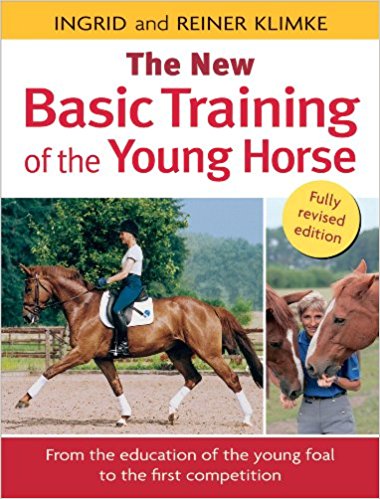
KlimkeYoungHorse

As she did with Reiner Klimke’s Cavaletti for Dressage and Jumping, Ingrid has refreshed the text and in particular the illustrations for the modern reader.  I especially enjoyed images of a 5 year old Windfall, the Trakhener stallion who went on to represent the US at the Olympics in eventing, and several of a young Damon Hill.  Many of the photos included in this updated edition are of Ingrid and her students riding three, four and five year olds; it is clear that the overall quality of animal in her stable is quite high, though, and so it was almost discouraging to see how wonderful these youngsters looked compared to how “normal” ones do, even at an older age.  However, it is important to have a clear picture of what it is you are trying to achieve, and these photos certainly represent this ideal well.

As is Klimke’s hallmark, the book takes readers through a system of progressive education for the youngster starting with being brought into the “yard” right through to their first season of competition.  While Klimke reminds readers that each horse is unique, and training must progress at an individual rate, it also seems clear that her horses progress fairly steadily and consistently.  When an animal is genetically gifted with three good gaits, a willing temperament and a natural aptitude for the work, it is naturally going to be easier to develop them in the sport horse disciplines.  I think it is important for those of us riding more “average” horses to bear in mind that some of the aspects of the process which come smoothly to Klimke on her string may necessarily take longer for the rest of us.

DRF Isabela Age 2 015.JPG
My own DRF Isabela, foaled in 2015.

With that being said, The New Basic Training of the Young Horse still offers readers an in depth review of important concepts related to the training scale and those exercises which help to develop them, as well as entire chapters devoted to the horse’s basic education, longeing (on the line and free), cavaletti work, jumping and cross country skills.  This sequence offers readers a glimpse into the progressive system which Klimke uses to develop her own horses; she emphasizes that youngsters should be trained on the flat, over fences and in the open before choosing to specialize in dressage or show jumping, if they show an aptitude here.

There are a few particular nuggets which I found especially meaningful.  In fact, the text opens with a copy of a letter written to Ingrid by her father, in which he says, “We want to understand the nature of the horse, respect his personality and not suppress it throughout his training.  Then we are on the right way” (Klimke, 2006, p.11).  I think this is a meaningful mantra for all trainers and riders, regardless of their specialty.  I might post it in my barn.

img_0947
At the end of the day, the most important activity in most horse’s schedule is this. 


Klimke reminds us that “the aim of basic training for the young horse is to use a systematic method to create a solid foundation for future specialization in a given discipline…we want the young horse, with the weight of the rider on his back, to stay in balance and outline while retaining his natural movement” (Klimke, 2006, p. 16).

In her section on longeing, Klimke states “Correct longeing is as important as correct riding and requires a lot of experience and intuition” (Klimke, 2006, p. 38).  I personally feel that longeing well is almost a lost art; I see far more incorrect, unsafe and unproductive longeing than the alternative, so I especially appreciated her further comments on this subject in this chapter.   She also reminds us that “the quieter the trainer and assistant(s), the calmer the horse will be” (Klimke, 2006, p. 51).  It can be hard when you get frustrated, but horsemen must learn to cultivate this type of mental calmness in themselves if they hope to achieve it in their horses.  Klimke goes on to elaborate on the importance of longeing in helping to warm up the muscles of a young horse’s topline, as well as taking the edge off, prior to mounted exercises with the rider.

The next several chapters dissect the training scale and the application of its concepts to the basic training of the youngster.  In particular, Klimke reminds trainers that “all exercises and movements should be ridden on the longest possible contact (with poll flexion) to improve the horse’s ability to work through the back” (Klimke, 2006, p. 67) (italics are the author’s).  This is a truly classical response to those riders and trainers who choose to force a young horse to work with an extremely flexed poll and short neck.
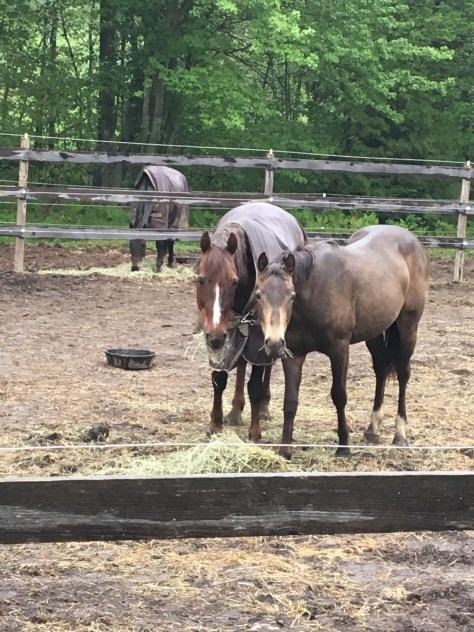
img_0954
Young horses can learn best from an older, experienced partner.

Another quote which I thought was particularly important was in regards to making mistakes as a trainer.  “It is unavoidable that we sometimes push the horse too hard; no trainer is perfect.  However, experienced riders acknowledge that they are solely responsible for their mistakes.  It is important to make the best of each situation” (Klimke, 2006 p. 71-72).  And as with helping children to learn how to behave, “the horse should be rewarded for all exercises done well and ignored for the ones that were not” (Klimke, 2006, p. 72).

 I found the chapters which focused on the basic ridden training to be an excellent, clearly written review of the fundamental concepts related to the training scale.  Klimke details many basic exercises, including the proper use of the aids and the common mistakes made by horse and rider, as well as defines essential concepts, phrases and movements. She emphasizes the importance of cavaletti work in the basic training of a horse, saying that it offers an opportunity to overcome problems in all phases of training.
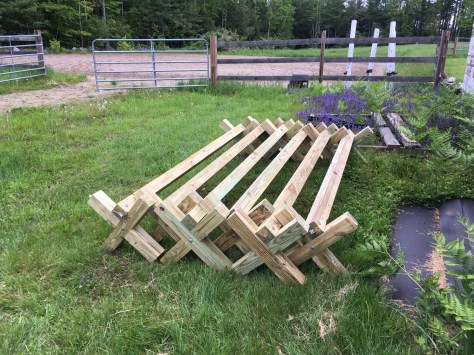
img_0961
New cavaletti all ready to be put to work. 

Klimke introduces the youngster to fences first with free jumping, proceeding to grids and small courses.  I will admit that her progression is more ambitious than what I would be up for, but even spread out over a longer period, it certainly provides a clear framework for the process of training over fences.  She also reminds readers that “jump training in the first year should only be done if the horse is willing” (Klimke, 2006, p. 152).

What I found especially refreshing about this book is Klimke’s emphasis that the basic training should be the same for all horses, regardless of their future discipline.  In general, I believe that this is the most appropriate philosophy.  Regardless of the rider’s discipline of choice,  the horse that has a broader base of training will be more confident, more experienced and will be more likely to suit the needs of a future owner.  I do not believe that specialization of a young horse (or young rider) provides them with the best foundation for future success.

Much like Klimke’s other written work, I think that The New Basic Training of the Young Horse should be required reading for any serious trainer or rider of sport horses.

5/5 stars


Motivation, Apathy, and “Coming About”

Mo*ti*va*tion (noun) the general desire or willingness of someone to do something

Synonyms:  enthusiasm, drive, ambition, initiative, determination, enterprise.

Motivation, or the lack thereof, is something which we all have to deal with from time to time.  When it comes to pursuing my riding goals, fitting riding time into my busy schedule, and/or doing all the various chores related to maintaining my horses and farm, lack of motivation is something which I have only rarely struggled with. In fact, skipping a ride for even valid reasons (pouring buckets of rain, celebrating a holiday) or shirking on a duty (not grooming my retired horse every day) usually causes me to go into a state of self-flagellating guilt.

motivation1

Until this spring.

This spring has been tough on me for reasons wholly unrelated to my horses. The truth is that there is some pretty heavy “life” stuff going on, which I will get through, but the going is pretty deep right now, and I am getting tired of slogging.  Enough about that but suffice it to say that this issue has taken a TON of life energy to manage and it has left me feeling depleted, insecure and not confident.

In addition, for the past five years, I have been dealing with on again/off again knee swelling and pain which has defied a causative diagnosis but which has responded well to draining and steroid injections.  Usually it happened to one knee at a time and then the joint stayed quiet for months to years in between flare ups and treatment.  This January, both of my knees decided to gang up on me.  There was the “bad” one and the “worse” one.  This time around, my doctor decided to schedule an exploratory arthroscopy to try to get some definitive answers.  While all the “pre approvals” and pre-operative appointments were scheduled, the pain in my knees just escalated.  My knees and calves swelled.  Riding went from being non painful to bearable to misery at anything other than the walk.  Before my surgery, doing really normal people things, like putting on pants and socks, was nearly impossible to do without pain.  So you can imagine that giving proper leg aids was also a challenge.  I felt useless and ineffective on a horse.

stallmats
With the help of Intern Kelly, one spring project which got done was the installation of stall mats in the barn aisle.

Being in pain stinks.  Chronic pain becomes like a mantle that you can’t quite put down.  You can numb it, you can suppress it, but it never really goes away.   You don’t sleep as well, you don’t eat well, and you start to weigh your actions in terms of whether the pain they will incur is worth the outcome.  Example:  is it worth climbing the stairs one more time to get a sweater?  Or would I rather just be cold today?

So it would be easy to label this pain as the cause for my loss of motivation.  I tried to keep going, but I found that increasingly I would let excuses slip in to justify not riding.

“It is too cold.”

“It looks like rain and I don’t want to get my tack wet.”

“The footing is too muddy/snowy/icy/dry/uneven.”

“I have no one to ride with and my horse is going to be upset to leave the group.”

Or I might manage to ride, but only stayed on for thirty minutes before being “done”.

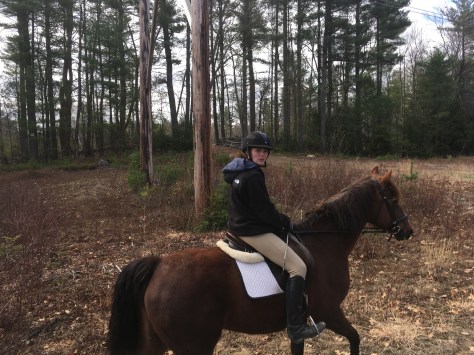
early spring ride
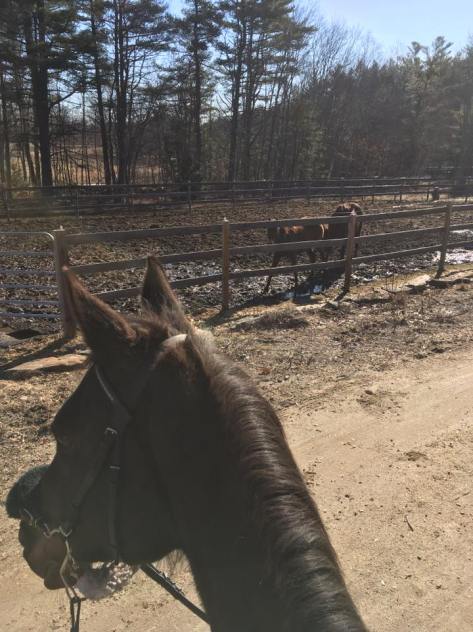
Mid April in southern New Hampshire did not bring inspirational riding weather.

I struggled to set any type of goals for the 2017 season at all.  I blamed it on not knowing what the outcome of the arthroscopy was going to be, and therefore how long I would be out of commission. But in reality, I was feeling overwhelmed by the effort it would take to actually DO any of the things which I could imagine doing.  You know, things like actually hitching the trailer, putting tack in it, and going somewhere with a horse.

I had had some tentative plans to enter a few early season distance rides with Lee.  I even got so far as to put one entry in the mail.  But I scratched just days later, after having a really bad weekend in terms of knee pain.  This was a perfectly acceptable reason for not doing the ride.  But the underlying truth was that I couldn’t stomach the idea of doing all the work to get ready to go to the ride, loading/hitching the trailer, or getting up super early to be there on time.  The ride itself was the least of my worries.

WTF was wrong with me????

izzylayingdown
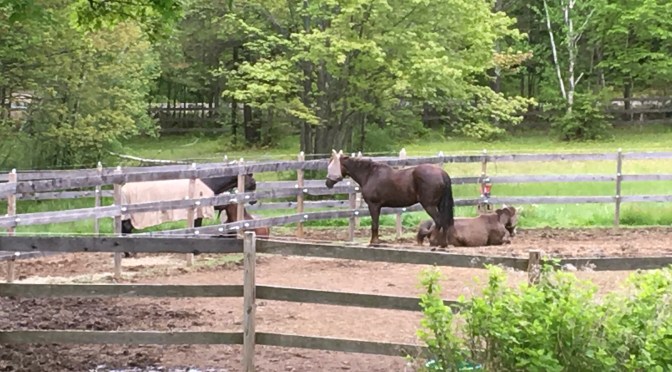
Izzy has the right idea.

Apathy ap*a*thy (noun) Lack of interest, enthusiasm or concern

Synonyms: Indifference, lack of interest, lack of enthusiasm, lack of concern, uninterestedness, lethargy, ennui

My Facebook feed is dominated by horses, dogs and cats, sprinkled here and there with a few posts about children or nature.  On any given Sunday, dozens of people I know have been out and about with horses in tow, attending clinics, dressage and jumper shows, schooling cross country, attending trail rides and more.  They post their pics and rave about how wonderful the day was and how much fun they had.  This spring, I would just look at these posts and think… “huh, that seems like a lot of work.  Good for them.” And I would stare out my kitchen window at my four horses and sip my coffee.

I did the basic chores.  The horses were groomed, fly sprayed, shod, and had their spring vaccines.  I went to get additional hay to carry us through the season and ordered grain.  I sent the trailer for its spring tune up and inspection. I laundered winter blankets and scrubbed and stored winter shoes. I started transitioning the horses to grass turn out.

I rode Lee and Anna four or five days per week.  Lee hacked or longed.  Anna did light dressage schools, hacked, and practiced wearing a double.  Izzy went for walks on the driveway and learned how to stand on the cross ties and wear a fly hat.  Marquesa was groomed and ridden by friends.  It was all done by rote.

img_0731
Intern Kelly was a great riding buddy this spring!

I tried to forgive myself for feeling this way.  I tried to be patient with my body, which seemed determined to make me miserable.  I tried to set super small goals each day (like, today I will do ONE extra thing that needs to get done).  I tried, with all of the morale I had left to muster, to not completely stop moving. I worried that if I did that, I would never get moving again.

Coming About:  A nautical term, used in sailing to indicate that the bow of the boat will start to turn through the wind

Synonyms:  Helm’s Alee

I had my knee surgery on May 23.  After being in so much pain for so long, the surgery wasn’t much worse.  Unfortunately, the procedure hasn’t yielded any definitive answers but the overall cleanup which occurred (along with yet another drain/injection of the other knee) has left me feeling better than I have in months.  I am still not allowed to ride, but I have had some students coming up to keep Lee and Marquesa going.  I might try to put Anna on the longe line later. We’ll see.

While I have been on lay up, I have had plenty of time to think and analyze and assess.  And what I think I have come to is that how I feel is how I feel…and it is okay.  Maybe I don’t have huge performance goals for the season with my horses.  But that doesn’t mean that I can’t enjoy them and keep moving forward.  Sometimes, your body and soul just needs some time to heal.  That is where my life energy is focused right now.

img_0940
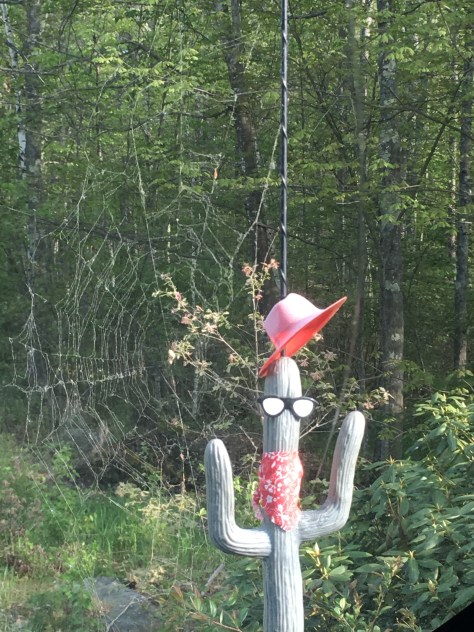
Signs you haven’t been driving your truck much:  the spiders are holding your Antenna Cactus hostage.

I set a few small goals for myself for the period during which I am going to be laid up:  1) re-read The New Basic Training of the Young Horse by Ingrid and Reiner Klimke 2) work on setting up a website for my farm 3) write a few blogs.  I have done some work on all three.

Last Saturday, I worked at the Central New England Region Show Jump Rally as the course designer and a judge.  The weather was pretty much perfect—sunny, slight breeze, temps in the mid to upper 60’s.  The courses rode well and the riders seemed to have fun.  I was surrounded by friends, students, former students and parents. Several of the riders were trying to qualify to compete at the USPC National Championships later this summer and it was exciting to see them ride up to the challenge.  I actually had fun.  I started to remember what that felt like.

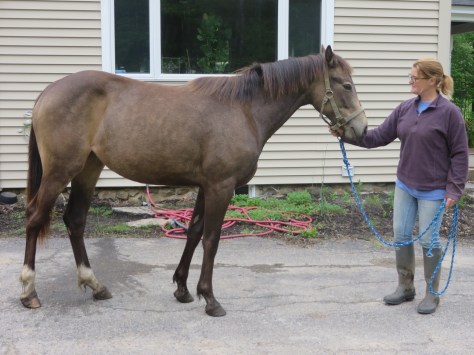
Tues May 30 was Izzy’s birthday.  I took a few conformation photos of her so that we can compare her in one year’s time.    She has been coming into the barn independently for grooming and handling daily.  She makes me smile whenever I enter the paddock with her friendly and inquisitive nature.

DRF Isabela Age 2 001
Getting two year olds to stand still for conformation photos is challenging. DRF Isabela 5/30/17

Slowly, I can feel some of my motivation coming back.  I can guarantee that I won’t be taking the world by storm this year.  But maybe, just maybe, I can get moving in the right direction again.

With Anna, I hope to make it out for some lessons with Verne Batchelder when he is in town, and maybe make it to one dressage show.  With Lee, maybe I can do some further exploration of my local trail network, or ship up to Tamarack Hill to ride with Denny, or to Pawtuckaway State Park to ride with friends.  Maybe we do a competitive ride, maybe we don’t. I can guarantee you that Lee doesn’t care.  I want to introduce Izzy to the trailer, do some basic in hand work, and improve her behavior with the farrier.

This is progress. These are actual tasks I can see myself accomplishing. There is hope.

fitness-motivation-quotes

I am usually a results driven person, and many of my personal goals have revolved around competition.  But as Denny (Emerson) says frequently, at the end of the day, no one cares about how you did at a show except for you, and your mother (and she only cares because she wants you to come back in one piece).  Perhaps the theme for this season will be to learn to enjoy the journey and to find a balance between the process and the result.  I hope that by looking at my goals from a different perspective, I may be able to make progress towards them without starting to feel overwhelmed, apathetic or detached.

In this way, I will try to Come About. As with turning a boat, it won’t happen immediately and I may have to fight the tides.  But so long as I keep pressure on the tiller, I should see this ship turn.