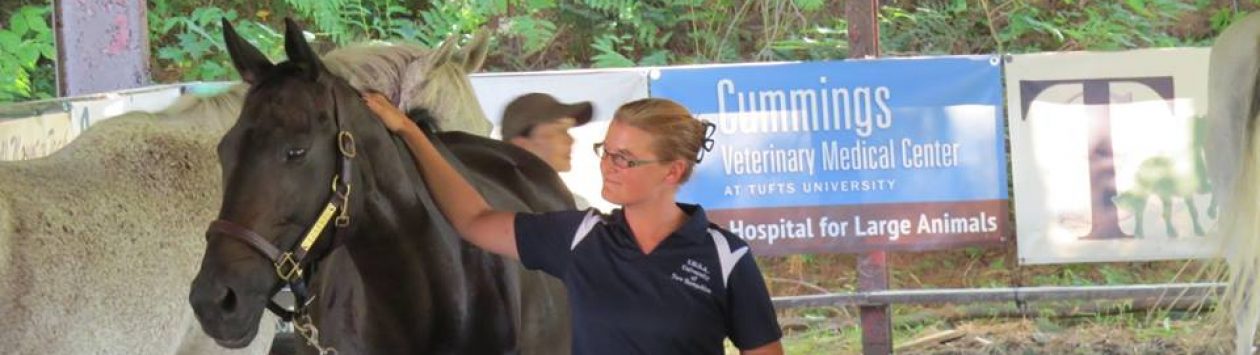
Area I USEA Annual Meeting: Tik Maynard

I had the occasion to attend the US Eventing Association (USEA) Area I Annual Meeting out in Holyoke, MA on January 7, 2018.  I try to make it every year to attend the event organizer’s meeting, and getting to stay to hear the guest lecture each year is an added bonus.  I was quite enthused to learn that Canadian event rider Tik Maynard had been asked to speak at this year’s meeting. Recently, I read a piece Tik wrote for Practical Horseman about the ground work training he had used with his Retired Racehorse Project mount, Remarkable 54.  I found the article well written and thoughtful, and had a sense from it that Tik was an educated, thinking horseman.  In his presentation, which he called, “7 Big Picture Ideas to Get Along Better with your Horse”, he did not disappoint.

My overall impression of Tik as a horseman only improved upon hearing his introduction—the son of a show jumper and a dressage rider, he attended college in his native British Columbia before embarking on a quest for absolutely top of the line horsemanship education by spending nearly two years apprenticing with riders such as Ingrid Klimke, Johann Hinneman, Anne Kursinski and David and Karen O’Connor.  The work was hard and sometimes he didn’t measure up—in fact, he was asked to leave Hinneman’s barn for “not being good enough”.  He worked hard to spend time with some of the best in different disciplines, even though eventing became his main passion.  At the O’Connors, he had his first exposure to natural horsemanship, which completely changed the way in which Tik approached horse training.
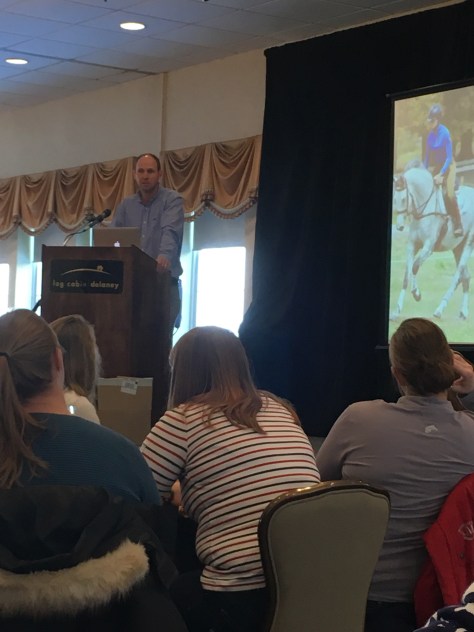
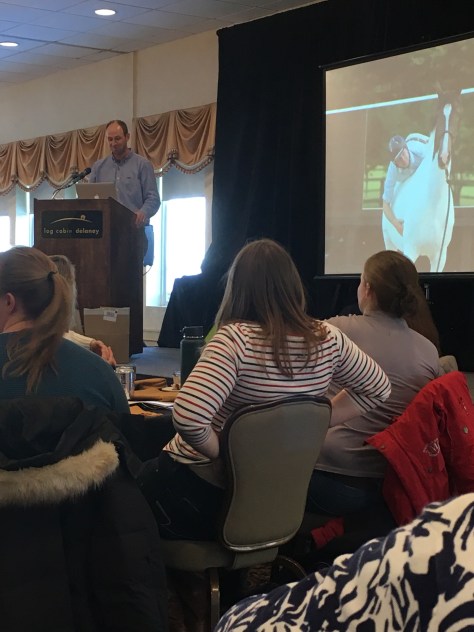
img_2339
Tik Maynard at the Area I Meeting.

This experience inspired him to do a working student position in Texas with a western rider who specializes in training cow horses using natural horsemanship techniques.  I may be getting the exact timeline wrong here, but you get the general idea.  In working at this facility, Tik says that he didn’t learn so much about riding— he learned a lot about horses. He became more interested in the behavioral side of horses—how they think, how they respond, and how they process training.

Through his practical education, Tik developed the perspective that all trainers have a philosophy which is the result of the unique combination of their personal training in technique and theory combined with their own instinct or horse sense.  Each trainer’s philosophy will be unique to them, which he thinks is a good thing.  It is sort of his premise that a student becomes a sum total of their teachers, and every experience has something to teach us, even if what we learn is what doesn’t work well. It is only once a trainer has a solid foundation and philosophy of their own that they can begin to use their imagination to, in Tik’s words, “do something better than it has ever been done before.”
img_2341

Tik’s personal philosophy would seem to prioritize a horse which is engaged in the learning process.  He talks about “The Look”, the moment when the horse looks at the trainer with both eyes and ears focused, seemingly saying, “What are we doing today?” He emphasizes a difference between communication and control in training.  And though he was told that there was no way that he would be able to combine natural horsemanship training with developing competition horses at the highest level, he has not allowed such negativity to dissuade him from his path.

In his presentation for the Area I Meeting, Tik highlighted seven concepts which he has found to be important in working with his horses in training.

  • Taming versus training. Tik argues that there are horses being ridden and shown which are barely tame, never mind trained.  For example, when the horse is showing even a slight fear reaction to certain stimuli, or grossly overacts to a small stimulus, these can both be signs that the horse is not fully ok with what is going on.  “It is like you have this horse simmering with energy just below the surface,” says Tik. “The horse reacts to the sound of a twig snapping, but that is not the cause of the horse’s tension.” Tik gave as an example of one of his horses, Carollina, who needed to be taught to really think forward.


“There are lots of ways to communicate with horses, but they only have two main ways to show how they feel—either more anxiety or more relaxation,” says Tik.  “Too often people learn to compete before they learn how to ride, and before they learn how a horse thinks.”


  • Start with something you can Your goal may be huge (compete at Rolex) but to get there you must learn all the skills which come before. When training, start with the skills that your horse can do well—even if they are quite basic—and build from there.  Tik used the example of teaching a horse to handle a bank.  Start with:  can my horse look at the bank?  Get closer to the bank?  Look across the bank and realize that there is someplace to go?  “You must be patient,” says Tik.  “For example, almost all water problems with horses are the result of someone pushing too hard with the horse’s first experience.”


When working with a horse which has lost confidence, it is important to take a step back and do many small things successfully before revisiting the thing which is hard.  “People often get into trouble because they skip steps,” says Tik. “There is still an attitude out there that you ‘have to win’.  You need to know that what you get into is something you can get out of.  Do not have a battle.  Back up to something you can do, and then repeat it.”

img_1345
Becoming exposed to unfamiliar stimuli should be like a game.


  • Make your session with your horse like a song. When working with a horse, your training session should contain moments at different levels of intensity. The warm up is gradual, and then you may progress to a new skill or lesson which is higher intensity, before the energy gradually comes down towards the end of the session.  “All moments are not created equal,” says Tik.

Horses can only learn when they are relaxed.  Tik says if there is a scale of tension, a horse must be under a level three in order to learn.  “You need to be polite, and do little polite things to help the horse be more invested in you,” says Tik.  “If you touch the neck on one side, touch the horse on the opposite side at the same time.  Approach a crosstied horse with the same care as a hard to catch horse.”

Tik tries to end each training session by dismounting in the area where he rode, facing away from the barn. He then loosens the girth and might remove the bridle, and waits there until the horse lets go and takes a deep breath.

“Rule number one is the person is safe at the end,” says Tik.  “Rule number two is the horse is safe.  Rule number three is that the horse is more relaxed at the end of the ride than at the beginning.”

img_0964
Learning to cross tie is one important basic skill which all horses should be taught.
  • Make your horse’s world neutral.

There are stimuli which will attract your horse (positives) and those which will repel them (negatives). The trainer needs to shift the horse’s energy towards where they want it to go to. As an example, Tik spoke about acclimatizing his OTTB, Remarkable, to the coliseum in preparation for their freestyle performance at the Retired Racehorse Project. The ring was full of banners, which worried the horse.  So Tik led the horse towards the banner, and had an assistant feed Remarkable a small treat from the opposite side of each banner until the horse began to relax.


Trainers need to make themselves be more interesting than anything else going on.  This means that the lesson being taught must be more interesting; trainers must learn when and how to be big with their actions (body, waving a flag) and when to be more subtle.  Which leads really well into Big Picture Idea #5….


  • Stop at the top of the bell curve.

As a horse progresses through their training, they will get better with a new skill and then often start to get worse—this is a sign that they are bored, frustrated or similar.  Tik reminded the audience that “repetition is the mildest form of punishment”, so a better approach is to get to the top of the exercise and then stop, even if the horse gets there quickly.  Continuing to repeat the exercise once the horse has already gotten the point of it for the day will mean that they are likely to end their lesson at an energy level higher than a 3 (see Big Picture Idea # 3).


  • Be a problem solver. Think.

Be creative. Seek help. Think laterally. “The more you do it, the better you get,” says Tik.
“Almost everything we do with horses is about communication or motivation.”

Tik says that the best trainers learn to think like a horse, and they also are aware of how they want the horse to be responding to them.  “Dressage horses think about the rider the whole time, but for jumping horses we maybe only want them focusing on the rider during the turns,” says Tik. “Then they need to focus on the jump.  So the horse needs to learn how to smoothly shift their focus.”

from-solstice-079
Lee says, “There is definitely something OVER THERE.”
  • What are the Olympics of Everything?

Tik joked with the audience, “what if there were an Olympics for cross ties, for leading, for being caught, etc?” His point is that no matter what kind of interaction we have with the horse, we can always work to make it better.  It is upon these smaller steps which big goals are achieved. “Have your end goal in mind but always stay in the present,” says Tik (seems relevant to so much in life, no?).

In listening to Tik’s presentation, as well as his responses to audience questions, I was struck by his calm demeanor.  He seems humble and authentic.  He did announce that he is working on a book with Trafalgar Square, scheduled for release in June 2018—I suspect that this text will be one to add to the library.


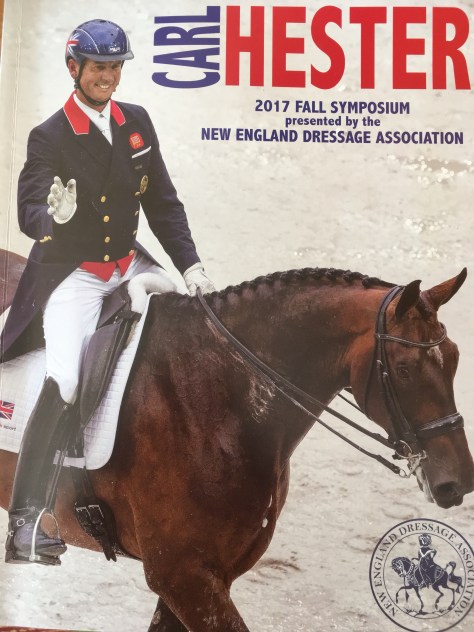
Notes and Observations:  Carl Hester at the NEDA Fall Symposium 2017

The northeast dressage community was electrified by the announcement that British dressage superstar Carl Hester would headline the 2017 New England Dressage Association (NEDA) Fall Symposium, held October 14-15, 2017 at the picturesque Equestrian Center at Pineland Farms in New Gloucester, ME.

PinelandKurLeeNewCar 092
Abby Hardy riding Geoffrey and a previous symposium held at Pineland.

Hester’s influence on the sport of dressage in the UK has been pronounced, and includes leading the team to medals at the World Equestrian Games, Olympics and European Championships.  In fact, at the Rio Olympics in 2016, Hester not only rode (Nip/Tuck) but was the trainer of the other three members of the team:  Charlotte Dujardin and Valegro (who Hester co-owns), Fiona Bigwood and Atterupgaards Orthilia and Spencer Wilton and Super Nova II.

The recent success of the British team is refreshing, as it comes after years of harsh criticism of previous Dutch and German champions, many of whom were proponents of hyperflexion/rollkur.  These horses were criticized for being too tense, incorrect in their movement and otherwise not truly demonstrating the throughness, obedience and correctness necessary at the world class Grand Prix level.  By contrast, Hester is a clear proponent of adherence to classical training methods; he has an eye for a horse, frequently selecting his mounts as youngsters and training them through the levels himself.  His horses, and their riders, fairly dance through their performances.

union-jack-1027898_960_720.jpg

Hester spoke to a sold out house; I was only able to attend on day one, but even just spending just one day auditing was enough to grasp clear themes which emerged through demonstrations which began with a four year old and progressed all the way through to Grand Prix.

Here are my top eight take aways from this symposium.

  • Try to keep horses as naturally as possible.

Hester was originally an event rider, and so maybe this is why he still believes in actually turning horses out.  “If you want to keep your horses sound and happy and easy to ride—leave them out,” said Hester.  He notes that youngsters which are not turned out enough often end up being overworked because they are so high that it takes a long time to establish the necessary suppleness and relaxation.  As horses move up the levels and need more energy for their work, they might need to be kept in more.  But even Hester’s most elite horses enjoy time in turnout daily.

To this point, Hester also believes in regular out of the ring hacking for dressage horses, both for mental health and to develop fitness.  Young horses may only work for 20-30 minutes per session but should be warmed up by moving around outside of the ring.  “Horses must be fit, and if you are just riding them for twenty minutes they will not be fit enough,” said Hester.

img_2122-1
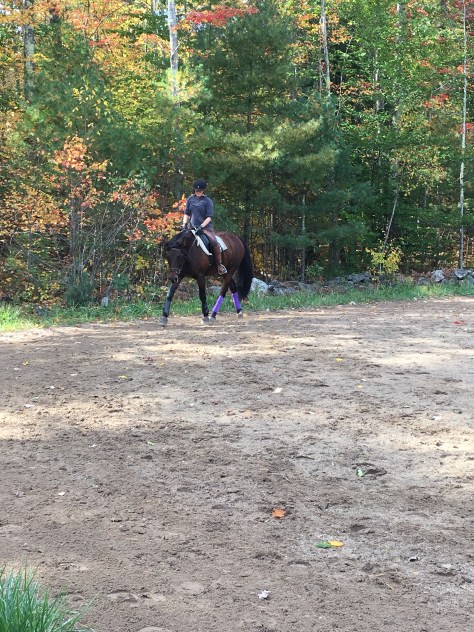
My own youngster, Izzy, clearly believes in the importance of sleeping and resting.  Especially when housekeeping has arrived to clean the paddock.
  •  Temperament, a good walk and a good canter are most important.

“I have been proven wrong many times by a horse with not the best movement but excellent temperament,” said Hester.

It is important for a dressage prospect to have as close to a perfect walk and canter as possible, because these gaits are much harder to improve than the trot.  However, a youngster with an unclear walk may simply need more strength. Horses with huge walks and a big overstep can be hard to collect. Riding zigzags up and down hills can help to improve the walk.

  • Less is more.

“All training goes like this,” said Hester, drawing a line in the air with his finger that resembled a rollercoaster.  Sometimes a horse will hit a phase of their training where they get more difficult, and this is not always a sign that the horse is being stubborn.  “Give them a break—a few weeks off,” said Hester.  “They can be tired or muscle sore.”

Hester repeated this theme in numerous ways during the day.  “Your horse isn’t born reading the dictionary—you must teach them the dictionary,” he said in regards to training youngsters.

“If the horse is not on the bit, do not force them,” said Hester. “The horse needs to work out where to put themselves.”  He reiterated this in several sessions.  “Do NOT be obsessed with the horse being ‘on the bit’,” said Hester.  “They will come onto the bit with correct work.”

During the work itself, horses need breaks when they become fatigued; a break can sometimes be as basic as taking a short diagonal while allowing the horse to lower their neck. “The rider must listen and feel for this request from the horse,” said Hester.

Make sure you finish a training session with work the horse finds easy.  Put the “meat” of your training towards the beginning or middle of your work.

img_1966
Hearing Hester’s words came at a perfect time for me, as work and school demands kept me from having as much time available for serious training.  Instead, I used the fall to focus on stretching, hacking, cavaletti work and strength building with my top horse, Anna.
  • Increase demands GRADUALLY 

Training must be systematic.  Youngsters should start by working on long straight lines and large circles.  They need to learn to turn from the outside aids of the rider, and be encouraged to reach through their topline in a long outline. A four-year-old might work just twenty to thirty minutes, four times per week, stretching in the walk, trot and canter, slowly building to the development of the ability to bend and straighten.  Once this foundation has been set, as a five-year-old the horse should work on smoother transitions, better balance, and increased lateral suppleness, using leg yield.

It takes time for horses to figure out what you want when you teach them something new.  On the first day, introduce the horse to the new skill; on day two review, then give them day three off.  On days four and five, repeat the lessons of days one and two.  Then go hacking on the weekend.

It. Takes. Time.

img_0724

  • TRANSITIONS 

Hester is obsessed with transitions.  He said he does “lots” of transitions per session—hundreds of them.  Big ones.  Small ones.  Between gaits, within gaits.

The trot to canter transition engages the inside hind, while canter to trot teaches the horse to come more forward into the rider’s hand and use their back more.  Canter-walk-canter will work towards getting the horse to truly sit behind and come off of their forehand.  “Listen for the sound of the front feet,” said Hester of this transition.  “You shouldn’t hear them.  These kinds of exercises build the strength to do the next level of collection.”

At the FEI levels, horses must be able to go from the trot or canter directly to the halt.  This starts by teaching a young horse to ride cleanly from trot-walk-halt.  Gradually, make the duration of the walk smaller until it goes away.  “Your piaffe-passage lives in the trot-halt transitions,” said Hester.  Hester recommends using a ground person to verify that each hind leg is squarely under the horse.  “This is how you ensure that each leg aid is activating the hind leg on that side,” said Hester.

For horses which come behind the leg, Hester recommends bringing them back as soon as they start to go forward, rather than waiting for them to slow down.  “You must take the leg off in between asks,” said Hester.  “Telling someone to ride forward when they don’t have the balance will not work.”

If you make it to Grand Prix, the transitions are the hardest part, especially from piaffe to passage and back.  “Good collection makes good extension,” said Hester.  At the lower levels, and for horses without a natural lengthening, asking for bigger strides on the circle can help to improve the gaits.

Jan Ebeling April 2017 038
Anna is a great example of a horse without much natural lengthening to her stride.  I have been trying to add “hundreds” of transitions to her work, ala Hester,  to try to develop more reach in her step.
  • Know your craft. Really, really know it.

Hester emphasized that all riders should understand the fundamentals of biomechanics and conditioning in the horse.  Riders should also choose a horse which suits their personality.

Self-carriage in the horse begins with teaching the horse to carry their own head and neck in the free walk on a long rein.  The rider should use their arms in a rowing fashion, pushing the neck down and forward.  Keeping the reins moving and looking for lightness in the hand is most important.

When tracking right, most horses bring their nose and haunches to the inside.  The rider must use more outside (left) rein to help keep the horse’s nose in front of their chest. When the horse tracks left, the rider can ask for more inside flexion to help stretch the chronically shortened right side. “When the nose and hips are to the right, the middle of the horse is out,” said Hester. “You need to bring the middle of the horse in.”

Hester made reference to an often misattributed quote of his student Dujardin, which goes something like “short reins win medals”.  “Short reins allow you to ride forward to the hand,” said Hester.  “Long reins will cause you to take back.  During the warm up, some horses will be very strong in the hand and some very light.  Do not mistake lightness for contact.”  The use of a driving rein position can be helpful for horses which curl in the neck in response to the rider’s hand.

Hester said that there is no hard and fast rule as to when introduce the double bridle.  “If the horse is not sure at first, I might hack out in it,” said Hester.  “But if the horse doesn’t go well to the snaffle then they won’t go to the bit in the double.  The horse must be in self carriage in the double bridle for it to work.”

Do not rely on your reins to create the shoulder in, rely on your legs.

To ride an accurate half pass, “put your destination in between your horse’s ears.”  Keep the rider’s weight on the inside seat bone.

Flying changes should be cued with a squeeze of the rider’s heel, not by drawing the entire leg back, especially on a dull horse.

Leg yield in canter can help to free up the horse within the gait; half pass in canter increases collection. In both movements, the horse’s shoulders should be leading slightly.

The half-halt is a forward aid.  “The half halt needs to feel like the horse is happy to go forward, not happy to stop,” said Hester.

Hester does not often use dressage whips.  “If you are going to ride with a whip, then the horse should not be best friends with it,” said Hester.  “But they also shouldn’t fear it.  The use of the whip should create a medium trot step instantly.”

“You ride for thirty to sixty minutes—do it right.”

Jan Ebeling April 2017 007

  • Be positive.

Training your horse should be like playing a game.  Make the work playful.  Reward often.  “Every time they give the correct reaction, offer a touch on the neck or a small pat with the inside rein,” said Hester.

The rider’s goal should be to put positive tension into their work, and afterwards stretch the horse and take a break.  “With the stretch, the horse shows relaxation,” said Hester.

To this end, rising trot can be a valuable tool.  “Rising trot is not just for amateurs and young horses,” said Hester.  “It can be helpful whenever you are asking the horse for more.  It can be used in the half pass, extended trot, etc.”

Always, always remember that horses are authentic.  “If the horse is difficult because he is stiff, he doesn’t do it to annoy you,” said Hester.  “He does it because he’s stiff, so you need to give him some time and work through it in a systematic way.”

anna-at-verne-2016-106
Sometimes your horse makes it very clear that they did not appreciate the way in which you asked for the flying change!
  • Dressage is not just about the movements.

Hester said that his older horses may work as much as two-three hours per day to develop the fitness necessary for elite dressage.  “But you are not just schooling the Grand Prix,” said Hester.  “You can’t do that. They must get fit through stretching, hacking and loosening.”

The hardest part of dressage, according to Hester, is attending to the care and health of your horse, and keeping them sound.  “It’s not what you invest in the horse, it is what you invest in training,” said Hester.  “Buy what you can afford; they might be two years old, but you can start here and train them.”

Hester said that it can be hard to stay inspired when working on your own.  “Everyone needs to find someone to work with,” said Hester.

anna-at-verne-2016-042
While I have taken inspiration from many coaches, it is Verne Batchelder’s assistance which has proven to be the most helpful with Anna.  

Final Thoughts

The content of this symposium was refreshing in its emphasis on correct, classical training and the emergence of the clear, horse friendly system that has led to Hester’s success.  There are no tricks or shortcuts, just a clever adherence to finding the joy in each individual horse, using their strengths to develop their weaknesses.  The horses chosen for demonstration were exceptional examples of the quality of work at each level.

img_2335

This won’t be a popular opinion—but for me, what was NOT refreshing about this symposium was all of the hoopla and rigmarole around it. Ex:  Tickets will go on sale at midnight, to NEDA members only.  Doors will open at 7:30 AM (symposium does not begin until 9:15). You will get a nametag to affix to your chair, no saving seats.  Dressage has a reputation for divas, for excessive wealth, for elitism.  This symposium did NOTHING to eliminate that perception; if anything, it enhanced it.  I don’t know how much came from Hester himself (for example, it is his request that no photographs are taken, out of respect for the training process and privacy of the riders) and how much came from NEDA.  Some of the demo horses came from Florida, Ohio and Maryland, for goodness sake. Of the over one hundred rider applicants, we couldn’t find animals from our membership’s base?  Where were the Irish horses, the OTTBs, the “native ponies”?  It is great to see these methods work well with the genetically blessed horses which were selected (again, I don’t know if Hester had final say and this was his design).  But I would suspect that most of the NEDA membership is not riding horses of this caliber, and it would have been inspirational to see even a modest transformation in a “normal” horse during the course of this symposium.  By the end of the day, I had had my fill of the “fussiness” of dressage.

With that being said, I am appreciative of the hard work and organization which went into the planning of this educational event, a process two years in the making.  We are lucky to have access to this caliber of education in the northeast and I am grateful for the hours of effort from the volunteers which put this together.

Hester closed day one with the following summary.  “Dressage is the art of putting a crooked person on a crooked animal and expecting them to be straight and then move to self-carriage,” said Hester.  “Self-carriage is having the horse balanced on all four legs.”