Virtual Horse Shows: Affordable and Fun!

                Horse shows are an essential aspect of the equine industry. According to the 2017 Economic Impact of the US Horse Industry Report, produced by the American Horse Council, over 1.2 million horses are used in competitive events annually and the four largest organizations sanction nearly 6,000 competitive opportunities, supporting 241,000 jobs and adding $11.8 billion in direct value to the national economy. What this report doesn’t capture, though, is the percentage of equestrians that might want to compete, or compete more often, but are limited by any number of factors. What if I told you that, thanks to the wonders of modern technology, most if not ALL of those limitations can be overcome?

JEF Anna Rose competing at a USDF dressage show several years ago.

Skeptical? I wouldn’t have believed me either, until the pandemic forced me to rethink content for a university course I teach, “Principles of Horse Trials Management”. Normally, students in this course play an integral role in the production and administration of our US Eventing Association sanctioned horse trials, held right on campus. But this fall, campus and local restrictions precluded us from being able to welcome outside guests to our facility and the trials were cancelled. I needed a meaningful, hands on, real world activity that would challenge students to learn, grow and experience some of the skills, tasks and problem-solving required in traditional competition management— all while maintaining social distancing and density rules.

The student-managed show jumping committee for a pre-COVID UNH Horse Trials.

Enter (figuratively and literally) the virtual horse show.

Prior to this year, I had heard of virtual shows but never thought much about them. But thanks to COVID, opportunities to compete in virtual horse shows have increased, with many organizations—ours included– making their first forays into the genre.

At first, I didn’t know quite where to start, so I decided to conduct some research. By which I mean, I entered a virtual show.

Dressage Show Online offers both virtual show management for groups/individuals as well as hosts shows of their own. There is no membership fee required to join; just create a profile, add your mount’s info, and then you can start competing. Tests cost just $30 (in total; no add on fees are required, and this includes the shipping for prizes). Once entered, riders film their test—in one take, from start to finish—and then upload it to the site before the deadline. Within a few days, the judge scores and provides comments on the test electronically and uploads a pdf of the score sheet. The judges range from USDF “L” graduates to USEF “S” judges—so this is legitimate scoring and feedback, just like you would expect at a traditional in person show.
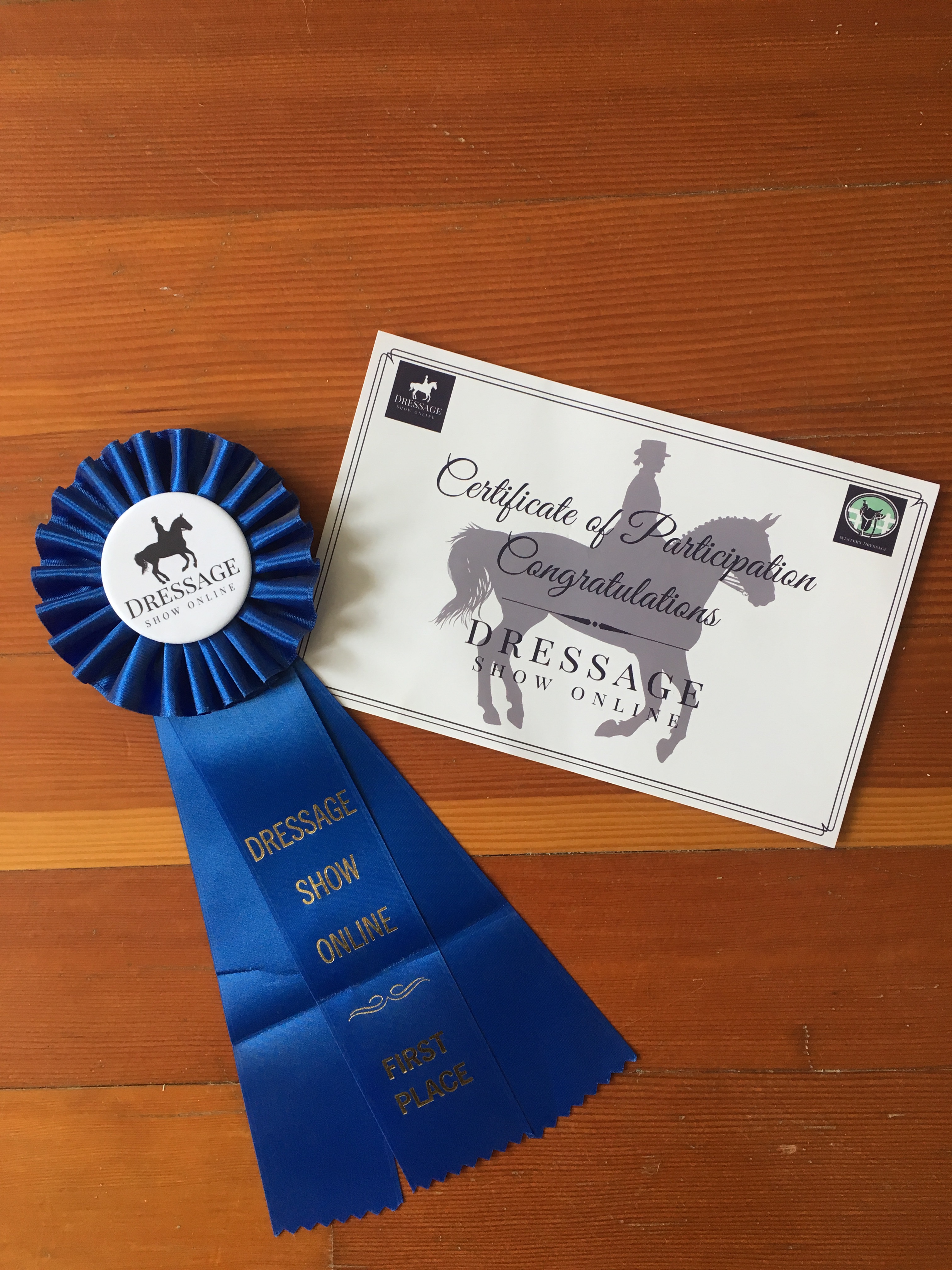
DRF Isabela‘s first official horse show ribbon for Introductory Test C.

The UNH Virtual Dressage Show that my students organized was inspired by this experience, but we put our own ‘Wildcat twist’ on the process. Entries were divided into an open division and a lesson horse division (where “serviceably sound” would be overlooked in the judging and protective boots allowed), and offered a “best turned out” award. And since we lacked a fancy website for competitors to upload to, we asked them to send videos via YouTube links that we compiled into a playlist for our judge.

I had no idea what kind of interest, if any, equestrians would have in entering the UNH Virtual Dressage Show. After purchasing ribbons and hiring USEF “r” judge Leslie deGrandmaison, I calculated that if we came up with 42 entries, we would at least break even.

Swag for the UNH Virtual Show. We also offered high score and reserve for the Lesson Horse Division, as well as for professional/adult amateur/junior rider categories within the Open Division.

Nearly 100 entries later, I learned that not only would people enter, they would do so with enthusiasm. What impressed me most, though, was the wide range of reasons that riders gave for doing so.

Some riders were UNH grads, wanting to compete at their alma mater one more time; others were regular competitors who had chosen not to travel to shows this season. Some belonged to barn or scholastic equestrian teams and had made a day of filming everyone’s videos, offering each other encouragement and support, a fun facsimile of a day at a regular horse show. But I was especially surprised by how many entrants were riders that in general lacked other opportunities to compete: they had no trailer, or their horse didn’t trailer well. Their horse was a lease, not allowed to leave the property. Their horse was older, and going to regular shows was too stressful. Yet they all wanted feedback and the opportunity to dress themselves and their horses up a little bit and show off their skills.

DRF Isabela practicing for her first dressage test. Entering the virtual show also motivated me to finally mount and install a set of arena letters I had been given nearly two years ago!

From an organizational perspective, a virtual show is more work behind the scenes than you might think. Once those videos started rolling in…well, there was a lot of detail-oriented work in making sure that each one played for us, was saved correctly and then added in the right order to the playlist. Like any show, you have your usual last minute hiccups; horses with abscesses needing to be substituted by a stablemate, entrants that ran out of time to video and needed to scratch, people who were overambitious in signing up for a higher level that wanted to change their entry. We also used paper tests that had to be copied, labelled, put in order, and mailed to our judge, so these late changes were harder to accommodate. But now that I have done it all once, I know better how to do it again. As with managing any horse show, the more you do it, the savvier you become.

From a competitor’s perspective—I was pleasantly impressed by my virtual show experience, and I am planning to enter again next season. The best part (well, besides the $30 entry fee) is that the feedback I received related to my young horse’s performance in her usual ring, under typical conditions. Truthfully, this is in many ways more helpful right now than comments I might get at an offsite show, where she will likely be more tense, anxious, or distracted than usual (she is just 5 years old, after all). Through the virtual show, I received a mini lesson from one of the best in the business; it helped to confirm that my training was on track and challenged me to put all the pieces together sequentially, under a little bit of pressure (aka, my videographer was not going to tolerate me asking for multiple re-takes). Entering a few shows next season will allow me to track progress in the training and provide me with areas to focus on next. Some virtual show platforms (such as Dressage Show Online) even offer championships and year end and performance awards.

Our submission to the September Dressage Show Online competition. We also submitted a video for the UNH Virtual Show as an “hors concours” entry.

But from an industry perspective, these unique competitions are serving the needs of an audience that traditional shows can’t reach, as well as providing an outlet for traditional competitors looking for additional feedback. At a time when the costs of traditional (especially sanctioned) competition are ever increasing, virtual shows eliminate much of the expense while maintaining the fun and achievement of competition. Riding at shows puts us—and our skills—under pressure, and can serve as a litmus test of how secure we are in our work. Whether we are riding for a judge in the booth or one behind the screen, we all want to put our best hoof forward.

Virtual competition is available in many disciplines besides dressage. The Athletic Equestrian League’s unique objective scoring criteria lent itself especially well to a virtual format, and the organization was able to offer its spring 2020 National Championship virtually. This fall, the UNH Equestrian team competed in AEL Virtual Collegiate Competition.

Post-pandemic, I hope to see the virtual horse show community continue to thrive, because I believe that moving forward, we need to increase inclusive opportunities for our sport. Virtual shows fill an important niche within our community by offering affordable, accessible competitive opportunities for equestrians at all levels.
The Soul of the Horse

On an unseasonably warm day in mid-October, I hauled JEF Anna Rose to beautiful Linden Woods Farm in Durham, N.H., for one final educational outing of the season—a clinic with Jeremy Steinberg. Anna and I rode with Jeremy earlier this summer, and the experience was both positive and helpful. But this fall, most of my arena sets with Anna had left me frustrated. We have a decade-long partnership, but yet it feels as if we are always dealing with the same fundamental issue, namely, generating positive forward energy. This fall, every ride was a struggle, and I found myself losing enthusiasm for doing much in the arena with her at all.  I think she felt exactly the same way.

As I attempted to get the earpiece sorted out at the start of my ride, I told Jeremy a bit of what I had been experiencing with her: The lackluster response to any forward driving aid. The blocked right jaw. The dull and non-adjustable feeling in the contact, because without energy and thrust from the hindquarters, there wasn’t anything to actually adjust. I told him that I didn’t feel like very much of a horse trainer, that Anna didn’t even feel like a Training Level horse (never mind a Third Level horse) and that I really hated having to ride so aggressively for such a minimal response. He nodded along with my comments, listening thoughtfully before he replied.

“Remove your emotion from this—it is not you. Some horses are this way. It is just the soul of this horse,” Jeremy said kindly.

I am sure I subconsciously chose an all dark outfit for a reason….

As I blinked away unexpected tears, Jeremy proceeded to tell me about several horses from his past, horses who like Anna had many wonderful qualities—temperament, genetics, beauty— but who didn’t have much ‘get up and go’, who lacked the inner fire that would allow them to easily climb the ladder in dressage.

The thing of it is, to the external viewer, it looks as if these horses should be able to do the work. The viewer concludes it is the rider who is simply not doing enough, or perhaps not riding well enough, to get the horse to perform to his full potential.

 Jeremy recalled a time when he was working with one of these horses under the tutelage of his mentor. His mentor kept offering feedback but nothing seemed to be improving the horse’s performance. Not wanting to be disrespectful but also becoming increasingly frustrated, Jeremy finally asked the mentor to get on and feel for himself.

“And then he understood it!” Jeremy explained triumphantly. Even the mentor couldn’t get the horse to perform.

At the clinic that day, we spent the entire ride simply focused on sending Anna forward. It was not pretty, and it was not fun. Jeremy advised that I establish in my own mind a ‘minimum tempo’, and if she dropped below that pace even a whisker, I was to firmly, forcefully, apply all of my driving aids. Hard. Even if we ended up in a gallop (which admittedly still took a few solid kicks with the spur and a strong whack with the wand). The emphasis was all on the upward transition.

Even Anna’s “gallop” is really just a somewhat faster canter.

In the moments where the energy was better, I tried to stay quiet and still while maintaining a steady contact, even if only for one stride. The perpetual issues I experience with Anna’s poll and jaw stem from her stalled engine; get the engine moving again, and the connection issues usually take care of themselves.

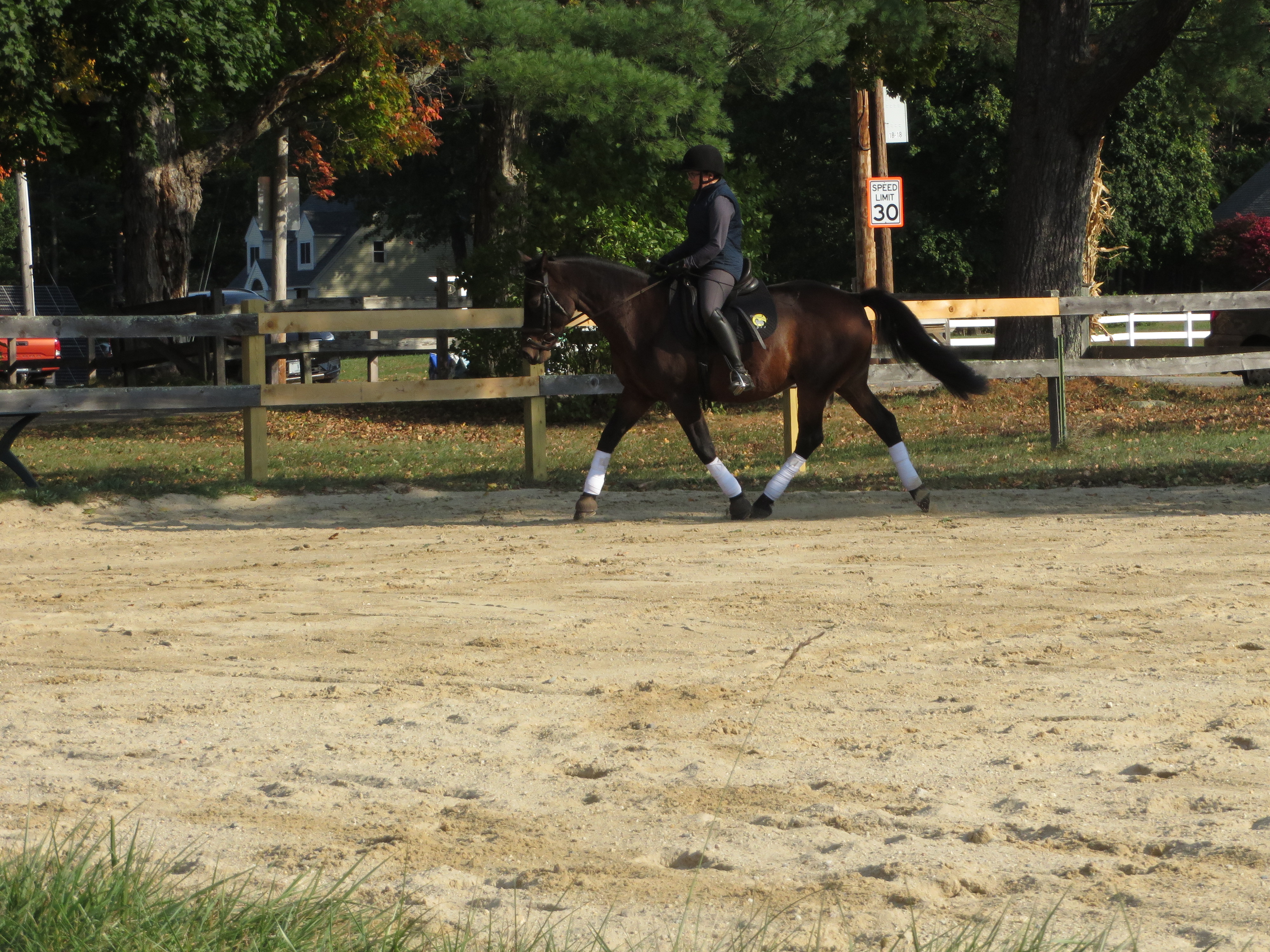
A slightly better moment in trot.

“Leave your brain out of the ring—be instinctive,” Jeremy offered by way of explaining the reaction time required. “When she dies in the tempo, then she must go, even if it is up to the gallop.”

For forty-five minutes or so, this is what we did. Me, kicking and using the dressage whip assertively, until I felt as if I were back on a cross country course desperately trying to make time. Anna, offering a few strides of a positive gait. The inevitable slow down. And repeat. Over and over and over.

I think this is one of those nicer moments.

Eventually, when Anna did offer a few consistent strides in minimum tempo, we added in a little shoulder in or a ten meter circle. Inevitably, I had to ride out of the movement with assertive aids yet again. There were a few nicer moments, but mostly it felt like one of us was working a whole lot harder than the other. And also, as if I had taken this exact lesson so very many times before.

While I rode, I kept hearing Jeremy’s voice on repeat: Some horses are just this way. It is the soul of this horse.

After our lesson, I stayed to watch a few more riders. In particular I wanted to see Leslie Ann McGowan, Linden Wood’s resident trainer, schooling the warmblood gelding Belfast, because this horse just makes me smile. I first saw this talented duo at a clinic with Jan Ebeling in 2017; the gelding was perhaps 6 years old then, new to Leslie Ann and quite green, yet everything he did looked easy. Effortless. Joyful. Now showing at the FEI levels, Belfast and Leslie Ann spent the day’s set working on canter pirouettes. Even when the pressure increased and the work became a little more demanding, the horse never quit or backed down.

The difference between his effort and Anna’s hit me like a fist. The soul of this horse was dancing. He was happy being an elite dressage horse. She is not.

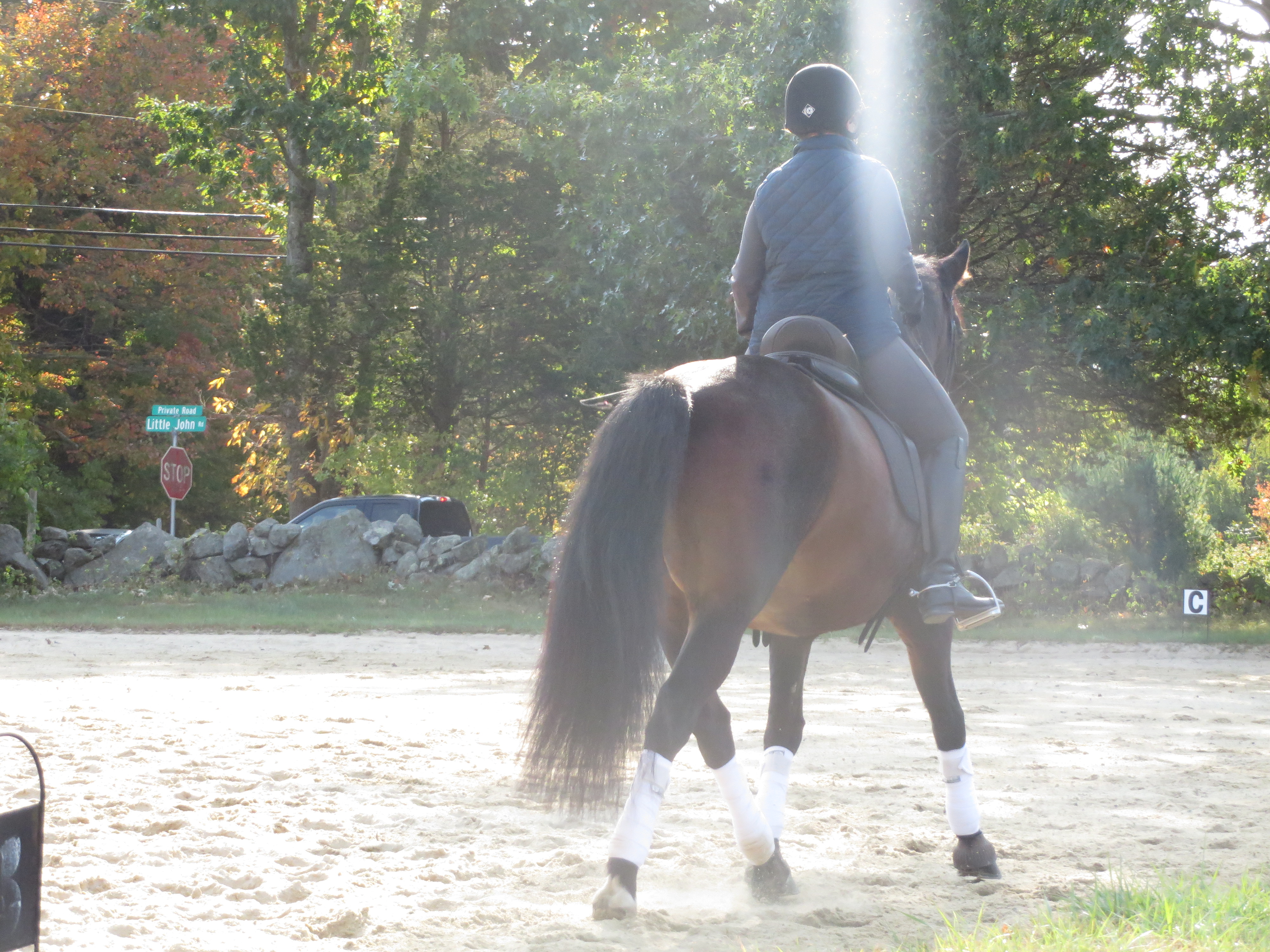
Anna and I in silhouette.

I bought Anna from her breeder as a green broke 6-year-old who had never even been cantered under saddle. The breeder described the mare’s personality by saying she “was pretty content to just watch”. Over the years, I have repeatedly been reminded of her breeder’s insight whenever I have challenged Anna to increase her performance level. Anna has always done whatever it is I have asked of her. But I have often had to ask with emphasis.

As a team, we have done and seen and accomplished a lot. She took me around my first (and only) Groton House Horse Trials and to two double clean cross country trips at the Fitch’s Corner Area I Eventing championships. She spent three months with me at Denny Emerson’s Tamarack Hill Farm, where we solidified our partnership over fences and hacked in the Vermont countryside. She received my first (and only) high score of the day at a dressage competition (back at Training Level) and she has earned scores over 60% all the way to Third Level Test 3. This fall, she and I completed the Ranger 100 Mile Challenge, tackling those miles in bite sized pieces along the trails in our backyard.

Anna with her Ranger 100 Mile Challenge Medal.

When I started concentrating on dressage with her, I had hoped that maybe she would make it to FEI. Perhaps that was too lofty of a goal; I knew she would never be a high scorer there but I hoped to finally have a chance to canter down centerline in tails, on a horse I trained myself. A few years ago, I could imagine riding Anna to what would be a pinnacle in my equestrian career.

                But more recently, I have downgraded my goals for her—from FEI to Fourth. From Fourth to really solid Third. Most recently, I hoped to collect the last two scores I need for the USDF Bronze Bar in the Third Level Musical Freestyle. We spent a whole season chasing them. The closest we came was still two points too low.

                It would mean so much to me to finish that long-term project with this horse, and then call it a day for her dressage career. But not if the cost is having to ride Anna so hard that she is completely miserable, and all the joy has left her. Not at the cost of her soul.

                When we got home from the clinic, I put up her dressage saddle and haven’t taken it off the rack since. Instead, we have hit the trails, and I have let her mane grow long and coat thick and fuzzy. Anna will stay home this winter and once the weather turns, for the first time since the age of 6, she will have a few months off to just be a horse.

                It is a fine line we tread sometimes, as stewards of these magnificent animals, to know when to push them through resistance in their training and when they have given us enough. It is equally difficult to come so close to your destination and then choose to turn back. But ultimately riding requires a partnership; two hearts working together as a team.

                I do not know what is next for Anna and I. But whatever comes, I must honor the soul of this special horse, and not force her to be someone she is not.