Tag Archives: horsemanship

Book Review: Ridden: Dressage from the Horse’s Point of View

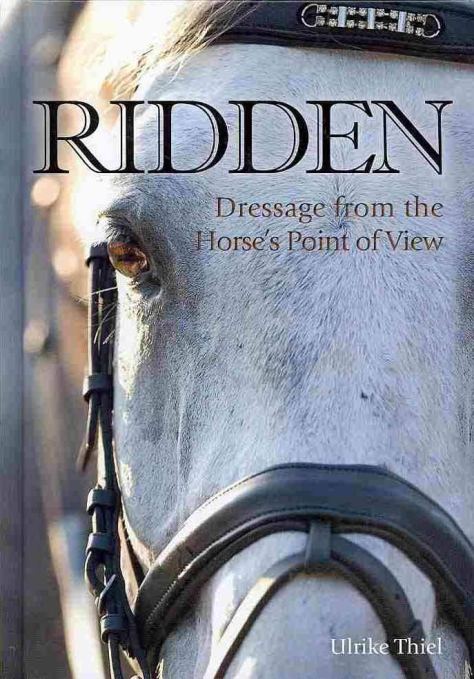
Ridden:  Dressage from the Horse’s Point of View by Ulrike Thiel

c 2013 Trafalgar Square Books: North Pomfret, VT. 225 pages.

ISBN 978-1-57076-558-2

Ridden: Dressage from the Horse’s Point of View is an intellectual read, part study of equine biomechanics, part reflection on training philosophy and part treatise on the essential need to commit to the classical principles in all work with horses.  Author Dr. Ulrike Thiel is a clinical psychologist, therapeutic and able-bodied riding instructor, and dressage devotee, and in this book she blends her education, experience and scientific analysis together in a manner which synthesizes a complex topic into a manageable narrative.

Riddencover

What Thiel does extremely well in this book is providing analogies, visuals and exercises which can help a rider to understand, in human terms, what a horse is experiencing under certain circumstances.  Through these means, Thiel helps the rider to have better empathy for how much most horses are willing to offer to us, despite muddled communication, improper balance and a host of other challenges.  She conscientiously takes the reader through the learning process which a horse and rider must undertake, including overcoming the predator/prey relationship by gaining a horse’s trust, confidence and respect.

Once Thiel has laid the framework for developing the horse/human relationship through mutual respect, she then delves deeper into the concepts espoused in classical dressage training, comparing the horse’s progression through the exercises to the process of learning to ski for a human (among her many hats, Thiel is also a certified ski instructor). Throughout, she emphasizes the fact that horses will forgive the mistakes of humans, but those mistakes must first be acknowledged to be rectified.  The consequences of failing to correct training missteps or rider issues can result in permanent physical damage to the horse.

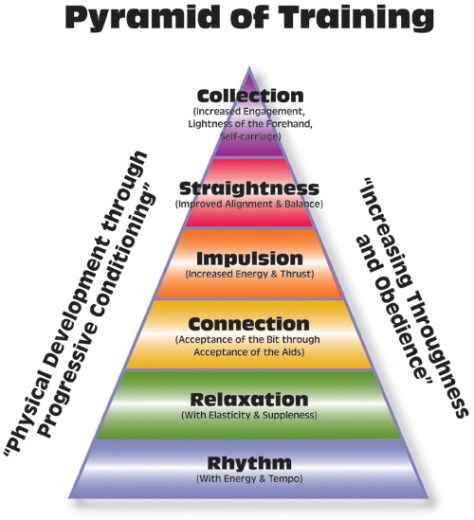
dressage-training-pyramid.jpg
From the United States Dressage Federation

After painstakingly laying out this foundation, Thiel turns her analytical focus to what she calls “modern” training methods—rollkur, hyperflexion, or low, deep and round (LDR).  These controversial training methods have been promoted by several high profile European dressage stars (including Olympic medal winners) and Thiel takes direct aim at the methods, their perpetrators, and the FEI for not wholly condemning their use. To write this book and publish it in her native Netherlands must have taken supreme courage, as one of the most famous proponents of hyperflexion has been two time Olympic gold medalist Anky Van Grunsven, who is a house hold name in the country.

It seems clear that Thiel’s motivations are truly to promote humane horsemanship and training methods, in spite of the risk of drawing what surely is sharp criticism.  “The excesses associated with equestrian sports are in the crossfire of criticism…Ultimately, the question we all need to ask is whether the well-being of the horse is being considered as he is used in sports, for pleasure, as a therapy animal, or for other purposes…As it is so often when money, power, and competition play a role, ethics and human assumption of responsibility are left by the wayside” (Thiel, 2013, p. 209).  Further, “I think the horse awakens different needs within humans.  The horse can be used as a tool to fulfill our desire for power and success” (Thiel, 2013, p. 214).

I would recommend Ridden to any horseman who is interested in better understanding why the classical training methods have endured for centuries, and why this approach is still the best way to train the horse to be the most they can be.  I hope that most equestrians that consider themselves to be true horsemen are willing to constantly put themselves under the microscope, asking what they can do better.  Reading this book and taking time to honestly reflect on its content should allow for that opportunity for growth.

I applaud Thiel for being brave enough to write this book, and for taking the time to combine intellectual and emotional rationale—left brain/right brain balance—to advocate for why adherence to classical training concepts is essential for equine well-being.

5/5 stars

Anna and the Adventures of the Double Bridle

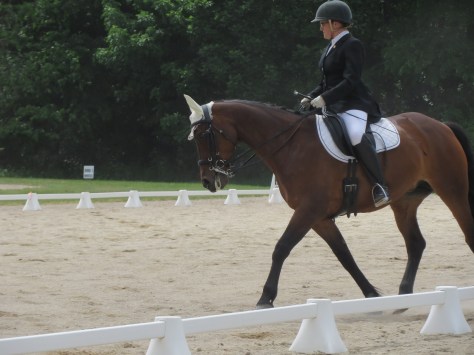
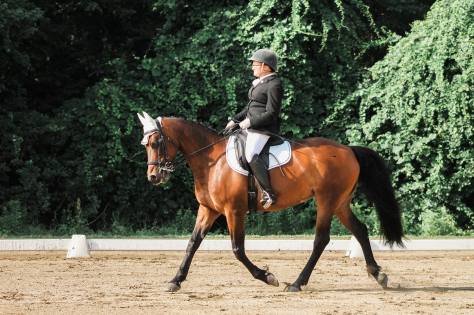
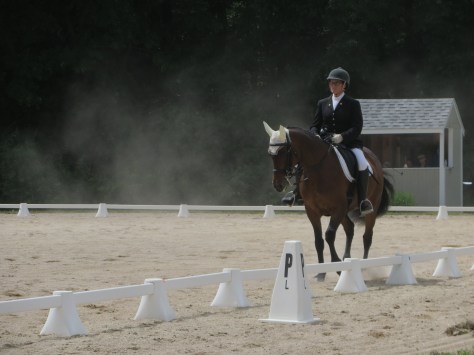
The 2017 season marked Anna’s debut at Third Level; while we certainly didn’t make anyone nervous, as my former coach used to say, we also didn’t get arrested by the Dressage Police, so it would seem that enough of our movements were recognizable at the level that they allowed us to go on our way.

Making the jump from Second to Third level is a significant step forward in the horse’s training.  The purpose of Third Level (as is stated at the top of the test) is as follows: “To confirm that the horse demonstrates correct basics, and having begun to develop an uphill balance at Second Level, now demonstrates increased engagement, especially in the extended gaits.  Transitions between collected, medium and extended gaits should be well defined and performed with engagement.  The horse should be reliably on the bit and show a greater degree of straightness, bending, suppleness, throughness, balance and self-carriage than at Second Level.”

Oh gee, is that all?

img_1448

But in all honesty, what I have found when the average dressage rider is debating moving up to Third Level is that they are worried about two things.  1) Will my horse do a flying change?  2) Can I ride in a double?

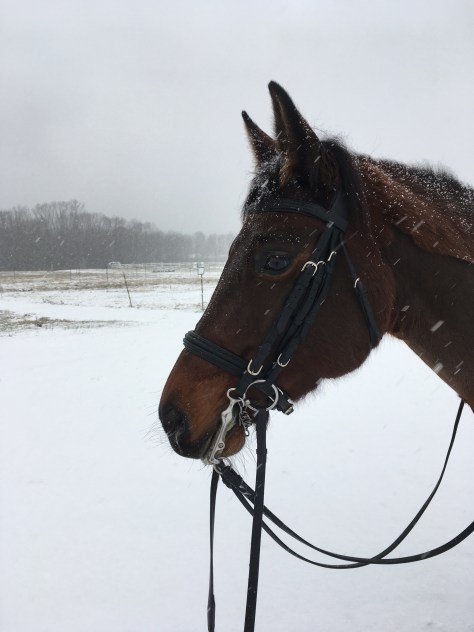
The double bridle, also known as the full bridle, is a somewhat controversial piece of equipment.  Third Level is the first time its use is permitted under USEF rules.  As its name implies, it has two bits—a snaffle, known as the “bridoon,” and a curb, also called a “Weymouth.” The bits serve different purposes.  The snaffle helps to achieve lateral and longitudinal flexion, as well as encourages elevation in the frame.  It is also used to help position the neck left or right, and encourages the horse to open the frame when necessary.  The curb’s role is to increase longitudinal flexion, helping to “close” the frame by bringing the head more towards vertical.  The correct use of a double bridle requires that the horse is classically trained; the rider’s hands should initiate but not force the horse’s head and neck into the correct position.

img_1313
Anna’s double.  The curb is pretty flat, with minimal port, and used to belong to my Hanoverian, Worldly.

It is the use of the curb which makes the double bridle both so helpful and also potentially so harmful.  For centuries, the curb was used alone and often one handed, by knights and soldiers needing immediate control and submission from their mounts. The double bridle was not commonly used until the close of the 1700’s, likely due to the influence of French masters Pluvinel and de la Guerniere. Each horseman taught that the curb bit could be used to enable the rider to achieve a higher level of communication with the horse, not simply domination. By employing two sets of reins, the rider could use the snaffle and curb bits separately or in combination, which allowed a greater degree of refined control for military maneuvers.

The curb must be carefully chosen and fit to the horse; when used appropriately, it can allow extremely refined communication between horse and rider.  It is a leverage bit and applies pressure to the poll and chin groove, as well as to the bars, tongue and the neck; any force applied to its rein will be magnified on the horse.

img_1314
A close up of Anna’s current bits.  Talk to me in a year and we shall see what she is wearing!

The strength of the curb depends on several factors.  The overall length of the cheek of the bit is important, but so is the length of cheek above the mouthpiece versus below it.  This ratio effects the way the leverage is applied to the horse.  The tightness and fit of the curb chain is also significant, with the ideal being that when the curb chain is engaged, the lower shank is brought to 45 degrees relative to the bars of the mouth. It may require some adjustment in the curb chain tension to find just the right setting. Ideally, two fingers fit between the curb chain and the chin. Finally, the shape of the mouth piece itself influences the severity of the curb.  The unique size and shape of the horse’s tongue, bars and palate all must be considered.  Usually, the length of the shank is about the same as the width of the mouthpiece; the curb should be a minimum of 5 mm wider at each side of the mouth to avoid the lips being squeezed between the shanks.  But a too wide curb will cause muddled signals to the horse.

Anna Third Level Debut 027
What I like in this photo, from our Third Level debut, is that she is soft in the jaw, properly using the muscles of her upper neck and is slightly in front of the vertical with her forehead.  I think we are about to ride a volte here, and she needs to be better supple on the right side and more engaged with elevation in the shoulders.  I also have NO contact to speak of on the curb rein.  It is an ongoing process!

de la Guerniere said, “The mouthpiece has to be chosen based on the inner construction of the horse’s mouth, the levers in relation to his neck and the curb chain based on the sensitivity of his chin.”

Of course, as with any bit, its severity is directly related to the skill of the user.  For example, while one might assume that a shorter shanked curb is less severe, its effects are felt more quickly and so it is not ideal for someone with unsteady hands.

ThirdLevelTackShack
Anna at a show in July– here you can see that I have too much contact on the curb, and the adjustment has brought the bit almost to horizontal.  This isn’t right either!  Good thing Anna is tolerant.  What I like in this photo though is that she is well engaged, reaching over her back, and is closer to level balance.  When you are not genetically blessed with uphill carriage, it takes quite a bit of weightlifting to get there.  This lovely photo is from MKM Equine.

I soon found that fitting the bits correctly, including consideration of the placement of the noseband, is almost an art form.  I still don’t think I have the adjustment just right, as will be seen in some of the photos here.

img_1359-1
Anna after a summer ride in which she did some of her first tempi changes! Thank you to the double for our more refined control!

I have ridden in doubles before, but it was only over the course of this season that I realized how little I really understood about the bridle, its use, and its effects.  The horse is only ready to begin using a double when they have developed a degree of collection and self-carriage.  When the hindquarter is properly engaged, the horse is then better able to lift their withers and base of the neck.  The curb uses even pressure to cause the horse to yield with relaxation in their lower jaw.

I was really on the fence about whether or not Anna was ready to start working in the double, because of our ongoing connection issues.  But after a session with my dear friend Jen Verharen in March, I felt sufficiently confident to at least start asking her to hack around in the double and get used to carrying two bits in her mouth.  Anna’s first ride in the double was only remarkable in that it was utterly unremarkable.  “Ho hum,” she seemed to say.  Just another day at the office.

img_0568
After her first ride in the double.  Please do not judge me for the extremely disorganized cheekpieces.  I promise that they got sorted out for the next ride! And it was raining that day– this isn’t all sweat.  🙂

I began riding Anna in her double once per week, usually on days when I was mostly doing stretching work.  Even before I started to take a greater feel through the curb rein, I noticed an improvement in the shape of her topline and neck, which I attribute (perhaps falsely) to the style of her bridoon.  Anna’s usual snaffle is a medium thickness KK loose ring with a lozenge; the bridoon on her double is a thin single jointed loose ring.  I wonder if the simplicity of the bridoon is more comfortable for her; of course, I haven’t actually gotten around to swapping out her regular snaffle to determine this! Perhaps this is a project for the winter season.

Gradually, I began to take more feel on the curb rein and introduced Anna to gentle pressure from the leverage bit.  I found that it was important to make sure that she was sufficiently loosened first, and already reaching through her back, before I took this additional contact.  When I attended a clinic with Jan Ebeling in April, I brought the double with me, but I didn’t feel confident enough yet to actually bring it out in such a public venue.

So when I took Anna down centerline for the first time at Third Level in June, I had had no direct coaching with her in the double.  However, I felt that its use sufficiently improved Anna’s outline and way of going such that it justified its use.  In reviewing the photos, I can tell that the curb helped to improve her elevation in the trot work, but I was not fully utilizing its benefits to help her in the canter. I knew I was still being too tentative.

Anna Third Level Debut 026
In this photo from Anna’s Third Level debut, you can see that I am not really using the curb rein.

Thankfully, I was able to work with Verne Batchelder over five sessions in July, August and September, which helped us to make excellent progress and gave me better insight into the use of the double during this horse’s training.  Verne encouraged me to ride Anna in the double more frequently, citing its positive effects on achieving a more correct shape through her topline and especially in her neck.  “Do not go into battle without your gear,” he laughed, as he also encouraged me to picture Anna working more towards Third Level Test 3 than Test 1.

Most of our sessions focused on positioning Anna’s neck such that she was unable to use it to block the flow of energy.  Usually this involved taking her nose slightly past the degree of flexion in her neck, waiting for her to relax, then gently straightening her by using my outside elbow.  Verne emphasizes the need to be able to swivel the horse’s head and neck at the poll; this helps to develop the muscles of the upper neck to the degree where it actually draws up and refines the area around the throatlatch.

img_2250
So I keep struggling with the adjustment of the curb chain; here you can see that the shank of Anna’s curb tends to align too much with her lips.  It should be closer to 45 degrees in relation to her bars.

Anna has quite a good walk, and really is capable of achieving scores of “8” or higher on these movements, and so we played with some walk exercises which also would help to further improve her connection. We did a series of half turns in the walk, all the while asking her to take a rounder outline through her topline and neck, more towards an FEI level of carriage, for short periods.  These turns were larger than competition sized, and we worked towards shorter, quicker steps.  This technique should help to develop greater activity in the half pass. Afterwards, we returned to forward riding on lines and larger circles.

img_2097-1
Anna is at her winter headquarters at High Knoll Equestrian Center this year. 

Flying changes are actually quite easy for Anna, and these are also an opportunity for higher scores in the show ring.  Verne worked with us on riding changes with greater elevation of the forehand, so that they could become bigger and more expressive.  He encouraged a gentle lift of the inside snaffle rein during the change to coincide with the leg cue; this will lay the foundation for a prompter response to a subtle aid in tempi changes later on.

Finally, we spent some time working on developing Anna’s medium trot.  The medium gaits are defined by their uphill tendency, which is of course the result of better engagement, self-carriage and true collection.  The horse should lift their shoulders and withers, not just flick the front feet. If the rider only thinks about power, most often the horse will do a lengthening and instead fall to their forehand.  In the double, Verne reminded me to keep my elbows bent and to focus on riding Anna’s shoulders up.  We increased the thrust for a few steps at a time, using these as building blocks to develop strength and carrying power.

Verne feels that the double bridle is a valuable training tool for a horse like Anna, who lacks natural elevation.  “The double bridle helps with elevation of the shoulder and neck in horses which are not naturally elevated,” says Verne.  “The withers follow the reins, but the rider cannot just lift the hand.  They must keep an active half halt and the connection into their elbow.”  I learned too that it is extremely important to keep a steady feel on the snaffle, not pulling just holding, whenever Anna was pushing towards a higher degree of balance and throughness.

img_1858
Doing some stretching work in the snaffle.

I always like to give Anna a little down time as I transition back to full time work in the fall, so in September we hung the double up for a few months and focused on stretching in the snaffle and hacking on the trails.  Even without the influence of the curb, it is clear that the work we have done in the double has helped to improve the shape and correctness of Anna’s topline.

img_1608
And when we go out hacking, it is usually in a mechanical hackamore, which is what she is wearing here, though I guess it is hard to tell!

There has been some debate in recent years regarding whether the double bridle should remain mandatory equipment at the FEI levels; when showing nationally, American riders can choose to ride FEI tests in a snaffle alone.  There seems to be some belief that those who can do Grand Prix in a snaffle are better riders.  But in the right hands, the double bridle should be regarded as “an instrument of finest understanding between horse and rider” (Rottermann, Eurodressage 11/3/14). A correctly trained horse will probably do well no matter which type of bridle they are wearing.

As far as Anna and I go, we of course need to continue to improve the quality of our communication.  I am sure there are some riders and trainers who will judge me for choosing to work this horse in a double bridle before every bit and piece of Third Level work was fully confirmed.  But truthfully, it seems like it was the right choice for this horse, and using this tool tactfully has helped to further her training and improved her strength and suppleness.

img_2253
Happy Holidays from Annapony and I! 

Sources

Edwards, E. Hartley.  Saddlery. London: JA Allen and Co, Ltd.  1987.

Politz, Gerhard.  “History of Bits, Evolution of the Double Bridle”. Posted 7/17/2008 (www.equisearch.com/articles/double_bridle_071708)

Rottermann, Silke. “The Double Bridle: An Instrument of Understanding”. Posted 11/3/2014. (www.euroressage.com/equestrian/2014/11/03/double-bridle-instrument-understanding)


Book Review:  From Birth to Backing

From Birth to Backing by Richard Maxwell with Johanna Sharples

c 1998 Trafalgar Square Publishing, North Pomfret, VT. 148 pages.

ISBN 1-57076-120-5

From Birth to Backing provides a glimpse into the training philosophies of Richard “Max” Maxwell, a UK based horse trainer whose methods are strongly influenced by Californian ‘horse whisperer’ Monty Roberts.  The text is logically arranged into age-appropriate chapters, with an overarching theme woven throughout that each step is essential and must be taken in sequence.  Therefore, Maxwell’s methods are useful to consider even if you are working with an older animal whose performance requires taking a step (or two or three) back.

BirthtoBacking

Maxwell takes readers through his step by step process, which begins with an overview of imprinting a foal, to introducing basic handling, to developing respect and trust in humans, to ultimately accepting the introduction of equipment and a rider.  While his methods are grounded in the philosophy of Roberts’ “join up”, there are no gimmicks here—no special halters, patented flags on a stick, etc.  All the methods and techniques which Maxwell describes could be executed by any educated and conscientious horse owner, using equipment they already own.

Maxwell is clear to emphasize throughout the book that to be the trainer of a young horse requires confidence and consistency; he recommends seeking outside help if the natural behaviors of a youngster trying to figure out the correct answer will be intimidating to the handler.  However, reading this book is still helpful for those not able to undertake the whole process themselves, for understanding the importance of both a clear methodology and calm, consistent handling could assist the owner of a young horse in selecting an appropriate trainer to establish the basics.

img_1031
Maxwell emphasizes that when introducing new items to the youngster, do not approach them timidly or try to “sneak” the new object up onto them.  “March up to the horse with the equipment, allow him to smell and investigate it, reassure him with your voice and place it firmly where you want it” (Maxwell, 1998, p. 73).

What readers may appreciate the most about this book is that the layout is quite intuitive.  Not only is each chapter focused on the particular skills most appropriate for a certain age range, but within each chapter, shorter segments help to break down the content into easy to comprehend chunks.  The text is filled with ample illustrations which help to reinforce the main themes.

While most of the concepts put forth in this book are familiar, one which I found rather unique was that Maxwell does not believe in using a lead horse when starting to hack out the youngster, as he feels that the horse should look exclusively to the rider for their confidence and safety.  Maxwell says, “Very often, riding out with an older horse is an emotional crutch for the rider rather than the youngster.  In my experience it doesn’t actually work that well either—I’ve never found that having an older horse there will stop a young horse bolting or misbehaving if he wants to” (Maxwell, 1998, p. 113).   Instead, he proposes taking your youngster out on solo hacks, and exposing them to as many potentially frightening stimuli as possible, preferably while the horse is still learning their balance under a rider—that way, their resistance will likely be minimal and their confidence in the rider increased from the very beginning.

img_1352
Introducing your youngster to as many unfamiliar stimuli as possible, while maintaining a calm, confident demeanor, will help build their trust in a human handler.

Overall From Birth to Backing is a fairly easy read, and its concepts clearly articulated and illustrated.  One of the amazing things about publishing is how quickly a text can start to feel stale, and at almost twenty years old, this book’s photos could use an update.  However, this should not take away at all from the essential message of the book:  establish a trusting relationship with your horse from the very beginning, and from there nearly anything is possible.

4/5 stars

The Breaking Point

I am cheering with my whole heart and soul, screaming really, my throat becoming raw, jumping up and down, urging the beautiful bay filly to keep surging forward.  She is stunning—raw power, gleaming coat, the crooked stripe on her forehead and bright yellow of her jockey’s silks distinguishing her from her older, more sedately adorned rival.  They are in a tight duel—they have led the pack since leaving the starting gate—and now as they crest the top of the stretch, my favorite has started to pull out in front.  I am yelling and kicking and riding my own ride down the stretch, as though my life depended on it, as though by sharing my own energy I can help her to cross the finish line in front.

I am in my parent’s living room, hundreds of miles from Belmont Park in New York, where the Breeder’s Cup is being held.  It is October 27, 1990 and I am 14.  My cheers and encouragement are heard only by my mother and my cat, who quickly left the room as soon as she felt the pulse of my frenetic and overly wired energy.  Until that summer, we had lived just outside of Saratoga Springs, NY, and I had spent many blissful August days standing track side, admiring Thoroughbreds, learning about pedigrees, and cheering for my favorites.  I dressed as a jockey every Halloween, wearing handmade pale yellow and purple silks.  I kept scrapbooks of newspaper clippings about anything Thoroughbred, each article I found about horse racing carefully filed and labelled in a series of big red books which lived in my closet.  On major stakes race days, I listened to the call on WGNA AM radio, religiously watched every Thoroughbred race televised on NBC,  and in the age of the VCR, dutifully recorded the Triple Crown series every year, a true disciple of the sport waiting for a return of the king who would once again wear the Triple Crown.

I am watching the 1990 Breeder’s Cup Distaff, a race for champion fillies and mares aged 3 and up.  The race was largely billed as a showdown between the race’s defending champion, Bayakoa, the six year old phenom and two time American Champion Older Female Horse, and Go for Wand, who had already been voted the recipient of the 1990 Eclipse Award for Outstanding Three Year Old Filly.  It was Go for Wand who I was pulling for—and with just about 100 yards left in the race, it looked like she had it.  She had a nose in front and was still pushing forward.

Go_For_Wand_BC_615_X_400_orig
Go for Wand

And in a split second, her forehand dropped, her neck rolled, and she flipped over, throwing her jockey Randy Romero to the ground before standing and trying to limp her way down the track.

And in that same split second, as surely as I had ever known anything in my whole fourteen years, I knew that I had just watched a horse sign her own death certificate on national television.  Bayakoa went on to win; Go for Wand suffered an open fracture to her right cannon bone.

If you can stomach it, here is a video of the race. 

My screams of enthusiasm became screams of horror, and I felt something come from deep inside my chest which I had never felt before.  I thought my insides were actually going to come out like a scene in Poltergeist— I was screaming and crying and shaking and wanted to throw things.  I was so, so, so angry and on the verge of losing control.  My mother came running, turned off the TV and tried to understand what had happened.  But I just couldn’t speak.

I know now that what I had felt that day was rage.  The flame burned so intense and so hot that after the emotion quelled, I realized that it had taken from me any desire to ever watch a live horse race again.  In one fateful moment, I went from being a devoted fan of the sport to someone who could no longer watch a horse race without first knowing that all of the horses made it back to the barn at the end.

A 2016 article featuring recent research on understanding catastrophic breakdowns in racehorses.

Refusing to watch has prevented me from seeing more contemporary horrors like Barbaro break his right hind leg in the 2006 Preakness, or Eight Belles fall at the end of the 2008 Kentucky Derby, the result of the same exact type of fracture as Barbaro but in both front fetlocks.  But not watching has not prevented me from hearing about these horrible tragedies and then once again replaying the fall and death of Go for Wand where it is seared into my memory.

eightbelles
I found this image of Eight Belles, who fell after finishing second in the Derby, on Pinterest, and I have been unable to find who originally took it….but it is one of the most haunting images.  Jockey Gabriel Saez tries to keep her calm.

This might not be a popular opinion right now, but I have felt the same way about upper level eventing for years.  I have been an event rider since 1997 and have organized at least two USEA horse trials per year since 2006.  But I am tired of trying to defend the sport when it feels like every time there is a major international contest, one of the participants does not come home.  I have never competed at preliminary level or higher, and I never want to.  I am in no way a part of the upper level eventing community; I can barely even be called a passing fan.  But I am a member of the greater eventing community, and so the loss this past weekend of the talented Thoroughbred cross gelding Crackerjack, and subsequent online civil war about both that specific situation and the greater questions of safety in the sport of eventing, affects me too.

Crackerjack and Boyd Martin at Pau (Dressage)– I haven’t/won’t watch the other video– I just can’t stomach it knowing what will happen.

In recent years, I have spent a lot of time ruminating on what is fair for us to ask our equine partners to do, and how far we should push them.   I am sure I still don’t know the answer. Horses are amazing, powerful, strong and yet so fragile. People will offer trite clichés when a horse or rider dies in the course of sport such as, “well, at least they were doing what they loved.”  But these are hollow and empty words, and are just a way to fill the void left when a vibrant, athletic and enthusiastic spirit departs us in a shocking and sudden manner.  Does anyone really take comfort in them?  I doubt it.

People also like to point out that horses have a propensity to harm themselves even in what seem to be the safest of environments; everyone (including me) can tell the story of a horse fatally injured at pasture or in a stall.  But can we agree that there is some sort of difference between losing a horse through a freak barnyard mishap and an accident in competition?  I think so.

SaratogaTimesUnion.jpg
Saratoga Race Track through the lens of an uncredited Times Union photographer. 19 Thoroughbreds died during its 2017 meet, the most since 2009.  Eight died in competition, nine while training, and two from “non-racing related issues”.

It might seem like a stretch to believe that one incident can change someone from loving a horse sport to hating it.  So if I am honest about my feelings regarding Thoroughbred racing, the seeds were there before Go for Wand’s death.  I had seen horses go down before, and their memories still haunt me.  In fourth grade, I wrote a short story about one, Foundation Plan, a dark bay colt foaled in 1982, who died at Saratoga while I watched from the rail.  Seeds can sit and wait for the right set of variables to present themselves so that they can grow into a fully formed thought or emotion.  Maybe value-driven emotions need to germinate for a while before they can come to flower. When the conditions are right, your true beliefs will appear before you in their full intensity.

In an October 29, 1990 New York Times article titled, “Breeders Cup: Track Life Goes On After a Day of Death”, writer Steven Crist notes that that year’s races claimed the lives of three horses and caused the forced retirement of a fourth, Adjudicating, who finished the Sprint but was found to have a repairable fracture later that night.   From the article:

“Go for Wand’s trainer, Billy Badgett, was inconsolable immediately after the death of what he called the “horse of a lifetime” but spoke about it yesterday morning.  “She had never been challenged that way,” he said.  “She just tried too hard.”

Earlier in the piece, Crist notes:  “Casual fans, who had come to Belmont on a rare outing or tuned into the national telecast of the $10 million racing card out of curiosity, were left seeking explanations, while industry insiders tried to explain that this was a horrible concentration of a rare aspect of the sport.”

Twenty seven years later and not much seems different.  While immediate connections grieve, the greater community recoils in horror.  And an industry is left trying to pick up the pieces.


Somewhere Between Marginal and Sufficient

Anna and I finished our 2017 show season the last weekend of August at a close to home recognized USDF/USEF show, held at Longfellow Farm in Nottingham, NH.    It was a beautiful afternoon, and the show organizers really worked hard to try to make the show a special experience for competitors.  We each received a goody bag with magazines, lip balm, a box of sugar cubes and a gift certificate to a web site I cannot afford.  There were real flowers in the port a potties.  They had a mini trade fair and fresh food. Tons of my friends were there, riding, coaching and grooming, and the whole thing felt a little bit like an end of summer picnic where we were all trying to absorb the late season sun and fun.

As I was setting up my equipment, I listened to the women at the trailer next to mine go through their own preparations.  At first, I wasn’t sure who was riding and who was coaching, but ultimately determined there were two rookie riders doing their first Opportunity classes, a conscientious horse owner, and one extremely patient trainer.  The riders’ nervous energy was palpable as they struggled to pull up their new full seats, bemoaned the lack of pockets in same for sugar cubes, and valiantly figured out how to tack up their mounts while still remaining clean.  A gentleman wearing a camera stood nearby, wisely far enough back from the action so as to not get caught up in it but close enough by to be showing support.  When it came time to mount, neither could manage to do so off the top of a 5 gallon pail, the only mounting block available.  So their trainer offered each of them a leg up.

Compared to these two, who as it turned out were riding in my ring, directly after me, I was the epitome of calm.  I methodically went through my usual preparations, putting on the white base layer, the choker which fits a little too tightly, the hairnet which always leaves an indent on my forehead secured under my gray velvet helmet.  My hand me down Pikeur jacket was an expensive purchase for its original owner; I acquired it for just $30 and spent an additional $35 spent to tailor it, though it still doesn’t feel like it fits me right.  It is just a bit out of style and the collar has faded in the sun, which I’m sure no one notices but me. I felt no nerves, no worries.  I tacked up Anna, mounted off the top of my own upturned 5 gallon pail, and headed to the warm up.

img_1117-1
Anna at a show at the Tack Shack in Fremont, NH, in July.

Anna and I performed Third Level Test 1 for the fourth time this season, and got yet another 58%. I somehow mistimed my warm up, leaving me a bit shortchanged in terms of the preparation, but at the end of the day I really don’t think it would have mattered all that much.  While our performances have progressively improved, the scores have not.  We have been rocking those 50’s (it sounds like a dance party, which would be a whole lot more fun): 57,55, 59, 58.  Close but not quite there.

img_1448.jpg

I do appreciate the comments from the judges.  Judges have a challenging job; they must sit for hours, running “tapes” in their mind which include the purpose of the level and the expectations of a movement at that level, and then they translate these ideals promptly into a succinct statement which justifies their assigned score.  I have sat and observed judges and scribed.  I have graduated from the USDF “L” learner judge’s program.  I have spent hours judging at schooling shows, watching many, many tests in which there was very little dressage going on, trying to figure out how to offer feedback which will be perceived as helpful but not overly negative.  Judges are usually really trying to help the riders they are watching.

But that day at Longfellow, as I held my yellow sheet on which the judge noted “capable horse who is obedient in changes and must be rounder and better on bit and connected”, I just felt defeated.  Like, what is the point of this?  Dressage is such a dumb sport, to get all dressed up in these ridiculous uncomfortable penguin suits and go to shows where they put flowers in the port a potties and then we go and ride these redundant patterns, over and over again, hoping that for the FIVE MINUTES the judge sees our horse, we can meet some mystical expectation of “dressageyness”.  Why am I wasting my time and energy doing this? Why did I spend an hour to bathe and braid my horse and load equipment into my trailer and then ship down here? For a 58%?

img_1449
Anna doing what she does best at the Longfellow show.  Nom nom nom.

I have been teaching riding since I was eighteen years old, over half my life.  I sure thought I knew everything when I first started, and it wasn’t until I was in my thirties that I began to understand that I didn’t even know what I didn’t know.  I have at least five former students to whom I taught the absolute basics of how to put a horse on the bit, which have now ridden to Grand Prix and finished their USDF Gold Medals. There are probably another five who are riding at Prix St. George or Intermediare I.  Meanwhile, I am over here still splashing around in the dressage kiddie pool, unable to get my swimmies off.

Anna Third Level Debut 027
UNH June show.


In the Chronicle of the Horse’s August 7 issue, there was a great article about an amateur rider named Elizabeth O’Connor.  This spring, she finished her USDF Gold Medal riding a one eyed off track Thoroughbred which she trained herself.  To say that the pair had overcome adversity to achieve this result is an understatement.  It is a story meant to inspire, to remind readers that one doesn’t have to have the fancy warmblood and that with hard work, grit and determination, one can get to the big goal.

But what if that isn’t really true, most of the time?  What if hard work and determination isn’t enough?  When do you decide that maybe the judge’s comments are correct, and it is time to pack up and go home before the Dressage Police show up and throw you out?

I was still feeling pretty defeated when I brought Anna to the beautiful Chesley Brook Stables in Dover, NH, to ride with Verne Batchelder on Labor Day.  I was tired emotionally and physically, having just ridden the two day 60 mile ride at GMHA with my Thoroughbred, Lee, finishing in the remnants of Hurricane Harvey on Sunday.  Verne quickly picked up on the fact that I seemed…down.

img_1124
Schooling with Verne at Chesley Brook in July.  Thanks Lauren for the photo!

A former classroom educator and lifelong equestrian, Verne is probably the best coach I have ever worked with in terms of getting the maximum performance out of Anna.  He has seen me ride different horses, and he knows both me and this horse well.  As professionals, there are certainly times when we need a kick in the backside but there are also times when we need a boost.  Verne reminded me that sometimes the biggest complement that a teacher receives is when their student exceeds them.  He also pointed out that I am doing Third Level on a somewhat lazy horse whose genetics do not automatically set her up for the job.  Anna is trained.  58% is close.  We are not in the 40’s.

“We are not going to become the masters of Third Level,” proclaimed Verne.  “We are going to keep going.  We are going to get this pony to FEI.”

Anna Third Level Debut 002
Warm up at UNH show in June. 

I don’t know if we will or we won’t, but that is almost irrelevant.  Everything Verne said was just what I needed to hear.  I have made a conscious choice to own my own horses, to do my own training, and to commit to the process and animals I have.  Giving up when you hit the hard spots can sometimes be the right choice, but at other times you have to just keep plugging away with the faith that with enough persistence, even the roughest of surfaces wear smooth.  If my goal was simply to get to Grand Prix, or to finish a USDF Silver or Gold Medal, I could do that….but the fastest route would be a totally different path than the one I have taken.  I haven’t chosen to lease a schoolmaster, or to buy a big mover, or even to devote my training energy and tack time 100% to dressage. And for these reasons, I have become (in my opinion) a more robust equestrian.

When I returned to my trailer at the Longfellow show, I was untacking and unbraiding Anna, who hungrily mowed down the grass of the field we were parked in.  My neighbors returned, elated, victorious; they had finished their first ever dressage tests at a rated show.  The horse owner saw me and said, “wow, I saw your test, and your horse was amazing!  It was such a great ride!”

“Thanks,” I smiled, knowing even without having seen the results that it was probably just another 58%.

“We actually rode right after you in the same ring,” she continued, flushed with excitement. “And when we saw you cantering on the diagonal, and then doing one of those changes, we totally panicked, because that wasn’t the test we knew!  Your horse is just beautiful.”

Anna Third Level Debut 068
She is kind of beautiful.  🙂

I guess I didn’t really hear her then, but in retrospect I appreciate the comments more now.  Why are we doing this silly sport, this art, called dressage?  It can’t be just for the score…because the score only represents one moment in time. You have to do it for the day to day victories, and for the incremental improvements which show that your horse is progressing.  My horse does flying changes.  And she half passes.  And she is starting to understand the double bridle.  We may be working on many elements still, but there are many others which she does well.  She received 7’s on her walk pirouettes; Verne thinks they should be 8’s.  My horse is a Third Level horse.

Anna Third Level Debut 063
This was after finishing our first ever Third Level test.  I have to remember it is the journey which matters most!

So while other people may be diving into the deep end, don’t mind me.  I’ll just be over here in the shallow end, gradually creeping my way into the deeper water. A little better than marginal, but not quite yet sufficient.


Keeping Up With the Jones’

I think every other photo or post on my social media stream is of someone’s baby horse doing some amazing accomplishment.  Whether they are winning on the line, learning to wear tack, or being taught groundwork basics, these youngsters just seem to be high achieving go-getters.

For one example, here is an excerpt from a recent sales post for a 2 year old Connemara cross (same age and cross as my Izzy):

“…Training so far has included all ground manners (cross ties, clips, loads on trailer and trailers well, leads, lunges, stands for farrier and vet, bathes, free jumps).  She has had a lot of saddle work as well as bridled (and longed in tack with no drama)…”

The mare looks lovely and has obviously had a busy spring.  But as I read the ad in early July, I have to admit that I felt, well, inadequate, in terms of my own work with Izzy.   At that time, Izzy’s resume was nowhere near so robust.

img_0964
Look, we cross tie like a grown up horse.

It’s not because she lacks the aptitude or temperament.  Izzy is simply the sweetest youngster I have ever interacted with. She is friendly, inquisitive and confident.  She arrived from Wisconsin the day before an authentic winter blizzard, and she settled right in. “No drama”, to use a recent quote.

Izzy is by the Connemara stallion Skyview’s Triton and out of a Thoroughbred mare named Honest Wit.  She was foaled on May 30, 2015, and so by my thinking she is a “young” two year old—when she arrived here in March, she wasn’t even quite two by the calendar.

img_0502
Fresh off the trailer on a very cold March morning in NH!

I spent time this spring just getting to know her better.   In working with Izzy, I want to make sure that each step of the process is taken as it comes, without hurry and with as much clarity of expectation as possible.  Izzy’s breeder, Janet M. Johnson of Dayton Ridge Farm, spends time with all of her youngsters and they work on learning “age appropriate” skills.  Izzy was already familiar with leading, grooming and having her feet handled when she arrived.  But even so, certain things were new.  The first time my farrier worked with her, Izzy regarded the foot stand with quite a look of horror and wanted nothing to do with it.  She is always a little funny with her right front hoof and sometimes pulls it away.  We just kept patiently handling her feet daily until it became routine.

One day in April, I was grooming Izzy in the barn aisle, holding her lead.  She was a little fussy and almost before I knew it, the lead had slid through my hands and Izzy was galloping down the driveway.  After a (terrifying for me) gallivant all about the front side of the property, and with the help of my housemate Lisa and a bucket of grain, she was back in hand.  But clearly we needed a better system.

img_0942

So I began introducing her to the cross ties.  I did one tie at a time, clipping the lead to the opposite side of the halter and holding it while I worked on grooming.  She explored the boundaries, and the first day that she hit the end of her tie I held my breath, not sure of what to expect.  Izzy pulled for a moment, and then just stood there.  Once I knew her response to the pressure seemed reasonable, I added the second crosstie.  And just like that…we crosstied.

While I was dealing with my knee issues this spring, intern Kelly handled most of the “walk Izzy around the property” duties.  But after recovering from my surgery, I began doing more “walk abouts” myself, taking Izzy up and down the driveway, leading from both sides, practicing transitions between the halt, walk and eventually the trot.  I added voice commands and started carrying a short bat, then a dressage whip.

img_0743
Intern Kelly, with her canine assistant Fox, take Izzy for a walk about.

As the black flies emerged in April, Izzy learned to wear a fly hat.  Bug spray made her very nervous at first, but with calm repetition you can now spray her while she stands loose in the field.

In late spring/early summer, I introduced Izzy to wearing a saddle pad.  I let her smell it, rubbed it on her body, and let her see it come up and over her back from both sides.  “No drama”.  From there, it was an easy step to wearing the soft cotton surcingle, even if I have to adjust it to the absolute smallest setting. Izzy still isn’t a fan of having it tightened, but once it is set, she seems unconcerned.

img_1031
First time wearing a saddle pad. 

I set a few further goals for her for the summer.  When presented in hand, two year olds must wear a bridle with a bit, so I felt it was appropriate for her to learn how to do that.  I wanted her to load onto and off my straight load two horse trailer quietly, and then go for a few short rides.  And I wanted to introduce her to the basics of longeing; in hand, we had started with the voice commands, but I wanted her to understand the concept of moving in a circle, responding to the handler’s voice and body cues, and to be comfortable with the equipment on and around her body. I wanted to do all of this through a series of short playful sessions, so that she enjoyed interacting with humans and remained her confident, inquisitive self.

img_1131
First day in a bridle.  Still sorting out the bit.

I am pleased to say that we have achieved all of that and more.  On each step of the journey, Izzy has remained fairly willing and mostly obedient.  Like any youngster, she has her moments of silliness and lost focus, but more often than not she stays mentally on task.  Izzy calmly wears her bit and bridle, she does transitions in hand and on a longe circle, and has happily walked and trotted over low cavaletti in hand and on the longe.  She ate several meals on the trailer and went for four short rides, two with a friend and two on her own.  And as an added bonus activity, she has been ponied off her turn out buddy Marquesa around the farm.  Maybe if I get brave I will take the pair of them out on the trails to see more of the world!

img_1301
Learning to “pony”– all three of us together!

It is funny, though, because in spite of all this success, when I see a post about someone else’s overachieving baby horse, it is hard to not compare.  Izzy doesn’t free jump (I have no where to do that, anyway), and I can’t really say that she is confirmed on the longe (she certainly doesn’t canter), and what the heck is that contraption they are longeing that youngster in anyway?  Should I be using some contraption?  I haven’t taken her off property to any breed shows, young stock shows or in hand future intergalactic performance horse testings.  She has yet to wear a saddle.  Am I doing this right? My friend’s two year does [insert accomplishment here].  Is this what human parents feel like when they find out that little Susie down the road went to elite swim camp or Johnny across the street just won a ‘budding artist’ award, while their own child is playing in a puddle and eating dirt?

img_0954-1
When learning, it is important to have good role models.

But then I remind myself to take a step back.  Because it really doesn’t matter what all of those other youngsters are doing.  The journey we are on with our own animals is just that—ours.  Izzy has successfully stepped up to—and exceeded—my expectations for her learning and development this summer.  In spite of the transition into the school year, and available daylight growing shorter, I will still have the opportunity to play with her more before winter settles in, to confirm her basic longeing, and maybe even experiment with some basic long lining to learn about steering and pressure on the bit.  But there is no hurry, no rush.  If all Izzy does this fall is continues to mature and develop physically, the time which we already spent laying a foundation this summer will be like “money in the bank” next spring.

Horses do not progress on our schedule.  My mentor Denny Emerson says all the time that the day you come into the ring with an agenda is the day you are not going to get where you want to go.  There is a difference between making progress towards your set goals and making progress, no matter what.  So I guess I will try to worry less about what everyone else’s baby horses are doing and just listen to mine.

She is pretty darn persuasive.

img_0864
The “golden girl”.

Bernie Traurig: a Solution to Every Problem

Clinicians that have trained and competed at the elite levels in multiple disciplines, have a depth of knowledge and experience that is the accumulated wisdom from countless types of horse and mentors.  Bernie Traurig, founder of www.equestriancoach.com, is just such a clinician, and he has made it his mission to give back to equestrian sport by improving access to top notch instruction, exercises and lessons.

Traurig recently gave a three day jumping clinic at Ridgeway Stables in Dover, NH, where he engaged auditors, riders and even his ring crew with tips, theory, questions and feedback.  Regardless of the level of horse or rider, Traurig’s advice and instruction centered on the importance of correct basics, equine responsiveness to appropriately applied aids, selecting the best equipment for the job and of course, always thinking like a horseman.

Here are five of the recurring themes Traurig emphasized throughout sessions which ranged from 2’9” to 3’6”.

#1: Basic Bitting is Best

Traurig believes that the best bit for each horse is the one which will offer the rider sufficient control and effectiveness in the aids in the mildest way possible.  “I don’t care what bit you have in the horse’s mouth, so long as it isn’t abrasive and works for the horse,” said Traurig.  “School in the mildest bit suitable for the horse and rider.  The horse has to accept pressure in a comfortable way.”

In fact, Traurig travels with a ‘bit bag’ and made frequent adjustments throughout the weekend to many horses’ equipment.  Every change was made on an experimental basis, with a willingness to adjust again if the change wasn’t working.

“I like to start with a single jointed bit and see how the horse responds,” Traurig said.  “If the horse has an extremely low palate, they may need a double joint.  I don’t like when [riders] just go to the gadget.  People tend to go wrong with gadgets and sharp or thin bits.”

While Traurig is not opposed to the use of leverage bits when they are required, he thinks there is a real art in finding what level of pressure a horse is happiest with on their bars.  “Stick with classical bits,” said Traurig.  “Tack rooms and tack stores should have walls and walls of Bert de Nemethy bits, not walls and walls of whatever the latest bitting fad is.”
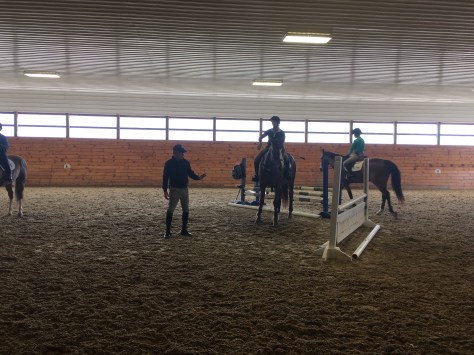
img_1077

#2 Constantly Improve Responsiveness

Regardless of experience level, each group’s warm up began with a period of establishing an energetic and active walk.  “This is the first step in putting the horse on the aids,” said Traurig. “Your horse must always march forward from your leg, with their nose reaching forward.  The rider must have a soft contact, not loose reins.  There are two ways to walk—totally off the contact or on a correct rein.  When going between them, you do not want to disturb the walk or the movements of the neck.”

Traurig reminded riders that their leg must always be on the horse’s “go” button, and that the horse’s response to forward is most important. “Never increase the pressure from your leg unless you want a response, whether asking the horse to move forward or sideways,” said Traurig.  “Otherwise, your leg should hang passively.”

In their warm up, most groups performed a variation of an exercise which helped to improve the horse’s responsiveness to both their rein and leg aids.  At the trot, Traurig had them perform a “shoulder yield”, guiding the front of the horse towards the rail with an opening outside rein away from the neck and an indirect inside rein at the neck.   Both hands were taken out to the side, in the direction to which the shoulders should move.  “Use very little leg,” coached Traurig.  “This is mostly a rein cue.  You are looking to displace the shoulders. ”

The more riders practiced the rein yield, the more subtle their aids became.  “Eventually the horse responds so well that you don’t see the aids, and you can use a subtle opening rein to shift the horse’s line without slowing them down,” said Traurig.  “This is excellent for a hunter class.”

Traurig reminded riders that the inside rein shapes the horse’s neck.  “Inside leg to outside rein is good but there is no shape in the neck,” said Traurig.  “Every book you read says indirect rein goes to the opposite hip.  But Littauer says that this depends on the effect desired.  When used toward the outside hip the indirect rein affects the whole body, but when used towards the other hand it only affects the head and neck.  The rein aids and the leg aids must be blended together.  You have two legs and two hands.  They all have to work together.”

img_1071

Riders next performed a leg yield away from the rail, then back to the rail, first in the walk and then the trot.  “Sitting trot works best for this,” saidTraurig.  “If you feel you can’t use your leg, then drop your stirrups.”

Traurig reminded riders that how their mount responded to the aids on the flat would translate into the jumping.  “You have to know if you see a forward distance that your horse will react,” said Traurig.  “The horse has to be in front of the leg.  If your horse ignores the aids, it’s okay to be a bit firmer once in a while.”

#3 Constantly Improve Position

“You should fix your position flaws not because of ‘good equitation’ but for correct basics,” said Traurig.

Traurig gave riders well balanced feedback, quick to offer praise even when some elements of an exercise went wrong.  In particular, he helped the riders to learn to feel when their positions were hindering their ride.

“The goal in the walk is to have elastic arms, allowing the horse to accept a soft feel and reach long over their backs,” said Traurig.  Several riders struggled at first to find the right balance between holding the reins too much or not enough, and Traurig helped them to find the middle ground.

In the warm up work, riders were told to stretch out at the two point in the trot, creating a 30 degree angle in the hip. Many riders felt their lower legs slide back when they transitioned into two point.  “When the leg goes back too far, you have to exaggerate holding it too far forward for at least thirty days,” said Traurig.  “Then it will be normal.”
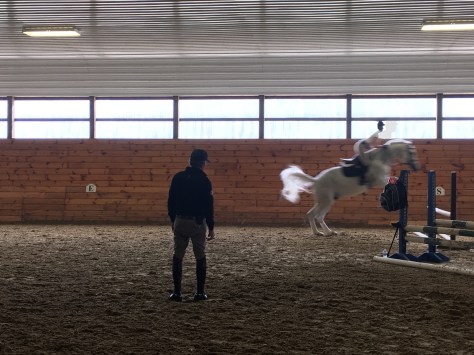
img_1076

Traurig helped riders to become more aware of their release style.  “A crest release on a hunter is fine, and the long crest release is fashionable, but it has a longer recovery time when you need to correct the line,” said Traurig.  “The automatic release allows more refined use of the rein aids in the air.  Riders can start using an opening rein to take their horse out to the rail before they even land.”

Even experienced riders can benefit from position checks.   On day two, Traurig challenged the most advanced riders to warm up without their irons in the counter canter.  He then had them raise their outside arm above their head, then drop the arm to hang behind their knee, all while maintaining the counter canter.  After returning to sitting trot, the riders were told to use their inside hand to grab the pommel to really pull their seat down.  Finally, they were asked to post without their irons for ten feet, then hold two point for ten feet, continuing this around the arena.

“When I was on the Team, we were each longed at least once per week,” said Traurig.  “Longeing is the best way to develop increased independence in the seat, and daily longeing will help make anyone a better rider.”
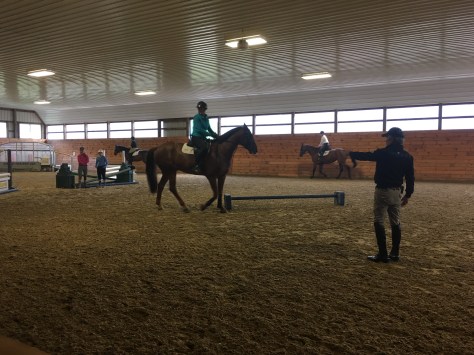
img_1061

#4 Perfect Practice Makes Perfect

A lot of becoming an effective rider is about knowing what to do and when, in just the right amount.  To achieve this end requires hours of practice; but as we all know, only correct practice will build the long term responses we want in horse and rider.

One young horse became hot and excited when approaching the fences.  “Repetition of schooling exercises which decrease anxiety and the aggressive approach to the jump are in order,” said Traurig.  “It is tedious, but necessary.”

For this horse, Traurig prescribed trotting jumps with plenty of halts after fences, with an emphasis on a gradual rather than abrupt transition.  “Take a few strides,” said Traurig. “As you practice it more, you can expect the halt to become more prompt.”

Once the horse jumped more quietly, he was allowed to canter a few fences, followed by a halt.  Eventually this would build to cantering into a line and trotting out.  “Be a horseman,” said Traurig.  “Always quit when the horse has been good, especially when they are young and green and have done well.”

Another experienced horse had a habit of stopping at new fences.  Traurig told the rider that she must carry a crop that is “worthy of a correction”.  “Do not change how you ride at a show,” said Traurig.  “Do not be intimidated by the crowd.  If the horse stops, you must give the correction.  Ride your horse absolutely quiet unless they stop.  Then you make the correction.  And then you ride like they are the best horse in the world.  You cannot ride a stopper aggressively.”

img_1066

#5 Details Matter

To be a truly excellent horseman, the rider must always pay attention to the smallest elements of precision, whether it is in terms of care, tack adjustment, or ridden performance.

Traurig’s sharp eye missed no detail and gave all participants a sense of the type of attention required.  For one example, he reminded everyone that spurs must be worn on the spur rest, or else it is not possible for the rider to apply their leg without using the spur.

img_1082

In another correction, Traurig told riders that they must be precise with the timing for the flying change.  “Do not do the change on a curved line,” coached Traurig.  “Hold them straight.  There are three fundamentals to riding a good change.  First, you need impulsion which you can balance, straightness produced by holding the line with an opening rein on the outside, and the correct timing and intensity of the leg aid, which is determined by who you are riding.  If the horse is hot or sensitive, you may have to stay in half seat to help them stay quiet.

If a horse has not yet learned the flying change, and especially when there is little room on the recovery side of a fence, riders should plan to trot at the corner no matter what.  “It is better to do this than to allow the horse to start swapping in front without changing behind,” said Traurig.

Knowing what is expected for your specific jumping discipline also falls in this category.  “For example, if there is a bending line on your hunter course, most of them are smooth so both holding the counter canter or doing a change is acceptable,” said Traurig.  “In lower level equitation, the same is true, but in higher levels you must either land on your new lead or do the flying change.”

img_1069

Even knowing how to ride a line well comes down to details.  “See your jump first, then look beyond it,” said Traurig.  “Approach management is key.  For example, knowing where to come to on the in of your bending line to effect the distance is a skill.  The trick is to hold your line on the landing so as to not put you on a half stride.”

Traurig told riders that for any line which requires a turn, the best technique is to look for the approach to the second fence first, then back up the line to where you have to make the turn from.  “Whenever you don’t see [a distance], stay out further and shorten the stride a little to buy some time,” said Traurig.

Finally, Traurig reminded riders that every horse has their own “right” canter, a speed at which they jump the best out of.  “You can jump any course in the world with good track control and the ability to adjust the length of stride,” said Traurig.

Final Take Aways

Traurig is an attentive and enthusiastic educator, passionate about communicating with all present the fundamental basics which underlay any successful equestrian performance.  Blending a commitment to correct basics with his precise ability to customize exercises and tools to suit each unique pair, Traurig is a master at giving riders the information they need to know, right when they need to hear it.

Traurig’s final piece of advice?  “The most important part of your body when you ride is your brain,” said Traurig.

This blog was previously posted on Horse Network.  Thanks for sharing!


Living your Values

A lifetime ago, when I was an undergraduate, I thought that I would be leading a very different type of life.  I graduated with a B.S. in Environmental Conservation, with a specialty in Environmental Affairs, and I was really interested in environmental education.  I wanted people to understand about the amazing beauty and balance in our natural world, hoping that such exposure would lead to an appreciation which would encourage conservation.   While in school, I studied abroad at the School for Field Studies in Nairobi (Kenya),  and interned at MASSPIRG in Boston (MA), the Seacoast Science Center in Rye (NH), and the New England Aquarium in Boston (MA). I stuffed envelopes, editing mailings, collected signatures and led tidepool tours, gave interpretive talks on Seacoast history and presented countless sessions on the mighty Homarus americanus (aka the American lobster).  But on Wednesdays, Thursdays and Saturdays, I served them on paper plates at the local seafood emporium in order to help pay for school.

lobster
Your H. americanus “fun fact” is that the average 1 pound lobster is 6-7 years old.

Life is full of these little paradoxes and tradeoffs.  “How is the swordfish tonight?” my customers would ask.  “Oh, it’s endangered.  Perhaps a nice salad?” I would reply with a laugh, as though I were kidding.  My father still thinks that one of the funniest things I have ever said was that I served endangered species on paper plates to pay for my degree in conservation.

While I still love natural history, marine biology and believe in environmental conservation, my passion for horses and for riding has always been stronger.  Upon graduation, I worked briefly in an elementary school but shortly after found myself managing a small horse farm and teaching some lessons.  That led to other management positions and more teaching, and I never really looked back.

img_1105
A beautiful spring sunset.

It is easy to disconnect from reality when you hang in the equine world for too long.  Let’s face it—there are some facets of what we do which just smack of First World Privilege.  It is something which from time to time has really bothered me—especially when clients get all worked up because Blaze is in the wrong colored blanket/boot set, or when I hear the amount of money which someone has dropped on a new horse, saddle or trailer.  In the July/August 2017 issue of USDF Connection, Susan Reed of Albuquerque, NM, wrote in her letter to the editor, “…I cannot imagine life without my animals.  However, when I see the amount of money that is spent on horses, equipment, training, and so on, I wonder at the value systems of those who choose that lifestyle….I taught school for 25-plus years and was distressed to see that my horses had better foot care, food and medical care than many of the kids in my classes…Where is the balance between making the world a better place for all creatures and being passionate about an art form, which to me is dressage?  I haven’t found a good answer yet.” (Emphasis is mine).

I felt chills when I read Ms. Reed’s letter.  Her sentiments echo the little voice in my own head, the one which I ignored for many years but which has become louder and louder in recent months.  What have I done to make this world a better place?

img_1305
This Eastern phoebe has been nesting on my front porch this year.  She is on her second clutch of eggs.

When I moved to Cold Moon Farm two years ago, one of my goals was to make it a model of implementing sustainable practices in horse farm management.  At the same time, I run on a shoestring budget, so I know that any progress would be gradual.  What could be overwhelming can sometimes be easier to manage in smaller chunks.  In the long term, I hoped that I could learn some “best practices” and then use media to help spread the word to more equestrians.

img_1015
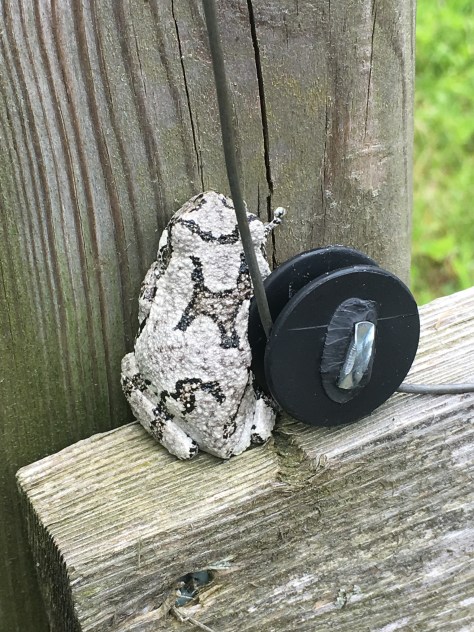
This gray tree frog was hanging out on the back pasture fence (no worries— this electrical wire isn’t “hot”!)

Progress has been slower than anticipated.

But slow progress is still progress, and this spring I took part in the New Hampshire Coverts Program, put on annually by UNH Cooperative Extension.  This three day workshop is geared towards land owners, managers and conservationists to train them to promote wildlife habitat conservation and forest stewardship.  I can’t believe how much information was packed into that workshop—I think most of us left feeling both overwhelmed and invigorated.

img_0859

Becoming a Coverts Cooperator is exciting to me for several reasons.  First, participating in the program allowed me to return to my “roots”, so to speak, and spend time with other conservation minded individuals.  Secondly, it showed me that becoming an effective land steward doesn’t happen overnight, and that there are many resources available for support and assistance.   Finally, I realized that it really is okay to try to manage this farm to meet my objectives; in other words, creating well placed riding trails, pastures and other horse areas is acceptable if that is what I want to do with my land.  I can emphasize improved habitat opportunities in other places on the property, and by managing the “horse parts” of the farm well, I can reduce the negative impact they might otherwise have on local ecosystems.

img_1037
White-throated sparrows are ground nesters, and so any brush hogging in shrub land areas should be done in August or later, so as to not disturb their young.

After attending the workshop, I contacted Strafford County Extension Forester Andy Fast and set up an appointment for him to visit the farm.  We walked all around the property but especially paid attention to the 26 acres which are in current use.  Two of these acres are classified as “farmland” (aka, field) and the rest are woodlot.  There are some basic trails out there but they need a brush hog and additional clearing to make them more usable for the horses.  Andy was excited by the amount of white oak on the lot, reminding me that it is a valuable food source for many species.  He recommended applying for funds through the Natural Resources Conservation Service (NRCS) to create a Forest Management Plan, which would allow for a possible small timber harvest.  Well planned timber harvests can have many benefits, including improving forest health, increasing diversity, improving wildlife habitat, and possibly yielding a little income which could then be used to improve the trails.

img_1121
Wild turkey hen and her eight “turklets” in the front pastures.  Eat more ticks, please!

I also participated in two further trainings.  First, I have become a “Speaking for Wildlife” volunteer, another program coordinated through UNH Cooperative Extension.  Groups such as senior centers, youth organizations, conservation commissions, libraries, etc., can sign up to have trained volunteers present a number of scripted slide shows on topics such as NH wild history, bat conservation, vernal pools and more.  Our commitment is to try to give just one presentation per year, which seems pretty reasonable!  I also attended a field workshop on managing shrub land and young forest lands for wildlife and bird species.  We visited two different sites, identifying nearly ten species of birds and actually mist netting two.

img_1058
This beautiful male Indigo Bunting now sports an ID band after flying into the mist net. 

For me, all of these actions have been tangible, rejuvenating steps which help to bring my life back into alignment with my core values.  I love horses—that will never change, and I continue to be passionate about riding, coaching and training others.  I will continue to take active steps towards achieving my personal goals with horses and for my business.  But at the same time, it is equally important to me that I am working to make this world a better place, and to not get so all consumed in the accuracy of a ten meter circle that I forget to appreciate all of the beauty and open space around me.

img_1093
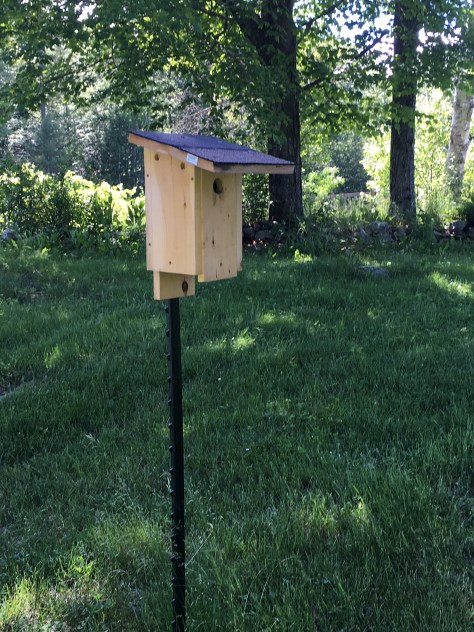
We installed three homemade bluebird boxes this spring; one housed tree swallows, and a second seems to have Eastern blue birds in it now.

Stay tuned for further updates on future actions which will help me to “live my values”.

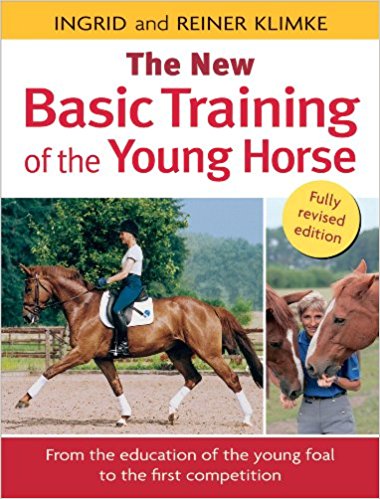
Book Review:  The New Basic Training of the Young Horse

The New Basic Training of the Young Horse by Ingrid and Reiner Klimke

c 2006 Trafalgar Square Publishing, North Pomfret, VT 208 pages

ISBN 978-1-57076345-8

Accomplished horseman Ingrid Klimke has updated this classic text of her late father with great success.  It has been years since I read the original, and I took advantage of being laid up while recovering from knee surgery to review the updated edition.

KlimkeYoungHorse

As she did with Reiner Klimke’s Cavaletti for Dressage and Jumping, Ingrid has refreshed the text and in particular the illustrations for the modern reader.  I especially enjoyed images of a 5 year old Windfall, the Trakhener stallion who went on to represent the US at the Olympics in eventing, and several of a young Damon Hill.  Many of the photos included in this updated edition are of Ingrid and her students riding three, four and five year olds; it is clear that the overall quality of animal in her stable is quite high, though, and so it was almost discouraging to see how wonderful these youngsters looked compared to how “normal” ones do, even at an older age.  However, it is important to have a clear picture of what it is you are trying to achieve, and these photos certainly represent this ideal well.

As is Klimke’s hallmark, the book takes readers through a system of progressive education for the youngster starting with being brought into the “yard” right through to their first season of competition.  While Klimke reminds readers that each horse is unique, and training must progress at an individual rate, it also seems clear that her horses progress fairly steadily and consistently.  When an animal is genetically gifted with three good gaits, a willing temperament and a natural aptitude for the work, it is naturally going to be easier to develop them in the sport horse disciplines.  I think it is important for those of us riding more “average” horses to bear in mind that some of the aspects of the process which come smoothly to Klimke on her string may necessarily take longer for the rest of us.

DRF Isabela Age 2 015.JPG
My own DRF Isabela, foaled in 2015.

With that being said, The New Basic Training of the Young Horse still offers readers an in depth review of important concepts related to the training scale and those exercises which help to develop them, as well as entire chapters devoted to the horse’s basic education, longeing (on the line and free), cavaletti work, jumping and cross country skills.  This sequence offers readers a glimpse into the progressive system which Klimke uses to develop her own horses; she emphasizes that youngsters should be trained on the flat, over fences and in the open before choosing to specialize in dressage or show jumping, if they show an aptitude here.

There are a few particular nuggets which I found especially meaningful.  In fact, the text opens with a copy of a letter written to Ingrid by her father, in which he says, “We want to understand the nature of the horse, respect his personality and not suppress it throughout his training.  Then we are on the right way” (Klimke, 2006, p.11).  I think this is a meaningful mantra for all trainers and riders, regardless of their specialty.  I might post it in my barn.

img_0947
At the end of the day, the most important activity in most horse’s schedule is this. 


Klimke reminds us that “the aim of basic training for the young horse is to use a systematic method to create a solid foundation for future specialization in a given discipline…we want the young horse, with the weight of the rider on his back, to stay in balance and outline while retaining his natural movement” (Klimke, 2006, p. 16).

In her section on longeing, Klimke states “Correct longeing is as important as correct riding and requires a lot of experience and intuition” (Klimke, 2006, p. 38).  I personally feel that longeing well is almost a lost art; I see far more incorrect, unsafe and unproductive longeing than the alternative, so I especially appreciated her further comments on this subject in this chapter.   She also reminds us that “the quieter the trainer and assistant(s), the calmer the horse will be” (Klimke, 2006, p. 51).  It can be hard when you get frustrated, but horsemen must learn to cultivate this type of mental calmness in themselves if they hope to achieve it in their horses.  Klimke goes on to elaborate on the importance of longeing in helping to warm up the muscles of a young horse’s topline, as well as taking the edge off, prior to mounted exercises with the rider.

The next several chapters dissect the training scale and the application of its concepts to the basic training of the youngster.  In particular, Klimke reminds trainers that “all exercises and movements should be ridden on the longest possible contact (with poll flexion) to improve the horse’s ability to work through the back” (Klimke, 2006, p. 67) (italics are the author’s).  This is a truly classical response to those riders and trainers who choose to force a young horse to work with an extremely flexed poll and short neck.

img_0954
Young horses can learn best from an older, experienced partner.

Another quote which I thought was particularly important was in regards to making mistakes as a trainer.  “It is unavoidable that we sometimes push the horse too hard; no trainer is perfect.  However, experienced riders acknowledge that they are solely responsible for their mistakes.  It is important to make the best of each situation” (Klimke, 2006 p. 71-72).  And as with helping children to learn how to behave, “the horse should be rewarded for all exercises done well and ignored for the ones that were not” (Klimke, 2006, p. 72).

 I found the chapters which focused on the basic ridden training to be an excellent, clearly written review of the fundamental concepts related to the training scale.  Klimke details many basic exercises, including the proper use of the aids and the common mistakes made by horse and rider, as well as defines essential concepts, phrases and movements. She emphasizes the importance of cavaletti work in the basic training of a horse, saying that it offers an opportunity to overcome problems in all phases of training.

img_0961
New cavaletti all ready to be put to work. 

Klimke introduces the youngster to fences first with free jumping, proceeding to grids and small courses.  I will admit that her progression is more ambitious than what I would be up for, but even spread out over a longer period, it certainly provides a clear framework for the process of training over fences.  She also reminds readers that “jump training in the first year should only be done if the horse is willing” (Klimke, 2006, p. 152).

What I found especially refreshing about this book is Klimke’s emphasis that the basic training should be the same for all horses, regardless of their future discipline.  In general, I believe that this is the most appropriate philosophy.  Regardless of the rider’s discipline of choice,  the horse that has a broader base of training will be more confident, more experienced and will be more likely to suit the needs of a future owner.  I do not believe that specialization of a young horse (or young rider) provides them with the best foundation for future success.

Much like Klimke’s other written work, I think that The New Basic Training of the Young Horse should be required reading for any serious trainer or rider of sport horses.

5/5 stars


Motivation, Apathy, and “Coming About”

Mo*ti*va*tion (noun) the general desire or willingness of someone to do something

Synonyms:  enthusiasm, drive, ambition, initiative, determination, enterprise.

Motivation, or the lack thereof, is something which we all have to deal with from time to time.  When it comes to pursuing my riding goals, fitting riding time into my busy schedule, and/or doing all the various chores related to maintaining my horses and farm, lack of motivation is something which I have only rarely struggled with. In fact, skipping a ride for even valid reasons (pouring buckets of rain, celebrating a holiday) or shirking on a duty (not grooming my retired horse every day) usually causes me to go into a state of self-flagellating guilt.

motivation1

Until this spring.

This spring has been tough on me for reasons wholly unrelated to my horses. The truth is that there is some pretty heavy “life” stuff going on, which I will get through, but the going is pretty deep right now, and I am getting tired of slogging.  Enough about that but suffice it to say that this issue has taken a TON of life energy to manage and it has left me feeling depleted, insecure and not confident.

In addition, for the past five years, I have been dealing with on again/off again knee swelling and pain which has defied a causative diagnosis but which has responded well to draining and steroid injections.  Usually it happened to one knee at a time and then the joint stayed quiet for months to years in between flare ups and treatment.  This January, both of my knees decided to gang up on me.  There was the “bad” one and the “worse” one.  This time around, my doctor decided to schedule an exploratory arthroscopy to try to get some definitive answers.  While all the “pre approvals” and pre-operative appointments were scheduled, the pain in my knees just escalated.  My knees and calves swelled.  Riding went from being non painful to bearable to misery at anything other than the walk.  Before my surgery, doing really normal people things, like putting on pants and socks, was nearly impossible to do without pain.  So you can imagine that giving proper leg aids was also a challenge.  I felt useless and ineffective on a horse.

stallmats
With the help of Intern Kelly, one spring project which got done was the installation of stall mats in the barn aisle.

Being in pain stinks.  Chronic pain becomes like a mantle that you can’t quite put down.  You can numb it, you can suppress it, but it never really goes away.   You don’t sleep as well, you don’t eat well, and you start to weigh your actions in terms of whether the pain they will incur is worth the outcome.  Example:  is it worth climbing the stairs one more time to get a sweater?  Or would I rather just be cold today?

So it would be easy to label this pain as the cause for my loss of motivation.  I tried to keep going, but I found that increasingly I would let excuses slip in to justify not riding.

“It is too cold.”

“It looks like rain and I don’t want to get my tack wet.”

“The footing is too muddy/snowy/icy/dry/uneven.”

“I have no one to ride with and my horse is going to be upset to leave the group.”

Or I might manage to ride, but only stayed on for thirty minutes before being “done”.

early spring ride
Mid April in southern New Hampshire did not bring inspirational riding weather.

I struggled to set any type of goals for the 2017 season at all.  I blamed it on not knowing what the outcome of the arthroscopy was going to be, and therefore how long I would be out of commission. But in reality, I was feeling overwhelmed by the effort it would take to actually DO any of the things which I could imagine doing.  You know, things like actually hitching the trailer, putting tack in it, and going somewhere with a horse.

I had had some tentative plans to enter a few early season distance rides with Lee.  I even got so far as to put one entry in the mail.  But I scratched just days later, after having a really bad weekend in terms of knee pain.  This was a perfectly acceptable reason for not doing the ride.  But the underlying truth was that I couldn’t stomach the idea of doing all the work to get ready to go to the ride, loading/hitching the trailer, or getting up super early to be there on time.  The ride itself was the least of my worries.

WTF was wrong with me????

izzylayingdown
Izzy has the right idea.

Apathy ap*a*thy (noun) Lack of interest, enthusiasm or concern

Synonyms: Indifference, lack of interest, lack of enthusiasm, lack of concern, uninterestedness, lethargy, ennui

My Facebook feed is dominated by horses, dogs and cats, sprinkled here and there with a few posts about children or nature.  On any given Sunday, dozens of people I know have been out and about with horses in tow, attending clinics, dressage and jumper shows, schooling cross country, attending trail rides and more.  They post their pics and rave about how wonderful the day was and how much fun they had.  This spring, I would just look at these posts and think… “huh, that seems like a lot of work.  Good for them.” And I would stare out my kitchen window at my four horses and sip my coffee.

I did the basic chores.  The horses were groomed, fly sprayed, shod, and had their spring vaccines.  I went to get additional hay to carry us through the season and ordered grain.  I sent the trailer for its spring tune up and inspection. I laundered winter blankets and scrubbed and stored winter shoes. I started transitioning the horses to grass turn out.

I rode Lee and Anna four or five days per week.  Lee hacked or longed.  Anna did light dressage schools, hacked, and practiced wearing a double.  Izzy went for walks on the driveway and learned how to stand on the cross ties and wear a fly hat.  Marquesa was groomed and ridden by friends.  It was all done by rote.

img_0731
Intern Kelly was a great riding buddy this spring!

I tried to forgive myself for feeling this way.  I tried to be patient with my body, which seemed determined to make me miserable.  I tried to set super small goals each day (like, today I will do ONE extra thing that needs to get done).  I tried, with all of the morale I had left to muster, to not completely stop moving. I worried that if I did that, I would never get moving again.

Coming About:  A nautical term, used in sailing to indicate that the bow of the boat will start to turn through the wind

Synonyms:  Helm’s Alee

I had my knee surgery on May 23.  After being in so much pain for so long, the surgery wasn’t much worse.  Unfortunately, the procedure hasn’t yielded any definitive answers but the overall cleanup which occurred (along with yet another drain/injection of the other knee) has left me feeling better than I have in months.  I am still not allowed to ride, but I have had some students coming up to keep Lee and Marquesa going.  I might try to put Anna on the longe line later. We’ll see.

While I have been on lay up, I have had plenty of time to think and analyze and assess.  And what I think I have come to is that how I feel is how I feel…and it is okay.  Maybe I don’t have huge performance goals for the season with my horses.  But that doesn’t mean that I can’t enjoy them and keep moving forward.  Sometimes, your body and soul just needs some time to heal.  That is where my life energy is focused right now.

img_0940
Signs you haven’t been driving your truck much:  the spiders are holding your Antenna Cactus hostage.

I set a few small goals for myself for the period during which I am going to be laid up:  1) re-read The New Basic Training of the Young Horse by Ingrid and Reiner Klimke 2) work on setting up a website for my farm 3) write a few blogs.  I have done some work on all three.

Last Saturday, I worked at the Central New England Region Show Jump Rally as the course designer and a judge.  The weather was pretty much perfect—sunny, slight breeze, temps in the mid to upper 60’s.  The courses rode well and the riders seemed to have fun.  I was surrounded by friends, students, former students and parents. Several of the riders were trying to qualify to compete at the USPC National Championships later this summer and it was exciting to see them ride up to the challenge.  I actually had fun.  I started to remember what that felt like.

Tues May 30 was Izzy’s birthday.  I took a few conformation photos of her so that we can compare her in one year’s time.    She has been coming into the barn independently for grooming and handling daily.  She makes me smile whenever I enter the paddock with her friendly and inquisitive nature.

DRF Isabela Age 2 001
Getting two year olds to stand still for conformation photos is challenging. DRF Isabela 5/30/17

Slowly, I can feel some of my motivation coming back.  I can guarantee that I won’t be taking the world by storm this year.  But maybe, just maybe, I can get moving in the right direction again.

With Anna, I hope to make it out for some lessons with Verne Batchelder when he is in town, and maybe make it to one dressage show.  With Lee, maybe I can do some further exploration of my local trail network, or ship up to Tamarack Hill to ride with Denny, or to Pawtuckaway State Park to ride with friends.  Maybe we do a competitive ride, maybe we don’t. I can guarantee you that Lee doesn’t care.  I want to introduce Izzy to the trailer, do some basic in hand work, and improve her behavior with the farrier.

This is progress. These are actual tasks I can see myself accomplishing. There is hope.

fitness-motivation-quotes

I am usually a results driven person, and many of my personal goals have revolved around competition.  But as Denny (Emerson) says frequently, at the end of the day, no one cares about how you did at a show except for you, and your mother (and she only cares because she wants you to come back in one piece).  Perhaps the theme for this season will be to learn to enjoy the journey and to find a balance between the process and the result.  I hope that by looking at my goals from a different perspective, I may be able to make progress towards them without starting to feel overwhelmed, apathetic or detached.

In this way, I will try to Come About. As with turning a boat, it won’t happen immediately and I may have to fight the tides.  But so long as I keep pressure on the tiller, I should see this ship turn.