
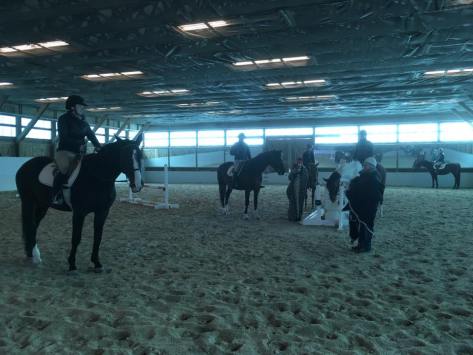
In mid April, 2017, Linden Woods Farm in Durham, NH hosted a two day clinic with Olympian Jan Ebeling. A serious rider and competitor, Ebeling brought his attention to detail and clear training system to the east coast, to the benefit of horses and riders ranging from First Level through FEI.

I was only able to attend day two of the clinic due to work commitments, but felt fortunate to be able to audit several sessions before taking my own lesson on Annapony at the end of the day. As I watched Ebeling work with a series of different types of horse, several themes emerged. In particular, Ebeling emphasized POSITIVE ENERGY, CLEAR EXPECTATOINS, MINIMAL BEND and CLARITY IN THE AIDS, regardless of the level of training of the horse or movement being executed. Calm and systematic riding was the order of the day.
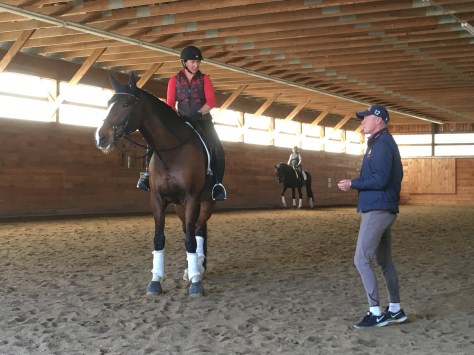
Ebeling told the audience that he always starts his training sessions the same way, with a progressive warm up. “I start by establishing a steady tempo and use larger circles and changes on the diagonals,” said Ebeling. “Nothing too tight.”
Ebeling reminded riders that all horses have an easier side, which is usually tracking to the left. This is the best direction to start both the warm up phase of a ride as well as to introduce new figures and movements. He recommends spending three to four minutes on each side, then adding in some work at the canter, before offering the horse a short break.

“Once the horse has had a warm up, they are ready for a more collected tempo and sitting work,” says Ebeling. For all horses save the most green, Ebeling believes in the rider working out of the sitting trot post warm up. For a greener horse, Ebeling says that he might stay in the posting trot a bit longer, especially if the contact and connection become less consistent in the sitting work.
For the greener horses, Ebeling emphasized the critical importance of riding with positive energy, which he says prevents the horse from thinking that a slower tempo is acceptable. At the same time, the rider must be careful to not ask for more tempo than the horse is able to keep balanced. “Most horses are pretty happy to go forward if you make it their habit,” says Ebeling. “If you have inconsistency in the frame, add a little bit of tempo, keep riding forward, and keep the hand the same.”

Establishing consistency in the expectations and performance was a theme which Ebeling returned to frequently. The free walk is another area in which Ebeling emphasized this idea. “The free walk should always go to the buckle and the rider must make the habit of always expecting a brisk, energetic walk,” says Ebeling. “When there is a transition from free walk to medium walk, the steps and frame become shorter but the rhythm and energy stay the same.”

The use of transitions between and within gaits was another theme which ran amongst the sessions. When riders do transitions on green horses, the exercises serve to tune up the horse’s understanding of the aids. It is important that the rider keep their aids consistent and clear. One example Ebeling brought forward was the position of the rider’s outside leg in the canter. “You must be super clear with your leg aid in the transitions, bending your knee and bringing the leg back,” says Ebeling. “Keep the outer leg back in the canter, not just for the transition, but also to support the gait. It must stay in place—no exceptions.”
Ebeling used transitions in many ways with riders throughout the day. Some horses did trot-walk-trot transitions in fairly quick succession, sometimes with only three strides in between each. With others, he shortened the timing so that the transition became more of an “almost walk” transition, or instead asked the horse to go into a short lengthening. Ebeling asked one rider to send her horse forward on the short side and then collect them through the shoulder in into an “almost walk” transition, and then ride forward into a ten meter volte. These frequent transitions challenged the horse’s balance and encouraged them to respond promptly to rider’s aids. For greener horses, Ebeling likes to use a little voice in the transitions. If the horse makes mistakes, such as coming above the bit or choosing the wrong lead, Ebeling reminded riders to not get into a battle with their horse; instead, just make them do the transition again.
Throughout the day, horses and riders both made mistakes. Ebeling reminded all that this is a necessary part of learning, but emphasized that it is important to not give the horse a break on a poor transition or movement. Ebeling says that when the horse repeatedly makes the same mistake on a figure, it is up to the rider to figure out how to change the cycle. This may mean making the exercise easier for the horse, overexaggerating an aid, or appreciating that at the moment, the exercise may require more strength than the horse has developed. “Even when the mistake is repeated, remind yourself that it is just a phase,” says Ebeling. “It can be frustrating, but don’t panic. It is just a matter of practicing.”
Ebeling also spoke of the importance of doing movements and transitions at different places within the arena. This can also be helpful when a horse starts to anticipate an exercise. “The same exercise, done at a different place in the arena, isn’t really the same exercise,” says Ebeling. “The goal is to get the horse to do the things you want so that you are able to praise them…you are always looking for the moment where you can praise them for doing the right thing.”
Being effectively able to apply the aids requires that the rider understand what the correct aids should be, and then to experiment with the intensity of each aid to determine the optimal application. One rider struggled with her half pass. Ebeling reminded her that it was important to keep the shoulder fore position as she turned her horse onto the line of the half pass, then to ride sideways through the use of the inner leg and outside rein; he said the half pass is basically two movements in one. But too much outside leg causes the haunches to lead, and too little will prevent the forward and sideways movement from developing. The rider must find the balance in the aids for success.
Ebeling reminded riders that keeping their position consistent is one of the quickest and most efficient ways to get the horse to understand the aids. “You must be very disciplined,” says Ebeling.
Ebeling told several riders (me included!) to be careful with their bending aids. It is easy to get the horses over bent to the inside, but the aid which needs to be emphasized is the outside rein. “Bend only a little and then get light,” says Ebeling. “Backing off on the rein aids doesn’t mean dropping them, it is like a softening. When you think to give, it is not necessary to move the arm, just relax the muscles. Finish every half halt with a release.”

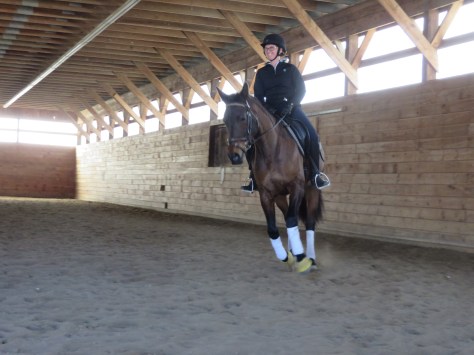
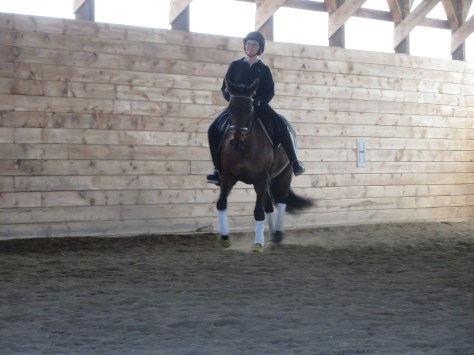
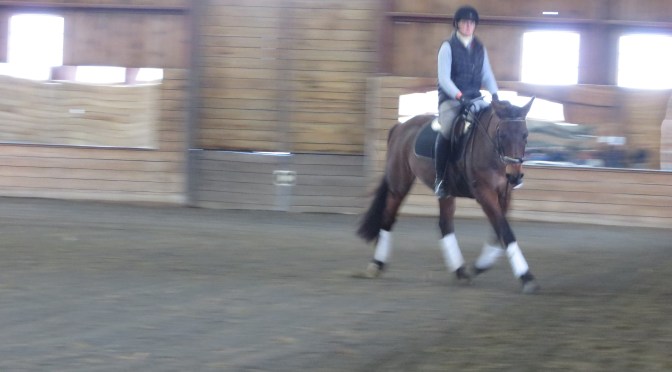
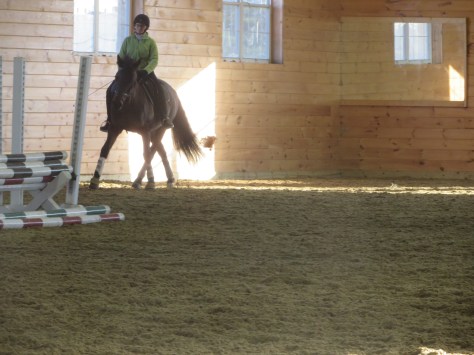
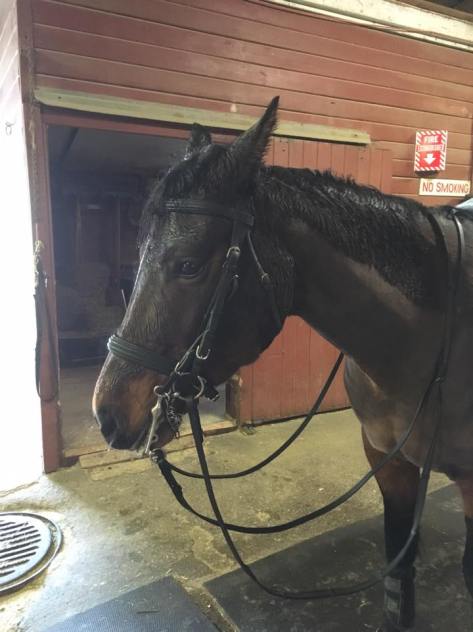
In my ride with Ebeling on Anna, these themes came forward yet again. I was a bit nervous going into the ride, as I was dealing with a knee injury which prevented me from effectively closing my right leg aids. And though she sported a trace clip, Anna definitely felt that this early spring afternoon was warmer than she liked given the amount of winter coat she was still wearing. In spite of these variables, we tried our best to step up to Ebeling’s program.
Here is some video of Anna early in our set with Jan Ebeling.
In our ride, Ebeling worked to help me keep Anna more positively forward (yes, the entire Story of Our Lives). He reminded me to watch the balance between the inside and the outside rein, particularly when tracking right, and that I need to be more steadfast in the consistency in the outside rein. One easy tip he offered was to increase the tension of my ring finger on the reins. Most riders will grip more tightly with their index and middle fingers, but increasing the tension of the ring finger will allow the rein contact and connection to remain steady yet not become restrictive. Ebeling had me ride Anna virtually straight into each corner, and then ask for only about two to three strides of bend in the corner itself.
A little further along…contact is getting more consistent.
Ebeling also had me ride many trot canter transitions to sharpen her response to the leg aid. In the upward transition, I had to make sure to not allow my shoulders to tip forward and to remain soft in the rein contact without letting go. For the downward transition, Ebeling wanted me to use virtually no rein pressure at all but instead use seat and voice aids…then immediately ride steady and forward.
While I felt that the quality of our connection improved through the set, I was a little disappointed in Anna’s overall lackluster response to the forward aids. In my opinion, she got a bit hot and tired and would have done better with a few shorter/intense sets rather than longer ones. I found it really difficult to keep her stepping up into the bridle, and in reviewing the photos and videos after the ride, she looks like she is barely round. Ebeling as well seemed a little flummoxed by her lackadaisical nature, and suggested that it might be helpful to treat her like an event horse again by taking her out for some gallop sets (not an option till my knee heals, I am afraid!). He also suggested looking at her feeding regimen to see if there is a way to feed increased energy without increasing her weight.
While I was a bit disappointed by the quality of my own performance, overall I really enjoyed watching Ebeling teach the other clinic participants and appreciated the consistency in his message. I would definitely come audit again, and perhaps ride once I am healed up!
Some nice walk work and then some tired trot!




 The Academic Equestrian